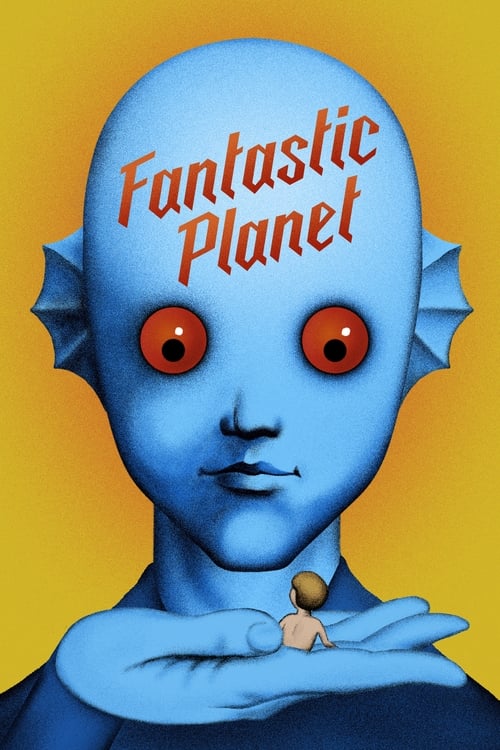
Fantastic Planet
1973 · René Laloux
For a trippy late-night watch when you want something unlike anything else — headphones on, lights off, ready to be transported rather than told a conventional story.
What it's about
On the planet Ygam, giant serene blue humanoids called Draags keep tiny humans — Oms — as pets, while wild Oms are hunted as vermin. Terr, an Om raised as a Draag child's plaything, escapes with a stolen learning device and carries forbidden knowledge to the wild Oms, setting a subjugated species on the road to rebellion. It's a science-fiction fable about domestication, knowledge, and what the powerful refuse to see.
The experience
Genuinely otherworldly — seventy-odd minutes of drifting, dream-logic strangeness where the landscapes breathe and the creatures unsettle, all carried on a hypnotic jazz-funk score. It's eerie and cerebral rather than scary, and it lingers like a half-remembered dream.
The craft
Roland Topor's designs give the film its uncanny power — biomorphic plants, impassive blue giants, machines that look grown rather than built — animated in deliberately stiff cutout style that makes everything feel like an illustrated book come alive. Alain Goraguer's psychedelic score has become legendary in its own right, endlessly sampled by hip-hop producers. This one rewards good speakers as much as a good screen.
Why it matters
A Special Jury Prize winner at Cannes and a cornerstone of adult animation, it proved animation could carry serious allegory for grown-ups and became a lasting influence on psychedelic and science-fiction imagery — and on music, through its much-sampled score.
Snapshot
Fantastic Planet (La Planète sauvage) is a feature-length animated science-fiction fable, roughly seventy-two minutes long, made as a French–Czechoslovak co-production and released in 1973. Directed by René Laloux from a screenplay he co-wrote with the artist Roland Topor — who also designed the film's entire visual world — it adapts Stefan Wul's 1957 novel Oms en série. On the planet Ygam, giant blue humanoids called the Draags keep tiny human beings, the Oms, as pets and vermin; a domesticated Om named Terr escapes with a stolen Draag learning device and helps the wild Oms organize, culminating in a forced truce between the two species. Rendered in deliberately stiff cutout animation over Topor's uncanny biomorphic landscapes and scored by Alain Goraguer's celebrated jazz-funk cues, the film won the Special Jury Prize (Grand Prix spécial du jury) at the 1973 Cannes Film Festival and has become one of the touchstone works of adult European animation.
Industry & production
The film sits at the intersection of two very different film cultures. Its French side gathered producers with strong art-cinema pedigrees — the production involved Les Films Armorial and Anatole Dauman's Argos Films, the same Argos associated with Chris Marker, Alain Resnais, and Jean-Luc Godard — signaling from the outset that this was conceived as a work of authorship rather than children's entertainment. The animation itself was carried out in Prague at the Jiří Trnka Studio, the renowned Czechoslovak animation house named for the master puppet animator. This division of labor — French conception and design, Czech execution — is central to the film's history.
The production was famously protracted, spanning roughly the late 1960s into the early 1970s. The standard account in the film's history holds that work in Czechoslovakia was disrupted by the political aftermath of the 1968 Prague Spring and the Warsaw Pact invasion, which delayed and complicated the collaboration and contributed to the years-long gestation. The film reached completion and premiered in 1973, where its Cannes prize gave it immediate international standing. In the United States it was picked up for distribution by Roger Corman's New World Pictures, an unusually highbrow acquisition for a company better known for exploitation fare, and circulated in an English-dubbed version. Precise budget and box-office figures are not part of the reliably documented record, and I will not invent them.
Technology
Fantastic Planet was made with traditional, decidedly analog animation technology: hand-drawn and hand-cut paper artwork photographed frame by frame on an animation stand, rather than the fully redrawn cel animation of the American studio tradition. The core apparatus is the cutout — flat, jointed paper figures and elements moved incrementally beneath a downward-facing camera, layered over painted backgrounds. This is a low-cost, labor-intensive method with a long European and Eastern-bloc lineage, and choosing it was as much an aesthetic decision as a budgetary one. The technology imposes limits — restricted articulation, a tendency toward planar, sliding motion — and Laloux and Topor embraced those limits as expressive features rather than concealing them. There is no optical or digital trickery of a later era here; the film's strangeness is achieved entirely through drawing, cutting, staging, and photography.
Technique
Cinematography
Because this is animation, "cinematography" means the work of the animation camera over Topor's compositions rather than live-action lensing. The film favors flat, frontal, tableau-like framings that present Topor's imagery almost as a series of illustrated plates brought into motion. Camera moves are used sparingly and pointedly — slow pans and pushes that let the eye travel across the density of an alien landscape, and scale contrasts that repeatedly frame the minuscule Oms against the enormous Draags and their architecture to dramatize the story's central power imbalance. The palette runs to eerie blues, ochres, and desaturated earth tones, giving Ygam a consistently otherworldly, slightly diseased atmosphere. I do not have reliably documented names for the individual camera operators, so I will not attribute them.
Editing
The cutting is measured and contemplative, matching the film's essayistic, fable-like register. Sequences of narrative event alternate with passages of pure spectacle — the Draags' meditations, the parade of bizarre Ygam wildlife — and the editing gives these digressions room to breathe rather than driving relentlessly toward plot. Terr's voice-over narration functions as a connective tissue that lets the film compress large spans of time and elide transitions, moving from his infancy as a pet to the Oms' organized resistance with an almost storybook economy. The specific editor is not something I can attribute with confidence from the documented record.
Mise-en-scène / staging
This is the film's most extraordinary dimension and the fullest expression of Topor's imagination. Ygam is populated by a relentlessly inventive bestiary — creatures that laugh, whistle, crystallize, or exist only to torment smaller animals — and by flora and geological forms that seem organic and menacing at once. The staging insistently plays scale: Oms scurry through grass that towers over them, are held in Draag palms, or are dwarfed by the smooth monumental interiors of Draag civilization. The Draags themselves, with their red eyes, blue skin, and finned ears, are staged as serene, godlike, and casually cruel. The overall mise-en-scène builds a coherent surrealist ecology in which beauty and horror are inseparable, and in which the human characters are literally and figuratively marginal within the frame.
Sound
Alain Goraguer's score is inseparable from the film's identity: a jazz- and funk-inflected soundscape of wah-wah guitar, electric keyboards, wordless vocals, and grooving rhythm sections that is simultaneously groovy and unsettling. Rather than underscoring action conventionally, the music establishes the film's dreamlike, faintly psychedelic mood and has since taken on a life of its own. The sound design otherwise leans on the strange vocalizations of Ygam's creatures and the calm, affectless speech of the Draags to reinforce alienness. The original is in French; the widely circulated English dub renders the narration and dialogue in English.
Performance
Performance here is vocal and, in a sense, graphic — expression carried by design and voice rather than by drawn facial nuance, since the cutout figures are deliberately limited in movement. In the French original the voice work sustains a cool, restrained tone, with Terr's narration providing the film's emotional through-line as observer and survivor. The Draags speak with an unhurried superiority that makes their casual violence more chilling. I do not have a reliable roster of the original French or English-dub voice performers and will not fabricate one.
Narrative & dramatic mode
The film operates in the mode of allegorical fable rather than psychological drama. Its narrative is a parable of oppression and revolt structured in broad movements: the domestication of Terr as a Draag child's pet; his acquisition, by accident, of the Draags' educational headset and thus of their knowledge; his escape and integration into the community of wild Oms; the Oms' technological and political awakening; and the climactic confrontation that forces the Draags to the negotiating table. Terr's first-person narration frames events as remembered history, lending the film the cadence of a legend or origin myth. Character interiority is minimal by design — figures function as representatives of species and positions rather than as rounded individuals — and the drama derives its force from the elegance and clarity of its central conceit, sustained by a steadily escalating stakes structure that ends not in annihilation but in an uneasy coexistence.
Genre & cycle
Fantastic Planet belongs to serious, idea-driven science fiction and to the tradition of animation made expressly for adults. Within science fiction it is a work of social allegory in the lineage of Wul's mid-century French SF, using an alien world to estrange and examine human hierarchies. Within animation it stands alongside other European and Eastern-bloc works that treated the medium as a vehicle for surrealism, satire, and political metaphor rather than family entertainment — a sensibility connected to the Trnka studio's own art-animation heritage. It arrived at a moment when adult animation was gaining critical legitimacy internationally, and its Cannes recognition helped mark that shift. It is not part of a franchise, but it forms an informal cycle with Laloux's later features, which continued his project of literary, design-led animated science fiction.
Authorship & method
The film is best understood as a genuine dual authorship between René Laloux as director and Roland Topor as designer and co-writer. Laloux (1929–2004) came to animation with an interest in psychiatric and outsider contexts — his earlier short work engaged with patients at a psychiatric clinic — and he brought a taste for allegory and a patient, contemplative directorial hand. Topor (1938–1997) supplied the film's total visual conception. A painter, illustrator, novelist, and provocateur, Topor co-founded the Panic Movement (Mouvement Panique) in 1962 with Fernando Arrabal and Alejandro Jodorowsky, and his darkly comic, grotesque, biomorphic imagination is stamped on every frame; he is also known outside this film as the author of the novel behind Polanski's The Tenant and as an actor (notably as Renfield in Herzog's Nosferatu the Vampyre). The screenplay adapts Stefan Wul — the pen name of Pierre Pairault — and his novel Oms en série. The score is by Alain Goraguer, a French composer and arranger with deep roots in French popular music (his associations include work with Serge Gainsbourg and Jean Ferrat), whose contribution is arguably as defining as the visuals. Reliable individual credits for cinematography and editing are thinner in the accessible record, and I have declined to assign names I cannot verify. The working method — French design and script realized by Czech animators at the Trnka studio — was itself a defining feature of the film's authorship.
Movement / national cinema
The film straddles national cinemas. On one side it is a product of French auteur and art-cinema culture, tied through Topor to Panic-Movement surrealism and through its producers to the milieu of the postwar French art film. On the other it is a Czechoslovak animation achievement, executed by the Prague studio bearing Jiří Trnka's name and thus heir to one of the world's most distinguished traditions of art animation. Made during the "normalization" years that followed the crushing of the Prague Spring, it carries — at least in its production circumstances and, many have argued, in its allegory of a subjugated people under a serenely dominant power — the imprint of its Cold War, Eastern-bloc context, even as its financing and conception were French.
Era / period
Fantastic Planet is very much a work of the early 1970s. Its jazz-funk score, psychedelic textures, and countercultural preoccupation with consciousness, meditation, and liberation locate it squarely in the immediate post-1968 moment. That period resonates on two levels: the global counterculture of the late 1960s and early 1970s, and the specific political weather of post-invasion Czechoslovakia. The film's imagery of an oppressed underclass, its interest in altered states, and its ultimately utopian-tinged plea for coexistence all speak to the era's anxieties and aspirations. It was received, and remains legible, as a period artifact whose surrealism and groove are inseparable from its early-Seventies origins.
Themes
The film's governing theme is oppression and the mechanics of dehumanization. The Oms — a coinage that puns on the French homme — are treated exactly as humans have treated animals and enslaved peoples: bred, kept as pets, exterminated as pests. The allegory is deliberately capacious, readable as a parable of slavery, colonialism, class, and speciesism at once, and it turns the viewer's identification against the ostensibly superior "civilized" beings. Knowledge and literacy function as the engine of liberation: Terr's accidental access to Draag education is what makes revolt possible, dramatizing education as power. A second cluster of themes concerns consciousness and transcendence — the Draags' meditations, in which their disembodied minds leave their bodies for a ritual essential to their species, become the film's great strange centerpiece and, ultimately, the leverage the Oms use to force peace. The ending's negotiated coexistence advances a further theme: that mutual survival, not conquest, is the only durable resolution to domination.
Reception, canon & influence
Critically, the film's standing was established early by its Special Jury Prize at the 1973 Cannes Film Festival, which certified it as a serious artistic achievement and not a genre curiosity. Over the following decades it accrued the status of a cult classic and then a canonical work of adult and international animation, regularly cited in surveys of the form and revived through restoration and repertory screenings; its reputation has if anything grown.
Looking backward, the film's influences are clear and acknowledged: Stefan Wul's source novel; the surrealist and Panic-Movement sensibility Topor carried from his work with Arrabal and Jodorowsky; and the deep well of European and Czech art animation embodied by the Trnka studio. Wul's mid-century French science fiction supplied the allegorical premise; Topor supplied the grotesque-organic visual language; the Prague tradition supplied the cutout craft.
Looking forward, its legacy is broad. It helped legitimize animation as a medium for adult, politically and philosophically ambitious storytelling, and it became a lodestar for later surreal and independent animators. Laloux himself extended its line in subsequent literary SF features made with major bande-dessinée artists — Les Maîtres du temps (Time Masters, 1982), developed with Moebius (Jean Giraud), and Gandahar (1988). Perhaps its most conspicuous afterlife has been musical: Alain Goraguer's score became a favorite source for hip-hop producers, whose sampling introduced the film's sounds to audiences far beyond animation circles and kept its aura alive in popular culture. Its distinctive design has continued to be invoked by illustrators, musicians, and filmmakers drawn to its singular fusion of the beautiful and the disturbing. Where specific claims of "direct influence" on particular later filmmakers circulate without solid documentation, they should be treated cautiously; what is firmly established is the film's enduring position as a canonical, widely imitated landmark of animated science fiction.
A Deleuzian reading
A blue hand, palm up, and a grown man standing in it as calmly as you'd stand on a floor.
The full Deleuzian reading of Fantastic Planet →
Reception
It won a Special Jury Prize at Cannes in 1973, then spent decades as a midnight-movie curio for animation heads and psychonauts before a 2016 Criterion release cemented its climb from trippy obscurity to acknowledged landmark of adult animation.
How Fantastic Planet was received, from release to now →
How to watch Fantastic Planet: what to notice on a first viewing
- Watch how an Om stands in a Draag's open palm. The figures are cutouts that can barely gesture, so a body simply being held or set down in a palm has to carry the whole relationship. The posture alone tells you who owns whom, with no dialogue or expression needed.
- Notice how flat and posed each composition looks. Topor's images arrive like illustrated plates held on screen long enough to read, packed with detail rather than composed for movement. You are meant to study these frames the way you would study a painting, not just follow them.
- Watch the Oms move through grass like a single swarm. The staging keeps the wild Oms scurrying together as one mass rather than as distinct individuals, agreeing with how the Draags themselves see them. The film's camera treats them the same way its villains do, before it ever asks you to see otherwise.
- Listen for wah-wah guitar under scenes of quiet cruelty. Goraguer's groove keeps playing under moments of casual violence and strange ritual alike, never simply matching the mood a scene would obviously call for. The music stays cool and grooving right where you might expect something more ominous, which is its own kind of unease.
- Notice the strange creatures that have nothing to do with the plot. Topor fills Ygam with animals that laugh, whistle, or crystallize for no narrative reason at all, digressions the editing gives as much room as the main story. The planet feels alive and indifferent on its own terms, not just as scenery for the Oms and Draags.
The whole guide to watching Fantastic Planet, with the keys for a rewatch →
Influences: the films it descends from and the films it influenced
- The Adventures of Prince Achmed (1926) — Established the articulated cutout technique — jointed paper figures moved beneath the camera — that is the exact mechanical foundation of Laloux's sliding, paper-doll character movement.
- Dom (House) (1958) — Pioneered surrealist cutout collage in which engraved and photographic fragments come menacingly alive, the disquieting flat-collage grammar Topor's biomorphic tableaux inherit.
- The Fabulous World of Jules Verne (1958) — Rendered literary science fiction through flat, cross-hatched engraving-style graphics that preserve the look of illustrated plates — the tableau-as-print aesthetic Fantastic Planet applies to Wul's novel.
- A Midsummer Night's Dream (1959) — Trnka's Prague studio, which physically animated Fantastic Planet, is defined here by the contemplative, near-still art-animation tempo and painterly frame composition Laloux borrows wholesale.
- Les Jeux des anges (1964) — Its abstracted machinery-of-cruelty imagery — organic forms processed into implacable systems — prefigures the Draags' casual, industrial dehumanization of the Oms.
- The Hand (1965) — A directly political allegory built from art-puppet craft at the Trnka studio, modeling how the studio's technique could carry adult, dissident meaning rather than children's whimsy.
- Les Escargots (1965) — The immediate prototype: the same Laloux-directed, Topor-designed cutout method and grotesque agricultural-horror imagination, scaled up two years later into the feature.
- Fando y Lis (1968) — Panic-Movement surrealism from Topor's co-founder — processional tableaux of a grotesque human bestiary crossing a hostile landscape — the live-action correlate of Topor's design language.
- Viva la muerte (1971) — The other Panic Movement co-founder's grotesque-organic, ritualized cruelty imagery shares Topor's precise vocabulary of the beautiful fused with the abject.
- Yellow Submarine (1968) — Extends the illustrator-authored European tradition — a single graphic artist's (Roland Topor) surreal cutout designs driving the whole film — that Yellow Submarine legitimized with Edelmann's portfolio-in-motion.
- Heavy Metal (1981) — Carried the Métal Hurlant / bande-dessinée-artist-as-animation-author model — literary adult SF drawn by comics illustrators — into feature animation, the same pipeline Laloux next used with Moebius.
- Les Maîtres du temps (Time Masters) (1982) — Laloux's own continuation of the method, replacing Topor with Moebius (Jean Giraud) — literary Wul-style SF realized through a single master illustrator's total design conception.
- Gandahar (1988) — Laloux's final feature repeats the formula — a Wul-derived allegory of biotechnological oppression designed by a graphic artist (Caza) — confirming Fantastic Planet as a repeatable authorial template.
- Aeon Flux (1991) — Inherits the elongated, biomechanical grotesque bestiary and cool, near-affectless staging of bodily transformation and predation that Topor codified for adult animated SF.
- Interstella 5555: The 5tory of the 5ecret 5tar 5ystem (2003) — Its cool, storybook European sci-fi surrealism and unhurried tableau staging feed the retro-planetary design language behind Interstella's alien concert worlds.
- Mars Express (2023) — Establishes French adult animation as serious speculative design, treating SF worldbuilding as allegorical craft rather than children's fare — the tradition Périn writes into.
- Jim Queen and the Quest for Chloroqueer (2026) — The founding French adult SF-animation allegory, staging a bodies-and-hierarchy parable through a single high-concept conceit — the template of SF-premise-as-social-allegory.
- Angel's Egg (1985) — An illustrator-driven (Roland Topor) surreal animated dreamscape where ornamental design and oneiric atmosphere override naturalistic movement — the European art-animation lineage Angel's Egg extends through Amano.
- Kirikou and the Sorceress (1998) — Roland Topor's planimetric cut-out graphics and deliberately un-volumetric character design set the European art-house alternative to rounded Disney modeling that Kirikou's decorative flatness continues.
- The Triplets of Belleville (2003) — Establishes the European adult auteur animated feature through cut-out figures and distorted, alien perspective — the arthouse-animation prestige lineage Belleville extends.
- Ruben Brandt, Collector (2018) — Roland Topor's surrealist cutout design and painterly flat compositing set the template for adult European animation built from an illustrator's static-art sensibility set in motion.
- Rio 2096: A Story of Love and Fury (2013) — Builds adult dystopian-SF animation from flat cutout graphic tableaux to allegorize domination and revolt, a precedent for Rio 2096's emblematic oppression-and-resistance staging.
- Monty Python's animations (1972) — A contemporaneous mass-audience deployment of cutout collage animation, moving jointed figures against flat backdrops with the same deadpan surrealist juxtaposition.
- Fehérlófia (Son of the White Mare) (1981) — Extends flat, graphic-poster animation into psychedelic mythic allegory, using saturated color fields and metamorphosing organic silhouettes as narrative engine much as Laloux does.
- Chronopolis (1982) — French auteur SF animation built on slow, tableau-framed, allegorical abstraction and a hypnotic score — the same 'art-animation as philosophical fable' register Laloux established.
- The King and the Mockingbird (1980) — French surrealist feature animation sharing the poetic-realist/surrealist inheritance and a political allegory of automated domination rendered through eerie graphic-design flatness.
- Belladonna of Sadness (1973) — Released the same year, it likewise subordinates all motion to an illustrator's hand — Roland Topor's line dictating cutout figures over flat grounds — and pairs it with a jazz-prog score used as continuous psychic commentary rather than underscore.
Similar films
- The Fabulous World of Jules Verne (1958) — influence & lineage
- Time Masters (1982) — shared sensibility
- Son of the White Mare (1981) — shared sensibility
- Planet of the Apes (1968) — shared sensibility
- Yellow Submarine (1968) — shared sensibility
- Interstella 5555: The 5tory of the 5ecret 5tar 5ystem (2003) — shared sensibility
- Mars Express (2023) — shared sensibility
- Fantasia (1940) — shared sensibility