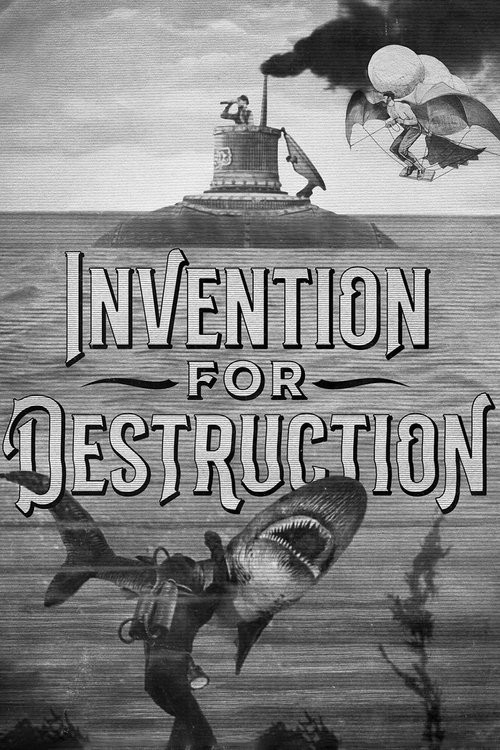
The Fabulous World of Jules Verne
1958 · Karel Zeman
For when you want pure enchantment — a rainy-afternoon film that makes you feel like a kid paging through an illustrated adventure novel. Comfort viewing with a strong dose of visual astonishment.
What it's about
A professor researching the secrets of pure matter is kidnapped by a would-be dictator and tricked into building a devastating super-weapon in his island lair. A young engineer-reporter and a woman rescued from a shipwreck race to warn the oblivious scientist before his invention hands the world to a madman. It's Jules Verne's universe in full: submarines, hot air balloons, pirate gangs, and marvelous machines on the cusp of the industrial age.
The experience
Watching it feels like a Victorian storybook waking up and moving — playful, wondrous, and gently ironic rather than thrilling in the modern sense. You spend as much time gasping at how each image was made as following the adventure itself.
The craft
Karel Zeman fused live actors with puppets, cut-out animation, models, and painted sets so that every frame looks like a nineteenth-century steel engraving come to life — hatched lines, striped seas, and all. It's a handmade special-effects universe decades ahead of its time, and it rewards a big screen where you can savor how seamlessly the trickery is stitched together.
Why it matters
A landmark of European fantasy cinema that showed effects could be an aesthetic, not just an illusion, and earned Zeman a reputation as a magician of the medium whose influence runs through generations of animators and fantasists.
Snapshot
Released in Czechoslovakia in 1958 as Vynález zkázy ("An Invention for Destruction," also circulated as The Deadly Invention), Karel Zeman's film is one of the landmark achievements of European fantasy cinema and the fullest expression of its director's lifelong project: to make moving pictures that look like the steel engravings of the nineteenth century. Loosely adapting Jules Verne's late novel Face au drapeau (Facing the Flag, 1896) while folding in motifs from across Verne's Voyages extraordinaires, the film follows a professor coerced by a would-be world conqueror into perfecting a super-explosive, and the young engineer and shipwrecked woman who try to thwart the scheme. Its true subject, however, is not plot but texture. Zeman fused live actors, marionettes, cut-out and model animation, matte painting, and a pervasive system of engraved hatching so that every image evokes the woodcut and steel-plate illustrations that first gave Verne's imagination its visual form. The result is a film that reads simultaneously as period pastiche, technical marvel, and a Cold War parable about the seductions of destructive science. It secured Zeman's international reputation and, in its American recut, introduced a generation of viewers to what a distinctly literary, illustrative form of fantasy could look like on screen.
Industry & production
The film was produced within the state-run apparatus of Czechoslovak cinema, centered on the Barrandov Studios in Prague and the Gottwaldov (Zlín) studio where Zeman had built his animation practice since the 1940s. Working under a nationalized industry meant Zeman operated without a commercial producer in the Western sense, but also within an environment that valued animation and children's/family fantasy as prestige exports — a domain in which Czechoslovakia, alongside its puppet-film tradition (Jiří Trnka), enjoyed genuine international standing. That institutional backing is essential to understanding the film: its extraordinarily labor-intensive, frame-by-frame compositing would have been difficult to justify under a strictly market-driven budget, but fit a system that treated such craftsmanship as cultural capital.
Vynález zkázy followed Zeman's earlier live-action/animation hybrid Journey to the Beginning of Time (Cesta do pravěku, 1955) and consolidated the method he would carry into Baron Munchausen (Baron Prášil, 1962). It arrived precisely as Czechoslovakia was preparing its self-presentation at Expo 58 in Brussels, and the film is closely associated with that moment of national showcase; it is widely credited with winning the Grand Prix at the 1958 Brussels World's Fair, an honor consistent with its status as a flagship of Czech technical artistry. Internationally it was picked up and recut for English-language markets, most familiarly for a United States release around 1961 under the title The Fabulous World of Jules Verne, with English narration added and some reframing of the material toward a Verne-brand adventure. The precise contractual details of these foreign releases are not something I can reconstruct with confidence, and I won't invent distributor terms or grosses.
Technology
The film is, above all, a technological artifact of pre-digital compositing. Zeman's central problem was optical: how to make actors, models, drawings, and painted backdrops coexist in a single frame that reads as a unified engraving. He solved it through meticulous in-camera and optical-printer layering — combining rear/front projection, matte work, glass shots, miniatures, and animation stands — rather than any single trick. The signature innovation is less a machine than a discipline: the imposition of a consistent graphic surface (parallel hatching, cross-hatching, stippling, ruled horizontal lines) across every element, including sets, props, costumes, painted seascapes, and even the "water" and "smoke." By printing or painting this line-work onto physical surfaces and marrying it to drawn animation of identical density, Zeman collapsed the visual difference between a photographed object and an illustrated one.
This required an unusually integrated pipeline between the live-action camera crew and the animation department, with elements shot to exacting registration so that separately produced layers would align. The technique is deliberately anti-illusionist in the modern sense: rather than hide the seams to simulate reality, Zeman foregrounds artifice so the whole frame declares itself a picture. That choice made the technology durable — the film does not "date" the way effects striving for photoreal illusion do, because it never pretended to be anything but a living engraving.
Technique
Cinematography
The photography subordinates naturalism to graphic legibility. Compositions are frequently frontal and stage-like, with strong horizon lines and layered planes (foreground silhouette, mid-ground action, engraved backdrop) that recall the depth conventions of book illustration rather than of location cinema. Lighting is comparatively flat and even, minimizing the modeling shadow that would betray the difference between a three-dimensional actor and a two-dimensional drawn field; the hatching, not the light, supplies tonal variation. The camera tends toward the stable and the tableau, moving when it must reveal the scale of a machine or vista but rarely calling attention to itself, so that the eye stays with the surface. The cinematography is credited to Zeman's regular camera collaborators — the names most consistently associated with this period of his work include Jiří Tarantík, Antonín Horák and Bohuslav Pikhart — though the division of labor among camera, optical, and animation staff is inherently blurred in a film of this kind.
Editing
Cutting serves clarity and wonder rather than tempo for its own sake. Zeman edits to present set-pieces — the submarine, the undersea sequences, the villain's island fortress, the climactic explosion — as unveilings, giving each contraption and vista room to be read. Transitions frequently exploit the illustrative conceit, with images behaving like plates turned in a book. Continuity is handled functionally to keep the adventure intelligible for a family audience, while the rhythm is calibrated so that the spectator has time to register the density of visual detail that is the film's real content.
Mise-en-scène / staging
This is the film's beating heart. Every stratum of the image is designed as a single graphic ecology: bicycles, cannons, diving suits, balloons, sailing ships and the professor's laboratory are rendered with Vernian steampunk elaboration and unified by hatched shading. Staging is theatrical and planar, actors often positioned as if posed for an engraver, their gestures broad enough to read within a busy field. The interplay of scales — human figures dwarfed by machines, machines dwarfed by seascapes — creates the sense of a whole illustrated world rather than a set of locations. Marionette-like animated figures, model vehicles, and drawn crowds populate the margins, so the frame teems with incident at its edges as well as its center.
Sound
The score is by Zdeněk Liška, Zeman's frequent musical collaborator and one of the most inventive Czech film composers of the century. Liška's music carries much of the film's emotional and adventurous register, shaping the sense of period romance and menace and binding the disparate visual elements into a continuous experience. The sound design leans on evocative mechanical and maritime effects — hissings, clankings, the churn of engines and sea — that lend physical weight to objects the image renders as drawings. In the English-language version, added narration reframes and paraphrases the action for foreign audiences; the specifics of that voice-over track belong to the export recut rather than to Zeman's original conception.
Performance
Acting is pitched to the illustrative mode rather than to psychological realism. The principal players — with Lubor Tokoš as the young engineer-hero among the leads — perform with a clarity of type appropriate to nineteenth-century adventure fiction: the earnest inventor, the imperiled woman, the abstracted professor, the imperious villain. Because the actors must share the frame with drawn and modeled elements, their physical performances are legible and slightly stylized, more akin to figures in a tableau vivant than to modern screen naturalism. This is a deliberate aesthetic alignment, not a limitation: the performers become another engraved element in Zeman's unified picture.
Narrative & dramatic mode
The dramatic mode is the boy's-own scientific romance, filtered through fable. The plot machinery — kidnapped savant, megalomaniac seeking a doomsday weapon, resourceful young protagonist, rescued heroine, secret island base — is pure Verne-derived adventure, and Zeman treats it with affectionate faithfulness to the genre's conventions rather than ironic distance. Yet the film also operates in a moral-allegorical register: the professor's innocent devotion to "pure matter" and pure knowledge is shown being captured and perverted toward annihilation, so that the adventure carries an unmistakable cautionary charge. The tone balances wonder and unease, delight in invention against dread of its misuse, without collapsing into either children's whimsy or heavy didacticism.
Genre & cycle
Vynález zkázy sits at the confluence of the science-fiction adventure, the literary fantasy, and the animated-hybrid film. Within science fiction it belongs to the "retro-futurist" or proto-steampunk lineage that imagines the future through the technological vocabulary of the industrial nineteenth century — a lineage that, decades later, criticism would name steampunk and often trace partly to Zeman's imagery. Within fantasy cinema it is heir to the trick-film tradition of Georges Méliès, to whom Zeman is routinely and justly compared as the "Czech Méliès." And within animation it is a keystone of the Czech school's hybrid experiments, distinct from Trnka's puppet features by its integration of live actors into a drawn world. It is less a work made to fit a commercial cycle than one that inaugurated an aesthetic others would later formalize.
Authorship & method
The film is unmistakably an auteur work in the sense that its style is inseparable from Karel Zeman's personal method. Zeman conceived, designed, and directed it as a Gesamtkunstwerk of animation and live action, and his authorship resides less in narrative signature than in a total visual philosophy: cinema as animated engraving, faithful to the look of Verne's original Hetzel-edition illustrations. That fidelity is the interpretive key — Zeman set out not merely to adapt Verne's stories but to bring Verne's pictures, and their period graphic idiom, to life. Among his key collaborators, composer Zdeněk Liška is the most consequential recurring artistic partner, providing scores across Zeman's major works; the camera and animation crews (with figures such as Tarantík, Horák and Pikhart associated with the period) executed the exacting compositing his vision demanded. The screenplay is Zeman's own adaptation of Verne; where earlier and neighboring Zeman projects drew on literary collaborators, I won't assign specific co-writing credits here that I cannot verify.
Movement / national cinema
The film is a defining product of the Czechoslovak animation and fantasy tradition, one of the richest national schools in the medium's history. That tradition — rooted in a deep Central European heritage of puppetry, illustration, and graphic art — produced both Trnka's puppet cinema and Zeman's hybrid films, and it enjoyed unusual prestige and resources within the socialist cultural economy. Zeman's work predates and helps set the stage for the Czechoslovak New Wave of the 1960s, sharing that later movement's formal daring and appetite for allegory while operating in a family-fantasy register. Internationally, Vynález zkázy became one of the primary vehicles through which the sophistication of Czech screen art reached Western audiences.
Era / period
Made in 1958, the film is doubly period-marked. Diegetically it inhabits a late-nineteenth-century industrial world of steam, ironclads, submarines and pneumatic marvels — the era of Verne's own writing. Historically it is a Cold War object, produced in a Soviet-bloc state at the height of anxiety about weapons of mass destruction, and its fable of a coerced scientist and a super-bomb reads pointedly against the nuclear age. This layering — an atomic-era parable dressed in Victorian steampunk — is central to the film's resonance, allowing it to speak to contemporary fears through the safe distance of antique adventure. Its near-simultaneity with Expo 58 also situates it at a moment when Czechoslovakia was actively projecting its modern technical and artistic capabilities to the world.
Themes
The governing theme is the moral ambivalence of scientific invention: the same ingenuity that produces wonders can be conscripted for destruction, and the innocent inquirer is culpably naïve about how his knowledge will be used. Around this core cluster several others — the megalomaniac's dream of domination through technological superiority; the romance of exploration and discovery for its own sake; the tension between pure curiosity and applied power. Formally, the film also thematizes the act of illustration itself: by making the world visibly drawn, Zeman foregrounds imagination, artifice, and the printed image as the medium through which we first apprehend the fantastic. Wonder and warning are held in permanent balance.
Reception, canon & influence
Critically, the film has long been regarded as Zeman's masterpiece alongside Baron Munchausen and as a summit of animation-live-action synthesis; it is credited with winning major recognition at the 1958 Brussels World's Fair, and its export success (notably the American recut The Fabulous World of Jules Verne) extended its reputation well beyond the Eastern bloc. Over time it has been secured in the canon as a foundational work of retro-futurist and proto-steampunk imagery and as a touchstone of Czech cinema, with the Karel Zeman Museum in Prague and subsequent restorations sustaining its visibility.
Looking backward, the film's influences are explicit and avowed: Jules Verne's fiction and, crucially, the graphic style of the original nineteenth-century engraved illustrations for his novels; the trick-film heritage of Georges Méliès; and the Central European traditions of puppetry and book illustration. Zeman transmuted these sources into a coherent new idiom.
Looking forward, its legacy is broad and often cited. Zeman's fusion of the hand-drawn and the photographed, and his affectionate Victorian-scientific imagery, are frequently named as inspirations by later fantasists — Terry Gilliam is among the filmmakers who have publicly credited Zeman, and the film's aesthetic is regularly invoked in discussions of directors drawn to handmade, illustrative fantasy such as Tim Burton and Wes Anderson, as well as in the visual genealogy of steampunk generally. While one should be careful to distinguish documented acknowledgment from more diffuse affinity, the throughline is real: Vynález zkázy demonstrated, decades before digital compositing, that cinema could inhabit the space of illustration itself — and that lesson continues to shape filmmakers who prize the visible, wondrous hand of the maker.
A Deleuzian reading
Start with the sea.
The full Deleuzian reading of The Fabulous World of Jules Verne →
Reception
A genuine international hit in its day — it took the Grand Prix at the Brussels Expo 58 film festival and got a splashy dubbed US release in 1961 — then slipped out of Anglophone memory for decades, until restorations and loud championing by fans like Terry Gilliam turned Zeman back into a name cinephiles drop with pride.
How The Fabulous World of Jules Verne was received, from release to now →
How to watch The Fabulous World of Jules Verne: what to notice on a first viewing
- Notice hatched lines drawn across sets, water, and smoke. Zeman paints parallel engraving lines onto props, water, and even costumes, so every element of the image reads as a steel engraving rather than a photograph. The whole world looks hand-drawn, which is exactly the illusion Zeman wants you to notice and enjoy.
- Watch live actors share the frame with drawn crowds and models. Marionette-like animated figures, model vehicles, and live actors are unified by the same hatched shading, so the margins of the frame teem with incident as much as the center. You start hunting the edges of every shot for what else is moving in this drawn world.
- Notice how small people look next to Verne's giant machines. Zeman stacks scales, tiny figures against huge submarines and cannons, huge machines against wider seascapes, so the whole picture reads like an illustrated world rather than real locations. The scale trick is what makes nineteenth-century invention feel simultaneously wonderful and slightly monstrous.
- Listen for how the score binds every drawn and live element together. Zdenek Liska's music carries the film's sense of period romance and menace continuously, gluing the mismatched textures of actors, models, and drawings into one experience. The music is doing quiet work to make a visibly patchwork world feel like a single place.
The whole guide to watching The Fabulous World of Jules Verne, with the keys for a rewatch →
Influences: the films it descends from and the films it influenced
- A Trip to the Moon (1902) — Zeman revives Méliès's in-camera stop-substitution trickery and flat painted theatrical proscenium staging, where fantastical machines and cosmic events unfold in a shallow hand-built tableau rather than a photographic space.
- The Impossible Voyage (1904) — A direct Verne-adjacent precedent: absurd scientific vehicles rendered as hand-painted contraptions moving across scrolling flat backdrops, the exact 'illustration-brought-to-motion' idiom Zeman systematized.
- The Adventures of Prince Achmed (1926) — Silhouette cutout animation staged as stacked planar layers against flat grounds, prefiguring Zeman's compositing of figures into discrete engraved picture-planes with no illusionistic depth.
- Journey to the Beginning of Time (1955) — Zeman's own immediately prior film that established his signature method of placing live actors inside animated, illustration-derived backdrops via multi-plane compositing — the technical rehearsal for Vynález zkázy.
- Alice (1988) — Carries forward the Czech live-action/animation hybrid, intercutting a real performer with handmade animated objects, prizing the visible tactile hand of the maker over seamless illusion.
- The Adventures of Baron Munchausen (1988) — Gilliam, who publicly credits Zeman, composites live figures into painterly engraving-derived Victorian backdrops and stages action in deliberately flat storybook planes.
- Time Bandits (1981) — Gilliam's flat collage/cutout animation aesthetic (developed for Monty Python) descends from the Méliès–Zeman trick-film lineage of moving illustrations layered against non-perspectival grounds.
- The City of Lost Children (1995) — Its retro-futurist, Victorian-scientific production design — brass contraptions and ambivalent inventions — extends Zeman's proto-steampunk imagery of wondrous, morally suspect machinery.
- Sky Captain and the World of Tomorrow (2004) — A digital-compositing revival of Zeman's exact conceit: live actors performing entirely inside an artificial, hand-styled retro-futurist illustration-world, the pre-digital lesson done with green screen.
- The Grand Budapest Hotel (2014) — Anderson's frontal, planar tableau staging and openly artificial miniatures/matte compositing echo Zeman's insistence on the flatness and visible handmade artifice of the picture-plane.
- Sin City (2005) — High-contrast graphic compositing that drops live actors into ink-and-hatching illustration frames — a literal contemporary realization of Zeman's principle that cinema can inhabit the space of drawing itself.
- The Science of Sleep (2006) — Gondry's cardboard-and-in-camera handmade effects revive Zeman's ethos of foregrounding the visible, artisanal apparatus rather than concealing the technique.
- Institute Benjamenta (1995) — The Quays' textural fusion of live action with hand-manipulated illustrative and stop-motion elements continues the Central European handcraft-fantasy lineage Zeman codified.
- Fantastic Planet (1973) — Rendered literary science fiction through flat, cross-hatched engraving-style graphics that preserve the look of illustrated plates — the tableau-as-print aesthetic Fantastic Planet applies to Wul's novel.
- The Pied Piper (1986) — Animated the crosshatched engraving/woodcut line directly, the same graphic-print surface Barta sculpts into his puppets, sets, and even the grain of the townspeople's skin.
- The Emperor's Nightingale (1949) — Shares the Czechoslovak animation studio tradition of adapting literature through meticulous handcraft and a book-illustration sensibility, though Trnka worked in dimensional puppetry rather than Zeman's engraved flatness.
- The Fabulous Baron Munchausen (1962) — Zeman's companion masterwork extending the identical technique — live actors composited into Gustave Doré-style engraved and hand-tinted backdrops, hatching lines animated into moving pictorial space.
- Hugo (2011) — Consciously resurrects the Méliès trick-film tableau and painted-set enchantment that Zeman also revived, foregrounding early cinema's hand-crafted illusion as its subject.
Similar films
- The Adventures of Baron Munchausen (1988) — influence & lineage · same viewing thread
- Alice (1988) — influence & lineage · same viewing thread
- Time Bandits (1981) — influence & lineage
- The City of Lost Children (1995) — influence & lineage · same viewing thread
- Faust (1994) — same viewing thread
- Metropolis (1927) — shared sensibility
- The Adventures of Tintin (2011) — shared sensibility
- The Pied Piper (1986) — shared sensibility
All the films related to The Fabulous World of Jules Verne →
Watch it with: curated runs of related films
- Dream Logic, Made by Hand — A run for when you want films where imagination doesn't just appear onscreen but rebuilds the world — stories nested inside stories, daydreams that leak into daylight, realities that quietly dissolve.