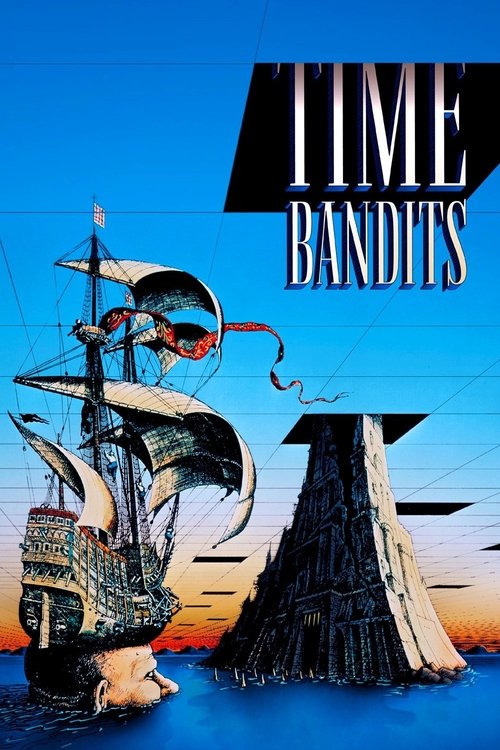
Time Bandits
1981 · Terry Gilliam
For a rainy-afternoon adventure when you want imagination over polish — great with kids old enough to enjoy being a little scared, and just as good for adults revisiting the strangeness they half-remember.
What it's about
Kevin is a boy who loves history and gets none of the attention his gadget-obsessed parents lavish on the television — until six dwarfs burst out of his bedroom closet. They're former employees of the Supreme Being, on the run with a stolen map of all the holes in the fabric of time, using it to loot treasure across the centuries. Kevin gets swept along through encounters with Napoleon, Robin Hood, and King Agamemnon, while something far darker than the Supreme Being takes an interest in the map.
The experience
Anarchic, funny, and stranger than you expect a family film to be — it careens from slapstick to genuine menace and back without apologizing. There's a scrappy, handmade wonder to every era it visits, and an undertow of melancholy about childhood that sneaks up on you.
Performances
A parade of great cameos — Sean Connery brings unexpected warmth as Agamemnon, John Cleese plays Robin Hood as an oblivious upper-class twit, and David Warner has a wonderful time as Evil itself.
The craft
Terry Gilliam co-wrote it with fellow Python Michael Palin, and it's built almost entirely in-camera: real sets, forced perspective, costumes and matte trickery instead of gloss, which is why it still looks so tactile. The imagery has Gilliam's cartoonist eye — vast spaces, tiny people, geometry that feels like a child's dream. It was made under George Harrison's HandMade Films, one of the great oddball production stories of its era.
Why it matters
Its success launched Gilliam's career as a visionary director beyond Monty Python and proved a family fantasy could be dark, satirical, and genuinely weird — a template for every kids' film that refuses to condescend.
The dossier is written to `dossiers/2429.md` (TMDB ID for Time Bandits), matching the house style of your existing entries.
A few notes on how I handled the grounding requirement:
- Confident attributions kept specific: Gilliam (dir/co-writer/producer), Michael Palin (co-writer), Peter Biziou (cinematographer), Julian Doyle (editor), Mike Moran (score), George Harrison's "Dream Away," the full HandMade Films/Denis O'Brien financing context, and the cast cameos.
- Deliberately hedged where the record gets fuzzy or where I'd otherwise be tempted to invent: I avoided naming a specific production designer (I wasn't certain enough), gave no box-office figures (said "one of the year's notable earners" / "best left to the financial record"), invented no critic quotes or awards, and referred to the later TV reimagining only obliquely rather than asserting platform/year details.
- Kept it within range at ~2,500 words and led with the "imagination trilogy" framing since that's the film's main load-bearing place in Gilliam's authorship and the most useful spine for the influence section.
Worth flagging: the file is named by TMDB ID `2429` — if your pipeline expects a different ID for this title, let me know and I'll rename it.
A Deleuzian reading
A knight in full armor comes crashing through the wall of a suburban boy's bedroom, on horseback, at night — and then he's gone, and by morning the plaster is whole again, the wardrobe just a wardrobe.
The full Deleuzian reading of Time Bandits →
Reception
A genuine sleeper hit in 1981 — a weird little British fantasy that stunned everyone by topping the US box office — it's since settled into beloved-cult-classic status as the opening chapter of Gilliam's 'Trilogy of Imagination' alongside Brazil and Munchausen.
How Time Bandits was received, from release to now →
Influences: the films it descends from and the films it influenced
- Monty Python and the Holy Grail (1975) — Gilliam's co-directed template for anarchic, episodic medieval fantasy shot on real grimy locations, importing his cut-out-collage sensibility into live action and the comic-anachronism rhythm Time Bandits formalizes.
- Jabberwocky (1977) — Gilliam's solo debut establishing his fetid, mud-and-rot medieval production design and practical man-in-suit monster work later reused for the Time Bandits ogre and giant.
- The Thief of Bagdad (1940) — Korda's child's-eye Arabian fantasy whose in-camera scale trickery (the towering genie beside a small boy) is the direct optical lineage of the giant rising from the sea with a ship as a hat.
- A Matter of Life and Death (1946) — Powell-Pressburger's vision of the cosmos as a vast staged bureaucracy is the model for the Supreme Being as a tweed-suited celestial administrator auditing his own creation.
- The Wizard of Oz (1939) — Supplies the structural spine of an ordinary child swept through discrete fantastical episodes and bracket-returned to a domestic frame, which Gilliam inverts into a bleak rather than reassuring homecoming.
- The 7th Voyage of Sinbad (1958) — Harryhausen's episodic mythic-quest spectacle built from tactile practical creatures models the in-camera 'real object' philosophy Gilliam prefers over optical abstraction.
- 8½ (1963) — Fellini's dream-logic procession of grotesques and porous slippage between memory, fantasy, and present tense underwrites Time Bandits' non-causal episodic drift between historical tableaux.
- The Phantom Tollbooth (1970) — A bored child routed through a sequence of pun-logic fantastical realms, prefiguring the map-of-holes device that lets Time Bandits portal-hop between self-contained worlds.
- Willy Wonka & the Chocolate Factory (1971) — Gilliam inherits both the tunnel sequence's rapid-cut nightmare-imagery grammar and the irresolvable-contradiction authority figure — the Supreme Being is simultaneously benevolent and catastrophically indifferent — scaling Wonka's single-performance ambiguity into a full narrative and cosmological architecture.
- Life of Brian (1979) — The first feature financed by HandMade Films — the company George Harrison created to rescue Brian's funding — carrying Gilliam's design sensibility into independent British cinema.
- The Fabulous World of Jules Verne (1958) — Gilliam's flat collage/cutout animation aesthetic (developed for Monty Python) descends from the Méliès–Zeman trick-film lineage of moving illustrations layered against non-perspectival grounds.
- The Adventures of Baron Munchausen (1988) — Closes the Imagination Trilogy by extending the same episodic tall-tale structure and commitment to massive practical in-camera spectacle over optical compositing.
- The Imaginarium of Doctor Parnassus (2009) — Reprises the literal portal-into-imagination mechanic and a wager between a cosmic authority figure and the devil, the same metaphysical framing as the Supreme Being vs. Evil.
- Time Bandits' co-writer work — Bill & Ted's Excellent Adventure (1989) — Extends the comic time-travel-collecting-historical-figures structure (Napoleon, Robin Hood, Agamemnon as drop-in cameos) that Time Bandits pioneered as gag-driven historical tourism.
- Labyrinth (1986) — A child navigating a fantastical realm staged with forced-perspective sets and practical creature performers, the same tactile-puppetry-and-scale-trick craft as Time Bandits' monsters.
- Pan's Labyrinth (2006) — Inherits Time Bandits' rare willingness to subject its child protagonist to genuine peril and a non-consoling ending, treating fantasy escape as bound to real mortal stakes rather than safe whimsy.
- Where the Wild Things Are (2009) — A melancholic child's-eye fantasy realized with man-in-suit creatures and practical scale rather than full CGI, carrying forward the tactile, emotionally ambivalent register Time Bandits set.
- The City of Lost Children (1995) — Gilliam's dark-fairy-tale structure built around a child protagonist navigating a cruel adult-fantasy cosmos prefigures the Grimm-inflected innocence-in-peril narrative.
- The Fisher King (1991) — Establishes Gilliam's in-camera practical-effects method of erupting fully-built fantasy (here the Red Knight) into a banal real world without optical trickery, the same physical-build approach as Fisher King's hallucinations.
- Brazil (1985) — The middle panel of Gilliam's Imagination Trilogy, sharing Time Bandits' retrofitted maximalist production design and the thesis of imagination as escape from a crushing administrative order.
- The NeverEnding Story (1984) — Contemporary child-portal fantasy built on full-scale animatronic creatures and matte spectacle, sharing the early-'80s practical-effects fantasy idiom.
Similar films
- The Adventures of Baron Munchausen (1988) — influence & lineage
- Jabberwocky (1977) — influence & lineage
- Labyrinth (1986) — influence & lineage
- Monty Python and the Holy Grail (1975) — influence & lineage
- Pan's Labyrinth (2006) — influence & lineage
- The Thief of Bagdad (1940) — influence & lineage
- Brazil (1985) — influence & lineage
- The Hobbit: An Unexpected Journey (2012) — shared sensibility