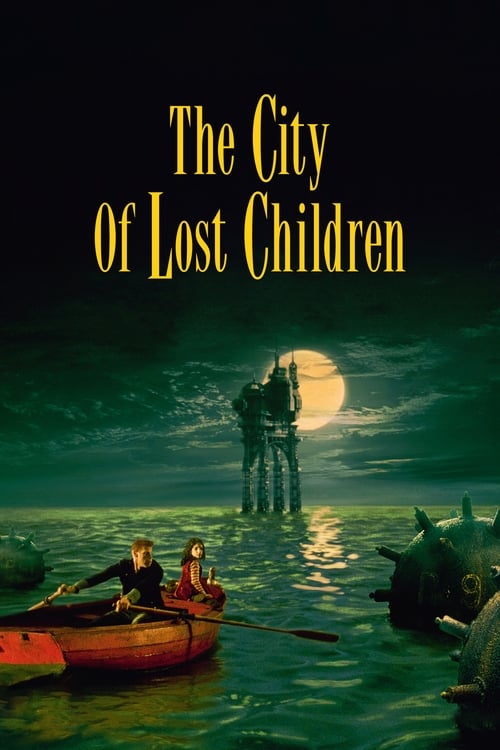
The City of Lost Children
1995 · Jean-Pierre Jeunet
For when you want to escape somewhere genuinely strange — a film to get lost in when ordinary movies feel too ordinary. Best for viewers who like their fantasy dark, handmade, and unlike anything else.
What it's about
In a fogbound, permanently nocturnal port city, an artificial man named Krank is aging fast because he cannot dream — so he has children kidnapped by a cult of blind zealots and steals their dreams in his offshore laboratory. When a gentle circus strongman's little brother is taken, he teams up with Miette, a sharp-eyed nine-year-old who runs with a gang of orphan thieves, to get him back. Around them swirls a carnival of clones, a brain in a tank, and other beautiful grotesques.
The experience
Like falling into someone else's dream — sinister and whimsical at once, dense with invention in every frame. It's more enchanting than frightening, but its fairy-tale menace has real teeth.
Performances
Ron Perlman is wonderfully tender as the childlike strongman, and young Judith Vittet plays Miette with an eerie, old-soul gravity that anchors the whole film.
The craft
Every inch is designed: rusted steampunk machinery, green-gold fog, distorted lenses, and elaborate sets that make the city feel both vast and claustrophobic. It's a triumph of physical world-building from the pre-digital era's twilight — a feast on a big screen with the sound up.
Why it matters
It cemented Jeunet's reputation as one of cinema's great visual fantasists and became a touchstone for dark, handcrafted fantasy design in films, games, and animation that followed.
Snapshot
The City of Lost Children (La Cité des enfants perdus) is a French dark-fantasy fable set in a fogbound, perpetually nocturnal port town of indeterminate era. Krank (Daniel Emilfork), an artificial man who cannot dream and is therefore aging prematurely, has children abducted by a cult of blind zealots, the Cyclops, so he can siphon their dreams. When the small brother of the gentle circus strongman One (Ron Perlman) is taken, One allies with a streetwise orphan girl, Miette (Judith Vittet), to breach Krank's offshore laboratory. Around them swarm a grotesque supporting world: a brain in a tank named Irvin, a troupe of cloned brothers, a malevolent dwarf called Mademoiselle Bismuth, a Siamese-twin "Octopus" who runs the orphan thieves, and a flea-borne mind-control serum. Though the assignment credits Jean-Pierre Jeunet alone, the film was directed jointly with Marc Caro, and that shared authorship is essential to understanding it. Coming between Jeunet and Caro's cult debut Delicatessen (1991) and Jeunet's later international success Amélie (2001), it is the most lavish and least naturalistic of their collaborations — a synthesis of design-driven cinema, fairy-tale dread, and bravura early digital craft.
Industry & production
The film was a large-scale European co-production, financed across France, Germany, and Spain, and produced by Claudie Ossard, who had backed Delicatessen and would later produce Amélie. Its budget was substantial by mid-1990s French standards — frequently described as among the more expensive French productions of its moment — reflecting an almost entirely studio-built world. I won't cite a precise figure, as reported numbers vary and I cannot verify a single authoritative one. The production was a showcase for the French studio system's appetite for cinéma du look-adjacent spectacle and for the international ambitions of Gaumont-era French genre filmmaking.
The shoot was famously protracted and design-intensive, conducted largely on soundstages because nearly every environment — the docks, Krank's rig, the sewers, the orphans' lair — was a constructed set rather than a location. The film premiered as the opening selection of the 1995 Cannes Film Festival, a notable berth that signaled France's institutional embrace of the project as a prestige event rather than a marginal genre item. Its commercial performance was modest relative to its cost; like Delicatessen, it found its largest and most durable audience internationally and on home video among genre and animation-adjacent viewers rather than through blockbuster theatrical returns. The casting of Ron Perlman — an American character actor with limited French — was both an international-sales calculation and a creative gambit; Perlman has recounted learning his dialogue phonetically.
Technology
The City of Lost Children sits at a genuine hinge point in cinema technology: it was one of the early European features to integrate digital visual effects into a heavily designed, miniature- and prosthetic-based aesthetic. The effects work was led by the French house Duboi (sometimes rendered Dubois/Duboicolor), whose digital intermediate and compositing tools allowed the filmmakers to manipulate color, multiply elements, and stitch together impossible spaces. The film is often cited as one of the first features to use a software-driven digital grade across substantial portions of its imagery, pulling the palette toward the bilious greens, ambers, and sepias that define its look — well before the digital intermediate became standard practice in the 2000s.
Two showpiece sequences are routinely singled out. The opening — a child's nightmare in which proliferating, malfunctioning Santa Clauses overrun a nursery — uses replication and compositing to surreal, claustrophobic effect. Elsewhere, a single teardrop sets off an absurdly elaborate Rube Goldberg chain of cause and effect across the town, a sequence whose precise timing depended on digital compositing to join discrete practical elements into one continuous causal flourish. These were not effects deployed for invisibility but for visible, ornamental wonder — technology in service of a hand-built, almost steampunk materiality rather than photoreal illusion.
Technique
Cinematography
Darius Khondji, who had shot Delicatessen and would soon become one of world cinema's most sought-after cinematographers (Se7en, and later work with Haneke, Fincher, and the Safdies), photographed the film with a deeply saturated, low-key style. The signature is an enveloping greenish-amber tonality, achieved through a combination of art direction, lighting, lab processes, and the early digital grading noted above. Khondji favors wide-angle lenses, deep space, and slightly distorting perspectives that lend faces a caricatural, expressionist weight. The camera is restlessly mobile — sweeping crane moves, impossible "impossible-eye" trajectories through keyholes and machinery, and swooping point-of-view shots — yet the frame is always densely, almost suffocatingly composed. Fog, water, and rust diffuse every light source, producing a world that feels perpetually damp and submerged.
Editing
The film's editing, by Hervé Schneid (a frequent Jeunet collaborator), is precise and rhythmically musical, particularly in its set-piece chains of cause and effect. Schneid's cutting serves Jeunet and Caro's love of clockwork: actions are broken into discrete graphic beats and reassembled so that the audience reads mechanism and consequence with delight. The teardrop sequence is the clearest demonstration — a montage logic in which each cut is a gear-tooth advancing an absurd machine. The pacing alternates between this kinetic intricacy and slower, dreamlike passages inside Krank's dream-stealing apparatus.
Mise-en-scène / staging
Production design is arguably the film's true protagonist. Marc Caro served as the principal designer of the film's visual concept, with art direction realizing a retro-futurist port out of riveted iron, dripping pipes, dirigible rigs, and Jules Verne–by-way-of-nightmare machinery. The legendary fashion designer Jean Paul Gaultier created the costumes, lending the grotesque ensemble — the Cyclops's optical headgear, the orphans' rags, Krank's wardrobe — a couture-grade specificity. Every frame is overstuffed with incident: the staging philosophy is maximalist, treating the proscenium of the screen as a vitrine crammed with mechanical curiosities. Faces are cast and made up as types out of caricature and fairground tradition, extending the design ethos to the human body itself.
Sound
The sound world is dense and tactile — creaking metal, foghorns, lapping water, mechanical whirs — building an immersive acoustic of damp industry. Angelo Badalamenti, best known for his work with David Lynch (Twin Peaks, Blue Velvet), composed the score, a significant collaborator who brought a melancholy, waltzing romanticism that cuts against the imagery's grotesquerie. Badalamenti's music supplies the film's emotional ballast: lullaby-like themes and circus-tinged motifs that frame the horror as fairy tale, lending tenderness to a world of cruelty.
Performance
Performance here is stylized rather than naturalistic, calibrated to the design. Ron Perlman plays One as a hulking innocent, all gentleness and bafflement, his physical bulk a deliberate contrast to childlike simplicity; the choice to keep his dialogue minimal and phonetic suits a character defined by feeling over speech. Daniel Emilfork's Krank is a gaunt, anguished grotesque — a creature pitiable in his sleeplessness as much as villainous. The young Judith Vittet, as Miette, anchors the film with a precocious gravity, playing a child forced into adult shrewdness; the unsettling, tender quasi-romantic register of her bond with One is among the film's most discussed and delicate effects. Dominique Pinon, the Jeunet-Caro repertory regular, plays the diver and the entire set of cloned brothers, a tour-de-force of single-actor multiplicity.
Narrative & dramatic mode
The film operates in the mode of the dark fairy tale rather than conventional science fiction or adventure, despite its genre labels. Its dramatic engine is a quest-and-rescue plot of fable-like simplicity — a strongman and a clever girl journey to a wizard's tower to save a stolen child — overlaid with a thematic meditation on dreams, memory, and aging. The storytelling is deliberately oneiric and digressive, privileging set-piece spectacle, visual gags, and tonal texture over psychological realism or tight causal economy. Some critics have found the narrative thin or secondary to the design, and that is a fair description of the priorities: plot functions as an armature on which to hang invention. The mode is closer to Grimm, Carroll, and the carnival than to literary SF, with the cruelty and peril of old folklore restored to a children's-story structure.
Genre & cycle
Generically, the film is a hybrid: fantasy adventure, dystopian science fiction, and grotesque fairy tale, with strong currents of what is sometimes called steampunk avant la lettre. It belongs to a small but distinct cycle of design-forward European fantasies and is frequently placed alongside the work of Terry Gilliam (Brazil, The Adventures of Baron Munchausen) and Jan Švankmajer for its mechanical-grotesque sensibility. Within the directors' own filmography it forms a diptych with Delicatessen — both retro-dystopian, both built on a closed, theatrical world and a community of grotesques — while pushing further into fantasy and spectacle.
Authorship & method
The crucial fact obscured by single-director billing is that this is a Jeunet and Caro film, the fullest expression of a partnership rooted in comics, animation, and music video. Caro, an illustrator and designer, was the principal visual architect; Jeunet, with a background in commercials and shorts, drove performance, comic timing, and the machine-like construction of sequences. Their method was storyboard-intensive and design-first — the film essentially drawn before it was shot — which accounts for its precision and its subordination of actors to a total visual scheme. The City of Lost Children proved their final feature collaboration; afterward Jeunet went to Hollywood for Alien: Resurrection (1997) and then to the warmer, more humanist Amélie, while Caro moved toward design and direction on his own terms.
The roster of collaborators is exceptional and clarifies the film's pedigree: Darius Khondji (cinematography), Angelo Badalamenti (score), Jean Paul Gaultier (costumes), Hervé Schneid (editing), and the visual-effects artists at Duboi. The screenplay was written by Jeunet and Caro with Gilles Adrien, their regular co-writer from Delicatessen. The repeated reliance on the same repertory of performers and craftspeople (Pinon above all) marks the work as the product of a tight authorial workshop rather than an assembled studio crew.
Movement / national cinema
The film is a product of French genre cinema in the long shadow of the cinéma du look — the 1980s movement (Beineix, Besson, Carax) prizing stylized surface, advertising-honed polish, and youthful romanticism. Jeunet and Caro inherit that movement's image-first values but inflect them toward the grotesque, the mechanical, and the bande dessinée (French comics) tradition, as well as the legacy of European surrealism and the puppet-and-stop-motion lineage of animators like Švankmajer. It is also a flagship of the French state-supported, internationally co-financed prestige genre film of the 1990s — proof that France would mount a fantastique spectacle at scale, opening Cannes, rather than ceding such territory to Hollywood.
Era / period
Made in 1995, the film captures a transitional moment when practical, hand-built effects and emergent digital tools coexisted on equal footing. It predates the wholesale digital turn while pioneering some of its techniques (notably digital grading), making it a kind of last analog-fantastique and first digital-fantastique at once. Within French cinema it belongs to a mid-decade flourishing of ambitious, design-driven filmmaking; within the directors' careers it is the high-water mark of their joint maximalism before the diverging paths of the late 1990s.
Themes
The film's central preoccupation is dreams — their theft, their necessity, and their relationship to innocence and to mortality. Krank's inability to dream is figured as a kind of death-in-life; he ages because he is cut off from the unconscious wellspring that children possess freely. Around this sit braided concerns: childhood and its exploitation by adults; orphanhood and improvised family (One and Miette form a surrogate kinship that the film treats with unusual tenderness); the artificial and the human (Krank, the clones, the brain in a jar all raise the question of what makes a being real); and aging, memory, and the fear of time. Sight and blindness recur as motifs — the Cyclops cult literalizes the trade of vision for false faith, and the act of seeing, surveilling, and dreaming-as-seeing organizes the imagery. Underneath the grotesquerie runs a melancholy humanism: a belief that tenderness and imagination are what redeem an ugly, mechanized world.
Reception, canon & influence
Influences on the film (backward): The film draws on a deep well of antecedents — the fantastique and surrealist traditions of French art and comics; Jules Verne's retro-industrial imagination; the fairy-tale cruelty of Grimm and the dream-logic of Lewis Carroll; German Expressionism's distorted spaces and shadows; and the carnival/freak-show grotesque. Among filmmakers, Terry Gilliam is the most frequently cited kindred spirit, and the stop-motion surrealists (Švankmajer, the Brothers Quay) share its tactile dread. It also extends the directors' own Delicatessen and the music-video/advertising aesthetic of the cinéma du look.
Critical reception: Response was admiring but divided along a consistent fault line — near-unanimous praise for the film's astonishing visual imagination, design, and craft, set against a recurring complaint that the narrative and characters were thin, the spectacle finally cold or exhausting. Several critics regarded it as a triumph of production design over storytelling; others embraced its dream-logic on its own terms. Its Cannes opening-night slot confirmed institutional esteem even where popular box office was modest. I am describing the contour of the reception rather than quoting specific reviews, which I cannot reproduce verbatim with confidence.
Legacy (forward): The film became a durable cult object, especially among animators, designers, and the steampunk and gothic-fantasy subcultures, who absorbed its riveted-iron, foggy-port aesthetic. Its early use of digital grading is cited in technical histories as a forerunner of the digital-intermediate era that reshaped color in 2000s cinema. For its makers, it was a career inflection point: it consolidated Jeunet's reputation enough to draw Hollywood's Alien: Resurrection and ultimately enabled Amélie, whose warmer palette and whimsical machinery clearly descend from this colder, crueler world. The collaboration's visual DNA — caricatural casting, clockwork set-pieces, saturated retro-futurism — can be traced across subsequent design-driven fantasy and remains the touchstone reference for "Jeunet-and-Caro" as a style unto itself.
A Deleuzian reading
Krank sits in his chair, wired to a sleeping child, and waits to be carried somewhere lovely.
The full Deleuzian reading of The City of Lost Children →
Reception
It opened the 1995 Cannes Film Festival to sharply divided reviews — critics dazzled by the design but calling it cold and convoluted — and did modest business abroad; three decades on it's a beloved cult object and a go-to reference for 90s dark-fantasy visual style.
How The City of Lost Children was received, from release to now →
Influences: the films it descends from and the films it influenced
- Delicatessen (1991) — The directors' own prior feature establishes their design-first, storyboard-intensive method and sepia-toned retro-decay mise-en-scène with comic-timed clockwork set-pieces — the immediate template this film expands.
- Brazil (1985) — Gilliam's retro-futurist dystopia of ductwork, riveted machinery, and bureaucratic grotesque is the most-cited kindred sensibility, modeling the maximalist hand-built production design and wide-angle distortion of cramped fantastical spaces.
- The Cabinet of Dr. Caligari (1920) — German Expressionism's painted, distorted spaces and chiaroscuro shadow supply the warped architecture and theatrical-nightmare staging logic the film inherits via its set-as-psychology design.
- Alphaville (1965) — Shooting a science-fiction dystopia entirely in real urban/industrial locations re-dressed as the future, achieving retro-futurism through atmosphere and shadow rather than effects — a French antecedent to the foggy-port world here.
- Time Bandits (1981) — Gilliam's dark-fairy-tale structure built around a child protagonist navigating a cruel adult-fantasy cosmos prefigures the Grimm-inflected innocence-in-peril narrative.
- Alice (Něco z Alenky) (1988) — Švankmajer's tactile stop-motion dread and surrealist Carroll-logic — animating found objects into menacing dream-machinery — feeds the film's grotesque, object-fetish texture.
- Street of Crocodiles (1986) — The Quays' rust-and-dust puppet surrealism, with its decayed Mitteleuropa machinery and uncanny miniature mise-en-scène, shares the same tactile-dread design vocabulary.
- The Fabulous World of Jules Verne (1958) — Its retro-futurist, Victorian-scientific production design — brass contraptions and ambivalent inventions — extends Zeman's proto-steampunk imagery of wondrous, morally suspect machinery.
- The Adventures of Baron Munchausen (1988) — Khondji's extreme wide-angle grotesquerie and the entirely built retro-fantastic port carry forward Munchausen's rule that a fantastic world is fabricated at 1:1 scale and photographed with a lens that curves it, not assembled in post.
- Alien: Resurrection (1997) — Jeunet's immediate next film exports the caricatural casting, wide-angle grotesque, and clockwork sequence-construction (plus Pinon and the workshop crew) into a Hollywood studio frame.
- Amélie (2001) — Directly descends in its digital color-grading, whimsical machinery, and saturated stylized mise-en-scène — the same craft warmed into a humanist palette rather than this film's cold cruelty.
- Dark City (1998) — Extends the digitally-composited retro-futurist nocturne — a perpetually dark city of distorted architecture built through matte and compositing — into late-90s noir science fiction.
- Sleepy Hollow (1999) — Carries forward the gothic-fairy-tale grotesque and desaturated digitally-graded palette over hand-built fog-bound sets, design-driven fantasy as total visual scheme.
- A Series of Unfortunate Events (2004) — Absorbs the riveted-iron, Victorian-steampunk dark-fairy-tale aesthetic of menaced children in a maximalist storybook world built from digital-composite design.
- The City of Lost Children's steampunk subculture descendants — Hugo (2011) — Inherits the clockwork-automaton fairy tale and foggy mechanical-Paris design, foregrounding the same fascination with intricate machinery and a child's wonder amid retro-industrial spectacle.
- City of Ember (2008) — Extends the riveted-pipe, perpetually-dim retro-industrial underworld design and children-navigating-a-decaying-machine-city narrative into family adventure.
- Blue Velvet (1986) — Angelo Badalamenti's dread-laced, lullaby-melancholic scoring — first defined for Lynch — is imported here to convert grotesque imagery into oneiric fairy-tale mood, the same composer applying the same method.
- Se7en (1995) — Darius Khondji's near-contemporaneous cinematography deploys the same desaturated, bleach-and-grade palette and oppressive low-key lighting, marking his signature pre-digital-intermediate look applied across both films.
- The Hudsucker Proxy (1994) — A contemporaneous retro-futurist fantasy built on totalizing stylized production design and clockwork-mechanical set-pieces, sharing the subordination of character to an all-encompassing visual scheme.
Similar films
- Delicatessen (1991) — influence & lineage
- Dark City (1998) — influence & lineage
- Alphaville (1965) — influence & lineage
- Resurrection (2025) — same viewing thread
- City of Pirates (1984) — shared sensibility
- Metropolis (1927) — shared sensibility
- Die Nibelungen: Siegfried (1924) — shared sensibility
- The Pied Piper (1986) — shared sensibility
All the films related to The City of Lost Children →
Watch it with: curated runs of related films
- Dream Logic, Made by Hand — A run for when you want films where imagination doesn't just appear onscreen but rebuilds the world — stories nested inside stories, daydreams that leak into daylight, realities that quietly dissolve.