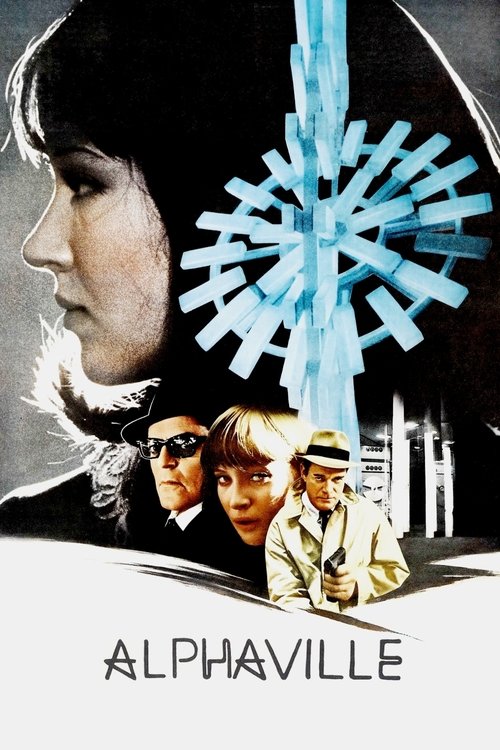
Alphaville
1965 · Jean-Luc Godard
For when you want something genuinely strange — a film to chew on for days rather than an easy ride. Best late at night, when its glowing corridors and whispering computer voice can get under your skin.
What it's about
Trench-coated secret agent Lemmy Caution drives into Alphaville, a city on another world run by Alpha 60, a computer that has outlawed love, poetry, and any word it can't define. His mission: find and eliminate the machine's creator. His complication: the scientist's daughter Natasha, who has never heard the word 'love' and wants to know what it means.
The experience
Disorienting and hypnotic — a pulp detective story played dead straight inside a nightmare of pure logic, all shot in stark nighttime black and white. It's cool to the touch, occasionally funny, and strangely romantic underneath the ice.
Performances
Eddie Constantine, a B-movie tough guy for years, brings a weathered, granite deadpan that the film turns into poetry; Anna Karina is haunting as Natasha, a woman relearning feeling word by word.
The craft
Godard built a dystopian future with no sets and no effects — just real 1960s Paris office towers, hotels, and neon shot at night, so the future turns out to be the present seen coldly. The high-contrast black-and-white photography and the computer's croaking narration create total atmosphere out of almost nothing.
Why it matters
Winner of the Golden Bear at Berlin in 1965, it proved science fiction needs ideas, not budgets, and its found-reality vision of a dehumanized city echoes through decades of dystopian film since.
Snapshot
Godard's most sustained genre exercise and one of the Nouvelle Vague's strangest achievements, Alphaville, une étrange aventure de Lemmy Caution smuggles a fully-formed dystopian science-fiction narrative into the real streets of mid-1960s Paris without a single constructed set. Shot in black-and-white in a matter of weeks, it plants pulp detective Lemmy Caution—already a familiar screen figure from a run of cheap French B-movies—inside a totalitarian future city governed by a computer called Alpha 60, which has banned poetry, love, and any word that cannot be logically defined. The film won the Golden Bear at the 1965 Berlin International Film Festival, cementing Godard's international standing while disorienting audiences who expected something closer to conventional genre entertainment. Fifty years on, it reads as one of cinema's most economical dystopias: the future costs nothing, because the present, correctly photographed, is already alien enough.
Industry & production
Alphaville was produced by André Michelin for the Paris-based companies Chaumiane and Filmstudio, on a budget consistent with Godard's habit of aggressive financial parsimony. The production's central conceit—that the cold, fluorescent modernity of Paris's corporate lobbies, parking structures, and hotel corridors required no augmentation to pass as a totalitarian capital of the future—was both an aesthetic manifesto and a practical solution to limited funds. The film belongs to a dense creative period for Godard: it followed Une femme mariée (1964) and Pierrot le fou would come the same year, confirming his mid-decade pace of roughly two features annually.
Eddie Constantine, cast as Lemmy Caution, was not a Nouvelle Vague figure by background. The American-born actor had spent the 1950s and early 1960s making a string of French-produced Lemmy Caution adventures—among them Lemmy pour les dames (1962) and À toi de faire, mignonne (1963)—based on the hardboiled British crime novels of Peter Cheyney. By casting Constantine, Godard appropriated a ready-made generic identity and the audience's accumulated familiarity with that identity, using the character's established toughness as found material rather than construction. Howard Vernon, a frequent presence in European genre films, played Professor Leonard Nosferatu, alias von Braun—a name that collapses Nazi rocket science into Gothic horror in a single gesture. Akim Tamiroff appeared as the broken Outlands agent Henri Dickson, a figure consumed by the city he was meant to infiltrate.
Technology
Alpha 60, the city's ruling intelligence, speaks throughout the film in a distinctive raspy, toneless monotone. The voice was produced using an electrolarynx—a device pressed against the throat of someone who has undergone laryngectomy, generating speech through mechanical vibration of the air column rather than the natural vocal cords. Godard's use of this medically-associated prosthetic gave the computer a voice that is identifiably human in origin yet profoundly dehumanized: neither robotic in the synthesized-electronic sense nor natural. The result is more unsettling than any synthesized effect available at the time could have achieved. The specific individual who provided the voice has not been definitively established in the public record.
The location photography of Paris's then-new corporate architecture—the lobby of what was then the EDF (Électricité de France) building features prominently, as do the interiors of the Hotel La Louisiane—turned post-war modernist construction into the visible fabric of a future city. No location was built or dressed to evoke futurity; Godard and Coutard simply framed what was already there.
Technique
Cinematography
Raoul Coutard, Godard's primary cinematographer across the most productive stretch of his career (from À bout de souffle in 1960 through the mid-1960s), shot Alphaville on high-speed black-and-white film stock, working largely with available light. The practical fluorescent tubes, bare incandescent bulbs, and glaring overhead fixtures of institutional interiors became the film's actual light sources, generating hard shadows, blown-out whites, and faces that emerge from near-total darkness. This approach—Coutard had developed it through necessity and refined it into a style—strips the image of any warmth. The black-and-white palette is less nostalgic than clinical, less film-noir romantic than lab-cold. Coutard uses wide-angle lenses that compress familiar spatial logic, making corridors longer, rooms more vertiginous, and the human figure smaller relative to its institutional surroundings. The visual grammar enacts the film's argument: the modern built environment, accurately rendered, already dehumanizes.
Editing
The film was edited by Agnès Guillemot, one of the key figures in the practical construction of Godard's work during the 1960s. The editing employs the jump cuts and elliptical compressions associated with Nouvelle Vague practice, but Alphaville also uses flash frames—single or near-single frames of blinding white light—to punctuate transitions and create a subliminal, strobing unease. The rhythm oscillates between deadpan, unhurried dialogue passages and sudden, disorienting compressions. The film refuses the propulsive momentum of the genre templates it borrows; scenes arrive and end according to logic that feels as arbitrary as it feels inevitable, which is part of the point.
Mise-en-scène / staging
Godard's staging is characteristically Brechtian in its refusal to smooth the seams of performance into naturalistic illusion. Characters address the camera, or speak in registers that do not quite cohere with their surrounding action. The execution scene, set at a swimming pool where condemned prisoners are shot and then retrieved from the water by synchronized swimmers performing a balletic recovery, is the film's most sustained and disturbing formal set piece: the staging aestheticizes murder as institutional spectacle, without ironic distancing sufficient to make it comfortable.
The film's geography is deliberately unstable. We understand Alphaville as a city, but the consistent reuse of a handful of actual locations makes it feel more like a labyrinth with a small number of connected rooms—a spatial constraint that, rather than damaging the fiction, deepens the sense of a closed, circular world.
Sound
Paul Misraki composed the score, drawing on jazz idioms and at moments producing something close to romantic lyricism. The contrast between Misraki's warm, relatively conventional musical language and the film's cold imagery generates a persistent ironic friction that is central to Alphaville's tone. Godard also incorporates extensive voice-over: Alpha 60's philosophical monologues, delivered in that electrolarynx rasp, advance a kind of anti-humanist theodicy, rationalizing the elimination of emotion through the vocabulary of systems theory and pure logic.
The poetry of Paul Éluard is spoken aloud within the diegesis, functioning as Lemmy's weapon. Passages from Éluard's Capitale de la douleur (1926)—a Surrealist collection whose title translates as "Capital of Pain"—are deployed against Alpha 60 as paradoxes the computer cannot resolve. Language that is irreducibly affective, that means something other than what it logically denotes, is what the machine cannot incorporate. Godard's sound design thus makes the audible materiality of poetry a plot device.
Performance
Constantine performs Lemmy Caution with studied impassivity, a deadpan that reads differently in Alphaville than in his earlier B-films because Godard makes the blankness philosophically loaded rather than simply tough. The character's immunity to Alpha 60's conditioning is not shown as emotional richness but as a kind of resistant opacity—he doesn't feel less, but he performs feeling as indifference, which the computer misreads. Anna Karina, who was Godard's wife during this period and his most significant performing collaborator of the decade, plays Natacha von Braun as someone gradually recovering a capacity for non-logical experience. Her performance is warmer, more vulnerable, and more legible than Constantine's, and the arc of her character—from Alpha 60's conditioned subject to someone capable of saying "je t'aime"—is where the film's emotional argument finally lands.
Narrative & dramatic mode
The narrative is built on a deliberate collision of generic registers: the hardboiled detective procedural (Lemmy Caution arrives in a hostile city with a mission, works contacts, is surveilled and threatened) and the dystopian science-fiction novel (a totalitarian society maintained by a sovereign machine, citizens conditioned to forget what the state has forbidden). Neither genre is satirized or subverted so much as inhabited simultaneously. Godard is interested in what the two modes share—both are fundamentally about individuals moving through environments that conceal lethal information—and in the way their vocabularies produce mutual estrangement when mixed.
The film's dramatic mode is declarative rather than psychologically exploratory. Characters announce positions, recite poetry, expound on the nature of consciousness. This is recognizably Godardian (and recognizably Brechtian), but it also fits the material: in a city where thought is administered, speech has become a form of ideology rather than expression, and dialogue that sounds like ideological statement rather than naturalistic talk is formally appropriate.
Genre & cycle
Alphaville belongs to a cycle of mid-1960s European art-cinema science fiction that approached the genre through literary dystopia rather than technological spectacle—Fahrenheit 451 (Truffaut, 1966) and, at a certain distance, Resnais's work are adjacent. It also participates in the French tradition of the polar—the tough crime film—through the Lemmy Caution franchise it cannibalizes. The combination proved generative: Godard demonstrated that science-fiction world-building did not require sets or special effects, only a willingness to read the present as already science-fictional.
Authorship & method
By 1965 Godard had developed a working method based on speed, improvisation within a pre-established conceptual frame, and the deliberate contamination of genre material with philosophical and literary content. His scripts were functional rather than complete—actors received pages on the day of shooting, and dialogue was subject to revision or replacement. This approach depended heavily on collaborators capable of rapid, high-quality work: Coutard's ability to achieve results under available light and on minimal preparation time was structurally necessary to Godard's method, not incidental to it.
Paul Misraki's score was composed with some independence from the editing; Godard's use of music characteristically involves juxtaposition rather than underscoring, and Misraki's warm jazz cues were applied against rather than with the imagery. Agnès Guillemot's editing translated the loose material of Godard's shooting style into a coherent, if elliptical, experience, a function she performed on multiple Godard films during the decade. Anna Karina's presence across numerous Godard films of this period (from Vivre sa vie in 1962 through Pierrot le fou) means she should be understood not simply as a cast member but as a creative element of this phase of his work, though the specific creative dynamics of their collaboration are difficult to reconstruct from the public record.
Movement / national cinema
Alphaville is a Nouvelle Vague film in the technical sense of being made by one of its founders, in the mid-1960s, using the low-budget, location-based, auteur-centered practices the movement institutionalized. But by 1965 Godard's work was increasingly diverging from the more humanist, less ideological branch of the movement associated with Truffaut and Rohmer. The film's explicit engagement with totalitarianism, its use of a political allegory that implicates both Fascism (the references to Nosferatu, von Braun, and the iconography of the Third Reich) and Cold War technocracy, marks it as an early indicator of the political radicalization that would culminate in Godard's Dziga Vertov Group work after 1968.
Era / period
The mid-1960s context is essential to the film's resonance. France was still processing its own recent experience of occupation, collaboration, and resistance, and Alphaville's imagery—citizens denounced, an intellectual class eliminated, forbidden words excised from a continuously revised dictionary that serves as the city's only Bible—invited that reading even while pointing simultaneously at Cold War technocracy and the dehumanizing logic of advanced consumer capitalism. The student movements that would explode in May 1968 were building; Godard's political sympathies were visibly sharpening. Alphaville sits at the hinge point of this trajectory, legible as both a relatively playful genre exercise and an early work of political cinema.
Themes
The film's central argument concerns the relationship between language and freedom. Alpha 60 governs Alphaville by controlling its vocabulary: words for emotion, for love, for conscience, are removed from the dictionary and their users executed. The Éluard poetry Lemmy deploys is not decorative but functional—poetic language, by definition, means something other than what it literally says, and is therefore outside the scope of a purely logical system. The film is, in this sense, a defense of the specifically literary against the administrative and the technical.
Alongside this is a sustained engagement with the question of what constitutes the human under systems that attempt its reduction. Natacha von Braun's arc—her recovery of the capacity for love—is treated not as sentiment but as an epistemological event: she learns to know something that cannot be computed. Lemmy's resistance to conditioning reads less as heroic individualism than as the persistence of a prior cultural formation (the hardboiled detective's loyalty to his own code) that happens to be incompatible with Alpha 60's system.
The film also operates as Cold War allegory from both directions simultaneously: the rationalist totalitarianism of Alpha 60 can be read as a critique of both Soviet-style state socialism and Western technocratic liberalism. Neither superpower ideology escapes the satire. The name "von Braun" tethers this to actual history: Wernher von Braun, the Nazi rocket scientist whose skills were recruited by both superpowers after 1945, whose passage from the V-2 to the Apollo program embodied a moral indifference to political context that Godard found representative.
Reception, canon & influence
Backward: influences on the film. The most direct precursor is Jean Cocteau's Orphic trilogy, particularly Orphée (1950) and Le Testament d'Orphée (1960): the journey of the protagonist into an underworld governed by alien logic, the figure of the mediating woman, and the use of ordinary locations transformed by framing into mythic space are all present in Alphaville. Fritz Lang's Metropolis (1927) provides the archetypal template of the city-machine and the scientist-creator whose daughter is implicated in rebellion. The Lemmy Caution cycle of B-films, and behind them Peter Cheyney's novels, supplied the generic DNA of the detective protagonist. The literary dystopias of Orwell and Huxley are legible in the background, as is the fiction of Borges—whose obsession with labyrinths, infinite libraries, and language that generates rather than describes reality finds a direct echo in the dictionary-as-Bible and in Alpha 60's philosophical monologues.
Reception. The film won the Golden Bear at Berlin in 1965, receiving strong critical recognition from the international festival circuit. Domestic commercial reception was mixed, consistent with the response to Godard's more experimental work throughout the decade. Critical opinion in France positioned it within the ongoing project of the Nouvelle Vague while noting its political dimension; Anglo-American criticism engaged with it largely through the lens of art-cinema appreciation. It was not a mainstream science-fiction hit in any market, nor was it designed to be.
Forward: the film's legacy. Alphaville's most significant contribution to film history may be methodological: it demonstrated that science-fiction world-building could be achieved without production design, using the estrangement of the contemporary real. George Lucas's THX 1138 (1971) draws on this model for its use of actual institutional spaces—tunnels, plazas, brutalist architecture—as the surfaces of a future society. Terry Gilliam's Brazil (1985) shares with Alphaville both the bureaucratic-totalitarian premise and the use of retrofuturist aesthetic incongruity. Ridley Scott's Blade Runner (1982), while more lavishly designed, inherits the neo-noir detective-in-dystopia structure and the central question of what distinguishes the human from the constructed.
The film's influence on European art cinema is harder to document with precision but is evident in the willingness of subsequent filmmakers—Wenders, Tati in his later work, Akerman in certain registers—to treat the contemporary built environment as already requiring no embellishment to function as alienated future space. Its specific combination of political critique, genre form, and philosophical content also established a template for what might be called the political genre film, a mode in which genre conventions are neither satirized nor abandoned but treated as a vehicle for ideological argument.
A Deleuzian reading
Start with the pool.
The full Deleuzian reading of Alphaville →
Reception
It won the Golden Bear at Berlin in 1965 but still split audiences, who couldn't decide if a sci-fi film with no sets was visionary or a prank; sixty years on it's canon, the founding document of lo-fi dystopia that every no-budget sci-fi film gets compared to.
How Alphaville was received, from release to now →
Influences: the films it descends from and the films it influenced
- À bout de souffle (1960) — Coutard's available-light formula — high-speed stock, ambient fluorescent and practical fixtures as sole light sources, wide-angle compression of interior corridors — debuted here and was carried unchanged into Alphaville, where the identical grammar shifts register from stylish to clinical.
- Pickpocket (1959) — Bresson's practice of directing non-professional 'models' to suppress emotional expression — delivering lines as pure phonation without interiority — gave Godard the template for Alphaville's deadpan-opacity mode: Constantine and Karina perform erasure of feeling as proof that the city has already succeeded.
- Last Year at Marienbad (1961) — Sacha Vierny photographed the Nymphenburg spa's labyrinthine corridors in high-contrast black-and-white to strip temporal anchoring from a real building; Godard and Coutard applied the identical real-location-as-alienated-non-time logic to Paris's EDF lobby and hotel interiors, establishing that modernity needs no augmentation to deny the present.
- La Jetée (1962) — Marker proved that a French dystopian fiction could be assembled entirely from existing locations and documentary stills with a declarative voiceover as primary narrator — no sets, no production design; Alphaville's no-budget-dystopia logic is this principle animated at 24fps and extended into genre.
- Vivre sa vie (1962) — Established Anna Karina's screen presence as a Godardian instrument of deadpan opacity — a face that encodes interior life the camera refuses to confirm — and pioneered the written-chapter declarative structure (twelve tableaux with headings) that Alphaville inherits wholesale as its narrative architecture.
- À toi de faire, mignonne (1963) — One of the B-series Lemmy Caution adventures that pre-sold Eddie Constantine's hardboiled American-in-France persona as a generic identity requiring no construction; Godard appropriated not just the actor but the character's accumulated cultural shorthand — casting as found material rather than casting as performance.
- Metropolis (1927) — Godard and cinematographer Raoul Coutard photograph existing Paris brutalist architecture in hard high-contrast black-and-white to construct a contemporary dystopia without built sets, directly invoking Metropolis's stratified-city logic while stripping out expressionist décor to reveal the real-world equivalents of Lang's future already embedded in the present.
- The Trial (1962) — Extends Welles's seizure of found modern locations (Paris shot as a dehumanized institutional future) to render bureaucratic dystopia with no built sets, only the alienating real city.
- Kiss Me Deadly (1955) — Casts a trench-coated detective (Lemmy Caution) into a nuclear-dread dystopia, transposing noir's nocturnal grammar onto science fiction exactly as Aldrich fused the PI film with atomic apocalypse.
- 2001: A Space Odyssey (1968) — HAL 9000's eerily intimate, almost-human voice — Douglas Rain instructed to communicate lethal indifference through calm vowels — descends from Alpha 60's electrolarynx: both films discovered that a computer is most disturbing when its voice sounds barely human rather than electronically synthetic, and Kubrick's 1968 HAL follows Godard's 1965 precedent.
- THX 1138 (1971) — Lucas directly replicates the location-as-future strategy — unfinished Bay Area BART tunnels and Lawrence Berkeley Lab facilities dressed as a totalitarian city — and adopts the all-white clinical environment, Bressonian performance suppression, and institutional corridors that compress human figures: Alphaville translated into American student-film terms.
- Punishment Park (1971) — Watkins deploys the declarative-mode political fiction in real Californian desert locations — a pseudo-documentary grammar in which the state apparatus is exposed as pure machinery through Brechtian refusal of narrative smoothing — extending Alphaville's practice of genre as political instrument into the pseudo-newsreel form.
- Blade Runner (1982) — Rick Deckard's Chandleresque hardboiled voiceover — a noir-polar detective narrating a dystopian future in first person — is a direct inheritance of Alphaville's genre-collision: the polar convention imported wholesale into science fiction, the private eye as the reader's guide through the future city. Scott builds elaborate sets where Godard used Paris streets, but the narrative grammar originates here.
- Brazil (1985) — Michael Kamen's score deploys lush romantic orchestration — full strings, nostalgic melody — against bureaucratic horror and state torture, inheriting Alphaville's ironic-jazz-score device: music whose warmth is in structural opposition to the coldness of what it accompanies, so that the irony itself becomes the critique.
- Safe (1995) — Haynes adopts the clinical wide-angle cinematography of antiseptic domestic and institutional spaces as evidence of environmental totalitarianism, and Julianne Moore's near-absent affective register — a performance of progressive self-erasure — directly extends Alphaville's deadpan-opacity mode: the body as symptom of a system that has colonized interiority.
- Upstream Color (2013) — Carruth's elliptical editing — withholding psychological causation, compressing years between cuts, presenting action without motivation in a rhythm that feels arbitrary until it feels inevitable — descends from Alphaville's editing logic; Carruth also shoots real industrial locations in available light as alienating environments, never building toward explanation.
- Gattaca (1997) — Godard's foundational decision to shoot contemporary Paris modernist structures — Orly Airport, the Maison de la Radio — as a sci-fi city without constructed sets is the direct methodological precedent for Niccol's use of Frank Lloyd Wright's Marin County Civic Center as built retro-futurism that requires no dressing to read as dystopian technocracy.
- Ghost in the Shell (1995) — Godard renders a contemporary city as science-fictional through camera angle and lighting alone, without production design alteration; his method of embedding essayistic philosophical argument inside a noir investigative structure is the direct formal template for GitS's hybrid genre form.
- Fallen Angels (1995) — Raoul Coutard's available-light cinematography treating a modern city's artificial illumination as alienating noir landscape is the formal template for Doyle's use of Kowloon neon as simultaneous light source and psychological register, rather than supplementary set dressing.
- The City of Lost Children (1995) — Shooting a science-fiction dystopia entirely in real urban/industrial locations re-dressed as the future, achieving retro-futurism through atmosphere and shadow rather than effects — a French antecedent to the foggy-port world here.
- Code 46 (2003) — Photographs contemporary Paris as a future dystopia with no built sets and fronts it with a noir investigator-protagonist — the exact 'shoot the present as the already-arrived future' + detective-hero strategy Code 46 reuses.
- Fahrenheit 451 (1966) — Truffaut, working in the same Nouvelle Vague context, used British New Towns (Roehampton, Cité Radieuse echoes) as ready-made dystopian futures requiring zero set construction — an independent arrival at Godard's identical location-as-future strategy applied to Bradbury, in the same 1965–66 production window.
- Playtime (1967) — Tati took the wide-angle available-light rendering of Paris's new glass-and-steel modernism to its logical conclusion — human figures dissolved into reflective institutional surfaces, the city as pure self-referential geometry — extending in comic register the visual argument Alphaville's Coutard grammar had already made in thriller register.
- Solaris (1972) — Godard constructs science fiction without production design by reframing unmodified contemporary locations as futuristic space through camera angle and editing — the formal sibling strategy to Tarkovsky's space station built from accumulated physical detail rather than optical effects, both refusing spectacular SF illusion in favor of defamiliarized realism.
- Band of Outsiders (1964) — Coutard photographs contemporary Parisian hotels and offices as noir-generic dystopian space using available light alone — the identical approach to treating real French locations as vessels for borrowed American genre mythology that defines Band of Outsiders' Paris.
- 1984 (1956) — Godard builds a surveillance dystopia from present-day locations and an omnipresent controlling voice/apparatus, sharing the technique of realizing an all-seeing state through ambient watching rather than future production design.
Similar films
- Vivre Sa Vie (1962) — influence & lineage · often watched together
- Breathless (1960) — influence & lineage
- Blade Runner (1982) — influence & lineage
- 2001: A Space Odyssey (1968) — influence & lineage
- Last Year at Marienbad (1961) — influence & lineage
- La Jetée (1962) — influence & lineage
- Brazil (1985) — influence & lineage
- THX 1138 (1971) — influence & lineage
All the films related to Alphaville →