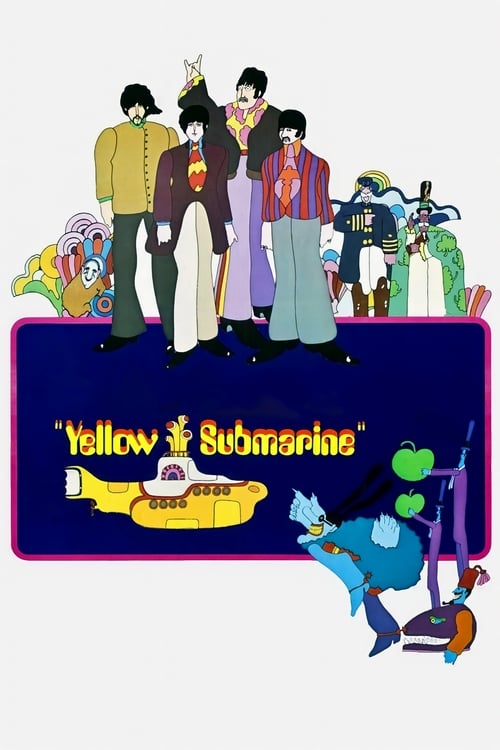
Yellow Submarine
1968 · George Dunning
For when you want pure visual delight and good vibes — a trippy, feel-good pick for a mellow night, a family watch, or any time you need color and music poured directly into your brain.
What it's about
The music-loving realm of Pepperland is conquered by the Blue Meanies, who drain it of color, sound, and joy. The lone escapee, old Admiral Fred, pilots a yellow submarine to Liverpool and recruits the Beatles, who journey back through strange seas — of time, of holes, of monsters — to sing Pepperland back to life. The slim quest plot is really a hanger for ten Beatles songs and a nonstop cascade of psychedelic imagery.
The experience
A candy-colored hallucination with a wink — playful, surreal, and gently absurd, drifting from gag to gag and song to song. It's less a story you follow than a mood you float through, and it's impossible to come out of it grumpy.
The craft
Heinz Edelmann's designs turn every frame into pop-art — an anthology of psychedelic styles unlike anything else in animation before or since, set to some of the Beatles' most inventive music. It absolutely rewards a big screen and good speakers: the 'Lucy in the Sky' and 'Eleanor Rigby' sequences alone are a gallery show in motion.
Why it matters
It made the case, at a moment when animation meant kids' fare, that the form could be sophisticated adult graphic art — becoming a defining visual document of 1960s psychedelia and an influence on generations of animators and designers.
Snapshot
Yellow Submarine is a feature-length animated fantasy built around ten Beatles songs, in which the peaceable, music-loving realm of Pepperland is invaded by the music-hating Blue Meanies. Old Fred, the region's Lord Admiral, escapes in a yellow submarine to Liverpool, recruits the four Beatles, and returns to restore color, sound, and love to a drained world. Produced in London by TVC (TV Cartoons) for King Features Syndicate, the film is remembered less for its slender quest narrative than for its extraordinary visual design—an anthology of pop-art and psychedelic idioms marshaled by German graphic designer Heinz Edelmann. It arrived at a moment when animation, particularly in the English-language commercial sphere, was assumed to be children's fare, and it made a durable case for the form as a vehicle for adult graphic experiment. Its reputation has only grown: it is now routinely cited as a landmark in the crossover between graphic design, popular music, and the moving image.
Industry & production
The film's institutional roots lie in the American television business. King Features Syndicate had produced The Beatles, a Saturday-morning cartoon series (1965–1967), under producer Al Brodax; Brodax then leveraged the group's contractual obligation to United Artists—which owed a further picture—into a feature. Crucially, the Beatles themselves were largely disengaged from the project, initially regarding the TV cartoons with disdain, and did not lend their own voices to their animated counterparts. Their obligation was principally to supply songs, including a quota of new compositions.
Production was executed by George Dunning's studio, TVC London, on a demanding schedule of roughly eleven months and with a large crew—dozens of animators and well over a hundred artists and technicians in total—working at speed and under budgetary pressure. This industrial reality shaped the aesthetic: because there was neither time nor money for the lush full animation of a Disney feature, the production leaned into flat, graphic, design-forward solutions, limited animation, held cels, and photographic and optical sequences that substituted ingenuity for drawn frames. The result is a film whose "look" is inseparable from its production constraints.
The Beatles' relationship to the finished work is a well-documented turn: reportedly skeptical beforehand, they were pleased enough by the result to agree to a brief live-action epilogue in which they appear as themselves. The film opened in the United Kingdom in July 1968 and in the United States that November.
Technology
Yellow Submarine is fundamentally a traditional hand-drawn cel-animation production, but its distinction lies in how freely it combined that base with other image technologies. Sequences were built not only from painted cels over backgrounds but from photographic collage, cut-out and montage imagery, tinted and manipulated live-action, and optical-printer effects. Rotoscoping—tracing animation from filmed live-action reference—was used selectively, most famously in the "Lucy in the Sky with Diamonds" passage, where dancing figures move with an uncanny, filmed-in-life fluidity against abstract fields.
The "Eleanor Rigby" sequence integrates photographic imagery of Liverpool, treating documentary reality as one more graphic layer. Charlie Jenkins is generally credited with the film's special photographic and optical sequences, which pushed the production beyond conventional cel work. What is notable technologically is less any single invention than the promiscuous mixing of techniques within one feature—an approach that treated the animation camera and optical bench as tools for graphic design rather than for naturalistic movement.
Technique
Cinematography
As a fully animated film, Yellow Submarine has no cinematographer in the live-action sense, and it would be a mistake to describe it with that vocabulary. Its "camera" is the animation stand and the optical printer, and its visual grammar is governed by graphic composition rather than lens choice. That said, the film is highly conscious of framing and of the flat picture plane: it favors bold, poster-like compositions, frequently withholds conventional depth in favor of layered color fields, and stages "camera movement" through scaling and sliding of graphic elements. Where an illusion of space is wanted—as in the submarine's passage through the various "seas"—it is generated by graphic recession and repetition (the Sea of Holes, the Sea of Monsters) rather than by photographic perspective.
Editing
The film's editing logic is essentially musical. Its structure is a string of song sequences hung on a quest, and cutting is keyed to the rhythm and mood of each track. Within numbers, the film moves associatively—image ideas succeed one another by graphic rhyme or comic non sequitur rather than by continuity. This is one reason the film reads as a proto–music-video anthology: each song becomes a self-contained edited unit with its own visual world. The available production record is thinner on the specific editorial personnel than on the design team, and I will not attribute the cutting to a named editor I cannot confirm; what is clear is that the assembly subordinates narrative continuity to musical and graphic pacing.
Mise-en-scène / staging
Staging is where the film's ambition concentrates. Each song sequence is realized in a distinct visual style—Op-art checkerboards, Art Nouveau curvilinear forms, Victorian collage, typographic play (the numerals of "When I'm Sixty-Four"), hard-edged geometric abstraction. Pepperland is staged as an idyll of saturated color and flowering form; its violation by the Blue Meanies is staged as a literal draining—color leached to gray, figures frozen, music silenced. The film's spaces are conceptual rather than geographic: the "seas" the submarine traverses are pun-worlds (Time, Science, Monsters, Nothing, Holes) whose staging externalizes states of mind and language games. This makes the mise-en-scène the film's real dramaturgy—meaning is carried by design transformation more than by plot.
Sound
Sound is the film's subject as well as its medium: the Meanies' war is a war against music, and the Beatles' counterattack is literally the deployment of songs. The soundtrack draws on both older and newly recorded Beatles material—among them the title song, "Eleanor Rigby," "Lucy in the Sky with Diamonds," "When I'm Sixty-Four," "Nowhere Man," "All Together Now," "All You Need Is Love," "Only a Northern Song," "Hey Bulldog," and "It's All Too Much." George Martin composed and conducted the orchestral underscore that bridges the songs. The dialogue track is dense with English wordplay and Liverpudlian wit; the Beatle characters are voiced by actors—among them John Clive, Geoffrey Hughes, and Paul Angelis (who also voiced the Chief Blue Meanie)—not the group themselves, and the vocal performances lean toward affectionate caricature of the band's public personae.
Performance
"Performance" here is a matter of voice and of drawn character. The animated Beatles are broad, benign types—laconic, punning, unflappable—rather than psychologically rounded figures, and the voice cast plays them as such. The richest performances are arguably the villains and the eccentrics: the Chief Blue Meanie as a petulant tyrant, and Jeremy Hillary Boob, Ph.D. (the "Nowhere Man"), as a comic figure of frantic, useless erudition. The film's comedy of performance is verbal and gestural, a music-hall register transposed into graphic bodies.
Narrative & dramatic mode
Dramatically, Yellow Submarine is a fable or quest-romance in the simplest key: a paradise lost to joyless tyrants and regained by the arrival of heroes bearing music and love. This armature is deliberately thin, a clothesline for set pieces. The dominant mode is the revue or anthology, closer to a suite of illustrated songs than to a plotted feature; its pleasures are episodic, associative, and pun-driven rather than causal. The Manichaean opposition—color/greyness, music/silence, love/malice—gives the film a fairy-tale clarity that lets the design carry the emotional weight. The reconciliation is characteristically utopian: even the Meanies are, in the end, invited to join in rather than destroyed, in keeping with the picture's flower-power ethos.
Genre & cycle
The film sits at the intersection of the animated feature, the pop musical, and the psychedelic art film. It belongs to the brief late-1960s cycle in which counterculture aesthetics—pop art, Op art, psychedelia—crossed into mainstream media, and it is arguably the most fully realized animated instance of that moment. As a Beatles picture it stands apart from the group's live-action films (A Hard Day's Night, Help!): where those are vehicles for the band's own presence, Yellow Submarine converts them into graphic icons, part of the era's traffic in the Beatles as visual brand. It also belongs, historically, to the lineage of the feature-length musical animation, but it pointedly refuses the naturalistic house style then associated with that lineage.
Authorship & method
Authorship of Yellow Submarine is genuinely distributed, which is part of its interest. George Dunning, the Canadian-born director who headed TVC London, oversaw the production and is the film's directorial author of record; his studio's willingness to treat animation as open-ended graphic experiment set the terms. But the film's decisive creative signature belongs to Heinz Edelmann, the German illustrator and art director whose designs for the characters and the successive song-worlds define what audiences remember; the picture is, in a real sense, an Edelmann portfolio in motion. Production was managed by Al Brodax of King Features, whose deal-making brought the film into being. Animation direction fell to figures including Robert Balser and Jack Stokes, coordinating the large drawing team, while Charlie Jenkins handled the photographic and optical special sequences.
The screenplay is credited to several hands—Lee Minoff (from whose story, drawn out of the title song, the project grew), Al Brodax, Jack Mendelsohn, and Erich Segal (later famous as the author of Love Story). It is well documented that the Liverpool poet Roger McGough contributed to the dialogue's regional flavor, sharpening its Scouse wit, though the exact scope of that contribution is not always precisely credited. On the music side, George Martin—the Beatles' longtime producer—provided the orchestral score alongside the group's songs. The method, then, was collaborative and design-led: a producer's package, a director's studio culture, and above all an illustrator's vision, executed at speed by a large, largely anonymous crew.
Movement / national cinema
The film is usually classified as British animation, produced in London, and it belongs to a distinctively British graphic-comic sensibility—one that would soon find another outlet in Terry Gilliam's cut-out animations for Monty Python. Yet its authorship is markedly transnational: American money and packaging from King Features, a Canadian director, a German designer, and an international drawing crew. Aesthetically it is best placed within the international pop and psychedelic design movement of the 1960s rather than within any single national school. It is, in that sense, a document of a European-inflected graphic modernism entering mass entertainment through a quintessentially British and quintessentially Liverpudlian pop phenomenon.
Era / period
Yellow Submarine is inseparable from 1967–68, the high-water mark of psychedelia and the counterculture, and specifically from the Sgt. Pepper-era Beatles as agents of a utopian, love-and-color worldview. Its iconography—flowers, kaleidoscopic pattern, Victoriana recycled as camp, the rhetoric of "All You Need Is Love"—is a precise period signature. The film also registers the period's darker shadow only obliquely: the Meanies' gray, joy-hating regime can be read as the counterculture's image of repression and conformity, but the film keeps its politics at the level of fable. As a period piece it is unusually pure, almost a time capsule of a specific eighteen-month cultural mood.
Themes
The film's governing theme is the redemptive power of art—specifically music—against a force that hates joy, color, and imagination. Its oppositions are elemental: creativity versus repression, plenitude versus deprivation, love versus malice. Language itself is a theme; the script delights in puns, nonsense, and wordplay, treating verbal invention as another form of the vitality the Meanies would suppress. There is a gentle utopianism throughout—the belief that even enemies can be won over by song and inclusion rather than defeated by force. And, self-reflexively, the film is about seeing: it stages a world in which perception can be drained or restored, making the act of imaginative vision its central value.
Reception, canon & influence
Contemporary reception was broadly warm, and the film was quickly taken more seriously than the Saturday-morning cartoon origins might have predicted; it was widely credited with demonstrating that commercial animation could be a serious graphic art form aimed beyond children. Its canonical standing has risen steadily, and it is now firmly established as a landmark of animation and of 1960s design.
Looking backward, the film synthesizes influences from pop art and Op art, Art Nouveau, Victorian illustration and collage, Surrealist juxtaposition, and the broader psychedelic poster aesthetic of its moment—Edelmann's designs are the channel through which these currents enter the film. Looking forward, its legacy is substantial. It is frequently cited as a forerunner of the music video, having modeled the song-as-visual-world unit years before MTV; its anything-goes graphic experimentation and its licensing of non-naturalistic animation to adult audiences influenced later animators, and its comic collage sensibility is often linked to Terry Gilliam's subsequent work. The film was restored and re-released around 1999, an occasion that reintroduced sequences (including "Hey Bulldog") that had been cut from some earlier prints and that reaffirmed its place in the canon. Where precise contemporary box-office and detailed personnel records are thin, the safest summary is qualitative: the film's influence is measured less in receipts than in the visual vocabulary it helped make available to popular culture.
A Deleuzian reading
The Meanies come over the hill and the colour runs out of Pepperland like water out of a tub.
The full Deleuzian reading of Yellow Submarine →
Reception
In 1968 it was praised as proof animation could be hip and adult, even as the Beatles themselves treated it as a contractual chore — they only warmed to it after seeing the finished film. Now it's canonized as the landmark of psychedelic animation and a gateway film generations of kids were raised on.
How Yellow Submarine was received, from release to now →
How to watch Yellow Submarine: what to notice on a first viewing
- Watch the color drain out of Pepperland at the start. Flowers, faces, and buildings turn gray under the Meanies, with no other sign of loss in the story itself. The grayness is not a symbol of the loss, it is the loss itself.
- Notice that each song looks like a different art style. The film shifts between Op-art checkerboards, Art Nouveau curves, Victorian collage, and blocky typography, a new visual world for nearly every number. The design does the storytelling; each look tells you something the thin plot never explains.
- Look at how flat and poster-like each composition is. The film avoids photographic depth, favoring layered color fields and bold graphic shapes over any illusion of three-dimensional space. Space here is built out of design, not out of anything resembling a camera's view of a place.
- Listen for the wordplay and puns running through every line. The dialogue is dense with Liverpudlian wit and nonsense language, treating verbal invention as its own form of energy alongside the songs. Language becomes another kind of music the film refuses to let the Meanies silence.
- Notice that the submarine's seas are not really places. The Sea of Holes, the Sea of Nothing, and the others are built from graphic recession and repetition rather than any mappable geography. These are less locations than pure states of feeling the submarine simply passes through.
The whole guide to watching Yellow Submarine, with the keys for a rewatch →
Influences: the films it descends from and the films it influenced
- Fantasia (1940) — Established the song-as-visual-world unit — each self-contained musical number generating its own animated universe with no connective narrative — the exact structural template Yellow Submarine applies to Beatles tracks.
- Dumbo (1941) — The 'Pink Elephants on Parade' sequence pioneered non-naturalistic, freely morphing dream imagery decoupled from physical logic and driven by the music, a direct precursor to the film's psychedelic song interludes.
- Gerald McBoing-Boing (1950) — UPA's flat, graphic-modernist limited animation — abstract color fields, minimal in-betweening, illustration-first staging — is the design idiom Edelmann and the TVC team scaled up to feature length.
- Begone Dull Care (1949) — McLaren's abstract imagery synchronized shot-for-beat to music at the NFB, where Dunning trained and worked, models the music-driven visual montage logic Dunning carried into TVC London.
- Sleeping Beauty (1959) — Eyvind Earle's flattened, tapestry-like, graphically stylized backgrounds pushed feature animation toward design-as-subject, prefiguring Edelmann's treatment of each environment as a poster-like graphic world.
- Gulliver's Travels (1939) — The Fleischer studio's rotoscoping of live figures into animation is the same optical technique used for the traced human-motion passages (notably the 'Lucy in the Sky with Diamonds' sequence).
- 1001 Arabian Nights (1959) — An early feature built entirely on UPA-style limited animation, proving flat graphic economy could sustain a full-length picture — the production economics and aesthetic Yellow Submarine inherited.
- Alice in Wonderland (1951) — Heinz Edelmann's flat pop-graphic backgrounds and picaresque, song-saturated episode structure — a sequence per number, each in its own color key — extends Alice's model of the animated feature as a chain of design set pieces strung on songs rather than a plot.
- Fritz the Cat (1972) — Capitalized directly on Yellow Submarine's proof that feature animation could be licensed to adult, counterculture audiences rather than children.
- Fantastic Planet (1973) — Extends the illustrator-authored European tradition — a single graphic artist's (Roland Topor) surreal cutout designs driving the whole film — that Yellow Submarine legitimized with Edelmann's portfolio-in-motion.
- Heavy Metal (1981) — Directed by Gerald Potterton, a Yellow Submarine sequence director, it builds a feature from discrete visual-worlds each scored to rock songs — the anthology-of-song-worlds structure taken to adult fantasy.
- Pink Floyd – The Wall (1982) — Gerald Scarfe's animated inserts continue the British tradition of an illustrator-author's graphic vision driving psychedelic, music-synchronized animation for an adult rock audience.
- Take On Me (1985) — Realizes Yellow Submarine's role as forerunner of the music video, using rotoscoped pencil-sketch animation as the song's self-contained visual world exactly as MTV-era clips would standardize.
- Interstella 5555 (2003) — A dialogue-free feature that animates an entire album as a continuous sequence of song-worlds, the purest modern extension of Yellow Submarine's structure of pop tracks as animated environments.
- Interstella 5555: The 5tory of the 5ecret 5tar 5ystem (2003) — The pop band rendered as animated protagonists whose own record supplies the score and episodic structure, pioneering the album-driven animated musical Interstella builds on Discovery.
- Song of the Sea (2014) — Heinz Edelmann's flat pop-graphic design stacks color-field planes as layered 2D cutouts rather than modeling depth, the same graphic-layering logic behind Song of the Sea's staging.
- Night Is Short, Walk On Girl (2017) — Pop-art flat color-field graphics and Heinz Edelmann's poster-illustration design — animation as moving screenprint — is the graphic-design lineage behind Nakamura's poster-flat, outlined-shape aesthetic.
- Spider-Man: Across the Spider-Verse (2023) — Early proof that a single film can weld incompatible visual idioms — pop-art collage, rotoscope, flat graphic cutouts — into one heterogeneous composited space, the principle Spider-Verse pushes to per-character rendering styles.
- KPop Demon Hunters (2025) — The template for commercial-pop integration in animation — building an animated fantasy around a real chart act's songs while swapping modal art styles sequence-by-sequence to match each track's mood.
- When the Wind Blows (1986) — Founded the British TVC feature-animation house style of flat graphic characters set against constructed depth, the graphic-vs-dimensional tension Murakami literalizes as 2D figures on 3D model sets.
- The Beatles (TV series) (1965) — Produced by the same Al Brodax / King Features operation with overlapping crew including Jack Stokes, it established the cartoon Beatles caricatures and song-illustration format the feature elevated.
- Monty Python's Flying Circus (1969) — Gilliam's cutout photographic-collage animation — Victorian engravings and pop imagery juxtaposed with Surrealist absurdity — shares and extends the comic collage sensibility Charlie Jenkins deployed in the film's optical sequences.
- Allegro Non Troppo (1976) — Consciously revives the Fantasia model of discrete music-generated animated worlds, a parallel 1970s pursuit of the same song-as-visual-world craft Yellow Submarine had just modernized.
- Willy Wonka & the Chocolate Factory (1971) — Dunning deploys music-as-primary-cut-structure — editing rhythm determined entirely by the musical phrase, each song triggering a suite of non-narrative imagery — within the same British pop-psychedelia cultural moment, establishing the grammar the tunnel sequence inherits for its incantatory associative-montage architecture divorced from story causation.
Similar films
- Fantastic Planet (1973) — influence & lineage
- Pink Floyd: The Wall (1982) — influence & lineage
- Fantasia (1940) — influence & lineage
- Alice in Wonderland (1951) — shared sensibility
- A Hard Day's Night (1964) — shared sensibility
- Mary Poppins (1964) — shared sensibility
- Captain Underpants: The First Epic Movie (2017) — shared sensibility
- Minions & Monsters (2026) — shared sensibility