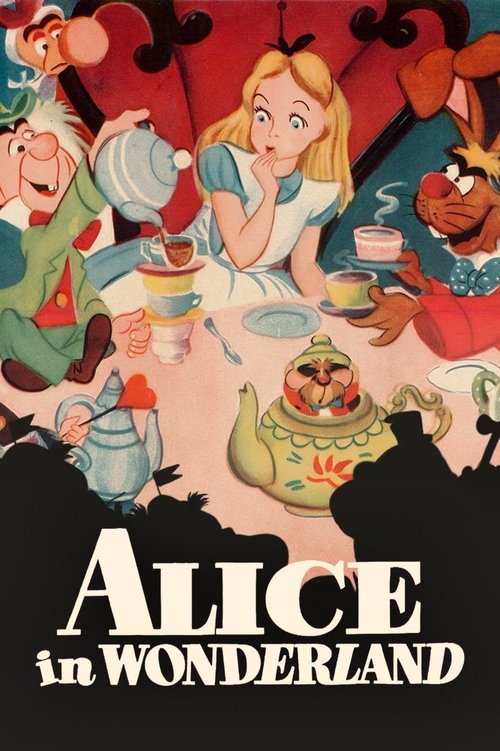
Alice in Wonderland
1951 · Clyde Geronimi
For when you want pure eye-candy strangeness — something short, wild, and unmoored that plays as well on a lazy afternoon as it does late at night when you're in the mood for something weirder than it looks.
What it's about
On a drowsy golden afternoon, a curious girl named Alice follows a hurried White Rabbit down a burrow and lands in Wonderland, a world that runs on nonsense. She drifts from one strange encounter to the next — a grinning cat that vanishes at will, a tea party that never ends, a caterpillar full of riddles, and a temperamental Queen whose garden hides real danger. There's no quest, exactly; just a girl trying to keep her head while everything around her refuses to make sense.
The experience
It moves like a dream you can't steer — fast, funny, a little unnerving, each episode dissolving into the next before you've gotten your footing. The colors are so loud and the logic so slippery that it can tip from delightful to genuinely anxious in a heartbeat.
The craft
Built on Mary Blair's flat, aggressively colorful concept art, this is Disney animation at its most visually daring — less storybook warmth, more graphic-design fever dream. The animators work as caricaturists, letting each grotesque or charming figure play in its own register, and the songs tumble past at the speed of the nonsense itself. The saturated palette rewards the biggest, brightest screen you can find.
Why it matters
A flop on release and reportedly a disappointment to Walt Disney himself, it found a huge second life decades later, embraced by audiences who prized exactly the untethered strangeness the studio had considered a failure — and it became one of the most visually influential films Disney ever made.
Snapshot
Disney's thirteenth animated feature is the studio's most formally radical and least emotionally secure film of its classical period — a 75-minute cascade of episodes adapted from Lewis Carroll's Alice's Adventures in Wonderland (1865) and Through the Looking-Glass (1871), built on Mary Blair's flat, chromatically aggressive concept art and animated by a team of the studio's best draughtsmen working largely as caricaturists rather than as builders of sympathy. Released in July 1951 through RKO, it failed commercially in North America and was received coolly in Britain, where Carroll's guardianship was felt most keenly. Walt Disney himself is generally reported to have judged the picture a failure of warmth. It then did something almost no Disney feature of the era did: it acquired a second life outside the studio's control, circulating on 16mm through college film societies in the late 1960s, absorbed into the visual vocabulary of psychedelia, and returned to theaters in 1974 as a hit. The film that Disney could not make audiences love in 1951 became, two decades later, the default global image of Wonderland.
Industry & production
Alice emerged from the longest development history of any Disney feature. Walt Disney's association with the name reaches back to the Alice Comedies (1923–27), the silent shorts that put a live-action girl into a drawn world and effectively founded the studio — a property related to Carroll only by title and conceit. Serious plans for a Carroll adaptation date to the 1930s, when Disney considered a live-action/animation hybrid; the arrival of Paramount's all-star live-action Alice in Wonderland in 1933 helped kill that iteration. Development resumed in the late 1930s, with British artist David Hall producing an extensive body of concept art in a Tenniel-and-Rackham register — spiky, engraved, Victorian — that survives as one of the great unmade Disney films.
The war intervened. Between 1941 and 1949 the studio absorbed a bitter animators' strike, the loss of European markets, government contract work, and a retreat into the low-cost "package features" (Saludos Amigos, Make Mine Music, Melody Time, and their siblings), anthologies of shorts stitched together because full features were unaffordable. Cinderella (1950) restored the single-narrative feature and, with it, the studio's solvency. Alice and Peter Pan (1953) were developed alongside it, with story and animation staff moving between the three.
An unusual detour in this period: Aldous Huxley, then working in Hollywood, was engaged in the mid-1940s to write a treatment. His approach reportedly braided Carroll's own biography with the fiction — a literary, adult conception that Disney rejected as unplayable for the studio's audience. The episode is well attested in the studio's institutional history, though the treatment itself is not widely circulated, and accounts of exactly why it was abandoned rest largely on later recollection.
The finished film was produced by Walt Disney at the Burbank studio, distributed by RKO Radio Pictures, and premiered in London on 26 July 1951, with American release following days later. Budget figures circulating in the literature cluster around $3 million; these are reported rather than documented from studio ledgers, and should be treated as approximate. What is not in doubt is that domestic returns disappointed, and that the picture was quickly withdrawn from active circulation.
Technology
Alice is a hand-made film in the fullest sense: every frame inked and painted onto cellulose acetate by the studio's Ink and Paint department, a decade before xerography (introduced at Disney with 101 Dalmatians, 1961) removed the inker's hand from the line. The film therefore belongs to the last phase of the fully hand-inked feature, in which a painted cel edge is a deliberate graphic decision rather than a photographic residue.
Photography was in Technicolor. For animation, Technicolor's three-color process could be executed by successive exposure — a single strip run three times through filters, feasible only because the subject is static artwork — and printed by the company's dye-transfer imbibition method, which yields the dense, non-fading saturation the film depends on. This matters aesthetically: Blair's palette of hot pinks against cyan, acid greens against violet, would collapse under a less aggressive printing process.
The multiplane crane, Disney's signature depth apparatus since the late 1930s, is used sparingly here, and its scarcity is the point. Where Bambi or Pinocchio mobilize layered planes to produce atmospheric recession, Alice mostly refuses depth in favour of the picture plane. The studio's optical and special-processes department, run by Ub Iwerks after his 1940 return, handled the trickier composites — the shifting scales, the dissolving Cheshire Cat, the bottle-and-key transformations — but the film's effects work is notably restrained by Disney standards, and the fantastical is carried by drawing and color rather than by process.
Technique
Cinematography
There is no cinematographer in the live-action sense; the "camera" is a rostrum stand shooting flat artwork, and the film's visual authorship lies with its art directors and background painters. What the animation camera contributes is a distinctive spatial logic. Large stretches of Alice take place in undefined space — limbo backgrounds, black voids, fields of flat color with no horizon. The fall down the rabbit hole, the corridor of doors, the Tulgey Wood, and the Queen's card-flat court are all staged against grounds that decline to specify where anything is. This is anti-illusionist by the standards of the studio that had spent the previous decade perfecting the illusion of a receding forest. Camera moves are correspondingly few and mostly lateral or scalar: pans across a hedge of talking flowers, pull-backs that reveal Alice's changed size. When the film wants disorientation it does not tilt or track; it changes the size relation between figure and frame.
Editing
Disney animation of this era does not edit in the post-production sense. Cutting is decided at the storyboard and exposure-sheet stage, before a frame is animated, and the credited film editor performs an assembly function rather than authoring rhythm. The decisive editorial intelligence is therefore in the story department, and Alice is where that intelligence shows most strain. The film advances by juxtaposition rather than causality: an episode ends, Alice moves on, a new set of characters arrives. Individual sequences are cut with real precision — the Mad Tea Party accelerates through short takes and overlapping business until it approaches incoherence, which is exactly its subject — but the macro-structure has no accumulating pressure. Nothing that happens at the Caucus Race changes what happens at the tea table.
Mise-en-scène / staging
This is the film's glory and its scandal. Mary Blair's concept work — flat, poster-like, indifferent to modeling, arriving at color emotionally rather than descriptively — was the guiding vision, developed into finished backgrounds by Claude Coats, John Hench, Ken Anderson and their colleagues. The result is the most graphically modern film Disney made before Sleeping Beauty (1959), and it sits in direct conversation with what UPA was doing at exactly this moment (Gerald McBoing-Boing, 1950; Rooty Toot Toot, 1951), often with artists who had passed through Disney. The garden of living flowers, the Queen's heraldic court, the psychedelic bestiary of the Tulgey Wood: these are designed as decorative fields, not as places.
The tension is that Disney's animators still drew in full round — weighted, squashing, dimensionally acting figures — and those figures are set against grounds that deny dimension. Much of the film's peculiar unease comes from this mismatch. Blair's boldest ideas are frequently reported to have been softened in the translation to finished backgrounds, and the finished film is less austere than her gouaches.
Sound
Oliver Wallace's score, nominated for the Academy Award for Scoring of a Musical Picture, works as connective tissue in a film that otherwise lacks it, using a light, high-strung orchestral idiom that mickey-mouses closely to gesture. The song count is famously excessive: fourteen numbers in seventy-five minutes, drawn from a much larger pool written during development — a total commonly given as thirty or more, which is a studio-lore figure rather than a verified count. Sammy Fain and Bob Hilliard supplied the principal songs ("I'm Late," "All in the Golden Afternoon," "Very Good Advice," "Painting the Roses Red"); "The Unbirthday Song" came from Mack David, Al Hoffman and Jerry Livingston; "'Twas Brillig" from Don Raye and Gene de Paul. The sheer density of numbers is itself structural: songs substitute for the dramatic development the episodes cannot supply.
Performance
The voice cast is drawn substantially from American radio and vaudeville, and the film's comic texture is theirs. Ed Wynn's Mad Hatter and Jerry Colonna's March Hare are essentially their stage personae transcribed into drawing; it is often reported that portions of Wynn's performance were lifted from loose rehearsal recordings rather than formal sessions, on the grounds that the ad-libbed takes were funnier. Sterling Holloway's Cheshire Cat is a masterpiece of vocal legato — the voice arrives before the body and lingers after it. Verna Felton's Queen of Hearts supplies the film's only sustained threat. Richard Haydn's Caterpillar, Bill Thompson's White Rabbit and Dodo, and J. Pat O'Malley's Walrus, Carpenter and Tweedles fill out an unusually adult-sounding ensemble.
Against them, Kathryn Beaumont's Alice is deliberately unstylised: a well-mannered English child, sincere and slightly prim. Beaumont, like the adult cast, was filmed in live-action reference footage for the animators — standard Disney practice, expanded in the 1940s. Marc Davis carried the bulk of Alice's animation and gives her genuine grace, but the character was designed to be a straight line to which everyone else is the joke, and the film's central weakness follows from that decision.
Narrative & dramatic mode
Alice is a picaresque without a goal. Its protagonist wants, in the loosest sense, to follow a rabbit; her second-act want — to get home — arrives late and is never dramatized as difficulty, only as fatigue. There is no antagonist until the Queen appears in the final movement, no romance, no mentor, no lesson learned that costs anything. The film's one genuine interior moment is "Very Good Advice," a small self-reproaching aria in which Alice, lost, admits she never takes her own counsel; it is the sequence that most clearly indicates what a psychologically continuous version of this film could have been.
Structurally, the picture is the package-feature era's ghost: a chain of set pieces, each self-contained, each brilliantly executed, adding up to accumulation rather than escalation. That the story team compressed two books — folding Through the Looking-Glass material (Tweedledee and Tweedledum, "The Walrus and the Carpenter," "Jabberwocky") into the Wonderland frame, while cutting the Duchess, the pig-baby, and the Mock Turtle — improved the pacing without solving the shape. Disney's own diagnosis, as generally reported, was that the film had no heart, and that its heroine gave the audience nobody to care about.
Genre & cycle
It belongs to the postwar Disney literary-adaptation cycle bracketed by Cinderella (1950) and Peter Pan (1953) — canonical European children's texts rendered in Technicolor with song scores and comic-relief animal ensembles. Within that cycle Alice is the outlier: the source resists the sentimental machinery, offering no orphan to rescue and no wish to grant. It is also, generically, a nonsense film — a mode with almost no other feature-length exemplars in commercial American cinema — and its closest kin are less the other Disney features than the anarchic cartoon short (Tex Avery's temporal and scalar violations at MGM; Bob Clampett's elastic hysteria at Warner Bros.), scaled to seventy-five minutes.
Authorship & method
Nominally directed by Clyde Geronimi, the film is in fact the product of Disney's tripartite sequence-director system: Geronimi shared direction with Wilfred Jackson and Hamilton Luske, each taking assigned sequences under Walt Disney's supervision, with the producer functioning as final author of story and tone. Below them, the "directing animator" credit gave individual artists effective authorship of characters: Ward Kimball's zanier register governs the Mad Tea Party, the Tweedles and the Cheshire Cat, and his sequences are recognizably a different film from the rest; Frank Thomas animated the Queen of Hearts; Marc Davis, Alice. Milt Kahl, Ollie Johnston, John Lounsbery, Eric Larson, Les Clark and Wolfgang Reitherman — the studio's "Nine Old Men," in effect its authorial college — are distributed across the picture.
The screenplay credit is a story-department roster rather than a writing team in the Hollywood sense, listing more than a dozen names including Winston Hibler, Ted Sears, Bill Peet, Erdman Penner, Joe Rinaldi, Dick Huemer, Milt Banta and William Cottrell. Oliver Wallace scored. The color and design vision belongs to Mary Blair, with backgrounds realized by Claude Coats and colleagues. As noted above, the editing credit does not describe an authorial function here; the cutting was fixed on storyboards.
Movement / national cinema
American studio animation at its industrial peak, made by a vertically integrated Hollywood producer distributing through RKO on the eve of the Paramount consent decrees' full effect. Its style, though, participates in a broader mid-century modernism: Blair's flattening, her poster-derived color (transformed by the Disney artists' 1941 goodwill tour of Latin America and its exposure to non-European chromatic traditions), and the general drift toward graphic abstraction align the film with UPA, with contemporaneous American commercial illustration, and with the design idiom that would define the following decade. The film's British literary source and its English-accented heroine sit uneasily inside this American modernism — a friction that British critics registered immediately as presumption.
Era / period
1951 is the last moment at which a film like this could be made in this way: the studio system intact, television not yet dominant, Technicolor dye-transfer still standard, animation still fully hand-inked. It is also the beginning of Disney's diversification. The studio's first television special, One Hour in Wonderland, aired at Christmas 1950 as promotion for the picture, and Alice would be among the first Disney features broadcast in edited form on the Disneyland series — a strategy that converted the theatrical library into a television asset years before rivals attempted it. Within four years the Disneyland park opened with Alice-derived attractions among its earliest, and the film's characters entered a merchandising and theme-park circulation largely independent of the film's own reputation.
Themes
Carroll's book is about the arbitrariness of adult rule-making experienced from below, and the film keeps this. Every authority Alice meets is either mad, tyrannical, pedantic or absent, and the rules they enforce are unstated until she breaks them: the Caucus Race has no finish, the trial has no evidence, the unbirthday is a bureaucratic joke, the Queen's justice is sentence-first. Language is treated as a hostile system — puns that turn into physical events, instructions that mean their opposite, a Caterpillar who interrogates identity ("Who are you?") as a genuine philosophical problem for a girl whose body will not hold a stable size.
Around that, the film adds a moralizing frame Carroll did not supply. It opens and closes on the riverbank with Alice's sister and a history lesson, and it lets Alice conclude that she has learned to take her own good advice. The Disney version thus converts an anti-didactic book into a mild cautionary tale about curiosity, which is precisely the reading Carroll wrote against — and, arguably, the reason the film's center feels hollow while its edges blaze.
Reception, canon & influence
Reception. The 1951 release underperformed in North America and drew mixed-to-hostile British notices, where the departures from John Tenniel's canonical illustrations and the Americanisation of Carroll's voices were treated as vandalism. Reviews on both sides generally conceded the animation's inventiveness while faulting the film's coldness and its relentless episodic churn. Wallace's Oscar nomination was its only major awards recognition. Disney withdrew it, and for two decades it was the studio's acknowledged problem child.
Influences on it (backward). Carroll and Tenniel first: the Disney designs are departures from Tenniel that presuppose him, and the Hatter's 10/6 hat card is inherited directly. Behind the project sit Disney's own Alice Comedies, the 1903 Hepworth British short and the 1933 Paramount feature, the Silly Symphonies' tradition of animate flora and fauna, and the abandoned David Hall designs whose Victorian gothic the finished film consciously rejects. The comic performance style comes from American radio and vaudeville; the graphic style from poster modernism as filtered through Blair.
Legacy (forward). Three distinct afterlives. First, design: the film is the strongest early argument inside Disney for flat, color-driven stylization, a line that runs to Sleeping Beauty's Eyvind Earle backgrounds and 101 Dalmatians' graphic line, and — through Blair herself — to "it's a small world" (1964) and the look of Disney's theme-park design generally. Second, counterculture: from the late 1960s the film circulated on campuses as a psychedelic text, its hookah-smoking Caterpillar, size-altering consumables and mushroom set pieces read through a lens Carroll's contemporaries would not have recognized and Jefferson Airplane's "White Rabbit" (1967) made explicit; the studio's 1974 theatrical reissue capitalized on this reading, and the picture has been profitable ever since. Third, iconography: for most of the world, Disney's designs — the grinning striped Cheshire Cat, the manic Hatter, the bulbous Queen — have displaced Tenniel as the mental image of Wonderland, a fact against which later adaptations have had to work deliberately. Jan Švankmajer's Alice (1988) is legible as an anti-Disney corrective; American McGee's Alice (2000) as a gothic inversion; Tim Burton's 2010 film, produced by Disney itself, as an attempt to re-plot the material with the causal spine the 1951 version never had.
The historical verdict has largely inverted. What read in 1951 as coldness and formlessness now reads as fidelity to a source that is itself cold and formless, and the film's refusal of dimensional space looks less like a failure of ambition than the boldest design gamble the studio took before 1959.
Reception
A box-office disappointment in 1951 — savaged by British critics for Americanising Carroll, and Walt Disney himself later admitted it lacked heart — it was reborn in the late '60s as a countercultural head-trip, and Disney leaned in with a psychedelia-flavoured 1974 re-release. Now it's widely treasured as one of the studio's strangest, most visually daring features.
How Alice in Wonderland was received, from release to now →
How to watch Alice in Wonderland: what to notice on a first viewing
- Notice how often the background is just flat color. Mary Blair's designs put Alice against black voids and unbroken fields of color instead of a defined room or landscape, especially in the rabbit hole and the corridor of doors. The empty grounds make Wonderland feel like nowhere in particular, which is part of what makes it unsettling.
- Count how many short cuts pile up at the tea party. The Mad Tea Party accelerates through quick shots and overlapping business until the scene edges toward incoherence. The chaos of the cutting is the joke, not a flaw in it.
- Count how many songs play in the first half hour. Fourteen numbers are packed into seventy-five minutes, written by several different songwriting teams, so a new song is never far away. The songs carry the momentum that the episodes alone don't build for you.
- Listen for how theatrical the Mad Hatter's voice sounds. Ed Wynn plays the Hatter like a vaudeville stage act transcribed straight into drawing, and Jerry Colonna's March Hare works the same way. The comedy comes from performers who built these voices for the stage before the film ever existed.
- Watch how Alice's size keeps changing scene to scene. The film shows disorientation by changing how large or small Alice is against the frame rather than moving the camera around her. Her shifting scale is the film's main tool for making you feel off balance.
The whole guide to watching Alice in Wonderland, with the keys for a rewatch →
Influences: the films it descends from and the films it influenced
- Snow White and the Seven Dwarfs (1937) — Established the sequence-director system and the rotoscope-adjacent live-action reference process that Marc Davis used for Alice — Kathryn Beaumont was filmed acting the role in costume on a soundstage, exactly as Marge Champion had been for Snow White, so the human figure carries naturalistic weight against stylized surroundings.
- Flowers and Trees (1932) — The first three-strip Technicolor cartoon; the Silly Symphonies' dye-transfer registration protocol and their convention of animate flora — flowers with faces, singing plants — is imported wholesale into Alice's Garden of Live Flowers sequence.
- The Skeleton Dance (1929) — Codified mickey-mousing — every action synchronized to a musical accent on the exposure sheet — the scoring discipline Oliver Wallace applies relentlessly across Alice's fall, the Caucus Race and the Tulgey Wood.
- Alice's Wonderland (1923) — Disney's own Alice Comedies established the live child navigating a drawn world as a Disney formal problem; the 1951 feature inverts the composite by drawing Alice but keeping her performance photographically referenced, preserving the same figure/ground tension.
- Alice in Wonderland (1933) — The Paramount all-star version's practice of conflating Wonderland and Looking-Glass into one episodic run — importing Tweedledum and Tweedledee and the Walrus and Carpenter from the second book — is the two-book conflation structure Disney adopts.
- The Three Caballeros (1944) — Mary Blair's first full-scale imposition of poster-modernist flat color on a Disney feature — saturated non-naturalistic fields, shapes read as color areas rather than modeled forms — the concept-art authority she carries into Alice's limbo backgrounds.
- Dumbo (1941) — The 'Pink Elephants on Parade' sequence pioneered the limbo background — figures floating in undifferentiated black with no ground plane, no horizon, no perspective cues — the exact device Alice uses for the Cheshire Cat, the Caterpillar and the rabbit-hole descent.
- Fantasia (1940) — Demonstrated the multiplane camera's deep-space capability at its most elaborate; Alice is legible as the deliberate withholding of that apparatus, refusing parallax and atmospheric recession that the studio had already mastered.
- Toot, Whistle, Plunk and Boom (1953) — Kimball pushes Alice's anti-illusionist flatness to its conclusion in CinemaScope — no modeling, no depth, characters as flat graphic shapes on color fields — winning the Oscar that vindicated the design gamble Alice was punished for.
- Sleeping Beauty (1959) — Eyvind Earle's vertical, tapestry-flat backgrounds executed in 70mm Technirama are the direct institutional descendant of Blair's argument in Alice that a Disney feature's backgrounds can be graphic design rather than illustration.
- One Hundred and One Dalmatians (1961) — Ken Anderson's Xerography-enabled visible-line style, where the animator's pencil line survives onto the cel and backgrounds are offset color washes, completes Alice's rejection of hand-inked illusionism by making the drawing itself the finished surface.
- Yellow Submarine (1968) — Heinz Edelmann's flat pop-graphic backgrounds and picaresque, song-saturated episode structure — a sequence per number, each in its own color key — extends Alice's model of the animated feature as a chain of design set pieces strung on songs rather than a plot.
- it's a small world (1964) — Blair's Wonderland palette and cut-paper flatness translated into built dimensional space — the same layered flat shapes and saturated color keys, now as ride architecture, which is how the Alice design language reached its widest audience.
- Alice (1988) — An explicit formal rebuttal built on stop-motion with real taxidermy, sawdust and a live girl in actual rooms — restoring the tactile Victorian object-world and Tenniel's grotesquerie precisely where Disney substituted weightless graphic color.
- Alice in Wonderland (2010) — Disney's own attempt to retrofit a causal three-act spine onto material the 1951 film left picaresque — inventing a prophecy and a Jabberwocky climax to replace the episodic churn that 1951 reviewers attacked and the studio never defended.
- Spirited Away (2001) — Establishes the template of a child falling through a threshold into a rule-bound nonsense realm where survival depends on decoding etiquette and contracts — the exact engine of the bathhouse's naming and labor rules.
- The Boy and the Heron (2023) — The down-the-rabbit-hole vertical descent into a nonsense-logic underworld, the animated-portal-fantasy lineage feeding the film's vertical-descent cinematography and Carrollian tumble into the lower world.
- The Jungle Book (1967) — Episodic-picaresque structure built as a string of encounters, each animated character shaped around a recognizable comic voice (Ed Wynn, Sterling Holloway) — the casting-to-persona method Jungle Book pushes further.
- The Cat Returns (2002) — Fixes the anthropomorphic-court template the Cat Kingdom reproduces almost beat for beat: an arbitrary monarch, ceremonial nonsense standing in for law, a girl physically resized by what she is given to eat, and an episodic chase back toward the exit.
- Der Fuehrer's Face (1943) — Ward Kimball's wartime shorts work — the same zany, elastic, anti-anatomical register and rapid-fire gag cutting — is directly continuous with his directing-animator authorship of the Mad Tea Party, which reads as a Kimball short embedded in someone else's feature.
- Peter Pan (1953) — Made by the same three-director team with Kathryn Beaumont again live-action-referenced as the lead girl, and Marc Davis again the directing animator on her — the identical reference-shoot-to-cel pipeline applied within two years.
- Gerald McBoing-Boing (1950) — UPA's contemporaneous limited-animation program arrives at the same limbo-background, flat-color, graphic-poster solution from outside Disney — the parallel case that makes Alice's flatness legible as period design argument rather than studio failure.
Similar films
- Alice in Wonderland (2010) — influence & lineage
- Alice (1988) — influence & lineage
- Yellow Submarine (1968) — influence & lineage
- One Hundred and One Dalmatians (1961) — influence & lineage
- Fantasia (1940) — influence & lineage
- The Wizard of Oz (1939) — shared sensibility
- Willy Wonka & the Chocolate Factory (1971) — shared sensibility
- Jabberwocky (1977) — shared sensibility