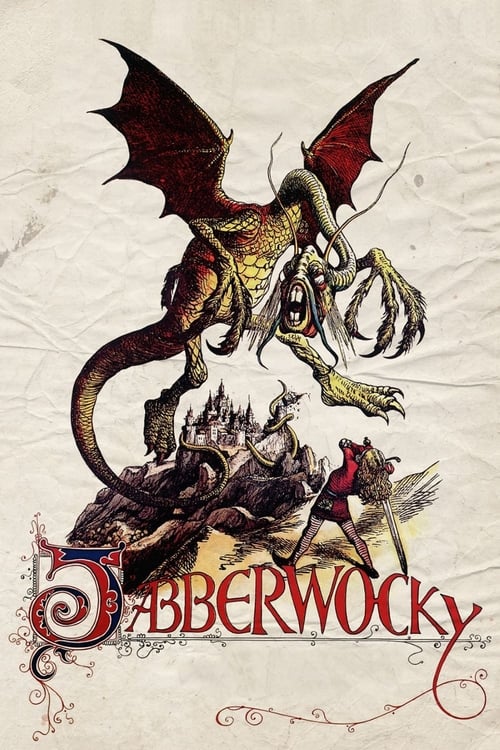
Jabberwocky
1977 · Terry Gilliam
For when you want your fantasy with mud on its boots — a strange, snickering midnight-movie alternative to castle-and-quest gloss. More cult oddity than comfort food.
What it's about
A cooper's son named Dennis leaves home after his father's death and wanders into a medieval kingdom under siege by a monster out of Lewis Carroll's nonsense poem — the dreaded Jabberwocky. He's not there to slay anything; he wants to make his fortune with sensible business ideas and win a woman who barely notices he exists. The kingdom, meanwhile, is filthy, greedy, and falling apart, and heroism keeps getting thrust on exactly the wrong man.
The experience
Grubby, absurd, and gleefully unromantic — a fairy tale where everyone has bad teeth and worse motives. The comedy runs on squalor and misunderstanding rather than punchlines, and the monster, when it comes, is genuinely nightmarish in a handmade way.
Performances
Michael Palin plays Dennis with a guileless, chipper obliviousness that holds the whole ramshackle world together — a hero too polite to notice he's in a horror show.
The craft
Terry Gilliam's first solo feature, and the birth of his signature look: a Middle Ages rendered as smoke, grime, rot, and clutter, every frame packed like a Bruegel painting. The practical monster design is startlingly effective, and the sheer density of the production design rewards a close, attentive watch.
Why it matters
The bridge between Monty Python and Gilliam's later fantasy epics — it established the mud-caked, anti-picturesque medieval aesthetic he would build a career on, and marked his emergence as a director in his own right.
Snapshot
Jabberwocky is Terry Gilliam's first solo feature as director, made in Britain in 1976 and released in 1977, between Monty Python and the Holy Grail (1975), which Gilliam co-directed with Terry Jones, and Monty Python's Life of Brian (1979). It takes its title and its monster from Lewis Carroll's nonsense poem in Through the Looking-Glass, but almost nothing else: Carroll's ballad supplies a name, a beast, and a shape of fable, onto which Gilliam grafts a picaresque about a cooper's son named Dennis who blunders into a filthy medieval kingdom and defeats a dragon largely by accident, in the pursuit of an entirely different ambition — a rationalized business plan and the hand of a woman who barely registers his existence.
The film matters for two reasons that have little to do with its plot. First, it is the film in which Gilliam's visual imagination separates itself from Python's sketch logic and becomes a directorial method: the animator's compositional instinct — foreground clutter, deep wide-angle space, grotesque bodies pressed against the lens — applied to live action for a full feature under his sole authority. Second, it is the origin point of what would become his signature obsession, the collision between a dreaming individual and a bureaucratic, filthy, self-serving system that neither notices nor rewards him. Everything Gilliam does later — Brazil, The Adventures of Baron Munchausen, The Fisher King, the doomed Don Quixote — is legible in embryo here.
It is also a film that has spent its life being mistaken for something it is not. Marketed in several territories in ways that implied a Python film (the presence of Michael Palin in the lead and Terry Jones in a small role encouraged the confusion), it disappointed audiences arriving for Holy Grail II and was reviewed accordingly. Its reputation has slowly improved as Gilliam's authorship became the frame through which it is read.
Industry & production
Jabberwocky was a low-budget British production shot in 1976, principally at Shepperton Studios with location work in Wales — Pembrokeshire's Pembroke Castle and Chepstow Castle in Monmouthshire are the most frequently identified sites — and it belongs to a specific and short-lived moment in British film financing. The mid-1970s British industry was in acute contraction: American studio investment, which had underwritten the 1960s boom, had largely withdrawn, and independent production ran on small budgets, tax-driven arrangements, and the residual infrastructure of studios like Shepperton and Pinewood that were operating well below capacity. A cheap, English-set, castle-and-mud costume picture with a comedy hook was exactly the kind of project that could be financed in that environment; an expensive one could not.
The film was produced by Sandy Lieberson — an American producer who had been central to British production in the period, associated with Goodtimes Enterprises and with films including Performance and That'll Be the Day — with John Goldstone, who would go on to produce Life of Brian and Monty Python's The Meaning of Life. Its budget was small by any measure, and the production's method was to convert that constraint into texture: castles that already existed, mud and straw in place of set dressing, crowds of extras in rags, and a single creature effect held back until the final act.
The commercial history is where the record deserves care. Jabberwocky was not a hit on the scale of Holy Grail, and the widely repeated account is that its distribution — particularly in the United States, where it was handled in a way that leaned on the Python association — set audience expectations it could not meet. I have not been able to verify specific box-office figures from an authoritative source and will not supply any; what can be said with confidence is that it was neither a failure that ended careers nor a success that changed Gilliam's negotiating position, and that his next solo feature, Time Bandits (1981), was financed outside the normal studio route, with George Harrison's HandMade Films, which suggests the industry had not been persuaded to underwrite him conventionally.
The production is also the beginning of Gilliam's lifelong pattern of difficulty. Accounts from the shoot — Gilliam's own, in interviews and in Gilliam on Gilliam, and Palin's published diaries covering the period — describe a first-time solo director learning on a compressed schedule with a crew who did not necessarily share his sense of what the film was. That friction is part of the historical record in a way that the financial detail is not.
Technology
The technological profile is that of a modest 1976 British production: 35mm color negative, largely available and practical light supplemented in interiors, and physical effects built and shot in camera. There is nothing here that advanced the state of the art, and the film's interest technologically is precisely in what it achieves without new tools.
The monster is the key case. The Jabberwock is a costumed/puppeted creature — a man-in-a-suit construction with articulated elements — realized by practical means and shot to conceal its limits: brief appearances, low light, obscuring foreground, movement toward the camera, and cutting that grants glimpses rather than sustained views. This is the standard 1970s solution to the problem of a screen dragon, the same problem Dragonslayer (1981) would solve four years later with go-motion at many times the cost. Gilliam's approach — hide it, then reveal it in an incomplete way — is a budget strategy that also happens to be a good horror strategy, and the creature retains an unsettling quality that fully lit exposure would have destroyed.
The other significant technology is optical: extremely wide lenses, used far more aggressively than was conventional in mainstream 1970s narrative cinema. The wide-angle distortion is Gilliam's substitute for production value. A wide lens close to a foreground object makes a small set feel enormous, gives a face a caricatural bulge, and lets him stack information from inches to infinity within a single frame — the animator's collage translated into optics rather than cut paper.
Technique
Cinematography
Terry Bedford shot the film; he had worked with Stanley Kubrick's productions in camera department roles before moving to features and commercials, and would later direct. The photography of Jabberwocky is one of its most consequential elements, and it establishes the visual grammar Gilliam would use for the rest of his career.
The dominant choices are wide focal lengths, deep focus, and low camera height. Faces come to the lens and distend; rooms bow at the edges; ceilings and vaults press down. Gilliam habitually fills the foreground — a hanging carcass, a wheel, a beam, a body — so that the viewer looks through something at the action, which produces both depth and a persistent sense of obstruction. The world is cluttered and the camera is embedded in the clutter rather than observing it from a clean vantage.
The palette is deliberately degraded: browns, grays, dung-colours, smoke, and a light that is either gray daylight or the orange of fire and rushlight. This is a decisive break from the clean, storybook medievalism of most screen fantasy up to that point, and it aligns Jabberwocky with a specific 1970s European sensibility about the Middle Ages as filthy, cold, and materially poor — a lineage running from Pasolini's Trilogy of Life and Bergman's earlier The Virgin Spring and The Seventh Seal through Holy Grail's mud-farmers to Rohmer's Perceval le Gallois (1978) and beyond.
Editing
Michael Bradsell edited. The cutting serves a picaresque structure — a sequence of encounters rather than a tightening plot — and its characteristic move is the interruption: an action begun in one register is cut off by an intrusion from another. Comic business is halted by sudden violence; ceremonial pomp is punctured by squalor; the hero's line of intention is repeatedly severed by the world's indifference.
The film also uses a running structural joke that depends entirely on editing: important events happen off-center or off-screen relative to what the camera and the protagonist are attending to. Consequential action occurs at the edge of the frame or just outside it while the ostensible subject continues obliviously. This is a comic strategy inherited from Python's habit of undercutting, but Gilliam converts it into something closer to a worldview — the sense that the significant and the trivial are indistinguishable to anyone inside the system.
Mise-en-scène / staging
This is the film's center of gravity. Gilliam trained as an animator and illustrator, and his method is compositional: he builds an image out of layers of stuff. Roy Smith is credited with the production design, and the achievement is a medieval world constructed almost entirely out of texture — straw, mud, rotten timber, dung, rust, wool, skin — with the visual density of a Bruegel or Bosch panel.
The debt to Northern Renaissance painting is explicit and has been widely noted in writing on Gilliam. Crowded compositions in which dozens of small human activities occur simultaneously, grotesque physiognomies, the mixing of the sacred and the scatological, the peasant body as comic and abject at once: these are Bruegel's terms, and Gilliam stages them. The city is a machine of commerce and filth; the castle is a warren of cold stone and idle ceremony; the countryside is menacing and mostly empty.
Staging within the frame is layered rather than linear. Characters occupy distinct planes; business runs in the background independent of the dialogue; the frame's edges are as active as its center. Where a conventional film would cut to show you a detail, Gilliam more often builds the detail into the shot and lets you find it.
The costuming and makeup extend this: teeth, sores, dirt, and deformity are deployed with a consistency that reads less as gross-out than as materialist argument. The film's medieval world is one in which bodies are damaged by work and by the absence of medicine, and in which the powerful are physically distinguished chiefly by being better fed.
Sound
De Wolfe — the long-established British production music library that had also supplied Holy Grail — is associated with the film's music, and the score's function is largely ironic: heraldic and processional cues attend events that do not merit them. The gap between the pomp of the sound and the squalor of the image is one of the film's steadiest jokes and one of its clearest inheritances from Python.
The sound design is dense and unglamorous — livestock, hammering, crowds, weather, the wet noises of butchery and eating. Dialogue is frequently buried in this ambience, and characters talk over each other and past each other. There is a persistent low-level din to the film that supports its thesis about a world in which nobody can hear anyone. Post-synchronisation was standard practice for British productions of this budget and period, and the somewhat detached quality of some dialogue is consistent with that.
Performance
Michael Palin plays Dennis, and the performance is a specific and slightly counterintuitive choice: rather than a wit or a fool, Palin plays him as an earnest, decent, relentlessly rational young man — a would-be systems-thinker with a plan for inventory and efficiency — dropped into a world with no interest in reason. The comedy comes from his persistence, not from his stupidity. It is a straight performance in a grotesque environment, and it prefigures Jonathan Pryce's Sam Lowry in Brazil almost exactly.
Around him, Gilliam casts an ensemble of British character actors, many with substantial theater and screen careers, and directs them broadly: Max Wall as the King, John Le Mesurier, Warren Mitchell, Harry H. Corbett, Rodney Bewes, Bernard Bresslaw, and Terry Jones in a small comic role among them. Several of these performers carried strong associations from British television comedy (Steptoe and Son, Dad's Army, Till Death Us Do Part, the Carry On films), and Gilliam uses that familiarity as a kind of shorthand — the audience recognizes the type instantly, which frees the film to be about the world rather than the characters.
The register across the ensemble is presentational rather than psychological: figures more than people, closer to the grotesques of a woodcut than to naturalistic characterization. This is a defensible interpretive choice given the film's project, and also the thing critics most often objected to.
Narrative & dramatic mode
The film is a picaresque, and its dramatic logic is anti-heroic in a specific structural sense. Dennis moves through a series of episodes in which he is variously beaten, mistaken, exploited, and ignored; he arrives at each new situation with a plan and departs from it having been overwhelmed by circumstance. The Jabberwock — the supposed engine of the plot — is offscreen for most of the running time, functioning as a rumor that structures the kingdom's economy and politics rather than as an antagonist Dennis pursues.
The decisive move is the ending's inversion of the fairy-tale contract. Dennis does slay the monster, but by accident and without intending to, and the rewards that follow — a princess, a kingdom — are precisely not what he wanted. He wanted Griselda, the grotesquely indifferent object of his affections, and a modest, well-organised business. The film ends by granting him triumph as a form of defeat. This is not merely a joke at the fairy tale's expense; it is a coherent statement about the relationship between individual desire and institutional reward, and it recurs across Gilliam's filmography.
The mode is comic but the tone is not consistently comic. The film contains real violence, real dread, and passages of genuine unpleasantness, and it does not signal when it is switching between registers. This tonal instability is deliberate, and it is the principal reason the film divided audiences: viewers primed by Python for continuous joke-delivery encountered long stretches that are not funny and are not trying to be.
Genre & cycle
Jabberwocky sits at the intersection of three currents. The first is the medieval-squalor cycle of the late 1960s and 1970s, in which European filmmakers reacted against the Hollywood and Technicolor Middle Ages — Pasolini's The Decameron and The Canterbury Tales, Bergman's medieval films, Rohmer's Perceval, and the immediately preceding Monty Python and the Holy Grail. These films share a commitment to dirt, cold, poor light, and bodies, and they treat the period as materially rather than decoratively real.
The second is British screen comedy at a transitional moment. The Carry On cycle was in terminal decline; Python had moved from television to film; the Ealing tradition was long finished. Jabberwocky's casting draws directly on the television-comedy talent pool of the period while its sensibility belongs to something newer and darker.
The third is the fantasy feature before the fantasy boom. In 1977, screen fantasy meant Ray Harryhausen's Sinbad films, animation, and the children's market; the post-Star Wars, post-Conan fantasy cycle of the early 1980s — Excalibur, Dragonslayer, Conan the Barbarian, Time Bandits, The Dark Crystal, Ladyhawke — had not yet arrived. Jabberwocky is an odd early entrant: a fantasy film that is not aimed at children, does not treat magic as wonder, and is more interested in commerce and mud than in quest.
It also participates, at a slant, in the literary-nonsense adaptation tradition. Carroll's poem is a source of title and creature only; the film is not an adaptation in any meaningful sense, and it would be an error to read it as one.
Authorship & method
Gilliam's method here is the animator's method transposed. His Python animations were built from cut-out engravings, Victorian illustration, and Renaissance painting, reassembled into sequences whose logic was associative and whose violence was abrupt and consequence-free. Jabberwocky takes that visual vocabulary — the crowded plane, the grotesque face, the sudden intrusion, the source in old European art — and rebuilds it with actors, sets, and lenses. The wide-angle lens is doing the work the cut-out layer did: flattening and exaggerating simultaneously, pulling the foreground into the viewer's face.
The screenplay is credited to Gilliam and Charles Alverson, an American writer and journalist who had worked with Gilliam in his pre-Python days in American magazine publishing. The Alverson collaboration is a documented point of friction in the film's history: accounts of the production indicate disagreement over credit and over the extent of Alverson's contribution to the finished script, and Alverson did not work with Gilliam again after their subsequent unproduced or unrealised projects. The precise apportionment of authorship between them is contested and I will not adjudicate it here; what is clear is that Alverson's role was substantive enough to be worth arguing about.
The key collaborators are worth naming precisely because Gilliam's authorship is so often discussed as if it were solitary. Terry Bedford's photography establishes the deep-focus wide-angle look. Roy Smith's production design supplies the material world. Michael Bradsell's editing manages the tonal swerves. Julian Doyle — who worked on the production and would go on to edit Brazil and to be a long-term Gilliam collaborator — is part of a group of technicians who carried Python-adjacent production practice into Gilliam's solo work. The absence of a composer of note is itself significant: using library music was a budget decision, but it also produced the ironic-pomp effect that a bespoke score might have softened.
What Jabberwocky establishes as method, and what Gilliam never abandons, is a preference for building the world in front of the camera rather than in the cut, a willingness to let the frame be overfull, and a refusal to stabilize tone.
Movement / national cinema
The film is British, and it belongs to the thin, undercapitalised British cinema of the mid-1970s — a period between the collapse of American investment and the brief revival signaled by Chariots of Fire and Goldcrest at the start of the 1980s. Its resourcefulness is characteristic of that moment: real castles standing in for sets, television actors, library music, practical effects.
But its sensibility is not straightforwardly British. Gilliam was an American — he took British citizenship years later, in the 1960s-onward arc of his life in London — and his sources are continental European: Bruegel, Bosch, medieval woodcuts, the Northern grotesque. The result is a film that looks less like British costume drama than like a European art-cinema treatment of the Middle Ages that happens to have been made by a comedy team's animator with English character actors. The kinship with Pasolini is real and has been widely observed, though it should be stated as affinity rather than as documented influence unless one is quoting Gilliam directly on the point.
Placed in the Python lineage, Jabberwocky is the moment where the group's collective sensibility splits into distinguishable authorships: Jones's medievalism is warmer and more scholarly, Gilliam's is colder and more pictorial, and after this film the two are no longer confusable.
Era / period
1977 is a hinge year in film history, and Jabberwocky arrived on the wrong side of it. Star Wars opened that year and redefined what popular fantasy would look like — clean, mythic, propulsive, technologically dazzling, and aimed at wonder. Jabberwocky is the precise opposite in every one of those terms: dirty, anti-mythic, digressive, technologically modest, and aimed at disillusion. Within a few years, the fantasy features that got made would be operating in the Star Wars aftermath, and Gilliam's own Time Bandits would have to negotiate with that fact.
The film also belongs to the broader 1970s exhaustion of heroic narrative — the same decade that produced revisionist Westerns, conspiracy thrillers, and downbeat endings across genres. Its cynicism about institutions, its unrewarded protagonist, and its treatment of the ruling class as parasitic and incompetent are of a piece with the period's temper on both sides of the Atlantic, and specifically with the British 1970s of industrial dispute and visible decline.
Themes
The system does not see you. The film's governing idea is that institutions — court, church, guild, market — operate according to their own logic and are perfectly indifferent to individual competence, desire, or merit. Dennis's rationality is not rewarded; it is not even registered. This is the seed of Brazil.
Commerce as the real plot. The Jabberwock's principal function in the kingdom is economic: it drives refugees into the city, inflates certain trades, occupies the court's attention, and structures a market. The film is unusually interested in money, inventory, guilds, and profit for a fantasy, and it treats the medieval world as a functioning if brutal economy rather than as a backdrop.
The body as material fact. Filth, disease, appetite, and butchery are constants. The film's insistence on physical degradation is not merely comic disgust; it is an argument about what pre-modern life materially was, and it silently indicts the sanitized medievalism it is reacting against.
Chivalry as fraud. Knights are vain, useless, and dangerous. Heroism is a performance the ruling class maintains for its own benefit. The one act of genuine monster-slaying in the film is committed by accident by a man who was not trying.
Desire misaligned with reward. Dennis wants the wrong things by the story's standards and is given the right ones by the story's standards, and this is presented as a loss. The refusal to let the fairy tale's currency be worth anything to its protagonist is the film's sharpest structural idea.
Reception, canon & influence
Critical reception. Contemporary reception was mixed to poor, and the reasons are well documented in the general shape though specific reviews should be consulted directly rather than paraphrased from memory. The dominant complaints were that the film was unpleasant rather than funny, that it lacked the joke-density of Holy Grail, and that its narrative was shapeless. The Python comparison was nearly universal and nearly always unfavourable, and the marketing that encouraged it did the film measurable damage with audiences who had bought a ticket to a different movie. A minority of critics recognized the visual achievement even while finding the film tiresome.
Its standing has risen substantially since. Once Gilliam's filmography existed to be read backward from — after Brazil in particular — Jabberwocky became legible as a first statement of a coherent authorial project rather than as a failed Python spinoff. It remains a minor film in his body of work and is not canonical in the way Brazil is, but it is no longer dismissed, and it has a durable cult following.
Influences on the film (backward). The clearest are pictorial: Bruegel and Bosch above all, and the tradition of the medieval and Renaissance grotesque in woodcut and engraving that fed Gilliam's animation practice. Narratively, the picaresque tradition — the episodic rogue's-progress of Lazarillo de Tormes, Candide, Tom Jones — supplies the structure. Cinematically, Monty Python and the Holy Grail is the immediate precursor in both look and production method, and the European medieval films of Pasolini and Bergman establish the anti-decorative approach to the period. Lewis Carroll supplies title, creature, and the license to be nonsensical, and little else.
Legacy (forward). The most direct legacy is internal: Jabberwocky is the template for Gilliam's own subsequent work. Dennis becomes Sam Lowry; the indifferent bureaucratic kingdom becomes the Ministry of Information; the wide-angle grotesque becomes the house style of Brazil, Munchausen, and The Fisher King; the ending's inverted reward recurs throughout.
Beyond Gilliam, its influence is diffuse but real. The dirty-medieval aesthetic it shares with Holy Grail — and pushes further into genuine grimness — became a durable mode, visible in later fantasy that treats the period as squalid rather than storybook, and eventually normalized to the point of being the default register for prestige medieval fantasy. Its treatment of a monster as an economic and political fact rather than a dramatic antagonist anticipates a good deal of later revisionist fantasy. And its formal proposition — that a fantasy world can be built out of density and texture on a small budget, with the lens doing the work of the production budget — has been a working lesson for low-budget genre filmmaking since.
The honest summary is that Jabberwocky is a flawed, tonally unstable, structurally loose film that contains, more or less complete, the artistic identity of one of the more distinctive directors of the following three decades. Its interest is less as an achievement than as an origin, though the best of its images — the crowded city, the cold castle, the half-glimpsed dragon — stand up on their own terms.
A Deleuzian reading
Look at what Gilliam keeps putting between you and the scene.
The full Deleuzian reading of Jabberwocky →
Reception
In 1977 it landed with a thud — critics and audiences expecting Holy Grail 2 got a grubby, morose medieval satire instead, and reviews were largely unkind. It's since been reappraised as the true start of Gilliam-the-filmmaker, with a 2017 Criterion restoration sealing its rehabilitation.
How Jabberwocky was received, from release to now →
How to watch Jabberwocky: what to notice on a first viewing
- Notice something blocking part of the frame in almost every shot. Gilliam keeps filling the foreground with a hanging carcass, a wheel, a beam, someone's back, so you often look through an object at the actual scene. You are placed in the mud with the clutter, not given a clean seat to watch the story from.
- Notice the mud, rot, and dung built into every space. Roy Smith's production design constructs the medieval world almost entirely from texture, straw, rotten timber, dung, rust, wool, so filth is a material fact, not a joke. The squalor is an argument about what pre-modern life actually was, not gross-out comedy for its own sake.
- Notice small activities happening in the background of a scene. Gilliam stages his crowds in distinct planes, with unrelated business running in the back of the shot while the foreground dialogue continues, Bruegel-style. The frame's edges are as active as its center, so you can find a whole different joke by looking away from the conversation.
- Listen for heraldic music playing over ordinary or squalid events. The score reaches for pomp and ceremony no matter what is actually happening on screen, opening a steady gap between what you hear and what you see. The mismatch between the music's grandeur and the image's filth is one of the film's most consistent jokes.
- Watch Dennis stay earnest and rational no matter what happens. Palin plays Dennis as a decent, business-minded young man surrounded by a broadly grotesque ensemble, never winking at his own absurdity. The comedy comes from his persistence in a world with no interest in reason, not from him being foolish himself.
The whole guide to watching Jabberwocky, with the keys for a rewatch →
Influences: the films it descends from and the films it influenced
- Monty Python and the Holy Grail (1975) — Gilliam carries over cinematographer Terry Bedford, the real-weather Scottish castle locations, and the working rule that armor is dented and mud is actual mud — the frame lit for damp stone rather than pageantry.
- Chimes at Midnight (1965) — Welles builds a medieval world on no money from bare stone, smoke and crowded low-ceilinged interiors; Jabberwocky's tavern and castle scenes use the same substitution of packed wide-angle texture for production value.
- The Trial (1962) — The very wide lens that turns corridors and offices into distorting funnels dwarfing a small functionary is exactly the grammar of Jabberwocky's throne room and guild interiors — Toland's deep-focus foreground grammar bent toward bureaucratic space.
- The Seventh Seal (1957) — Bergman's anti-decorative Middle Ages — plague carts, flagellant processions, faces shot as woodcut types — licenses Gilliam to stage the period as an epidemic rather than a storybook.
- The Canterbury Tales (1972) — Pasolini casts non-professional faces for their irregularity and stages bawdy business in Bruegel-derived multi-plane tableaux; Jabberwocky's crowds are cast, made up and blocked on the same principle, down to the teeth.
- Fellini Satyricon (1969) — Episodic drift through a teeming grotesque world where makeup and casting turn every extra into a caricature — the model for Jabberwocky's picaresque shape and its background freakery.
- Macbeth (1971) — Polanski's British-shot medieval fixed the template of real castles in real rain with blood and filth treated as continuity elements; Jabberwocky inherits both the location discipline and the flat, unheroic staging of violence.
- The Three Musketeers (1973) — Lester runs comic business in deep-focus background planes while the plot proceeds in front, and plays the period as filthy and physically incompetent — the staging logic behind Jabberwocky's layered gags and its habit of putting the violence at the edge of frame.
- Tom Jones (1963) — The picaresque engine of a passive, naive hero pushed through episodes by other people's schemes, scored with jaunty period pastiche against squalor — the structural and tonal template for Dennis's progress.
- Andrei Rublev (1966) — Tarkovsky reads the medieval as an economy of commissions, labor and raw material (the bell-casting); Jabberwocky's guilds, tournament and monster-as-market-force follow that materialist accounting rather than a heroic one.
- Time Bandits (1981) — Gilliam re-runs the passive-protagonist picaresque and the inverted-reward ending, again building fantasy from wide lenses, forced perspective and practical squalor instead of optical effects.
- Brazil (1985) — Dennis's absorption into an indifferent bureaucratic kingdom becomes Sam Lowry's, and the low-angle wide-angle grotesque of the castle interiors becomes the house grammar of the Ministry of Information.
- The Adventures of Baron Munchausen (1988) — Scales up the Bruegelian crowded plane and hand-built creature work, still preferring in-camera layering — foreground rubbish, mid-ground business, painted depth — over composite effects.
- Hard to Be a God (2013) — Pushes foreground obstruction to its limit: bodies, animals and filth continually cross the lens in deep-focus long takes, absolutizing Jabberwocky's principle that the world is built out of clutter in front of the camera.
- The Green Knight (2021) — An anti-fairy-tale picaresque that sends an undeserving, largely passive hero through discrete episodes to an inverted reward, keeping the monster mostly offscreen and the period damp, muddy and unromantic.
- Monty Python's Life of Brian (1979) — Same ensemble and same low-budget location discipline, deploying the identical device of a literal-minded straight man carried through a grotesque crowd by other people's fanaticism.
- The Name of the Rose (1986) — Annaud and Ferretti cast deformity and rot as the period's default and shoot smoky interiors in deep focus with objects crowding the lens; the monastery throng is assembled exactly like Jabberwocky's city crowd.
- Delicatessen (1991) — Degraded ochre palette, extreme wide-angle close-ups that bulge grotesque character faces, and dense mechanical ambience — a direct extension of Jabberwocky's lens-and-texture method of world-building on a small budget.
Similar films
- Monty Python and the Holy Grail (1975) — influence & lineage
- Time Bandits (1981) — influence & lineage
- The Adventures of Baron Munchausen (1988) — influence & lineage
- Brazil (1985) — influence & lineage
- Alice in Wonderland (1951) — shared sensibility
- Alice in Wonderland (2010) — shared sensibility
- Wallace & Gromit: The Curse of the Were-Rabbit (2005) — shared sensibility
- Alice (1988) — shared sensibility