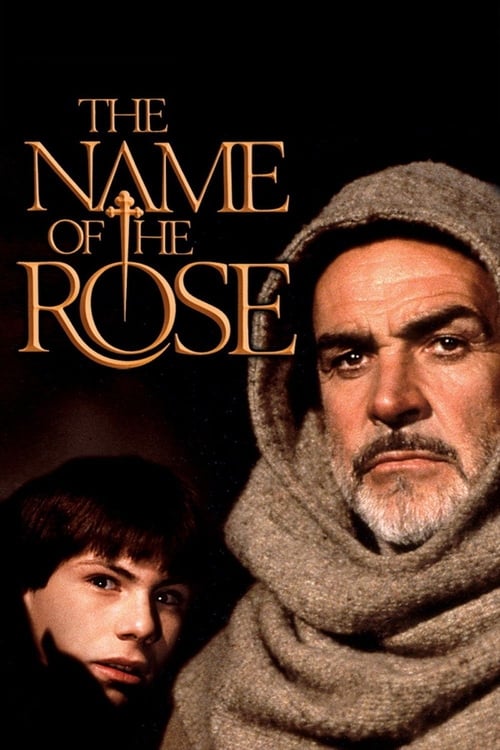
The Name of the Rose
1986 · Jean-Jacques Annaud
For a long dark evening when you want to be fully transported — a smart, atmospheric mystery to sink into, ideally with the lights off and no phone. Immersive comfort for lovers of the gothic.
What it's about
In 1327, the sharp-witted Franciscan friar William of Baskerville arrives at a remote Italian mountain abbey for a theological summit and finds the monks dying one by one under sinister circumstances. With his young novice Adso in tow, he follows the clues into the abbey's forbidden labyrinth of a library — while the Inquisition arrives with simpler, crueler answers. It's a detective story where the murder weapon might be an idea.
The experience
Absorbing and pleasurably grim — a slow-burn mystery thick with fog, candlelight, and dread, cut with flashes of wit. It makes you feel the cold of the Middle Ages and the thrill of watching reason work in a world run on fear.
Performances
Sean Connery is at his warmest and wiliest as William — the rare detective whose intelligence you can watch operating — with F. Murray Abraham radiating chill menace as the inquisitor Bernardo Gui and a very young Christian Slater as the wide-eyed novice.
The craft
The production design is the star alongside Connery: a brooding abbey, a vertiginous labyrinth library, and faces that look pulled from medieval woodcuts. Annaud builds the fourteenth century with mud, parchment, and shadow rather than pageantry, and it looks magnificent on a big screen.
Why it matters
It proved a dense literary bestseller about monks and manuscripts could work as gripping popular cinema, and it remains the template people reach for when they imagine the medieval murder mystery.
Snapshot
The Name of the Rose is Jean-Jacques Annaud's adaptation of Umberto Eco's 1980 bestseller Il nome della rosa, a medieval murder mystery that doubles as a treatise on signs, knowledge, and the institutional fear of laughter. Set in a remote northern Italian Benedictine abbey in the year 1327, it follows the Franciscan friar William of Baskerville (Sean Connery) and his young novice Adso of Melk (Christian Slater) as they investigate a series of deaths among the monks during a theological conference on the poverty of Christ. William's rationalist sleuthing — explicitly modeled on Sherlock Holmes, whose name and method haunt the film — collides with the Inquisition in the person of Bernardo Gui (F. Murray Abraham). A German-French-Italian co-production mounted on a large European budget, the film is notable for its obsessive material reconstruction of the late Middle Ages, its grotesque human faces, and its role in reviving Connery's flagging career. Its opening title card famously calls the film "a palimpsest of Umberto Eco's novel," an honest admission that a four-hundred-page semiotic labyrinth had been pared to a genre thriller.
Industry & production
The film was the signature project of German producer Bernd Eichinger and his company Constantin Film, who acquired rights to Eco's novel and assembled a pan-European financing structure across West Germany, France, and Italy. The production was costly by the standards of continental European cinema of the period — frequently cited in the tens of millions of dollars — making it one of the more ambitious "European prestige" pictures of the mid-1980s, a category that sought literary respectability and international markets simultaneously. Twentieth Century Fox handled significant distribution. I should flag that precise budget and box-office figures circulate in varying forms and I will not assert a specific number; what is well documented is that the film was a substantial commercial success in continental Europe while receiving a cooler, more divided reception in the United States.
Casting Sean Connery was contentious. By the mid-1980s Connery's box-office standing was uncertain, and reporting from the period indicates that at least one financing partner balked at his casting, viewing the actor — then indelibly associated with James Bond — as wrong for a cerebral medieval monk. Annaud fought for him. The gamble paid off: Connery's performance is widely credited as a hinge in his late-career resurgence, immediately preceding his Oscar-winning turn in The Untouchables (1987). The film also gave Christian Slater an early major screen role as Adso and featured Ron Perlman — fresh from Annaud's Quest for Fire — as the deranged hunchback Salvatore, plus Michael Lonsdale as the Abbot and Feodor Chaliapin Jr. as the blind librarian Jorge de Burgos.
The screenplay is credited to four writers — Andrew Birkin, Gérard Brach, Howard Franklin, and Alain Godard — a multiplicity that reflects both the international production and the difficulty of compressing Eco's discursive novel into a workable thriller. Eco himself kept a deliberate distance; he is generally reported to have been wary of adaptation, and the production's "palimpsest" framing acknowledged that the film could only ever be a partial overwriting of the book. Production stretched across roughly a year of preparation and a demanding shoot.
Technology
The film is a work of analog, photochemical, location-and-set craft rather than technological novelty; there is no significant optical-effects or early-digital dimension to speak of, and to claim otherwise would be invention. Its "technology," properly understood, is the technology of physical reconstruction. The single most consequential built element was the abbey complex — most prominently its great fortified tower, the Aedificium, housing the labyrinthine library — constructed as an exterior set on a hilltop outside Rome, reportedly the largest such set built in Europe in some years at the time. Interiors and cloister sequences drew on real medieval architecture, with Kloster Eberbach, the former Cistercian monastery in Germany's Rheingau, serving as a principal location. The labyrinth library — the film's signature space — was conceived as an Escher-like impossible architecture of stairs and chambers, a deliberately disorienting set rather than a real building. Practical fire effects for the climactic conflagration, extensive candle and torch lighting, and heavy prosthetic and dental work for the monks' faces constitute the film's real technical frontier.
Technique
Cinematography
The photography is by Tonino Delli Colli, one of the great Italian cinematographers, whose résumé spans Pasolini, Pier Paolo Pasolini's Il Vangelo secondo Matteo, Sergio Leone's Once Upon a Time in America, and later Benigni's Life Is Beautiful. His work here is built around darkness and scarce, motivated light: scenes are lit as if by the candles and slit windows actually present, yielding deep shadow, amber pools, and a near-monochrome cold palette of stone gray, brown, and black appropriate to a snowbound winter abbey. The labyrinth sequences exploit chiaroscuro and the vertiginous geometry of the set, while exteriors emphasize fog, mud, and the oppressive bulk of the architecture. Delli Colli's restraint — refusing prettiness — is central to the film's claim of medieval authenticity.
Editing
Editing is credited to Jane Seitz. The cutting serves a conventional investigative structure: the film advances through William's discovery of clues, interrogations, and nocturnal excursions into the library, intercut with the gathering threat of the Inquisition. The pacing is deliberate, even stately, in keeping with the somber tone, with the murders and the climactic fire providing the principal accelerations. The compression of Eco's dense intellectual digressions into propulsive scene-work is itself an editorial-dramaturgical achievement, though some critics judged that the streamlining hollowed out the novel's ideas.
Mise-en-scène / staging
Production design by Dante Ferretti — another Fellini and later Scorsese collaborator — is arguably the film's dominant authorial signature. Ferretti and Annaud pursued a vision of the Middle Ages as filthy, cold, cramped, and physically oppressive, a corrective to the clean pageantry of older costume pictures. The abbey is staged as a vertical hierarchy of spaces: the scriptorium of light and learning above, the kitchens and ossuary below, and the forbidden library at the apex, accessible only through concealed passages. Crowds of monks are arranged in dense, frieze-like compositions; the staging of the Inquisition tribunal and the burnings emphasizes institutional spectacle and mass cruelty. The labyrinth, with its impossible Escher geometry, externalizes the film's theme of knowledge as a maze that the Church seeks to keep impassable.
Sound
James Horner composed the score, working partly in a sacred-music idiom — chant-like vocal textures and austere orchestral writing rather than the soaring romanticism of his better-known work. The score is used sparingly; much of the film leans on diegetic sound — wind, bells, the murmur of Latin liturgy, fire — to sustain its atmosphere of cold isolation. Plainchant and the sonic world of monastic ritual are integral to establishing place. The multinational cast performs in English, a pragmatic choice for international distribution that nonetheless flattens the novel's play of Latin and vernacular tongues.
Performance
Connery anchors the film with a performance of dry intelligence, irony, and physical authority; his William is a humane rationalist whose pleasure in deduction is tinged with melancholy about the institution he serves. The role earned him the BAFTA Award for Best Actor. F. Murray Abraham, fresh from his Oscar for Amadeus, plays Bernardo Gui as a study in serene fanaticism, a worthy antagonist to Connery's reason. Christian Slater's Adso supplies the novel's first-person vantage and its single thread of erotic awakening, in his encounter with a nameless peasant girl (Valentina Vargas). Annaud's casting of strikingly unusual faces — Perlman's Salvatore, Chaliapin's blind Jorge, the gallery of deformed and aged monks — is a performance strategy in itself, treating physiognomy as a register of the medieval world's strangeness, a method Annaud had honed on the largely wordless Quest for Fire.
Narrative & dramatic mode
The film operates in the mode of the classical detective story transplanted to the fourteenth century — a "whodunit" whose detective reasons from material evidence against a backdrop of supernatural dread. The names announce the lineage: William of Baskerville invokes Conan Doyle (and the Franciscan logician William of Ockham), while Adso echoes Watson as both companion and narrator. The story is framed as the aged Adso's retrospective memoir, lending it an elegiac, confessional cast. Beneath the murder plot runs a second, intellectual mystery — the identity and danger of a forbidden book — so that the investigation becomes an allegory about access to knowledge. The dramatic engine couples two clocks: the accelerating body count and the arrival of the Inquisition, which threatens to resolve the mystery through torture and fire rather than reason. The film's tragic structure lets William solve the crime yet fail to save the library, a downbeat irony at odds with the genre's usual restorations of order.
Genre & cycle
The Name of the Rose sits at the intersection of the historical-medieval epic, the literary prestige adaptation, and the detective thriller. Within the 1980s cycle of European literary adaptations aimed at the international market, it is a leading example of "heritage" filmmaking inflected toward darkness rather than nostalgia. It belongs as well to a small tradition of intellectual mysteries in which the puzzle is finally about ideas — censorship, heresy, interpretation — and it anticipates the later vogue for conspiratorial historical thrillers set among religious institutions. Its insistence on a grimy, demystified Middle Ages distinguishes it within the medieval-film genre from both the chivalric romance and the Hollywood biblical epic.
Authorship & method
Jean-Jacques Annaud directs as a meticulous materialist. His prior films — the Oscar-winning Black and White in Color (1976) and the dialogue-light Quest for Fire (1981) — already showed a preoccupation with immersive reconstruction of unfamiliar human worlds and with faces and bodies as narrative instruments, both of which define his approach here. Annaud's method centered on research-driven authenticity: building the abbey, casting for period-appropriate physiognomy, and lighting by available sources. His key collaborators form a roster of European art-cinema craft: cinematographer Tonino Delli Colli, production designer Dante Ferretti, and composer James Horner, with editing by Jane Seitz. The four-handed screenplay (Birkin, Brach, Franklin, Godard) reflects a collective, producer-shaped authorship typical of large co-productions, even as the finished film bears Annaud's unmistakable sensory signature. Eco's relationship to the project was that of a respected but guarded source author; the "palimpsest" credit tacitly cedes that the film is an interpretation, not a transcription.
Movement / national cinema
The film resists tidy national placement. It is a German-led co-production (Eichinger/Constantin), directed by a Frenchman, shot by an Italian master on Italian and German locations, performed in English by an international cast. It is best understood as an artifact of 1980s pan-European "Europudding" filmmaking — pejorative when the blending is incoherent, but here disciplined by Annaud's strong directorial control and the unifying Italian craft of Delli Colli and Ferretti. It exemplifies a European industrial strategy of competing with Hollywood through literary prestige and production scale rather than through stars or spectacle alone, while still importing Anglophone stars for global reach.
Era / period
Made in the mid-1980s, the film reflects that decade's appetite for large-scale literary adaptation and for a "realist" turn in historical cinema that prized dirt, disease, and architectural mass over romance. Its production coincides with a high-water mark for the international co-production model and for Eichinger's ambitions to make German-financed cinema of global reach. Connery's career trajectory situates it precisely at the turn from his post-Bond doldrums to his late-1980s renaissance. The film's intellectual concerns — censorship, the suppression of laughter, institutional control of knowledge — also resonated with a broader cultural moment of interest in semiotics and in Eco's own public profile as a theorist.
Themes
At its center is the conflict between reason and dogma: William reads the world as a system of legible signs, while the abbey's authorities treat curiosity itself as sin. The forbidden object is the lost second book of Aristotle's Poetics, the volume on comedy, and the murders flow from one zealot's conviction that laughter — by dissolving fear, including the fear of God — would topple the Church. The film thus dramatizes the politics of knowledge: who may read, who may interpret, what must be hidden or burned. Adjacent themes include the Franciscan controversy over the poverty of Christ (the conference's pretext), the violence of the Inquisition against heresy and the poor, and the tension between faith and empirical inquiry. Adso's brief sexual awakening introduces a counter-theme of bodily, untheological human love. The closing image — the burning library, knowledge consumed even as the crime is solved — frames the whole as an elegy for endangered learning.
Reception, canon & influence
Critical reception at release was sharply divided. Many reviewers, especially in the United States, found the film handsome but ponderous, and judged that it had reduced Eco's richly digressive, idea-saturated novel to a competent costume thriller — the recurring complaint that the "palimpsest" had erased too much of the original text. Others praised its atmosphere, its production design, and Connery's performance. The film fared markedly better commercially and critically in continental Europe, and it accrued significant industry honors: Connery won the BAFTA for Best Actor, the film won a BAFTA for makeup, and it took the César in France for Best Foreign Film along with prizes in West Germany. Eco's own ambivalence toward adaptation is part of the record; he is reported to have been reluctant to license his work to film thereafter, which contributed to the novel's long absence from further screen treatment until a later television version.
The influences on the film are explicit and literary: Conan Doyle's Sherlock Holmes (the Baskerville name, the deductive method, the Adso/Watson pairing), the medieval philosophy of William of Ockham, Borges (the blind librarian Jorge de Burgos and the library-as-labyrinth nod unmistakably to Jorge Luis Borges and "The Library of Babel"), and the visual logic of M.C. Escher in the labyrinth's impossible stairs. Eco's own scholarship in semiotics and medieval studies is the deeper substratum.
Its influence forward lies less in direct imitation than in establishing a durable template: the scholarly detective unraveling a conspiracy buried in religious history, a mode later popularized in a more middlebrow register by the wave of ecclesiastical-conspiracy thrillers. The film also stands as a landmark of demystified medieval production design, its grimy authenticity informing later historical filmmaking, and it remains the benchmark visual realization of Eco's novel. For Connery it was career-defining in its timing; for Annaud it confirmed the immersive, research-driven historical mode he would continue in Seven Years in Tibet and Enemy at the Gates. Where the historical record on internal production details and exact financials is thin or inconsistent, that thinness is itself worth noting rather than papering over — but the film's standing as the canonical screen encounter with Eco, and as a turning point for its star, is secure.
A Deleuzian reading
Start with a man holding a page to a candle.
The full Deleuzian reading of The Name of the Rose →
Reception
It bombed in the US but was a massive hit across Europe (especially Germany and Italy), winning the César for Best Foreign Film — and time has fully sided with Europe: it's now a beloved medieval mystery classic and the film that kicked off Sean Connery's late-career renaissance.
How The Name of the Rose was received, from release to now →
Influences: the films it descends from and the films it influenced
- Barry Lyndon (1975) — Pioneered shooting interiors by motivated candlelight and firelight as the sole source, the available-source lighting logic Tonino Delli Colli extends in the abbey's amber scriptorium and night-corridor scenes.
- The Decameron (1971) — Established the casting of grotesque, weathered non-professional faces for medieval authenticity, lensed by the same Delli Colli who would shoot Name of the Rose — the direct precedent for Annaud's physiognomy-casting of the monks.
- Andrei Rublev (1966) — Modeled the mud-stone-and-candle immersive reconstruction of a lived monastic world, treating a religious institution as gritty material reality rather than gilded backdrop, the demystified-medieval approach Annaud and Ferretti adopt.
- The Seventh Seal (1957) — Built high-contrast medieval tableaux around expressive faces to stage the reason-versus-dogma argument visually, the chiaroscuro-and-physiognomy grammar Name of the Rose inherits for its disputations.
- Quest for Fire (1981) — Annaud's own dialogue-light prehistoric reconstruction that taught him to carry narrative through bodies, faces, and immersive period detail — the method he transfers directly to the abbey.
- Day of Wrath (1943) — Used candlelit chiaroscuro interiors and held physiognomic close-ups within a story of religious persecution and forbidden inquiry, the austere ecclesiastical lighting and face-reading Name of the Rose echoes.
- The Hound of the Baskervilles (1939) — Codified the Holmes deductive method and the Watson-companion pairing that Eco and Annaud explicitly borrow — William 'of Baskerville' and the chronicler Adso reproduce the Holmes/Watson investigative structure by name.
- Seven Years in Tibet (1997) — Continues Annaud's signature immersive, research-driven reconstruction of an unfamiliar enclosed world, the working method he consolidated on Name of the Rose.
- Enemy at the Gates (2001) — Extends the same physical-reconstruction-over-effects historical immersion, rebuilding Stalingrad as Annaud rebuilt the abbey, with faces and grime carrying the period.
- The Ninth Gate (1999) — Reworks the scholar-detective tracing forbidden knowledge through rare antique books and a library-as-labyrinth, the bibliophilic-sleuth structure Name of the Rose built around the hidden manuscript.
- The Da Vinci Code (2006) — The middlebrow fulfillment of the template Name of the Rose established: a scholarly detective unraveling a conspiracy buried in church history through textual and symbological decoding.
- The Hour of the Pig (1993) — Drops a rational investigator into a grimy, demystified medieval world where superstition and clerical power obstruct deduction, directly inheriting Name of the Rose's reason-against-dogma detective frame and earthy design.
- Black Death (2010) — Carries forward the grimy, demystified medieval production design and the inquisitorial faith-versus-reason conflict that Name of the Rose made the benchmark for screen Middle Ages.
- Perfume: The Story of a Murderer (2006) — Pursues the same exhaustively researched, sensory period reconstruction of a pre-modern world — an investigation rendered through immersive material grime in the Annaud mode.
- Wake Up Dead Man: A Knives Out Mystery (2025) — The ecclesiastical whodunit that pits rational deduction against religious faith inside a cloistered setting — the faith-versus-reason clerical mystery this entry foregrounds.
- The Mission (1986) — Same-year European prestige co-production staging a religious-historical drama through physical location reconstruction and a sacred choral score (Morricone), the parallel template to Annaud's monastic immersion and Horner's liturgical music.
- The Last Emperor (1987) — A Europudding co-production that, like Name of the Rose, achieved prestige through on-site physical reconstruction and exhaustive period research rather than studio fakery.
- Amadeus (1984) — Shares the framed-memoir device of an aged narrator confessing a buried past plus the mid-1980s prestige period-adaptation mode, the same narrative frame as Adso recalling his youth.
- The Age of Innocence (1993) — Showcases Dante Ferretti's research-driven, archivally exact production design — the same designer's method that built the abbey, applied to a different milieu.
- The Good Shepherd (2004) — Stages the whodunit inside cloistered religious architecture lit by candle and torch, making the monastery itself a chamber-mystery set — the 'chamber-mystery' plus 'ecclesiastical-chiaroscuro' fusion the seed works in miniature.
- Jabberwocky (1977) — Annaud and Ferretti cast deformity and rot as the period's default and shoot smoky interiors in deep focus with objects crowding the lens; the monastery throng is assembled exactly like Jabberwocky's city crowd.
Similar films
- Andrei Rublev (1966) — influence & lineage
- The Mission (1986) — influence & lineage
- Conclave (2024) — shared sensibility
- The English Patient (1996) — shared sensibility
- The Devils (1971) — shared sensibility
- The Trial of Joan of Arc (1963) — shared sensibility
- The Count of Monte Cristo (2024) — shared sensibility
- A Man Escaped (1956) — shared sensibility