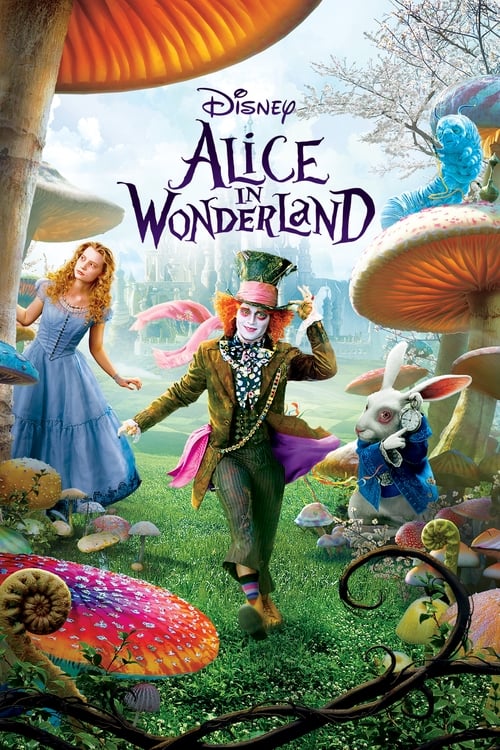
Alice in Wonderland
2010 · Tim Burton
For a low-stakes family fantasy night or when you want pure visual eccentricity without having to think hard — comfort viewing with a strange face on it.
What it's about
Alice Kingsleigh, nineteen and fleeing a stiff Victorian marriage proposal, tumbles back down the rabbit hole into a realm she visited as a child — and finds it under the tyranny of the Red Queen. Prophecy says she must take up a sword and face the Jabberwocky, and the Mad Hatter, the White Queen, and the rest of Carroll's menagerie are counting on her to become the Alice they remember.
The experience
A candy-gothic spectacle — Burton's crooked trees and swollen heads rendered in wall-to-wall digital fantasy, brisk and busy rather than dreamy. It plays as a hero's-quest adventure with a streak of macabre whimsy, pitched squarely at family viewing.
Performances
Helena Bonham Carter steals the film as the Red Queen, all imperious bellow and wounded vanity atop a digitally inflated head; Johnny Depp's Mad Hatter is the swing-for-the-fences oddball turn the marketing was built on.
The craft
A landmark of its digital moment: nearly the whole world is built in post, with 3D conversion, heavy green-screen sets, and character designs that warp actors into living illustrations. Colleen Atwood's Oscar-winning costumes and the production design carry Burton's signature into every frame.
Why it matters
A billion-dollar smash that effectively launched Disney's decade of live-action fairy-tale remakes and reboots, reshaping what the studio's family blockbusters would look like.
Snapshot
Tim Burton's Alice in Wonderland is not an adaptation of Lewis Carroll so much as a franchise-scaled sequel bolted onto the world Carroll invented. Linda Woolverton's screenplay imagines Alice Kingsleigh at nineteen, returning to a realm she had visited as a child and misremembered as "Wonderland" — its true name, the film insists, is Underland. Framed by a stiff Victorian betrothal she is fleeing, Alice tumbles down the rabbit hole a second time into a kingdom under the tyranny of the Red Queen, where prophecy dictates that she must don armor, take up the Vorpal Sword, and slay the Jabberwocky on the "Frabjous Day." Released by Walt Disney Pictures in March 2010 in the immediate wake of Avatar, and post-converted to 3D, it became a colossal commercial success and, arguably, the film that inaugurated Disney's decade-long cycle of live-action reimaginings. Critically it was received with far more ambivalence than affection: a triumph of design and marketing draped over a narrative that many found generic. It is a revealing hinge film — the point where Burton's gothic sensibility met blockbuster IP machinery.
Industry & production
The film was a Walt Disney Pictures production, developed with producers Joe Roth, Richard D. Zanuck (a longtime Burton collaborator), and Suzanne and Jennifer Todd. Its production strategy was defined by two industrial forces. First, the property: Carroll's Alice's Adventures in Wonderland (1865) and Through the Looking-Glass (1871) are public-domain touchstones with unmatched brand recognition, allowing Disney to build a "new" tentpole on pre-sold familiarity — a logic that would soon govern Maleficent, Cinderella, and the studio's later remake slate.
Second, timing. The picture was shot before Avatar opened but released roughly three months after it, and Disney's decision to convert it to stereoscopic 3D in post-production placed it squarely in the format's commercial gold rush. This drew industry controversy on two fronts: filmmakers and critics debated the legitimacy of post-conversion versus native 3D capture, and, more consequentially, Disney's push to compress the theatrical-to-home-video window triggered a public standoff with major UK and other exhibitor chains, some of which threatened to boycott the film. The dispute became an early skirmish in the ongoing war over release windows.
Commercially the gamble paid off spectacularly. The film grossed over $1 billion worldwide, making it one of the highest-earning releases of 2010 and one of the small handful of films to that point to cross the billion-dollar threshold. That success directly greenlit a sequel, Alice Through the Looking Glass (2016), directed by James Bobin rather than Burton, which underperformed sharply — a reversal that retrospectively frames the 2010 film's returns as owing more to novelty, timing, and Burton–Depp star power than to durable audience affection.
Technology
Technologically the film is a landmark of the "digital backlot" method. The overwhelming majority of Underland was built as computer-generated environment, with actors performing on green-screen stages and against partial set pieces. Sony Pictures Imageworks led the extensive visual-effects work, which encompassed fully synthetic characters, digitally altered performers, and entirely virtual landscapes.
Several of the film's signature images are pure digital manipulation of human performance: the Red Queen's grotesquely enlarged head, achieved by compositing Helena Bonham Carter's face onto a scaled body and set; the diminished, oversized, or stretched Alice of the shrinking-and-growing sequences; and the Cheshire Cat, a keyframe- and effects-driven creation voiced by Stephen Fry. The Mad Hatter's enlarged eyes and shifting complexions were likewise digital enhancements of Johnny Depp's live performance.
The 3D dimension was, again, added in post-conversion — the film was not photographed with stereoscopic rigs. This makes it a key case study in the early-2010s debate over whether converted 3D delivered comparable depth to natively captured stereo. The combined production and post pipeline positioned the film alongside Avatar and Robert Zemeckis's performance-capture experiments as part of a broader turn toward films in which live action and computer imagery become nearly indistinguishable substrates.
Technique
Cinematography
Dariusz Wolski, better known for the Pirates of the Caribbean films, served as cinematographer — a notable choice given Burton's long association with other DPs. Because so much of the frame was ultimately generated or extended digitally, Wolski's work was inseparable from the visual-effects design: much of the "photography" involved lighting actors on green-screen stages to match environments that would be painted in later. The resulting look is high-key and saturated, favoring an almost storybook clarity rather than the shadowed chiaroscuro of Burton's earlier gothic work. Underland trends toward decayed pastels and desaturated grays under the Red Queen, brightening toward the White Queen's domain — a scheme legible as much through production design and color grading as through in-camera lighting. Where the film reaches for the vertiginous scale-shifts of Carroll's world, the camera and the digital environment operate as a single instrument.
Editing
Chris Lebenzon, one of Burton's most frequent editors, cut the film. The editing carries the burden of a plot that must move Alice through a picaresque series of set-piece encounters — with the White Rabbit, the Tweedles, the Blue Caterpillar, the Hatter's tea party, the two Queens' courts — and then converge on a climactic battle. The rhythm is brisk and destination-driven, subordinating Carroll's episodic, dreamlike drift to the forward propulsion of a quest structure. The climactic Jabberwocky combat is assembled in the accelerated, coverage-heavy manner of contemporary fantasy action, a mode somewhat at odds with the languid nonsense-logic of the source.
Mise-en-scène / staging
This is the film's most celebrated dimension. Production designer Robert Stromberg — fresh from Avatar — and costume designer Colleen Atwood constructed an Underland of exaggerated organic forms, twisted architecture, and heightened silhouettes. The staging leans on scale distortion as its central visual grammar: characters tower and shrink, the Red Queen's court is a theater of cruelty in miniature, and the environments dwarf or magnify Alice to externalize her uncertain sense of self. Atwood's costumes — Alice's shifting dresses that grow and shrink with her, the Hatter's motley layering, the Queens' opposed palettes of red and white — do much of the storytelling. The film's two competing courts are staged as moral and chromatic opposites, a clean allegorical geography.
Sound
Danny Elfman, Burton's defining musical collaborator across their careers, composed the score. The music supplies the film's most consistent tonal thread of Burtonian identity: a recurring "Alice's Theme," delivered with wordless choir, music-box delicacy, and surging orchestral fantasy, that lends melancholy and wonder to imagery that might otherwise read as merely busy. Sound design amplifies the scale gags and the creature vocalizations, and the voice performances — Alan Rickman's grave Blue Caterpillar (Absolem), Fry's insinuating Cheshire Cat, Michael Sheen's fretful White Rabbit, Christopher Lee's brief, sepulchral Jabberwocky — carry much of the world's character through the ear.
Performance
Mia Wasikowska anchors the film as Alice, playing her with a watchful reserve and a slow-kindling resolve rather than wide-eyed whimsy; the performance is deliberately grounded against the surrounding spectacle. Johnny Depp's Mad Hatter, in his seventh collaboration with Burton, is the film's marketed centerpiece — a mercurial creation shifting between Scots-inflected menace and childlike tenderness, expanded well beyond Carroll's marginal figure into a quasi-companion for Alice. Helena Bonham Carter's Red Queen is broad, petulant comedy — an imperious toddler-tyrant — while Anne Hathaway plays the White Queen as an arch, floating parody of fairy-tale grace. Crispin Glover (the Knave of Hearts), Matt Lucas (both Tweedles), and a deep bench of British voice talent fill out an ensemble pitched between pantomime and menace.
Narrative & dramatic mode
The film's most consequential creative decision is structural: it discards Carroll's mode entirely. Where the books are episodic, associative, and governed by dream-logic and wordplay — narratives that resist climax and moral — Woolverton's screenplay imposes the architecture of the hero's journey. Alice is a "chosen one" fulfilling a written prophecy; the loose menagerie of Wonderland is reorganized into a rebellion against a usurping tyrant; and the story resolves in a single-combat monster-slaying that restores a rightful queen. Nonsense becomes destiny. This turn — from anarchic fantasy to campaign-driven fantasy-adventure — is the film's central and most debated act of interpretation, and the source of much critical disappointment: the machinery of empowerment narrative overwrites the very quality (irrational, uncontainable strangeness) that makes Carroll singular.
Genre & cycle
The film sits at the intersection of family fantasy, coming-of-age story, and CGI adventure spectacle. More importantly, it is a foundational entry in a cycle it helped create: Disney's live-action reinterpretation of its animated and public-domain heritage. Its billion-dollar success established the commercial template — a familiar title, a revisionist "empowered heroine" framing, maximalist digital design, and 3D presentation — that Disney would pursue through Maleficent (2014), Cinderella (2015), and the wider remake program of the 2010s. Within the fantasy genre it also belongs to the post-Lord of the Rings / post-Narnia wave in which children's fantasy was routinely rescaled into epic quest-and-battle form.
Authorship & method
As an authored work, Alice in Wonderland is a study in tension between a singular sensibility and an industrial mandate. Burton's method here is fully committed to the digital-backlot approach — direction of actors within volumes to be completed in post — which distances it from the handcrafted, tactile artifice of his earlier films. The distinctive Burton signatures survive at the level of design vocabulary (spirals, stripes, gothic whimsy, sympathetic outsiders) and through his key collaborators: composer Danny Elfman, whose score is the clearest carrier of authorial identity; costume designer Colleen Atwood, a frequent Burton partner; and star Johnny Depp, whose Hatter extends the pair's gallery of melancholic eccentrics. Yet the writing came from Linda Woolverton, a Disney veteran (Beauty and the Beast, The Lion King) whose instinct for structured, empowerment-driven storytelling arguably shapes the finished film more decisively than Burton's visual authorship. Cinematographer Dariusz Wolski and editor Chris Lebenzon complete a crew balanced between Burton's regulars and blockbuster specialists. The result reads less as a personal Burton film than as a Burton-flavored studio product — a recurring critique of his later career.
Movement / national cinema
The film resists neat placement within a national cinema. It is an American studio production drawing on the deepest well of English literary fantasy, shot largely in controlled and virtual environments, and staffed heavily with British performers. Culturally it belongs to a transatlantic tradition of Hollywood mining Victorian English children's literature for blockbuster material. Aesthetically its lineage runs through the American gothic-fantastic strand Burton himself defined in the 1980s and 1990s, now industrialized. If it participates in any "movement," it is the digital-spectacle turn of late-2000s Hollywood rather than any geographically bounded school.
Era / period
Its historical moment is precisely legible. Arriving in early 2010, it is a creature of the immediate post-Avatar landscape, when 3D was briefly treated as the future of exhibition and studios rushed conversions to market. It also stands at the threshold of the franchise-and-IP era that would dominate the 2010s, and — pointedly — near the start of Disney's transformation of its own back catalog into a live-action remake engine. Diegetically, its Victorian frame lets the film stage a period-costume feminism, positioning Alice's rejection of a scripted marriage against the empowerment fantasy of Underland. It is thus doubly a period piece: a portrait of 1860s England and a fossil of 2010's technological and industrial anxieties.
Themes
The film's governing theme is self-possession — Alice's search for what the Hatter calls her "muchness," the recovery of an identity Victorian society would suppress. Its quest is explicitly figured as a coming-of-age: the child who once dismissed Wonderland as a dream must, as a young woman, claim it as real and act within it. Around this cluster secondary motifs of madness as authenticity (the Hatter and Alice bond over shared "bonkers" imagination), tyranny versus rightful order (the opposed Queens), and destiny versus free will — the film flirts with prophecy only for Alice to insist she chooses her own path. A frame-story coda extends the empowerment theme outward, with Alice carrying her Underland-forged assertiveness back into the commercial and social world of Victorian England. These themes are sincere but broadly drawn, and their conventionality is part of why the film's imaginative ambition is so often located in its surfaces rather than its ideas.
Reception, canon & influence
Critical reception was decidedly mixed. Reviewers widely praised the production design, costumes, and Elfman's score, and responses to the cast were split — Wasikowska and Bonham Carter drew appreciation, while Depp's Hatter divided opinion between admirers of its invention and critics who found it mannered and over-featured. The dominant reservation was narrative: many argued that reforging Carroll's anarchic nonsense into a formulaic quest with a CGI battle betrayed the source's spirit, and the post-converted 3D was frequently singled out as murky and unnecessary. The film's institutional honors landed squarely on its craft: it won Academy Awards for Best Art Direction/Production Design (Robert Stromberg and Karen O'Hara) and Best Costume Design (Colleen Atwood), and was additionally recognized in the visual-effects field — an awards profile that neatly mirrors the critical consensus that the film's achievement was material rather than dramatic.
Influences on the film (backward): Its deepest debt is to Carroll and to Sir John Tenniel's original illustrations, whose iconography (the playing-card court, the grinning Cheshire Cat, the Jabberwocky derived from the Through the Looking-Glass poem) it freely recombines. Structurally it draws on the hero's-journey template codified in modern fantasy blockbusters, and technologically it follows directly from Avatar and the performance-capture and digital-environment experiments of the preceding years. It also draws on Burton's own back catalog of gothic fairy tales and the Disney tradition of animated-fairy-tale storytelling that Woolverton helped shape.
Legacy (forward): The film's influence is industrial more than artistic. Its enormous grosses validated the strategy of building tentpoles from public-domain and legacy properties reframed around empowered protagonists, and it is widely credited as a catalyst for Disney's live-action remake program and its cycle of revisionist fairy tales. It also intensified the early-2010s 3D boom and the exhibitor conflict over release windows. Artistically its reputation has not risen with time; its direct sequel failed commercially, and the film is now most often discussed less as a work in its own right than as the moment a distinctive auteur's sensibility was absorbed into, and helped design, the IP-driven blockbuster economy that followed. Where the record of its longer cultural afterlife is thin, that thinness is itself telling — the film's lasting mark is on studio strategy far more than on the art of fantasy cinema.
A Deleuzian reading
Alice drinks from the little bottle and the room gets bigger.
The full Deleuzian reading of Alice in Wonderland →
Reception
A billion-dollar smash in 2010 that critics shrugged at even then — and its reputation has only sunk since, now widely blamed for kicking off Disney's live-action-remake industrial complex and cited as the moment Burton's style became a brand.
How Alice in Wonderland was received, from release to now →
How to watch Alice in Wonderland: what to notice on a first viewing
- Watch Alice hold still while the room changes size. When she shrinks, Burton keeps Wasikowska steady and swells Underland and Colleen Atwood's dress around her until she is standing inside a tent made of her own clothes. The scale gags are about who has control, not about size. Alice becomes something the world is doing.
- Watch the color change as Alice moves between the courts. Dariusz Wolski lights everything high-key and storybook-clear. The Red Queen's ground runs on decayed pastels and gray, the White Queen's brightens toward pale, and Atwood dresses each to match. The film sorts its sides by palette, so you always know whose ground you are standing on.
- Watch Depp's face shift color and mood mid-sentence. The Hatter's eyes are digitally enlarged and his complexion changes as he swings between Scots-edged menace and childlike hurt. The close-up is finished after the shooting, in post. Feeling here is partly rendered rather than only acted, which was new for a face at this scale.
- Listen for Elfman's wordless choir returning as Alice's music. Danny Elfman writes her a recurring cue of wordless voices over music-box delicacy and brings it back at every turn of her story. It is the most Burton-like element in the film. The melancholy here arrives through the score rather than through anything in the design.
- Watch how little Wasikowska reacts to the wonders around her. She plays Alice watchful and faintly put out rather than wide-eyed, with resolve kindling slowly. The spectacle keeps escalating around a deliberately grounded center. Her stillness is the one fixed point on offer, which is how you keep your bearings in Underland.
The whole guide to watching Alice in Wonderland, with the keys for a rewatch →
Influences: the films it descends from and the films it influenced
- The Wizard of Oz (1939) — Codifies the template of a young woman pulled from a drab, desaturated reality into a high-key Technicolor otherworld organized as a homeward quest — reprised in Alice's gray Victorian frame giving way to saturated Underland.
- Alice in Wonderland (1951) — Supplies the recombined character iconography (grinning Cheshire Cat, the playing-card court) filtered through Disney house design that Burton's production design directly quotes and reshuffles.
- Beauty and the Beast (1991) — Establishes Linda Woolverton's tightly structured, empowerment-driven heroine architecture, whose three-act 'agency' arc she transplants onto Alice more decisively than Burton's visual authorship.
- Edward Scissorhands (1990) — Founds the Burton–Elfman–Depp method — the melancholic pale-eccentric outsider and Elfman's leitmotif-driven fairy-tale scoring — that the Hatter and this soundtrack extend.
- Charlie and the Chocolate Factory (2005) — The immediately prior Burton/Depp mannered-eccentric lead and candy-hued production-design maximalism feed directly into the Hatter's over-featured performance and Underland's palette.
- The Lord of the Rings: The Return of the King (2003) — Cements the post-LOTR blockbuster convention of resolving a fantasy quest in a massed CGI battle against a single monster — the Jabberwocky climax that critics said betrays Carroll imports this wholesale.
- Sky Captain and the World of Tomorrow (2004) — Pioneers the fully digital-backlot method — actors directed inside empty volumes with every environment built in post — the exact production approach Burton adopts here.
- 300 (2006) — Normalizes shooting an entire feature against green-screen virtual sets with high-contrast, chroma-pushed compositing, the digital-backlot aesthetic Alice inherits.
- Avatar (2009) — Directly precedes Alice in performance-capture-adjacent volume shooting and virtual-environment integration, and triggers the stereoscopic-3D spectacle wave Alice was rushed (via post-conversion) to ride.
- The Chronicles of Narnia: The Lion, the Witch and the Wardrobe (2005) — Industrializes the portal-fantasy tentpole model: a child crosses into a fully CG realm to topple a tyrant-queen in a climactic pitched battle.
- Alice Through the Looking Glass (2016) — The direct sequel extends the same digital-Underland design language and Colleen Atwood costume vocabulary, inheriting the original's material-over-dramatic craft profile.
- Maleficent (2014) — Stromberg (Alice's production designer) directs and Woolverton writes the revisionist-fairy-tale-with-empowered-heroine formula that Alice's grosses validated, using the same digital-creature-heavy craft team.
- Cinderella (2015) — An early flagship of the Disney live-action remake program Alice directly catalyzed, again pairing Atwood-style couture spectacle and empowered-heroine reframing with a legacy property.
- The Jungle Book (2016) — Extends Alice's model of reframing a Disney legacy title as a photoreal digital-environment tentpole, pushing the empty-volume backlot method to near-total virtual production.
- Beauty and the Beast (2017) — The apotheosis of the remake program Alice launched — a live-action redo of the very Woolverton-scripted animated film whose empowerment structure Alice had carried forward.
- Oz the Great and Powerful (2013) — Production designer Robert Stromberg reprises Alice's Oscar-winning saturated all-digital fantasy backlot for another public-domain property under the same 3D-tentpole mandate.
- Snow White and the Huntsman (2012) — Colleen Atwood's costume design anchors another entry in the revisionist, empowered-warrior-heroine fairy-tale cycle Alice's box office helped launch.
- Mirror Mirror (2012) — A costume-forward fairy-tale spectacle (Eiko Ishioka) riding the same early-2010s revisionist-fairy-tale wave that privileges couture and production design over narrative fidelity.
Similar films
- Alice in Wonderland (1951) — influence & lineage
- Edward Scissorhands (1990) — influence & lineage
- Beauty and the Beast (2017) — influence & lineage
- The Wizard of Oz (1939) — influence & lineage
- Cinderella (2015) — influence & lineage
- The Lord of the Rings: The Return of the King (2003) — influence & lineage
- Tangled (2010) — shared sensibility
- Alice (1988) — shared sensibility