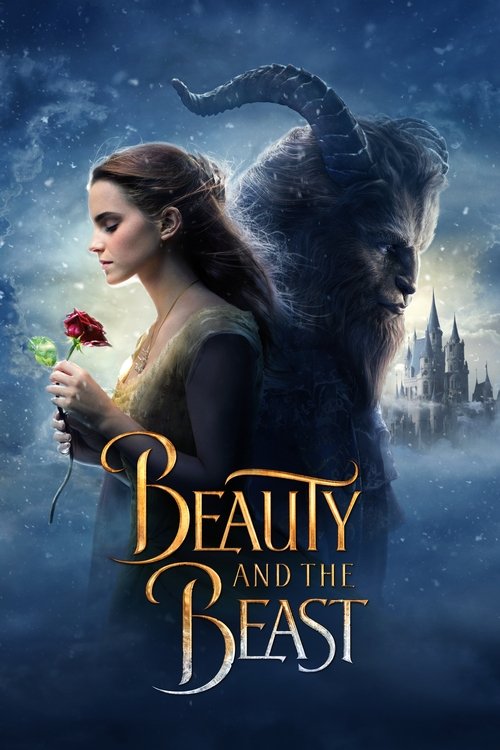
Beauty and the Beast
2017 · Bill Condon
For a cozy family night or when you want pure fairy-tale comfort — zero challenge, maximum nostalgia, the cinematic equivalent of rereading a favorite book.
What it's about
In a French village in the 18th century, Belle — bookish, restless, out of step with her neighbors — trades her freedom for her father's and becomes the captive of a prince cursed into the form of a beast, in a castle where the servants have been transformed into living clocks, candelabras, and teapots. Unless he can learn to love and be loved before the last petal of an enchanted rose falls, the curse becomes permanent. It's Disney's live-action retelling of its own animated classic, songs and all.
The experience
Lavish, familiar, and unabashedly romantic — a film that wants to wrap you in ballgowns, candlelight, and Alan Menken melodies. It moves at a stately musical's pace and aims squarely at the heart, banking on your affection for a story you likely already know.
Performances
Emma Watson brings a self-possessed intelligence to Belle, and Dan Stevens manages real warmth and wounded pride from under a fully digital Beast; Luke Evans has a ball as the preening villain Gastón.
The craft
The production design is genuinely opulent — the ballroom, the castle, the village all built to overwhelm — and the Menken score returns with new songs added. The digital household objects and Beast are technical showpieces that land differently for different viewers. This is a film made for a big bright screen and good speakers on the musical numbers.
Why it matters
A billion-dollar juggernaut that proved the commercial case for Disney's live-action remake program and set the template every subsequent remake followed.
Snapshot
Bill Condon's Beauty and the Beast is Disney's live-action remake of its own landmark 1991 animated feature — itself the first animated film nominated for the Academy Award for Best Picture. Arriving in March 2017, it was the studio's most ambitious "reimagining" to date within a remake cycle that had begun tentatively earlier in the decade. The film retains the 1991 film's story architecture, its Alan Menken score, and its central romance between the bookish Belle (Emma Watson) and a cursed prince (Dan Stevens), while expanding the running time to roughly two hours and grafting on new songs, backstory, and a fully digital cast of enchanted household objects. Commercially it was a phenomenon — grossing over a billion dollars worldwide and standing among the top-earning releases of 2017 — while critically it occupied an uneasy middle ground: admired for craft and spectacle, questioned for the very fidelity that made it a hit. It is best understood less as an independent artwork than as a case study in franchise stewardship, nostalgia economics, and the technological maturation of photoreal digital performance.
Industry & production
The film was produced by Mandeville Films (David Hoberman and Todd Lieberman) for Walt Disney Pictures, and shot principally at Shepperton Studios in England, with Sarah Greenwood's built sets standing in for the provincial French village of Villeneuve and the Beast's castle. It sits at a pivotal point in Disney's live-action-remake strategy. Tim Burton's Alice in Wonderland (2010) had proven the billion-dollar potential of reworking animation-adjacent properties in live action; Maleficent (2014), Cinderella (2015), and Jon Favreau's The Jungle Book (2016) refined the model. Beauty and the Beast was the moment the studio turned that model on one of its most beloved and awarded animated titles, raising the stakes of fidelity: audiences arrived with the 1991 film memorized. Disney's calculus — recognizable IP, four-quadrant appeal, built-in soundtrack — paid off spectacularly and effectively locked in the remake pipeline that followed (Aladdin, The Lion King, Mulan, and beyond). The production also generated pre-release publicity through Condon's remarks characterizing a brief subplot involving Gaston's sidekick LeFou (Josh Gad) as an "exclusively gay moment"; the ensuing coverage, including a reported theater cancellation and age-rating discussions in some territories, became part of the film's marketing weather, though the on-screen content itself was slight.
Technology
Technologically the film's center of gravity is the Beast, realized through performance capture rather than a practical creature suit or hand-drawn animation. Dan Stevens performed on set in a muscle-suit rig and on stilts, wearing a head-mounted camera to capture facial performance, with the digital Beast built over that data by the visual-effects teams (Digital Domain among the principal vendors). This approach — an actor's full performance driving a photoreal non-human character — descends from the lineage of Gollum and Favreau's Jungle Book animals, and it let the Beast retain Stevens's eyes and micro-expressions, central to selling the romance. The enchanted objects — Lumière, Cogsworth, Mrs. Potts, and the rest — were fully computer-generated characters animated to preserve traces of their voice actors' faces within candelabra, clock, and teapot forms, a considerably harder anthropomorphic problem than the 1991 hand-drawn versions. Large set-piece numbers such as "Be Our Guest" were constructed as dense digital environments layered over the practical dining hall. The production is a demonstration of how, by 2017, photoreal CG had become reliable enough to carry lead-character emotional weight for a mainstream family audience.
Technique
Cinematography
Tobias A. Schliessler photographed the film in a lush, saturated, high-key register appropriate to a storybook fantasy, favoring warm gold interiors for the castle's enchanted spaces and cooler tones for its cursed decay. The camera is mobile and often sweeping — craning and circling through musical numbers to echo the fluid "camera" moves that CGI had made routine in animation. The most-discussed visual passage is the ballroom waltz, staged in the golden gown against a domed, frescoed hall, which consciously reprises the 1991 film's celebrated computer-assisted ballroom shot. Throughout, the image privileges scale, texture, and costume detail over naturalism; this is cinematography in service of production design and spectacle rather than an independently authored visual argument.
Editing
Virginia Katz, a long-standing Condon collaborator (she cut Dreamgirls, Kinsey, and Gods and Monsters), edited the film. The cutting is organized around the songs, and Katz's task was largely one of integrating live-action performance with extensive digital character animation and effects plates into coherent musical sequences. The rhythm is broadly faithful to the beats of the animated original, which is both the film's discipline and its constraint: the editing rarely surprises a viewer who knows the 1991 film, instead expanding scenes to accommodate new material — added backstory for Belle's mother and the Beast's upbringing, and the new songs — without fundamentally re-choreographing the story's shape.
Mise-en-scène / staging
This is the film's strongest craft dimension. Production designer Sarah Greenwood and set decorator Katie Spencer built a detailed Rococo world, and costume designer Jacqueline Durran — a repeat collaborator of theirs on Joe Wright's films — dressed it, from Belle's practical blue-and-white village dress to the emblematic yellow ballgown and Gaston's militaristic red. Both Greenwood and Durran are among British cinema's most decorated craftspeople, and their work here reads as a genuine authorial contribution: the staging leans into theatrical, painterly tableaux, dense with props and period ornament. The Beast's castle is designed as a physical embodiment of the curse — Gothic, frozen, overgrown — that visibly warms as the romance thaws it.
Sound
The soundscape is built on Alan Menken's score and the songbook, mixed for the immersive scale of a modern musical. Vocal performances were recorded for the principal cast, and it was reported and widely noted that Emma Watson's singing received digital pitch assistance in post — a point of some critical commentary about the trade-offs of casting a star lead over a trained singer. The enchanted-object numbers required tight synchronization of dialogue and song to animated CG characters. Beyond music, the sound design services the fantasy — magic, transformation, the Beast's vocalizations layered over Stevens's voice — in a polished, unobtrusive studio register.
Performance
Emma Watson plays Belle as capable and self-possessed, and the production emphasized the character's revised agency — recast here as an inventor in her own right, not only a reader. Critical response to her performance was divided, some finding it earnest and modern, others cool. Dan Stevens's Beast is the film's most technically interesting turn, a performance delivered almost entirely through capture and voice yet retaining wit and hurt. Luke Evans makes a robust, comic-menacing Gaston, and Josh Gad's LeFou supplies broad comedy. The supporting voice cast is a roster of prestige: Ewan McGregor (Lumière), Ian McKellen (Cogsworth), Emma Thompson (Mrs. Potts), Stanley Tucci, Audra McDonald, Gugu Mbatha-Raw, and Kevin Kline as Belle's father Maurice. The ensemble's theatrical pedigree suits the material's musical-theater roots.
Narrative & dramatic mode
The film operates in the integrated book-musical mode, where songs advance character and plot rather than pausing for spectacle alone — a form Disney's 1989–1994 animated renaissance had itself adapted from Broadway, largely through Menken and lyricist Howard Ashman. Structurally it is a fairy-tale romance of transformation and interiority: the "monster" who must learn to love and be loved. The 2017 screenplay by Stephen Chbosky and Evan Spiliotopoulos preserves this spine while adding motivating backstory — the fate of Belle's mother, the origins of the prince's cruelty, and a plague-haunted history for Villeneuve — apparently to answer questions the leaner animated version left as fairy-tale ellipsis. Whether these additions deepen the tale or over-explain its dream logic is a central critical question about the film.
Genre & cycle
Beauty and the Beast belongs to two overlapping genres — the film musical and the fairy-tale fantasy — and to one very specific industrial cycle: the Disney live-action remake. Within that cycle it is arguably the fullest expression of the "faithful" wing (as opposed to the revisionist Maleficent, which retells its source from the villain's perspective). It hews closely to a specific, canonized predecessor, and its meaning is largely relational: it exists in dialogue with the 1991 film and, more distantly, with the tale's long history — Jeanne-Marie Leprince de Beaumont's 1756 version and Jean Cocteau's 1946 La Belle et la Bête, whose imagery haunts every screen incarnation of the story.
Authorship & method
Bill Condon is a director whose career braids two strands: literate, character-driven dramas about performance and identity (Gods and Monsters, for which he won the Academy Award for Adapted Screenplay; Kinsey; Mr. Holmes) and large-scale musical and franchise filmmaking (Dreamgirls; the final two Twilight installments). Beauty and the Beast draws on both — his affinity for backstage/showtune spectacle and his interest in outsiders and hidden selves. The authorship here, though, is emphatically collaborative and, in significant measure, corporate: Condon works within a studio brief to honor a beloved text. His key collaborators shape the result at least as much as he does. Composer Alan Menken returned to his own 1991 score, writing new songs — "Evermore," "Days in the Sun," "How Does a Moment Last Forever," and others — with lyricist Tim Rice, since Menken's original collaborator Howard Ashman had died in 1991; the new material self-consciously extends rather than replaces the classic songbook. Editor Virginia Katz and the screenwriters Chbosky and Spiliotopoulos round out the core creative team, alongside the design partnership of Greenwood and Durran. The "method," in short, is stewardship: interpretation constrained by fidelity.
Movement / national cinema
The film resists a movement label. It is a Hollywood studio product financed by Disney, but physically it is a British production, made at Shepperton with a heavily British crew and a design team drawn from the top of the UK film-craft world. In that sense it participates in the long tradition of American studios using British studios, talent, and heritage-film craftsmanship for period spectacle. It is not "national cinema" in any expressive sense; it is transnational blockbuster manufacture with a distinctly British artisanal backbone.
Era / period
As an artifact of 2017, the film sits squarely in the era of IP-driven, nostalgia-monetizing tentpole filmmaking, when major studios increasingly favored known quantities — remakes, sequels, cinematic universes — over original properties. It also reflects the period's technological confidence in photoreal digital humans and creatures, and the period's cultural conversations: the mild "gay moment" discourse and, more substantively, an attempt to update the heroine's agency for a post-2010s audience sensitive to the passivity of older fairy-tale princesses. The film's diegetic setting is a stylized, ahistorical "once upon a time" France, deliberately timeless rather than pinned to a real 18th-century milieu.
Themes
At its core the film restates the tale's enduring themes: the distinction between outward appearance and inner worth; love as a transformative and reciprocal force; the redemption of cruelty through empathy. Belle's arc foregrounds intellectual curiosity and non-conformity — the woman who reads, invents, and refuses the handsome brute — while Gaston embodies toxic charisma and entitlement, and the Beast the possibility of change. The 2017 additions layer in themes of grief and inherited damage (both leads shaped by absent or failed parents), nudging the romance toward a story of two wounded people healing each other. Underneath runs the meta-theme, perhaps unintended, of the remake itself: memory, preservation, and the desire to make the past live again in richer detail.
Reception, canon & influence
Critical reception was mixed-to-positive. Reviewers broadly praised the production and costume design, the Menken score, and the ambition of the enchanted-object realizations, while a substantial strand of criticism argued that the film's close adherence to the 1991 original left it feeling redundant — technically superior in places, but lacking the animated version's economy and inventive lightness. Emma Watson's Belle and the digitally assisted singing drew divided notices. Commercially, however, the film was an unqualified triumph, grossing over a billion dollars worldwide and ranking among the year's biggest releases.
Influences on the film (backward): the immediate parent is Disney's 1991 animated feature (directed by Gary Trousdale and Kirk Wise, with Menken and Ashman's songs); behind that stand the literary tale as codified by Leprince de Beaumont and the visual poetry of Cocteau's 1946 film. Technologically it inherits the performance-capture lineage running through Andy Serkis's Gollum and Favreau's The Jungle Book, and industrially it follows the template of Disney's earlier remakes, especially Cinderella (2015).
Legacy (forward): its most concrete influence is on Disney's own strategy. As one of the highest-grossing entries in the live-action-remake cycle, it validated the "faithful billion-dollar remake" and helped accelerate the run of adaptations that followed. Its lasting cultural footprint is modest as an artwork — the 1991 film remains the canonical version — but considerable as a business event and as a marker of where photoreal digital character work stood in the late 2010s. The honest scholarly verdict is that its importance is industrial and technological more than aesthetic: a film that shaped a studio's decade of output more than it shaped the art of the musical or the fairy tale.
A Deleuzian reading
A woman in a yellow gown steps into a gold room and starts to turn, and the camera lifts and swings around her and the animal she's dancing with.
The full Deleuzian reading of Beauty and the Beast →
Reception
A $1.26 billion juggernaut in 2017 — the biggest live-action musical ever at the time — that critics greeted with a shrug and audiences with nostalgia; now it's routinely Exhibit A in the case against Disney's live-action remake machine, remembered more as a business decision than a film.
How Beauty and the Beast was received, from release to now →
How to watch Beauty and the Beast: what to notice on a first viewing
- Watch the camera crane and circle through every song. Schliessler keeps the camera airborne in musical numbers, echoing the fluid virtual camera moves that CGI animation had already trained audiences to expect. The live-action camera imitates a cartoon camera, matching the film's method of remaking its own animated source.
- Notice the castle's warm gold rooms against its cold, gray ones. The palette splits between saturated gold interiors for enchanted spaces and cooler, drained tones for rooms the curse has left cold. Color does the story's emotional work before any dialogue does.
- Look at how many props and period details fill each room. Greenwood and Spencer's Rococo sets pack every frame with ornament, and Durran's costumes are built with the same density. The staging works like painted tableaux you arrive at, not spaces the story moves through naturally.
- Track the Beast's eyes when he isn't speaking. Dan Stevens plays the role almost entirely through capture, and his face carries feeling the plot hasn't given him anywhere to put yet. This is the film's newest craft achievement: an emotional performance built entirely on a face that doesn't physically exist.
- Listen for how smooth Belle's singing sounds against her speaking voice. Emma Watson's vocals received reported pitch correction, giving her singing a different texture than her spoken dialogue. The seam between speech and song exposes a real trade-off in casting a star over a trained singer.
The whole guide to watching Beauty and the Beast, with the keys for a rewatch →
Influences: the films it descends from and the films it influenced
- Beauty and the Beast (1991) — The direct parent: the ballroom waltz crane and 'Be Our Guest' are restaged nearly shot-for-shot, and Menken's score plus Ashman's song architecture are inherited wholesale as the film's structural spine.
- La Belle et la Bête (1946) — The enchanted-object animism — living candelabra, sentient household fixtures — and the sympathetic, leonine Beast design descend from Cocteau's surrealist décor and human-eyed monster.
- Cinderella (2015) — Established the 'dignified faithful live-action Disney remake' template, including Sandy Powell's costume-as-authorship approach and the practice of grafting added protagonist backstory onto the canonical tale.
- The Jungle Book (2016) — The immediate technical parent: photoreal-CG environments and a fully digital creature performance keyed to a live actor, the pipeline B&B adopts for the Beast.
- The Lord of the Rings: The Two Towers (2002) — Andy Serkis's Gollum codified the performance-capture-lead technique — an actor driving a digital character's face and body — that the Beast's facial mocap directly extends.
- Avatar (2009) — Pioneered the facial performance-capture rig that maps an actor's micro-expressions onto a photoreal non-human face, the core method behind Stevens's digitally augmented Beast.
- Dreamgirls (2006) — Condon's own prior musical supplies his song-organized cutting and backstage-showtune spectacle method, carried directly into the 2017 numbers.
- Chicago (2002) — Condon's adapted screenplay here worked out his strategy for restructuring a stage book-musical into editing-driven screen numbers, later applied to the integrated musical form of B&B.
- Moulin Rouge! (2001) — Model for the craning, circling camera and high-key saturated palette deployed for maximalist, kinetic musical set-pieces.
- Alice in Wonderland (2010) — Launched Disney's billion-dollar CG-heavy fairy-tale live-action model — the industrial template of green-screen fantasy tentpole that B&B follows commercially.
- Enchanted (2007) — A Menken-scored, self-aware live-action Disney fairy-tale musical that rehearsed translating the animated musical idiom into live-action staging and orchestration.
- Aladdin (2019) — Directly extends the 'faithful billion-dollar remake' formula B&B validated, including new songs written to self-consciously enlarge the classic songbook rather than replace it.
- The Lion King (2019) — Pushes the photoreal-CG remake further by rendering the entire cast as digital creatures, escalating the performance-driven photoreal-animal work B&B used for the Beast.
- The Little Mermaid (2023) — Repeats B&B's exact playbook — Menken returning to his own score with a new lyricist adding songs to the vintage songbook, wrapped in photoreal-CG spectacle.
- Cats (2019) — A parallel experiment applying digital-fur performance capture to human leads within an integrated book-musical, testing the same photoreal-character-plus-song approach.
- Wicked (2024) — Extends the lavish rococo production design and integrated book-musical staging into big-screen spectacle, sharing B&B's costume-as-authorship and song-driven cutting.
- Twilight: Breaking Dawn – Part 2 (2012) — Condon's other CG-franchise tentpole, where he honed directing actors against heavy digital-character work and photoreal effects under a fidelity-bound studio brief.
- How to Train Your Dragon (2025) — Live-action remake that preserves the original's iconic score as emotional through-line — the Menken continuity mirroring Powell's returning themes.
Similar films
- Beauty and the Beast (1991) — influence & lineage
- Beauty and the Beast (1946) — influence & lineage
- Cinderella (2015) — influence & lineage
- Alice in Wonderland (2010) — influence & lineage
- Moulin Rouge! (2001) — influence & lineage
- Beauty and the Beast (1979) — shared sensibility
- Tangled (2010) — shared sensibility
- Dracula (2025) — shared sensibility