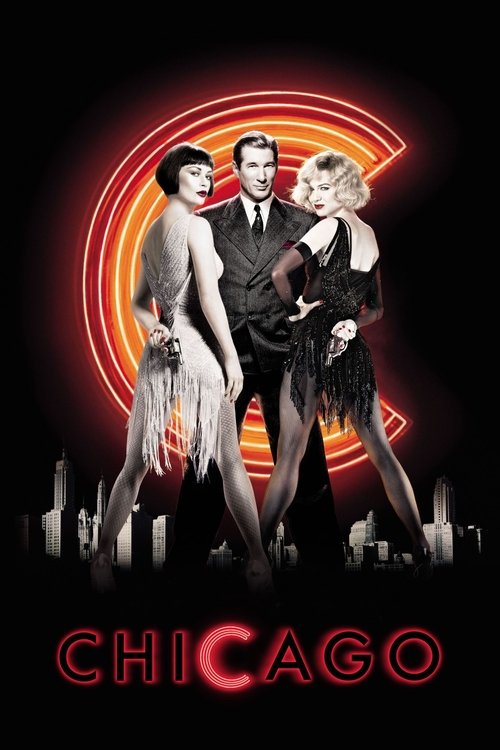
Chicago
2002 · Rob Marshall
For a night when you want pure razzle-dazzle — showstoppers, sequins, and wicked laughs — with just enough acid underneath to feel smart about it. Comfort viewing with claws.
What it's about
Two murderesses — vaudeville star Velma Kelly and wannabe Roxie Hart — land on the same death row in 1920s Chicago and discover that the only thing standing between them and the gallows is publicity. With a silver-tongued lawyer spinning their crimes into front-page melodrama, the rivals compete for headlines in a city where a murder trial is just another opening night.
The experience
Brassy, fast, and gleefully cynical — the numbers erupt out of grim jailhouse reality like fever dreams, and the whole thing moves with a chorus line's snap. It's funny and dazzling first, and the satire's bite sneaks up on you afterward.
Performances
Renée Zellweger plays Roxie's hunger for fame with a kewpie-doll ferocity, Catherine Zeta-Jones is all lethal poise and killer pipes as Velma — a performance that won her an Oscar — and Richard Gere has slippery fun as the lawyer who treats the press like his orchestra.
The craft
Rob Marshall solved the puzzle that stalled the film for decades by staging every musical number inside Roxie's fame-addled imagination, razor-cut against the grubby Cook County jail. The Kander and Ebb songs are irresistible, the editing is percussive, and it's a film built for a big screen and loud speakers — the numbers land like knockout punches.
Why it matters
It completed the early-2000s resurrection of the Hollywood musical, swept up six Oscars including Best Picture, and its satire of celebrity criminals and the public's short memory has only grown sharper.
Bob Fosse never got to film his 1975 stage vaudeville about murder as showbiz, so it fell to Broadway choreographer Rob Marshall, whose debut solved the problem that had stalled the project for decades: the numbers unfold inside Roxie Hart's fame-addled imagination, razor-cut against the grubby reality of a Cook County jail. Renée Zellweger's Roxie and Catherine Zeta-Jones's Velma — rival murderesses competing for headlines in 1920s Chicago — are pure Kander and Ebb creations, cynics who grasp that in America a trial is just another opening night, and Richard Gere's silver-tongued lawyer conducts the press like an orchestra. Its satire of celebrity criminality and the public's short memory has only sharpened with time. Arriving on the heels of Moulin Rouge!, the film completed the resurrection of the Hollywood musical, taking six Oscars including Best Picture — the first musical so honored since Oliver! in 1968 — with Martin Walsh's editing doing the work Fosse once did with hips and bowler hats.
A Deleuzian reading
A woman walks a corridor in Cook County jail.
The full Deleuzian reading of Chicago →
Reception
A box-office smash that swept the 2003 Oscars — six wins including Best Picture, the first musical to take the top prize since Oliver! in 1968 — then spent years as a punching bag in 'undeserving winner' debates, and has lately been reappraised as a sharper, more cynical film than its awards-bait reputation suggested.
How Chicago was received, from release to now →
Influences: the films it descends from and the films it influenced
- Cabaret (1972) — The direct blueprint: Kander & Ebb songs and Fosse's angular vaudeville choreography sealed onto the Kit Kat Klub stage as ironic counterpoint to the plot — Chicago literalizes this by relocating every number into Roxie's imagination.
- All That Jazz (1979) — Fosse's fantasy production numbers as projections of a character's psyche, cross-cut against grim reality — the reality/fantasy editing scheme Chicago adopts wholesale.
- Sweet Charity (1969) — Fosse's film-directing debut established the tight framing, fragmented body-part isolations, and cutting-on-movement that 'builds dance by editing' rather than holding the full figure — the exact grammar of Chicago's numbers.
- Moulin Rouge! (2001) — The immediate sibling of the revival: hyperkinetic music-video cutting that manufactures dance and spectacle from editing tempo — a parallel solution to staging numbers for a post-MTV audience.
- West Side Story (1961) — Revived the serious book musical on film by staging numbers as editing-driven fantasy, extending the West Side Story lineage of using cutting rhythm—not just camera—to render dance cinematically.
- Gentlemen Prefer Blondes (1953) — Inherits the Cole-via-Fosse jazz idiom and the dual-register cutting between diegetic scene and fantasy performance number that Blondes uses in its intercut musical set-pieces.
- Funny Girl (1968) — Revives the Ziegfeld-era razzle-dazzle production number and the brassy self-asserting woman, staged as show-within-a-show set pieces.
- Kiss of the Spider Woman (1985) — Kander and Ebb numbers staged as intercut fantasy escapes from a jailed reality — the same intercutting-reality-and-fantasy engine, scripted by Bill Condon.
- Memoirs of a Geisha (2005) — Marshall's own director-choreographer method — cross-cut musical setpieces and life conceived as staged performance — carries directly into Memoirs' dance numbers and its framing of geisha life as choreographed spectacle, with Beebe/Myhre/Atwood/Scalia partly retained.
- Pitch Perfect (2012) — Its editing intercuts an imagined performance stage with narrative reality on musical accents, the concert-stage vocabulary Pitch Perfect adopts for its ICCA numbers.
- The Greatest Showman (2017) — Establishes the beat-locked, quick-cut number as internal fantasy intercut with drab reality — the editorial grammar Showman borrows for staging songs as psychological interiority rather than diegetic performance.
- Beauty and the Beast (2017) — Condon's adapted screenplay here worked out his strategy for restructuring a stage book-musical into editing-driven screen numbers, later applied to the integrated musical form of B&B.
- Wicked (2024) — Revived the commercial Hollywood stage-to-screen adaptation and set the editing-driven template for translating a Broadway song ledger into feature form that Wicked's fidelity-with-expansion approach inherits.
- Better Man (2024) — Literalized characters' interior psychology as fantasy production numbers cut against mundane reality, the staging device Better Man uses to externalize Robbie's mental states.
- Wicked: For Good (2025) — Re-established the prestige Broadway-to-Hollywood adaptation as a viable Oscar tentpole, defining the pipeline and cutting grammar For Good works within.
- 42nd Street (1933) — Founding backstage-musical structure (audition/rehearsal to opening night) and the 'putting on a show' frame Chicago inherits and refracts through vaudeville.
- Gold Diggers of 1933 (1933) — Busby Berkeley's numbers exist only in edited/kaleidoscopic space with no coherent stage geography — the precedent for spectacle that lives in the cut, not in a filmable proscenium.
- 8½ (1963) — The interpenetration of memory, fantasy, and reality within one protagonist's head — the source Fosse (and later Marshall) drew on for staging inner life as performance.
- Singin' in the Rain (1952) — Self-reflexive showbiz backstage musical about celebrity manufacture and media image — Chicago's media-spectacle theme in a classical MGM register.
- The Band Wagon (1953) — The 'show within a show' backstage form and the diegetic-number logic that keeps musical fantasy nested inside a theatrical frame.
- Nine (2009) — Marshall reprising his own imagined-numbers-on-a-single-stage device, this time explicitly adapting 8½ — the direct authorial continuation of Chicago's method.
- Dreamgirls (2006) — Written by Chicago's screenwriter Bill Condon; a backstage Motown musical that likewise pushes numbers into heightened non-realist psychological space and foregrounds celebrity manufacture.
- Sweeney Todd: The Demon Barber of Fleet Street (2007) — A stage-to-screen adaptation greenlit in the screen-musical gold rush Chicago's Best Picture win reopened, using cinematic interiority to justify song.
- Hairspray (2007) — Post-Chicago Broadway-to-film revival that reproduces the fast-cut, energetically edited ensemble number as the default screen-musical style Chicago validated.
- La La Land (2016) — Extends the imagined/fantasy-number device — numbers that erupt from and comment on characters' inner longing — within the same musical-revival lineage Chicago reignited.
- Burlesque (2010) — Explicitly models its club-stage numbers and cutting on Chicago's Fosse-via-Marshall vaudeville playbook, framing every song as a bounded stage performance.
Similar films
- Moulin Rouge! (2001) — influence & lineage
- La La Land (2016) — influence & lineage
- All That Jazz (1979) — influence & lineage
- Cabaret (1972) — influence & lineage
- Singin' in the Rain (1952) — influence & lineage
- The Sting (1973) — shared sensibility
- The Trial of the Chicago 7 (2020) — shared sensibility
- Some Like It Hot (1959) — shared sensibility