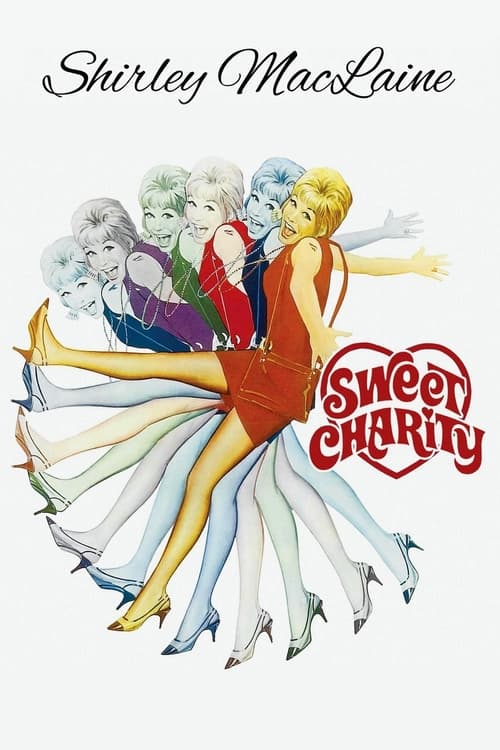
Sweet Charity
1969 · Bob Fosse
For when you want a big old-fashioned musical with a bittersweet streak — something that lets you belt along and still leaves a lump in your throat. Comfort viewing with an honest bruise under the sequins.
What it's about
Charity Hope Valentine dances with strangers for a living in a seedy New York ballroom, and somehow keeps believing love is right around the corner. After one betrayal too many, she meets Oscar — a shy, decent man who might finally be the one to lift her out of the life she's ashamed to name. It's a big, splashy musical built around a small, bruised heart.
The experience
It swings between razzle-dazzle production numbers and moments of real loneliness, so you're grinning through one scene and aching through the next. The dancing is electric — all angles, hips, and attitude — and the whole thing runs on Shirley MacLaine's desperate, radiant optimism.
Performances
Shirley MacLaine carries the film — funny, gawky, and heartbreaking, a dancer's body wrapped around an open wound of a character who refuses to stop hoping.
The craft
This is Bob Fosse's first film as director, and you can watch him inventing his screen style number by number: the slouched shoulders, the frozen poses, the sudden zooms and cuts that turn choreography into montage. It's a huge Technicolor roadshow production, so the colors and staging genuinely reward the biggest screen you can find. Some sequences are among the most imitated dance staging ever put on film.
Why it matters
A famous commercial casualty of the studio musical's collapse, it's now valued as the laboratory where Fosse worked out the cinematic language he'd perfect a few years later — the bridge between Broadway choreography and modern movie-musical editing.
Snapshot
Sweet Charity is Bob Fosse's feature directorial debut: a roadshow musical adapted from the 1966 Broadway show he had staged and choreographed, which was itself a transposition of Federico Fellini's Nights of Cabiria (1957). Shirley MacLaine plays Charity Hope Valentine, a dance-hall hostess whose faith in love survives a serial history of betrayal. The film arrived at the exact moment the big-studio musical was collapsing under its own budgets, and it became both a commercial casualty of that collapse and a laboratory in which Fosse worked out—often through excess—the cinematic vocabulary he would discipline three years later in Cabaret. It is best understood as a transitional work: the last gasp of the Technicolor roadshow spectacle and the first stirring of a distinctive screen author.
Industry & production
The film was produced and released by Universal Pictures, with Robert Arthur producing, as a prestige roadshow attraction—reserved-seat engagements, an overture, intermission and entr'acte, and a lavish 70mm presentation. This model had made fortunes in the mid-1960s (My Fair Lady, The Sound of Music), and every major studio chased it into the end of the decade. By 1969, however, the strategy was cratering: expensive, old-fashioned musicals were failing in rapid succession, and Sweet Charity shared that fate. It is consistently described in the historical record as a costly production that underperformed badly at the box office; precise figures vary across sources, so beyond noting it as a significant commercial disappointment I will not assign numbers.
Fosse's engagement was itself notable. He was hired to direct on the strength of the stage version, but he was a Broadway man untested behind a camera, and Universal surrounded him with seasoned studio professionals. The gamble's near-failure reportedly endangered his film career; that it was redeemed by Cabaret (1972)—which won Fosse the Academy Award for Best Director—is one of the defining reversals in New Hollywood's early history. A well-documented production wrinkle is the ending: Fosse shot a downbeat conclusion faithful to Fellini, in which Charity is again abandoned, and an alternate, more consoling version was also prepared. Different release and broadcast versions have carried different endings, and the ambiguity around Charity's fate—summed up in the film's ironic "and she lived hopefully ever after"—is part of its textual identity.
Technology
Sweet Charity is a showcase of late-roadshow technology: Technicolor, anamorphic Panavision widescreen, and 70mm blow-up presentation with stereophonic sound for the reserved-seat engagements. The format demanded large, deep sets and sustained long takes for the dance numbers, but Fosse pushed against the stateliness the technology usually enforced. He leaned hard on the optical-printing and post-production tools of the era—freeze-frames, jump cuts, split-screen, and abrupt zooms—so that the film's "modernity" is as much a matter of laboratory effects as of staging. The tension between the format's grandeur and Fosse's restless cutting is one of the picture's defining and most-debated qualities.
Technique
Cinematography
Cinematography is by Robert Surtees, a multiple-Oscar-winning veteran whose career stretched from The Bad and the Beautiful and Ben-Hur to the era-defining The Graduate (1967) and, soon after, The Last Picture Show (1971). Surtees gives Fosse both classical widescreen command—the deep, sculpted spaces of the Pompeii Club and the Fandango Ballroom—and the mobility the director's editing scheme required. The camera is frequently unmoored: high angles that flatten the dancers into pattern, sudden telephoto compressions, and framings that isolate a hip, a hand, or a bowler hat in a way that translates Fosse's stage grammar into lens terms. Where the film is criticized, it is usually for the disjunction between Surtees's polished imagery and the aggressiveness with which it is chopped in the cutting room.
Editing
Editing (credited to Stuart Gilmore) is the film's most conspicuous and most contested element. Fosse, entranced by the European art cinema he admired—Fellini above all, but also the freeze-frames and jump cuts associated with the French New Wave—imposed a percussive, interruptive cutting style on numbers that might, on stage, have unspooled in continuous time. Musical phrases are broken by hard cuts; images freeze at the peak of a movement; perspectives multiply within a single beat. Many critics found the approach gimmicky and self-conscious, obscuring rather than serving the choreography. The importance of this over-reach is retrospective: Fosse himself absorbed the lesson, and the tighter, motivated cutting of Cabaret—where every edit answers to the drama—reads as a direct correction of Sweet Charity's indulgences.
Mise-en-scène / staging
This is where the film is least disputed and most influential. Fosse's choreography is the mature statement of a style now synonymous with his name: turned-in knees, rolled shoulders, splayed or "jazz" hands, angular hip isolations, the erotic use of stillness, and props—bowler hats, chairs, a brass railing—as extensions of the body. Two set-pieces are canonical. "Big Spender," staged at the Fandango, arrays the hostesses along a railing in poses of predatory languor, their come-ons curdled into contempt; it is among the most-quoted numbers in American musical cinema. "The Rich Man's Frug," a cool, mod discotheque ballet at the Pompeii Club, is a study in detached 1960s chic, its dancers moving with hypnotic, affectless precision. Against these, "If My Friends Could See Me Now"—Charity alone in a movie star's apartment, giddy with disbelief—and the rooftop yearning of "There's Gotta Be Something Better Than This" show Fosse's staging bent toward character rather than spectacle.
Sound
The film carries the Cy Coleman score—jazz-inflected, brassy, urban—rendered for the wide roadshow soundstage. The vocal performances are integrated into the numbers rather than dubbed to invisibility, and the loud, driving orchestrations suit Fosse's staccato editing. Beyond noting the era-standard stereophonic mix for 70mm engagements and the prominence of Coleman's brass-forward arrangements, the granular technical record of the sound work is thin, and I won't over-specify it.
Performance
Shirley MacLaine anchors the film in the role Gwen Verdon—Fosse's wife and muse—had originated on Broadway. MacLaine is not the technician Verdon was, and some critics registered the difference, but she brings a bruised, gallant vulnerability that fits the film's sentimental streak; her Charity is defined by resilience rather than glamour. John McMartin reprises his stage role as the anxious, claustrophobic Oscar, lending continuity from Broadway. The supporting cast is a roster of talents: Chita Rivera and Paula Kelly as Charity's fellow hostesses Nickie and Helene, sharp and warm in equal measure; Ricardo Montalbán as the Italian film star Vittorio Vidal (a knowing Fellini echo); Stubby Kaye; and Sammy Davis Jr. as Daddy Brubeck, presiding over the hippie-church number "The Rhythm of Life."
Narrative & dramatic mode
The narrative is episodic and picaresque, a structure inherited from Fellini: Charity moves through a series of encounters—robbed and pushed into a lake by one lover, swept into the orbit of a movie star, trapped in an elevator with the neurotic Oscar—each raising and then dashing her hopes. The dramatic mode oscillates uneasily, and deliberately, between comedy and pathos. Neil Simon's stage book (the film's screenplay is credited to Peter Stone) supplies wisecracking, borscht-belt-adjacent comedy, while the underlying Fellini material insists on melancholy and near-tragedy. The result is a "sweet-and-sour" musical whose emotional register never fully resolves—an instability that the twin endings only underline. Charity is less a character who changes than one whose unchanging optimism is tested to the point of cruelty; the film's meaning lives in whether we read that optimism as heroic or as delusion.
Genre & cycle
Sweet Charity belongs to the late-1960s cycle of large-scale studio musicals—alongside Star!, Doctor Dolittle, Hello, Dolly!, and Paint Your Wagon—that attempted to repeat the Sound of Music formula and instead precipitated the genre's commercial collapse. Within that cycle it is distinguished by its European art-film source and its refusal of wholesome uplift; it is a musical about a taxi dancer, sanitized from Fellini's prostitute but still tethered to the demimonde. It thus sits at a hinge: a roadshow musical in form, but one straining toward the adult, ambivalent sensibility that "New Hollywood" was bringing to the screen in the same year as Midnight Cowboy and Easy Rider.
Authorship & method
The film is, above all, a Fosse work, and its authorship question is unusually clean because Fosse controlled both choreography and direction. His method here was to import the visual ideas of the art cinema he revered and to test them at feature scale—sometimes recklessly. The key collaborators frame that method:
- Composer Cy Coleman and lyricist Dorothy Fields provided the score. Fields, a veteran of an earlier songwriting generation, gave the show one of her last major credits; the Coleman–Fields songs ("Big Spender," "If My Friends Could See Me Now," "The Rhythm of Life," "I'm a Brass Band") are the film's durable core.
- Screenwriter Peter Stone adapted Neil Simon's stage book for the screen, retaining the comic scaffolding while opening the material cinematically.
- Cinematographer Robert Surtees supplied classical widescreen craft as a foundation for Fosse's experiments.
- Editor Stuart Gilmore executed the interruptive cutting scheme that defines—and, for many viewers, mars—the picture.
- Costume designer Edith Head dressed the film in the studio's high style. The orchestration and dance-arrangement work associated with Fosse's ensemble (a relationship that would deepen on Cabaret and All That Jazz) also shaped the score's brassy sound.
The through-line is that Sweet Charity is where Fosse learned to direct film by doing too much; his subsequent authorship is legible partly as a reaction against this debut.
Movement / national cinema
As a product, the film is squarely American studio cinema in its terminal roadshow phase. Its sensibility, however, is transatlantic. Fosse's borrowings from Fellini's Italian neorealism-turned-fabulism and from the stylistic devices of the French New Wave place it in dialogue with 1960s European art film even as it operates within the Hollywood system. This grafting of European technique onto an American commercial genre is characteristic of the moment when New Hollywood directors were absorbing foreign models; Sweet Charity is an early, imperfect instance of that cross-pollination inside the musical.
Era / period
1969 is the fault line, and Sweet Charity straddles it. It was conceived and sold as the kind of blockbuster spectacle that had defined the mid-decade, yet it opened into an industry being remade by Bonnie and Clyde, The Graduate, and the youth market. The reserved-seat, overture-and-intermission presentation already felt like an artifact; the ambivalent ending and demimonde subject felt like the future. The film's failure was thus overdetermined by its period—too expensive and formally old for the new audience, too knowing and downbeat for the family audience the roadshow model required.
Themes
The governing theme is hope as both virtue and vulnerability: Charity's inexhaustible faith in romance, repeatedly exploited, poses the question of whether persistence in the face of disappointment is nobility or self-deception. Around it cluster the film's other concerns—loneliness and anonymity in the modern city; the commodification of female companionship and the dignity of women who trade in it; the chasm between romantic fantasy (the movie star, the storybook marriage) and lived reality; and the yearning for self-transformation voiced in "There's Gotta Be Something Better Than This." The "hopefully ever after" coda crystallizes the film's refusal to grant its heroine either tragedy or fairy tale, leaving her—and us—suspended in the hope itself.
Reception, canon & influence
Contemporary reception was mixed to poor, and the film's commercial failure was severe enough to become part of its story. Much of the criticism targeted the very stylization now considered Fosse's signature: reviewers found the optical effects and jagged editing showy and distracting, and some judged MacLaine's performance more effortful than Verdon's stage template. The picture is generally regarded as an interesting misfire—admired in its set-pieces, faulted in its whole.
Its lines of influence run in both directions. Backward, the film descends most directly from Fellini's Nights of Cabiria, with Giulietta Masina's Cabiria the template for Charity; it also draws on Fosse's fascination with European modernist cinema and on the accumulated conventions of the Broadway-to-Hollywood musical. Forward, its significance is largely biographical and stylistic: Sweet Charity is the crucible in which Fosse's screen style was forged and then chastened. The lessons of its over-cutting produced the rigor of Cabaret and, later, the self-lacerating reflexivity of All That Jazz (1979), works that secured his reputation as a screen author. The choreography itself entered the permanent canon—"Big Spender" and "The Rich Man's Frug" are endlessly excerpted, imitated, and referenced—so that the film's dancing has outlived the film's reputation. Within musical-theater history, the movie also helped fix the show's songs and staging in popular memory, feeding the property's long stage afterlife. Its ultimate legacy, then, is paradoxical: a commercial failure whose individual sequences became touchstones, and whose very flaws taught its director how to make the masterpieces that followed.
A Deleuzian reading
A row of women leans on a brass railing.
The full Deleuzian reading of Sweet Charity →
Reception
A notorious 1969 box-office bomb that nearly sank Fosse's film career before it started — Universal lost millions on it. Now it's been reclaimed as the birth of the Fosse screen style, with 'Big Spender' and 'The Rich Man's Frug' treated as all-timer musical numbers even by people cool on the whole film.
How Sweet Charity was received, from release to now →
Influences: the films it descends from and the films it influenced
- Nights of Cabiria (1957) — Charity is a near-direct transplant of Giulietta Masina's Cabiria — the same episodic picaresque of a good-hearted woman on society's margins, repeatedly courted and betrayed, resolved on an identical ambiguous smile-through-tears rather than a wedding.
- 8½ (1963) — Fosse's fantasy interludes and self-reflexive slippage between a character's interior wish and observed reality copy Fellini's fluid modernist framing, treating the musical number as a mental space rather than a staged event.
- Breathless (1960) — The jump-cuts and freeze-frames Fosse grafts onto 'If My Friends Could See Me Now' and the finale are lifted wholesale from Godard's deliberate rupture of continuity editing.
- The Pajama Game (1957) — Fosse's 'Steam Heat' first codified the bowler-hat, splayed-fingers, and props-as-body-extension vocabulary that structures every Charity number, most visibly 'Big Spender.'
- Damn Yankees (1958) — Fosse's screen-choreography debut established the angular, hip-cocked, isolated-limb style of 'Whatever Lola Wants' that 'The Rich Man's Frug' refines into pure geometric froideur.
- West Side Story (1961) — Robbins's model of dance choreographed and cut specifically for the anamorphic frame — movement as cinematic narrative, not a proscenium record — is the template Fosse tests and overreaches at feature scale.
- Ben-Hur (1959) — Cinematographer Robert Surtees carried his classical 65/70mm roadshow anamorphic craft directly into Charity, supplying the stable widescreen foundation over which Fosse layers his optical experiments.
- The Umbrellas of Cherbourg (1964) — Demy's reinvention of the musical as a European art-cinema form gave Fosse license to treat the Broadway property as an auteur medium open to modernist stylization.
- On the Town (1949) — Pioneered pulling the musical number onto real city streets, the location-shot Manhattan realism Fosse adopts for Charity's exteriors against which the artifice of the numbers registers.
- Gentlemen Prefer Blondes (1953) — Fosse, who called Cole 'the teacher of us all,' extends Cole's angular, isolation-based jazz staging into the signature Fosse vocabulary of turned-in knees and articulated hands.
- Cabaret (1972) — The chastened correction of Charity's over-cutting — Fosse confines song to the diegetic Kit Kat Klub stage and motivates every edit, converting the debut's reckless optical tricks into disciplined dramatic method.
- All That Jazz (1979) — Extends Charity's jump-cut and freeze-frame reflexivity into a full autobiographical montage grammar, the fragmented interruptive cutting now a mature, self-lacerating authorial system.
- Lenny (1974) — Applies the time-scrambling, interruptive editing scheme first attempted in Charity's numbers to non-musical biographical material, proving the device could carry dramatic structure.
- Chicago (2002) — Canonizes Fosse's vaudeville body-isolation choreography and stages each song as the heroine's interior fantasy — the exact 'numbers as mental projection' logic Charity pioneered a generation earlier.
- Moulin Rouge! (2001) — Builds an entire aesthetic from the excess reviewers rejected in Charity — kaleidoscopic jump-cut, freeze-frame musical montage cut to a frenetic rhythm rather than the sustained dance take.
- Nine (2009) — Explicitly fuses Fellini's 8½ with Fosse staging — songs as an artist's interior confessions — reconstituting the precise ancestry (Italian art cinema plus Broadway isolation dance) that Charity first synthesized.
- The Wiz (1978) — Introduces the shattering of a single dance into dozens of short, non-matched setups with zooms and freeze-frames — the coverage philosophy that lets a director without musical instincts assemble a number in the cutting room.
- Hello, Dolly! (1969) — A fellow big-budget 70mm roadshow musical released the same year whose severe commercial failure shared in the genre-collapse moment that doomed Charity's expensive stylization.
- Funny Girl (1968) — A near-contemporary roadshow star-vehicle musical built, like Charity, on a single actress carrying the picture through show-stopping numbers as the integrated book-musical form gave way.
- What a Way to Go! (1964) — Reunites Shirley MacLaine with an episodic-iterative structure — a woman's serial romances — each rendered as a self-contained big fantasy production number.
Similar films
- All That Jazz (1979) — influence & lineage
- Funny Girl (1968) — influence & lineage
- Hello, Dolly! (1969) — influence & lineage
- Lenny (1974) — influence & lineage
- Nights of Cabiria (1957) — influence & lineage
- Cabaret (1972) — influence & lineage
- West Side Story (1961) — influence & lineage
- Some Like It Hot (1959) — shared sensibility