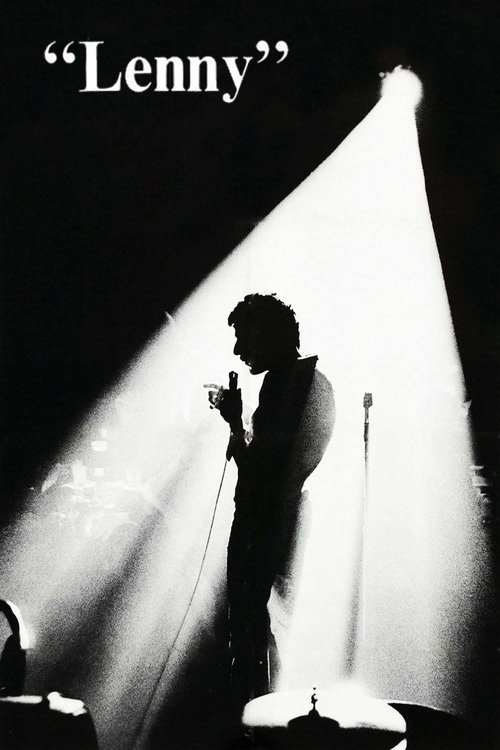
Lenny
1974 · Bob Fosse
For when you want a serious, adult biography with real bite — something to think about and argue about afterward. Challenge, not comfort; it's about free speech paying its full price.
What it's about
The life of Lenny Bruce, the 1960s comedian who turned the nightclub act into fearless social commentary — on race, sex, drugs, and hypocrisy — and was prosecuted for obscenity until the courtrooms consumed him. The film moves between his electric club performances, his volatile marriage to stripper Honey Harlow, and the interviews of those who knew him, reconstructing the man from testimony and tape.
The experience
Jagged, smoky, and intense — it cuts between stand-up, memory, and interview like a documentary having a fever dream. Funny in flashes, but the dominant feeling is watching a brilliant man grind himself against a wall, and it leaves a bruise.
Performances
Dustin Hoffman doesn't impersonate Bruce so much as inhabit his rhythm, riffing through whole club sets like live wire; Valerie Perrine is heartbreaking as Honey, a performance that won her Best Actress at Cannes.
The craft
Bob Fosse shot it in stark black and white and structured the whole film like a set of tape-recorded interviews, letting testimony and performance collide in the editing. The nightclub scenes feel genuinely live — sweat, smoke, and hostile silence — and the mosaic construction was daring for a studio biography.
Why it matters
A multiple Oscar nominee that helped define the modern warts-and-all biopic, and confirmed Fosse — between Cabaret and All That Jazz — as one of the era's boldest American directors.
Snapshot
Lenny is Bob Fosse's second feature after Cabaret (1972) and the film in which he most fully abandoned the musical's protective armature. Adapted by Julian Barry from his own 1971 Broadway play, it reconstructs the life of Lenny Bruce — the Long Island–born comedian who transformed the nightclub monologue from a delivery system for gags into an instrument of moral inquiry, and who spent the last years of his life litigating that transformation in criminal courtrooms until an obscenity prosecution and a morphine overdose closed the account in 1966. Dustin Hoffman plays Bruce; Valerie Perrine plays Honey Harlow, the stripper he married; Jan Miner plays his mother, Sally Marr.
The film's governing decision is structural rather than dramatic. Fosse and editor Alan Heim built the picture around a set of tape-recorded interviews conducted after Bruce's death — Honey, Sally, and Bruce's manager (Stanley Beck) speaking to an unseen interviewer — and let those testimonies detonate the chronology. The result is not a life told forward but a life reconstructed under interrogation, cut in high-contrast black and white by Bruce Surtees, with the stand-up performances functioning as both narrative spine and running commentary. It arrived in the same year as Chinatown, The Conversation, and The Godfather Part II, and belongs unmistakably to that New Hollywood cohort's appetite for institutional rot and unreliable memory. It received six Academy Award nominations, including Best Picture, Best Director, Best Actor for Hoffman, and Best Actress for Perrine, and won none of them — the year of The Godfather Part II. Perrine had already taken the best actress prize at Cannes.
What Lenny is finally about is the collision between a man who believed words were morally neutral and a state apparatus that believed otherwise. Fosse's sympathies are obvious, but the film is harder on its subject than a martyrology would be: it watches Bruce become a bore, a courtroom pedant reading transcripts aloud to audiences who came to laugh.
Industry & production
Fosse came to Lenny in an extraordinary position. In 1973 he had won the Academy Award for Cabaret, the Tony for Pippin, and the Emmy for Liza with a Z — an unduplicated sweep that bought him latitude nobody hands a second-time director. He spent it on a black-and-white biography of a dead comedian whose act had been ruled obscene, produced by David Picker's Marvin Worth Productions and released by United Artists, a studio then unusually hospitable to director-driven projects.
Marvin Worth's involvement is the pivot. Worth had known Bruce and had already produced the 1974 documentary Lenny Bruce Without Tears material and shepherded Bruce's story through several forms; he held the rights and the relationships that made access to Honey Harlow and Sally Marr possible. Julian Barry's play had run on Broadway in 1971 with Cliff Gorman as Bruce — Gorman won the Tony — and the stage version was a far more theatrical, hallucinatory piece, using masks, ensemble, and expressionist devices. Barry rewrote it substantially for Fosse, stripping the stage machinery and moving toward the documentary-interview frame. Gorman was not cast; Hoffman, then at the height of his post-Midnight Cowboy, post-Straw Dogs standing, was.
Hoffman's preparation is one of the better-documented aspects of the production: he studied Bruce's recordings and surviving performance footage extensively and worked to reproduce not merely the material but the rhythm — the trailing-off, the self-interruption, the New York cadence sliding into jazz-musician argot. The film shot largely in and around Miami and New York in 1974, with nightclub sequences staged in real rooms rather than on sets wherever possible.
The commercial calculus was not obvious. A monochrome, structurally fractured film about obscenity law, released by a major, is a New Hollywood artifact in the precise sense: studios in 1974 were still willing to underwrite a proven director's difficult second picture on the theory that prestige and awards attention had cash value. The six nominations vindicated that theory in reputational terms. The film performed respectably rather than spectacularly; precise figures vary across sources and are not worth asserting here.
Technology
Lenny is shot in 35mm black and white at a moment when black and white had become a deliberate, slightly expensive choice rather than a default. By 1974 laboratory infrastructure for monochrome had thinned considerably; Surtees and Fosse were opting out of the industry standard, and the film's texture — heavy grain, crushed blacks, blown highlights around practical light sources — reads as a decision about credibility rather than nostalgia. The reference points are photojournalism and 1960s cinéma vérité documentary, not classical Hollywood gloss.
The other technological substrate is the audio tape recorder, which is not merely a prop but the film's organizing device. The interview sequences center on a reel-to-reel machine, and the film's structure is essentially that of a tape being assembled — testimony gathered, spliced, played back. This places Lenny in close conversation with the era's fascination with recording as both evidence and distortion: 1974 is also the year of The Conversation, and the Watergate tapes were in the national bloodstream. Bruce's own career was substantially documented and prosecuted on the basis of recordings and transcripts of his performances; the state's case against him was, in a literal sense, an argument about what was on tape and on paper. Fosse's decision to frame the film through recording apparatus is therefore thematically exact rather than merely stylish.
Technique
Cinematography
Bruce Surtees — son of cinematographer Robert Surtees, and by 1974 already established through his work with Don Siegel and Clint Eastwood — gives the film a photographic grammar of available light and aggressive contrast. Nightclub sequences are lit as nightclubs actually are: a hard frontal spot, a surrounding void, cigarette smoke made visible in the beam, faces sculpted into planes of white and black with little modeling in between. Surtees was known within the industry for shooting darker than conventional practice permitted, and Lenny is a sustained demonstration — large areas of the frame carry no detail at all, and the audience is frequently a mass of silhouette and glint rather than a set of readable faces.
Away from the stage, the visual approach shifts register but not palette. The interview footage adopts a documentary flatness: fixed framings, subjects addressing an off-screen presence, the camera occasionally adjusting as if reacting rather than pre-composed. The dramatized biographical passages sit between the two modes, using long lenses and handheld coverage in ways that keep them tonally adjacent to reportage. The consistency of the monochrome across all three registers is what allows Heim's cutting to move between them without a seam.
Editing
Alan Heim's work here is the film's authorship as much as Fosse's, and it earned him an Academy Award nomination; he and Fosse would continue the collaboration through All That Jazz (1979), where the same principles are pushed to their limit. The method is associative rather than chronological. A phrase in an interview cues a scene from a decade earlier; a punchline from the stage lands over an image that gives it a second, crueler meaning; a courtroom reading of Bruce's own words is intercut with the performance those words came from, so that the audience hears the same sentence as comedy and as evidence within seconds.
This is the central formal argument of Lenny: that context is the whole of meaning, and that the prosecution's method — extracting language from the room in which it was spoken — is itself the obscenity. The editing does not state this. It performs it, repeatedly, and the viewer arrives at the proposition by having been made to feel the gap between the two versions of the same words.
Heim also controls the film's decline. As Bruce's act degenerates into courtroom recitation, the cutting slows and the intercutting thins; the film's own vitality drains in step with its subject's. The final movement is markedly less kinetic than the first — a structural choice that risks tedium and largely earns it.
Mise-en-scène / staging
Fosse's staging instincts were formed in the theater, and Lenny's nightclub sequences are choreographed in a strict sense even though nobody dances. Bruce's relationship to the microphone, the stool, the edge of the stage, and the darkness beyond it is worked out with the precision of a musical number: where he plants, when he turns his back, how far he leans into the light. The strip-club material around Honey is staged with the same rigor and a colder eye — Fosse was expert in the mechanics of commercial eroticism and consistently unromantic about them, a thread running from Sweet Charity through Cabaret to All That Jazz.
Elsewhere the film favors cramped, unglamorous interiors: motel rooms, backstage corridors, cars, the beige institutional spaces of courthouses. There is almost no establishing grandeur. The world of Lenny is a circuit of small rooms, which is both accurate to the working comedian's life and a visual argument about confinement.
Sound
Sound design is subordinated to voice. The film is dominated by talk — Bruce's monologues, the interview testimonies, courtroom readings — and the mix keeps the spoken word forward and dry, with room tone and audience noise arranged around it. Ralph Burns, who had orchestrated Cabaret for Fosse and would score All That Jazz, provides music that is sparse and largely diegetic or near-diegetic: jazz textures appropriate to the rooms Bruce worked, rather than an emotive underscore. The refusal of conventional scoring in the dramatic passages is conspicuous and consistent with the documentary premise.
The most expressive sound choice is the treatment of audience response. Laughter in Lenny is a variable the film manipulates precisely — full and rolling in the early club scenes, thinner and more scattered as the material turns, and finally near-absent, leaving Bruce's voice hanging in a room that has stopped meeting him. The audience track is the film's most economical index of Bruce's collapse.
Performance
Hoffman's Bruce is a study in erosion. Early on he plays a mediocre, ingratiating comic doing bad impressions, and the physical vocabulary is all eagerness — light on the feet, seeking the room. As Bruce finds his voice, Hoffman's rhythm changes: the delivery becomes conversational, digressive, willing to let silence sit, and the performer stops selling. The late Bruce is heavier, sweatier, verbally circular, gripping a sheaf of legal transcripts as if the paper itself were the act. Hoffman resists the biopic temptation to make deterioration picturesque; the last scenes are simply the spectacle of a talented man boring people.
Valerie Perrine's Honey Harlow is the film's emotional ballast and its most underrated element. She carries the interview frame, and the performance is calibrated across two timescales at once — the young stripper of the flashbacks and the depleted woman recalling her, with the second constantly shading the first. Her Cannes prize and Oscar nomination were both deserved. Jan Miner's Sally Marr supplies the film's one source of unsentimental warmth, and Stanley Beck's manager provides its institutional cynicism. The supporting cast around the club circuit and the courtrooms is populated with faces that read as found rather than cast, reinforcing the documentary texture.
Narrative & dramatic mode
Lenny is an anti-chronological biography told as an oral history. Its narrators are unreliable in the ordinary human way — grieving, self-justifying, imprecise — and the film never adjudicates between them or supplies an authorial correction. This is a substantial departure from the standard biopic contract, in which the audience is granted privileged access to the truth of a life.
Three modes braid together: the interviews (present tense, documentary), the dramatized life (past tense, conventional narrative), and the stand-up performances (a third temporality that belongs to neither, since a routine is both an event in Bruce's life and a text the film can quote at will). Fosse exploits that third category constantly, using the act as chorus. A routine about hypocrisy plays over — or beside — a scene of Bruce's own hypocrisy, and the film declines to underline the irony.
The dramatic engine is not "will he succeed" but "what is being taken from him, and how much of it is he giving away." The obscenity trials supply external pressure; the addiction and the collapse of the marriage supply internal decay; the two are treated as intertwined rather than as separate acts. Crucially, Fosse withholds the martyr's climax. There is no vindicating speech, no courtroom triumph. The film's structure — testimony gathered after a death — means the ending is known from the first frame, and the interest lies entirely in the mechanism.
Genre & cycle
The film sits at the intersection of two 1970s American cycles. The first is the revisionist biopic, in which the great-man narrative is dismantled rather than celebrated — a line that runs from Patton (1970) through Lady Sings the Blues (1972) and forward to Raging Bull (1980), and which shares with Lenny an insistence that the subject be permitted to be unpleasant.
The second is the New Hollywood paranoid cycle: films about institutions grinding down individuals, surveillance, recorded evidence, and the impossibility of vindication. Lenny is not a thriller, but its worldview is that of The Conversation and The Parallax View, released the same year. The prosecution of Bruce is presented as bureaucratic and largely faceless — not a villain but a procedure — and that treatment is characteristic of the moment.
It also belongs to a smaller lineage: the show-business self-portrait as autopsy. Fosse would complete that arc with All That Jazz, where the dying performer is explicitly himself. Lenny is the rehearsal for it, with the safety of a real historical subject standing between Fosse and the material.
Authorship & method
Fosse's authorship is legible in the film's rhythm above all. His signature is the collision cut between performance and life, the treatment of the stage as a place where truth is both spoken and sold, and a persistent moral suspicion of the applause he spent his career engineering. Cabaret established the method by cutting between the Kit Kat Klub numbers and the political catastrophe outside; Lenny removes the songs and keeps the structure. In doing so it identifies what Fosse actually cared about — not the musical, but the ironic adjacency of the stage and the world.
The key collaborators form what amounts to a repertory. Alan Heim (editor) cut Lenny, All That Jazz, and Star 80, and the associative, montage-forward grammar is his as much as Fosse's. Ralph Burns (music) had arranged Cabaret and would score All That Jazz; his restraint here is a discipline imposed by the material rather than an absence of ideas. Bruce Surtees (cinematography) was not a repeat Fosse collaborator, and his contribution is correspondingly distinct — the low-light, high-contrast documentary look he brought from his Siegel and Eastwood work is what keeps Lenny from looking like a theatrical adaptation. Julian Barry (writer) had the unusual task of dismantling his own successful play; the film's willingness to abandon the stage version's expressionist machinery in favor of the interview frame was, by all accounts, developed in close collaboration with Fosse.
Two further elements of method are worth noting. First, the reliance on primary source: Bruce's routines are quoted rather than invented, which constrains the screenplay in productive ways and gives the performance sequences a documentary authority. Second, the treatment of the interviewees — the film's frame invites the audience to notice that even sympathetic testimony is shaped by the needs of the person testifying.
Movement / national cinema
Lenny is a New Hollywood film in the strict institutional sense: a studio picture given over to a director's formal experiment, made possible by the collapse of the old production hierarchy and the temporary ascendancy of the director as author. Its immediate American context is a cinema preoccupied with institutional failure and with the unreliability of official accounts — a preoccupation with obvious roots in Vietnam and Watergate.
Its formal debts, though, are substantially European. The interview-as-structure and the documentary texture point toward cinéma vérité and direct cinema — the Maysles brothers, D. A. Pennebaker, Richard Leacock — whose methods had been absorbed into American fiction filmmaking by the early 1970s. The fractured chronology and the intercutting of testimony with dramatization also recall the modernist biographical experiments of the 1960s, and Citizen Kane stands behind the whole enterprise as the founding instance of a life assembled from contradictory witnesses. Fosse's version of the Kane structure is deliberately less schematic: there is no Rosebud, no reporter, and no promise that the pieces will resolve.
Era / period
The film operates across two periods and is precise about both. Its depicted era runs from the late 1950s through 1966 — the Catskills-and-strip-club circuit, the emergence of an urban hip counterculture with its own jazz-derived vocabulary, the beginnings of the sexual revolution, and the specific legal environment in which American obscenity law was being rewritten around the Roth standard and the litigation that followed it. Bruce's prosecutions occurred exactly at the hinge, and the film is attentive to the irony that the freedoms he was jailed for asserting were substantially established within a few years of his death.
Its production era, 1974, is the second period, and it presses on every frame. The post-Watergate distrust of official process, the sexual frankness newly permissible on screen, the willingness to end a film in defeat — all of these are 1974 conditions rather than 1964 ones. Lenny is in part a film about how recently the recent past was, made by people who had watched a set of battles conclude and were not certain what had been won. The MPAA-rated commercial cinema in which Lenny could quote Bruce's routines verbatim was itself the product of the fight that killed him.
Themes
Language and the law. The film's central argument is that words carry no fixed moral charge and that meaning is a function of context, intent, and room. The prosecutions dramatize the opposite claim — that certain words are contaminated in themselves — and the film's editing structure is engineered to refute it.
Performance as confession and evasion. Bruce uses the stage to tell the truth and to avoid it. His most honest material is a way of not talking to his wife.
The cost of being right. Fosse is unsentimental about vindication. Being correct about obscenity law did not save Bruce; it consumed him, and the film watches the consumption without suggesting it was worth it or that it wasn't.
Addiction and appetite. Drugs are presented as continuous with the rest of Bruce's hungers — for audiences, for transgression, for the sensation of being at the edge. This continuity between artistic and self-destructive drive is Fosse's lifelong subject.
Memory as construction. The interview frame means the audience never meets Bruce directly, only a Bruce assembled from people with reasons to remember him a particular way.
Marriage as a failed collaboration. The Honey relationship is treated as a serious partnership between two performers, deformed by addiction, jealousy, and the asymmetry of their careers — not as a subplot.
Reception, canon & influence
Contemporary critical reception was strong but not uncomplicated. The six Academy Award nominations — Picture, Director, Actor, Actress, Adapted Screenplay, and Cinematography — indicate an industry consensus that the film was a serious achievement; it lost across the board in a formidable year. Perrine's Cannes best actress award established her international standing. Praise concentrated on Hoffman's transformation, Surtees's photography, and the editing; reservations tended to cluster around the same points from different angles — that the structure was more impressive than moving, that the film's admiration for its subject was in tension with its clear-eyed portrait of his decline, and that the last act's descent into courtroom recitation, however faithful, is hard going. Those reservations have not gone away and are, arguably, the film's design working as intended.
Influences on the film (backward). Citizen Kane supplies the multiple-witness architecture. Direct cinema and cinéma vérité supply the interview grammar and the available-light monochrome. Fosse's own Cabaret supplies the performance/reality intercut. Julian Barry's stage Lenny, with Cliff Gorman, supplies the material and — by negative example — the decision to abandon theatrical stylization. Behind all of it is the primary record: Bruce's albums, the surviving performance footage, the court transcripts, and How to Talk Dirty and Influence People, his 1965 autobiography.
Legacy (forward). Lenny's most direct descendant is All That Jazz, in which Fosse turned the same apparatus — associative editing, performance as confession, the artist's self-destruction watched without pity — onto himself, with Heim and Burns again central. Star 80 (1983) completes the trilogy of destruction.
More broadly, Lenny helped establish the modern template for the serious biopic: monochrome or period-specific stylization, non-linear structure, a subject permitted to be unlikeable, and a refusal of triumphant closure. Raging Bull (1980) is the most conspicuous inheritor — black and white, a repellent protagonist, a performer's physical transformation as the film's central spectacle — though Scorsese's sources are his own. The line continues through films that treat the biographical subject as a problem to be examined rather than a life to be honored.
The film also durably shaped the cultural memory of Lenny Bruce himself. For a large portion of the audience that has encountered Bruce at all since 1974, Hoffman's performance is the encounter — a fact that carries the irony the film would appreciate, since a man who insisted on context and the live room is now known primarily through an actor's reconstruction. Bruce's posthumous pardon by New York State in 2003 arrived nearly four decades after his death and three after the film; Lenny had done more than the courts to fix his status as a free-speech figure rather than a convict.
Within Fosse's career, Lenny is the film that proved Cabaret was not a genre accident. Its critical standing has remained steady rather than rising — it is admired more than it is loved, and it is less revived than Cabaret or All That Jazz. But its formal decisions have been so thoroughly absorbed into the biographical film that they no longer read as decisions, which is the ordinary fate of genuinely influential work.
A Deleuzian reading
A hard frontal spot, cigarette smoke made visible in the beam, a man standing in the light, and past the light nothing at all.
The full Deleuzian reading of Lenny →
Reception
A prestige hit in 1974 — six Oscar nominations including Best Picture — Lenny went home empty-handed in the Godfather Part II year and slowly slid into 'the one between Cabaret and All That Jazz' status; now it's the Fosse film cinephiles love to call underrated.
How Lenny was received, from release to now →
How to watch Lenny: what to notice on a first viewing
- Notice how small and bare most rooms in the film are. Between the club, Fosse keeps returning to motels, corridors, cars, and beige courthouses, a circuit of cramped, unglamorous interiors with no establishing grandeur. The rooms strip away any sense of a wider world, keeping the story locked inside Bruce's working life.
- Listen for how the room's laughter changes as the film goes on. Full and rolling in the early scenes, the laughter thins as Bruce's act turns and finally goes almost silent, a crowd heard but never individuated. The room functions as a single measuring instrument for how far Bruce has drifted from his audience.
- Notice how Hoffman's physical energy shifts across the film. Early Bruce is light on his feet, eager, working the room; later he grows heavier and slower, circling the same points without selling them. The change in his body tells the story of his decline more plainly than any line of dialogue.
- Watch jokes on stage paired with scenes from his life. Fosse and editor Alan Heim repeatedly cut a punchline from Bruce's act against an image from his private life that gives the same words a second meaning. The same sentence lands twice, once as comedy and once as something closer to confession.
The whole guide to watching Lenny, with the keys for a rewatch →
Influences: the films it descends from and the films it influenced
- Citizen Kane (1941) — Supplies the exact architecture Lenny runs on — an unseen interviewer collecting contradictory testimony from intimates and associates, with each flashback launched out of an interview rather than a dissolve, so the subject is never available except as other people's accounts.
- A Face in the Crowd (1957) — Treats amplified audience laughter as a moral instrument rather than atmosphere — Kazan's canned-laughter machine, run against the performer's contempt for the crowd, is the direct precedent for Fosse's manipulated, looped and abruptly dropped-out club laughter.
- The Pawnbroker (1964) — Ralph Rosenblum's subliminal flash-cuts — memory intruding in frames-long bursts with no optical marking of the transition — established the American grammar for the unsignposted associative intercut Alan Heim uses to collide bit, bust, and testimony.
- Dont Look Back (1967) — The touring-performer template Surtees photographs from: grainy available-light 16mm monochrome, cramped hotel rooms shot with practicals, and the press interrogation staged as an adversarial performance the subject is simultaneously giving and refusing.
- In Cold Blood (1967) — Conrad Hall's high-contrast black-and-white reconstruction of a documented case — real locations, transcript-derived dialogue, and a non-chronological braid that withholds the outcome everyone already knows — is the model for Lenny's fidelity-to-the-record aesthetic.
- Petulia (1968) — Antony Gibbs's anti-chronological cutting, which drops fragments of past and future into a scene without warning and lets the viewer assemble causality retroactively, is the structural precedent for Lenny's refusal to date its own flashbacks.
- Midnight Cowboy (1969) — Hoffman's Ratso established the erosion method he brings to Bruce — physical deterioration built cumulatively across a fractured timeline so the audience registers decline through the body between scenes rather than through any dramatized turning point.
- The Beguiled (1971) — Bruce Surtees's low-key available-light method — rating film for practicals and candles, letting faces fall into near-black rather than adding fill — is the photographic technique he carries directly into Lenny's club spots and motel-room interviews.
- Cabaret (1972) — Fosse's own engine: the collision cut between a staged number and the offstage catastrophe it ironically comments on; Lenny keeps the intercut and removes the songs, substituting the monologue for the musical number.
- Sweet Charity (1969) — Applies the time-scrambling, interruptive editing scheme first attempted in Charity's numbers to non-musical biographical material, proving the device could carry dramatic structure.
- All That Jazz (1979) — Fosse and Alan Heim turn the same apparatus on Fosse — associative performance/life intercutting, an interview frame (the Angelique dialogues) replacing the reporter, and a self-destructing artist observed without absolution.
- Raging Bull (1980) — Bookends the life with the subject rehearsing a nightclub monologue into a dressing-room mirror, using the same device Lenny does — the stage act as the site where the man narrates and sells himself — under period-authentic high-contrast monochrome.
- Star 80 (1983) — Completes Fosse's destruction trilogy by pushing the oral-history frame further: survivor testimony shot to camera, plus Snider's own reel-to-reel self-recordings, intercut against the reconstruction they are describing.
- Bird (1988) — Structures a musician's decline as a non-chronological series of club sets photographed at the edge of underexposure — Eastwood inheriting the Surtees available-light discipline — with the diegetic performance carrying the score.
- Man on the Moon (1999) — Restages the comedian's routines at full length and verbatim, then cuts on audience reaction — hostility, walkouts, silence — so the act's reception rather than its content is the dramatic event, exactly Lenny's method.
- American Splendor (2003) — Intercuts the living subject's own interview footage with the actor's dramatization of the same episodes, making explicit the testimony-versus-reconstruction seam that Lenny keeps just beneath the surface.
- Control (2007) — Shoots a performer's biography in high-contrast monochrome with available and stage light, and stages complete numbers as unbroken performances rather than montage, treating the act as the documentary evidence the drama must answer to.
- Blaze (2018) — Braids three timescales — a single club set, a radio interview conducted about the dead man, and the remembered life — cutting between them associatively, a direct structural reprise of Lenny's act/testimony/past triangulation.
- Inside Llewyn Davis (2013) — Fosse used high-contrast desaturated cinematography to render the failure-biopic as documentary-adjacent testimony, establishing the template of depicting artistic integrity and commercial failure as structurally inseparable — the moral logic Llewyn Davis inherits without the conventional biopic retrospective frame.
- Good Morning, Vietnam (1987) — Dramatized a stand-up comedian as serious-actor material, validating the comic-to-dramatic transformation built around a performer's verbal act.
- Jo Jo Dancer, Your Life Is Calling (1986) — Invents the comedian-as-tragic-subject grammar Pryor inherits: the act shot as a lone figure carved out of black by a follow spot, intercut against the life so that the routines function as testimony rather than as musical numbers.
- Zelig (1983) — Builds an entire life out of talking-head witnesses and manipulated period monochrome, extending Lenny's testimony spine to the point where the interview material becomes the film's only reliable connective tissue.
Similar films
- All That Jazz (1979) — influence & lineage
- Cabaret (1972) — influence & lineage
- Crimes and Misdemeanors (1989) — shared sensibility
- Sweet Charity (1969) — shared sensibility
- Carnal Knowledge (1971) — shared sensibility
- Barton Fink (1991) — shared sensibility
- Funny Girl (1968) — shared sensibility
- Tootsie (1982) — shared sensibility