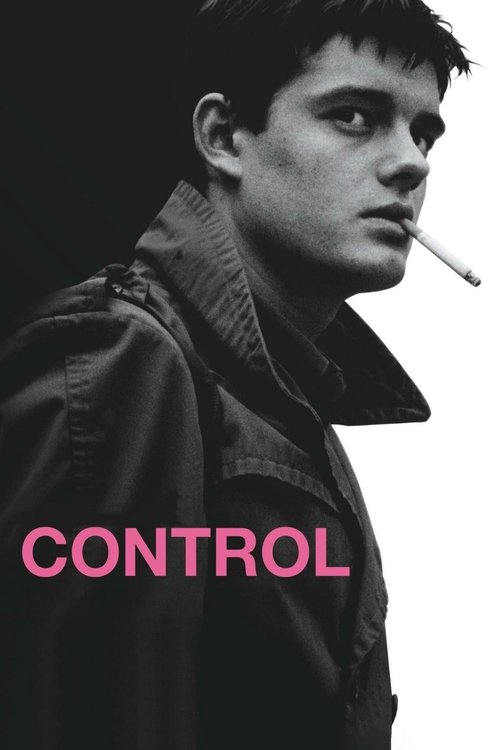
Control
2007 · Anton Corbijn
For when you want a beautiful, sorrowful film to sit with — late-night viewing for music lovers and anyone drawn to stories of people who burn briefly. Not a pick-me-up; a film for when you want to feel something deeply.
What it's about
Macclesfield, England, the 1970s: a bookish teenager named Ian Curtis marries young, takes a day job at the employment exchange, and starts fronting a band that will become Joy Division. As the band's stark sound begins to find an audience, his life narrows under the weight of epilepsy, medication, a marriage strained by an affair, and the growing gap between the man on stage and the one who comes home. It follows him from schoolboy days in 1973 to his death at twenty-three in 1980.
The experience
Stark, tender, and quietly devastating — a slow-building portrait that trades rock-movie euphoria for kitchen-sink intimacy. The concert scenes crackle, but what lingers is the silence of a terraced house. It leaves you hollowed out in the way the best sad films do.
Performances
Sam Riley is uncanny as Curtis — the strange marionette dancing on stage, the withdrawn husband off it — and Samantha Morton, as his wife Deborah, does wrenching work with watchfulness and hurt.
The craft
Anton Corbijn, the photographer whose images helped fix Joy Division's visual myth, shoots in ravishing black and white — every frame composed like one of his album portraits — and had the cast perform the songs live. The music sounds immense; this one deserves good speakers.
Why it matters
It reset the bar for the music biopic by refusing the genre's rise-and-triumph formula, deepened the Joy Division legend for a new generation, and launched Corbijn's filmmaking career.
Snapshot
Anton Corbijn's first feature is a black-and-white account of the last seven years of Ian Curtis's life, adapted from Touching from a Distance (1995), the memoir written by his widow, Deborah Curtis. It is a rock biopic that systematically refuses the genre's engine: there is no triumphal ascent, no montage of chart positions, no scene in which the world recognizes genius. Instead there is a terraced house in Macclesfield, a job at the employment exchange, a marriage entered into at twenty, a diagnosis of epilepsy, an affair, and a suicide on the eve of Joy Division's first American tour in May 1980. Corbijn, the Dutch photographer whose 1979 images of the band did as much as any record sleeve to fix their visual myth, made the film as a deliberate correction to that myth — locating the band's austerity not in art-school theory but in domestic exhaustion. The result was among the most critically admired British features of its year, and it has aged into the standard-bearer for a particular kind of anti-heroic music film.
Industry & production
Control is a British independent film in the most literal sense: assembled outside the studio system from a patchwork of private, regional and international money, and made cheaply enough that its formal severity was never a commercial liability. The producing team brought together Orian Williams and Todd Eckert with Deborah Curtis, whose book supplied both the rights and the point of view; Tony Wilson, the Factory Records co-founder who signed Joy Division and who is himself a character in the film, was involved on the executive side. Corbijn has said publicly that he put his own money into the production — an unusual level of exposure for a first-time director, and a fact that helps explain how completely the film reflects a single sensibility.
Principal photography took place in the English North and Midlands, with regional screen-agency support shaping the choice of locations; Nottingham and its surroundings supplied a good deal of the period texture that Manchester itself, redeveloped past recognition by the mid-2000s, could no longer provide. The production drew on the surviving physical geography of the story — Macclesfield's terraces, the flat industrial horizons, the municipal buildings — rather than reconstructing them on a stage.
The film premiered at the 2007 Cannes Film Festival as the opening title of the Directors' Fortnight, where it took several of the sidebar's prizes, and it was subsequently picked up for the United States by the Weinstein Company. In Britain it was a significant awards presence, sweeping much of the British Independent Film Awards, including Best British Independent Film, and figuring in the BAFTA conversation. Commercially it performed as a well-reviewed specialty release rather than a crossover: respectable rather than transformative. Its industrial significance lies less in its returns than in its demonstration that a photographer with no feature credits could raise money on the strength of an image-based pitch and deliver something durable.
Technology
The film's most conspicuous technical decision is also its least visible. Control was shot on 35mm color negative and rendered monochrome in the digital intermediate, a workflow that had only recently become standard practice. This matters: photochemical black-and-white gives you the response curve of the stock, while a digital conversion lets you weight the color channels after the fact, deciding scene by scene how skin, brick, sky and fabric will separate in gray. The grays of Control — the way pale English skin sits against dark wool, the way an overcast sky retains detail instead of blowing out — are the product of decisions made in a suite, not in a lab. The film is thus a 2000s artifact wearing a 1970s surface.
The other technological choice concerns the music. Rather than have the cast mime to Joy Division's studio masters, the production had the actors learn their instruments over a rehearsal period and perform live on set, recorded as performance rather than playback. This required period-appropriate backline and a location sound approach closer to a concert recording than to conventional dialogue coverage. The trade-off is deliberate: the band in Control sounds thinner, rawer and more provisional than Martin Hannett's records, which is precisely the point — Hannett's cavernous production is a studio invention, and the film wants the room before the invention.
Technique
Cinematography
Martin Ruhe, shooting his first feature with Corbijn and beginning a long collaboration, builds the film out of two registers. The first is the composed frontal tableau: characters centered or held in flat, symmetrical arrangements against wallpaper, brick, corridor tile, the geometry of a housing estate. These shots are unmistakably a photographer's, and several of them quote the visual language Corbijn himself established in his 1979 Joy Division sessions — figures dwarfed by architecture, faces turned partly away, the negative space carrying as much weight as the subject. The second register is handheld and closer, reserved largely for the performance sequences and for moments of crisis, where the camera loses its composure along with Curtis.
The lighting is unforgiving and largely low-key: interiors lit as though by whatever bulbs the room contains, exteriors accepting the flat gray of Northern daylight. There is no glamour lighting anywhere in the film, including onstage, where the band is often reduced to silhouette and hard backlight. Depth is generally shallow; Curtis is frequently isolated in focus with his surroundings dissolving, a visual analog for his withdrawal.
Editing
Andrew Hulme's cutting is patient in the domestic scenes and abrupt at the seams. The film moves through seven years in a series of discrete blocks separated by hard cuts and occasional black, refusing the connective tissue — the traveling montage, the dissolve, the calendar page — that biopics normally use to smooth chronology. Scenes are permitted to run past their dramatic function into discomfort: an argument continues after its point is made; a silence in a kitchen holds. Against this, the concert sequences are cut fast and percussively, in time with the music, so that the film's only real velocity is musical. The effect is to make performance feel like the sole condition under which time moves at all. The final movement slows almost to stasis, giving Curtis's last night an unbearable amount of unbroken screen time.
Mise-en-scène / staging
The film's controlling opposition is scale. The Curtis house is small, cluttered, low-ceilinged, filled with the specific objects of a mid-1970s working-class marriage — the drying rack, the two-bar fire, the television always audible. Corbijn stages the domestic scenes so that bodies are constantly obstructed by furniture and doorframes; there is nowhere in these rooms to stand freely. Outside, the compositions invert: enormous skies, motorway bridges, the concrete slabs of postwar municipal building, human figures placed small and off-center. Curtis moves between two kinds of confinement, and neither offers relief.
Costume and set decoration avoid the biopic vice of period as spectacle. Nothing is presented for the pleasure of recognition; the clothes are drab and often ill-fitting, and the band's eventual severity of dress reads less as a style choice than as the only available formality. The staging of the performances is likewise anti-spectacular — small rooms, indifferent crowds, bad stages — which retroactively makes the mythology look like something assembled by other people after the fact.
Sound
The soundtrack operates on three levels. Source music places us historically and psychologically: Bowie, Iggy Pop, the Velvet Underground, Kraftwerk and the first wave of British punk are heard as records played in bedrooms and at gigs, marking Curtis as a listener before he is a performer. The band's own material arrives as live performance, with all the imprecision that implies. And New Order — the surviving members' post-Curtis band — supplied original score, an authorship decision with obvious emotional freight: the music that comments on Curtis's death is made by the people who lived through it.
Corbijn uses silence with equal deliberation. The domestic scenes carry a low bed of household noise, and the film repeatedly strips even that away in Curtis's worst moments. The last sequence is largely unscored, and the record playing in the house that night — the film follows the accounts in Deborah Curtis's memoir, including the television broadcast of Herzog's Stroszek and Iggy Pop's The Idiot — functions as diegetic elegy rather than commentary. Joy Division's own recording of "Atmosphere" is withheld until the very end, arriving over the film's closing image of smoke rising from a crematorium chimney, which converts a song most viewers already know into something close to unbearable.
Performance
Sam Riley, cast largely unknown and himself a singer — he had appeared in Michael Winterbottom's 24 Hour Party People in a role cut from the final film — gives a performance built on withholding. His Curtis is quiet, funny in an offhand way, and increasingly absent from his own life; the arc is not escalation but evacuation. The onstage work is the performance's other half: Riley reproduces Curtis's arm-windmilling, jerking dance not as impersonation but as an involuntary discharge, which makes the resemblance to a seizure impossible to unsee.
Samantha Morton's Deborah is the film's ballast, and the role is written almost entirely in reaction. Morton plays her with a stillness that reads first as ordinariness and later as endurance; she is given very little declarative dialogue and is required to carry the film's moral weight in silence. Alexandra Maria Lara plays Annik Honoré with a warmth that the film does not moralize about, and Toby Kebbell's manager Rob Gretton supplies most of the available comedy, a necessary pressure valve. The remaining band members — Joe Anderson, James Anthony Pearson, Harry Treadaway — are played as workmates rather than acolytes, which is one of the film's quiet accuracies.
Narrative & dramatic mode
Control is structured as chronicle rather than plot. It proceeds by date and event with almost no dramatic foreshadowing, and it declines the biopic convention of the origin scene in which talent announces itself. Curtis's writing is shown as private and unglamorous; the songs surface without explanation. The film's causal engine is not ambition but obligation — a marriage, a child, a job, a band, a lover, a body that fails — and Curtis's tragedy is rendered as a man unable to relinquish any of them.
The dramatic mode is realist and observational, closer to social realism than to the heightened register of most music films, but with a stylized photographic surface that pulls against the realism. The film also carries a structural honesty about its own partiality: it is adapted from one witness's memoir, with that witness as a producer, and its account of the affair has been disputed by others who were present. Rather than a flaw, this is worth reading as the film's defining formal condition — it is explicitly a wife's account of a husband, not a definitive history of a band.
Genre & cycle
The film belongs to the mid-2000s revival of the music biopic — Ray (2004), Walk the Line (2005), La Vie en Rose (2007), Todd Haynes's I'm Not There (2007) — but it defines itself against the American, Oscar-shaped variants of the form. Its closer relatives are films about failure and dissolution: Gus Van Sant's Last Days (2005), which similarly refuses to dramatize a musician's suicide as revelation, and the British social-realist tradition of constrained provincial life.
It also sits in a specific micro-cycle: the Factory Records screen mythology. Winterbottom's 24 Hour Party People (2002) had already told this history as postmodern comedy narrated by Tony Wilson, with Curtis's death a fast-moving episode in a larger farce. Control is that film's photographic negative — same events, opposite register — and Grant Gee's documentary Joy Division arrived the same year, making 2007 a moment of concentrated re-examination. Between them, the three films form an unusually complete case study in how a single music scene can be narrated as comedy, as tragedy, and as archive.
Authorship & method
Corbijn's authorship here is unusually literal. He photographed Joy Division in London in 1979, having moved from the Netherlands substantially because of the band, and he directed the 1988 video for "Atmosphere," made eight years after Curtis's death. Control is therefore the third installment of a decades-long engagement, and it is knowingly self-critical: a film by the man whose images helped make Curtis an icon, arguing that the icon obscured a twenty-three-year-old with a wife, a daughter, epilepsy and a day job. Corbijn's method — long apprenticeship in still photography and music video, an eye trained on the single arresting frame — accounts for both the film's compositional confidence and its comparative indifference to conventional scene-building momentum.
Matt Greenhalgh's screenplay does the essential structural work of converting a memoir into scenes without turning it into an argument; his dialogue is flat, regional and unliterary, and he resists giving Curtis explanatory speeches. Martin Ruhe's cinematography translates Corbijn's photographic instincts into a moving-image grammar and established a partnership that continued through The American (2010) and A Most Wanted Man (2014). Andrew Hulme's editing supplies the rhythmic discipline — the willingness to hold, and the willingness to cut hard — that keeps the film from becoming a series of beautiful stills; he too continued with Corbijn. New Order's score closes the authorial circle by placing the surviving participants inside the film's commentary track.
Movement / national cinema
Control is a British film about a specifically Northern English experience made by a Dutch director, financed partly with European money, and launched at a French festival sidebar — a set of facts that complicates any simple national reading. Its formal lineage is unmistakably British: the black-and-white industrial landscape and the working-class domestic interior descend directly from the British New Wave of 1959–63, from Saturday Night and Sunday Morning and A Taste of Honey, and from the tradition of documentary photography that ran alongside them. Terence Davies's Liverpool films are a nearer relative still, in their treatment of the family home as a site of both tenderness and entrapment.
But the outsider's eye matters. Corbijn, raised in a Dutch Protestant minister's household, has repeatedly connected his aesthetic austerity to that upbringing, and his North of England is regarded with the intensity of someone who chose it rather than inherited it. The film consequently avoids both the nostalgia and the class condescension that often attend English period regionalism; it treats Macclesfield as a place, not as a symbol of deprivation.
Era / period
The film covers 1973 to 1980 — from glam-era adolescence to the threshold of the 1980s — and reads that span as a collapse of possibility. The early sequences are saturated with the promise of pop transformation: a teenage Curtis in eyeliner with Bowie on the record player, borrowing an identity. What follows is the systematic withdrawal of that promise under the pressure of early marriage, a dead-end job in the state employment apparatus, and a national mood of industrial decline. Punk arrives as permission rather than salvation, and the film is careful to show that the band's rise changes almost nothing about the material conditions of Curtis's life until it is too late.
Produced in 2007, the film also belongs to a moment of intense retrospection about post-punk, when the music's influence on a new generation of British and American guitar bands had made Joy Division commercially legible again. Control engages that revival ambivalently: it supplies the icon the revival wanted while insisting the icon was a person who died young and badly.
Themes
The governing theme is the impossibility of the title. Curtis is shown attempting to control a body that seizes without warning, a marriage he cannot leave and cannot inhabit, a love affair he cannot resolve, and an audience whose expectations he cannot meet — and the film's cruellest irony is that his only experience of mastery occurs onstage, in a performance that mimics the loss of bodily control. Illness is treated with unusual seriousness: the epilepsy is not a metaphor but a medical fact with medication, side effects, and a documented interaction with the touring life the band could not afford to stop.
Related threads run alongside. Domesticity is presented as both the thing that sustains Curtis and the thing that suffocates him, and the film's refusal to villainise either woman is central to its ethics. Youth and premature adulthood are foregrounded — the film keeps reminding us how young everyone is. And there is a persistent meditation on image-making: on the gap between the photographed figure and the person, a subject Corbijn returned to directly in Life (2015), his film about the photographer Dennis Stock and James Dean.
Reception, canon & influence
Critical reception in 2007 was strongly favourable, particularly in Britain, where reviewers singled out Riley's performance, Morton's, and the film's refusal of biopic uplift; the black-and-white photography was almost universally praised, though a minority of critics argued that its beauty aestheticized its subject's suffering and risked delivering precisely the icon the film claimed to dismantle. That objection remains the most substantial critique of the film and is worth taking seriously. Its festival record — the Directors' Fortnight opening slot and prizes at Cannes, a near-sweep of the British Independent Film Awards, BAFTA recognition — established it quickly as a canonical British film of the decade, and it has held that position.
Working backward, the film's debts are legible: the British New Wave for its landscape and its class realism; Terence Davies for the weight of the domestic interior; Van Sant's Last Days for the refusal to dramatize suicide as climax; and, embedded directly in the text, Herzog's Stroszek, which the film shows on the television during Curtis's last hours in accordance with the memoir's account — a citation that lets one film about a doomed outsider stand inside another. Corbijn's own photographic archive is the most direct source of all, with several compositions functioning as restagings of his 1979 sessions.
Forward, Control's influence has been felt chiefly as a license. It demonstrated that a music biopic could be commercially and critically viable while eliminating the genre's reassurances — the discovery scene, the triumphant concert, the redemptive coda — and a cohort of subsequent films took that permission, including Sam Taylor-Wood's Nowhere Boy (2009), also written by Matt Greenhalgh and likewise directed by a visual artist, which applied the same domestic-realist lens to John Lennon's adolescence. Its practice of having actors learn and perform the music live, rather than mime to masters, has become a recurring benchmark in the genre's critical discourse. And it launched Corbijn's second career: the compositional stillness, the isolated protagonist and the mistrust of exposition that define Control recur across The American, A Most Wanted Man and Life, making his first feature the clearest statement of a style he has spent the years since refining.
A Deleuzian reading
Watch where the furniture is.
The full Deleuzian reading of Control →
Reception
Premiered in Cannes' Directors' Fortnight in 2007 to immediate acclaim, picking up prizes there and Best British Independent Film at the BIFAs — and unlike most instant hits it has held its ground, now routinely cited as one of the great music biopics.
How Control was received, from release to now →
How to watch Control: what to notice on a first viewing
- Notice how doorframes and furniture always partly block Curtis in the house. Corbijn and Ruhe shoot the Macclesfield rooms head-on and symmetrical, leaving chair backs and doorframes in the shot, so no one stands freely. The house's own architecture becomes a physical form of the confinement closing in on him.
- Watch how outdoor shots dwarf Curtis under huge gray sky and concrete. Outside the house, Corbijn inverts the scale: enormous skies, motorway bridges, postwar concrete, with Curtis placed small and off-center in almost every exterior frame. He moves between two kinds of confinement, indoors and outdoors, and neither ever offers relief.
- Listen for records playing in bedrooms before Curtis ever performs onstage. Bowie, Iggy Pop, the Velvet Underground and Kraftwerk arrive first as source music heard at home and at gigs, establishing Curtis as a listener before a performer. The film locates his art in ordinary teenage listening, not in a moment of inspiration.
- Watch Riley's stage dance, arms windmilling, jerking without full control. Riley plays Curtis's onstage movement as involuntary discharge rather than choreography, so the resemblance to a seizure becomes impossible to unsee. His only apparent mastery onstage mimics the very loss of bodily control that defines his illness.
- Notice hard cuts and black gaps between years of Curtis's life. Seven years arrive in discrete blocks joined by hard cuts, never by dissolve or montage, so time seems to sit rather than flow. The gaps mark years where nothing he does changes what actually needs to change.
The whole guide to watching Control, with the keys for a rewatch →
Influences: the films it descends from and the films it influenced
- Saturday Night and Sunday Morning (1960) — Freddie Francis's monochrome location shooting of Midlands factory floors and terraced streets established the grammar Control reuses for Curtis's Macclesfield employment-exchange day job — the working man framed inside his workplace geometry rather than escaping it via montage.
- A Taste of Honey (1961) — Walter Lassally's gray Salford exteriors and Shelagh Delaney's flat, unliterary regional dialogue are the direct model for Greenhalgh's refusal to give Curtis explanatory speeches — characters state facts in local idiom and the landscape carries the affect.
- Kes (1969) — Chris Menges' available-light interiors, shot long-lens from a distance so performers behave rather than perform, is the source of Ruhe's low-key practical-light domestic scenes and the deliberately unhelped, non-projected delivery Riley and Morton use indoors.
- Distant Voices, Still Lives (1988) — Davies' frontal, locked-off tableau of the working-class front room — held past the point of narrative usefulness, with diegetic singing carrying the emotional register instead of score — is the compositional template for Control's static two-shots of the Curtis kitchen and bedroom.
- Radio On (1979) — Martin Schäfer's monochrome of a depopulated late-70s England, scored entirely by period source cues heard as environment (Bowie, Kraftwerk, Devo on car radios), is the precedent for Control treating its post-punk records as diegetic furniture rather than needle-drop punctuation.
- Stroszek (1977) — Cited inside the film itself — Herzog's flat, unpitying observation of a doomed outsider plays on the Curtis television during his last hours, importing an entire aesthetic position as a diegetic object rather than as homage.
- Raging Bull (1980) — Michael Chapman's decision to shoot recent-past monochrome as anti-nostalgia — stripping period glamour from a subject audiences knew in color — is the argument Corbijn's digital-intermediate desaturation makes, alongside the long static domestic-violence takes staged in cramped rooms.
- Don't Look Back (1967) — Pennebaker's handheld 16mm backstage-and-transit reportage — musicians as bored, unglamorous travelers between rooms — supplies the observational register for Control's van and dressing-room scenes, the same photojournalist's eye Corbijn brought from his 1979 stills sessions.
- Sid and Nancy (1986) — Roger Deakins' grimy British punk realism plus Gary Oldman singing rather than miming set the precedent for Control's live-on-set vocal and instrument recording, and for building a music film around a death the narrative refuses to redeem.
- Backbeat (1994) — Its live-tracked Hamburg club performances, deliberately loud and imprecise instead of cut to studio masters, is the direct technical antecedent for having Riley, Anderson, Treadaway and Morrissey learn and play the Joy Division catalog on set.
- 24 Hour Party People (2002) — Robby Müller's handheld DV maximalism over the identical Factory Records milieu is the formal proposition Control answers point-for-point — same catalog and same rooms, rebuilt as composed monochrome stillness rather than jittery comic reportage.
- Last Days (2005) — Harris Savides' long-held wides and Van Sant's placement of the suicide off-screen and off-climax, leaving only ambient aftermath, is the structural permission for Control ending on cremation-smoke and administrative quiet rather than a death scene.
- Nowhere Boy (2009) — Same screenwriter (Matt Greenhalgh) and the same visual-artist-turned-director route, applying Control's domestic-confinement lens to Lennon's adolescence — kitchen and front-room scenes displacing the discovery-and-triumph beats entirely.
- The American (2010) — Martin Ruhe and editor Andrew Hulme carry Control's method into genre: frontal tableau, shallow-focus isolation of a single figure in an interior, and Hulme's willingness to hold a shot then cut hard on movement rather than on dialogue.
- Life (2015) — Makes explicit what Control does silently — restaging famous still photographs (Dennis Stock's Dean sessions) as moving-image compositions, the same practice by which Corbijn rebuilt his own 1979 Joy Division frames inside his first feature.
- England Is Mine (2017) — Takes Control's most extreme constraint — the pre-fame Northern musician confined to a day job and a family house, with the famous catalog withheld from the soundtrack entirely — and builds a whole film from it.
- Maestro (2023) — Combines Control's two signatures — boxy period monochrome for the early decades and live performance captured on set in an unbroken take (the Ely Cathedral Mahler) — while keeping the marriage, not the career, as the film's confined domestic center.
- Love & Mercy (2014) — Stages the recording session as a sustained scene of labor with performers actually playing, rather than compressing creation into a montage, extending Control's replacement of the biopic's 'discovery' beat with observed process.
- A Most Wanted Man (2014) — Corbijn's own debut establishes his signature — the solitary, melancholy man isolated within a meticulously composed, near-monochrome frame, an authorial visual program carried directly into Bachmann's portraiture.
- I'm Not There (2007) — Same-year music biopic using stark, photographer's monochrome to mythologize a singer — a contrasting case where style, not casting, becomes the interpretive instrument.
- Basquiat (1996) — A stills photographer does for Curtis what the painter did for Basquiat: static frontal portrait framings, monochrome surface treated as the point rather than the mood, and decline staged by progressively stripping dialogue out of the performance.
Similar films
- 24 Hour Party People (2002) — influence & lineage
- Sid and Nancy (1986) — influence & lineage
- Michael (2026) — same viewing thread
- Fjord (2026) — often watched together
- The Story of Lovers Rock (2011) — shared sensibility
- Atonement (2007) — shared sensibility
- The Devil and Daniel Johnston (2006) — shared sensibility
- Morvern Callar (2002) — shared sensibility
All the films related to Control →
Watch it with: curated runs of related films
- The Making of a Legend — A run of biopics that watch private people get forged into public icons — the ambition, the pressure, and the loneliness of becoming somebody the world can't stop looking at.