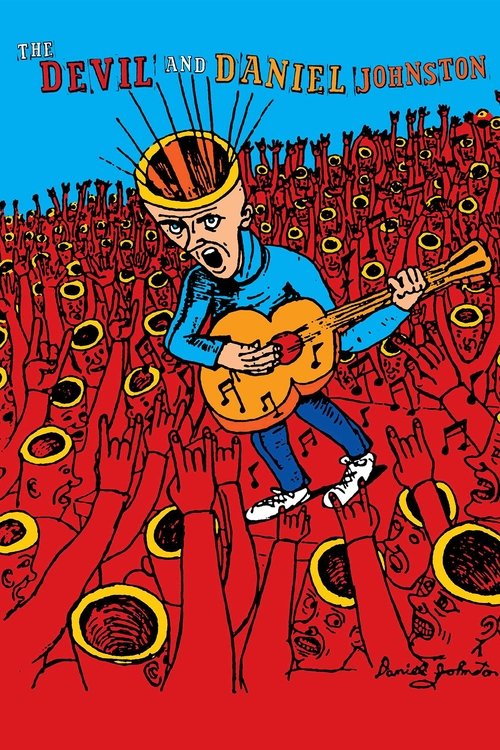
The Devil and Daniel Johnston
2006 · Jeff Feuerzeig
For when you want a true story that genuinely moves you — great for music lovers, but really for anyone drawn to portraits of fragile, singular people. Expect to come out wanting to hear the songs and feeling protective of the man.
What it's about
A documentary portrait of Daniel Johnston, the outsider musician whose homemade cassette recordings — childlike, raw, and devastatingly sincere — made him a cult hero of the American underground. It follows him from a devout small-town childhood through his hungry pursuit of fame and the bipolar disorder that repeatedly wrecked his life, as God, the Devil, and an unrequited love become the obsessions running through his songs and drawings.
The experience
Funny, eerie, and quietly wrenching — you swing between delight at Johnston's oddball genius and real alarm at how close art and illness run in his story. It never lets you settle into easy inspiration; the sadness and the charm arrive together.
The craft
The film is built from an astonishing archive: Johnston compulsively recorded his own life on cassette and Super 8 for decades, so much of the story is told in his own voice and images, woven together with striking clarity. It plays almost like a found autobiography, and the songs land hardest through good speakers.
Why it matters
It won major documentary honors and brought Johnston's music to a far wider audience, becoming a benchmark for films about outsider artists and the tangled relationship between mental illness and creativity.
Snapshot
The Devil and Daniel Johnston is a feature documentary about the American outsider musician and visual artist Daniel Johnston, a songwriter of cult renown whose lo-fi cassette recordings and childlike, harrowing songs made him a fixture of the 1980s Austin, Texas underground and, later, an object of alternative-rock veneration. Directed by Jeff Feuerzeig, the film traces Johnston from a devout West Virginia and Texas childhood through his emergence as a self-releasing tape artist, his courtship of fame, and the manic-depressive illness (bipolar disorder) that repeatedly derailed his life and threaded a private mythology of God, the Devil, and unrequited love through his art. The title puns on Stephen Vincent Benét's short story "The Devil and Daniel Webster," reframing Johnson's struggle as a folkloric bargain — talent shadowed by torment. The film premiered at the 2005 Sundance Film Festival, where it won the Directing Award in the documentary competition, and received a U.S. theatrical release in 2006 through Sony Pictures Classics. Its distinguishing formal feature is its near-total reliance on Johnston's own lifelong self-documentation: he had recorded himself compulsively on audiocassette and Super 8 film for decades, so the film is built substantially from its subject's archive of his own voice and image.
Industry & production
The film sits squarely in the independent, festival-launched documentary economy of the mid-2000s, a period when theatrical nonfiction enjoyed unusual commercial visibility in the wake of successes across the genre. It was produced through the independent producer Henry S. Rosenthal, a longtime Feuerzeig collaborator, and financed and made outside the studio system before being acquired for distribution. The production's central logistical fact is unusual: rather than an expensive shoot, its raw material was an enormous pre-existing personal archive — Johnston's tapes, home movies, drawings, comic books, and album art — supplemented by newly shot interviews with family, friends, former managers, and collaborators. This lowered production risk on the "capture" side while shifting the labor toward archival research, rights, restoration, and editorial construction.
Feuerzeig came to the project already versed in music documentary; his earlier feature, Half Japanese: The Band That Would Be King (1993), signaled a sustained interest in idiosyncratic underground musicians. Distribution by Sony Pictures Classics — a specialty label with a strong record in awards-track documentary and arthouse fare — placed the film in the prestige independent pipeline: festival premiere, critics' support, platform theatrical rollout, and durable home-video and DVD life. Detailed budget and box-office figures are not something I can cite reliably here, and I will not invent them; the film's commercial footprint is best understood as modest theatrical returns amplified by a long tail among music and cult-cinema audiences.
Technology
The film's technology story is really the story of amateur and consumer recording technology as an artistic instrument. Johnston's self-archive was made on the domestic tools of the 1970s and 1980s: portable cassette recorders (he famously recorded and dubbed his own albums at home, handing tapes directly to people), boomboxes, and Super 8 home-movie cameras. That material carries the texture of its formats — tape hiss, distortion, dropout, the grain and gate-flutter of small-gauge film — and the documentary preserves rather than sanitizes these artifacts, so that format degradation becomes expressive.
For its contemporary layer, the film uses conventional mid-2000s documentary interview capture, and its post-production belongs to the digital nonlinear-editing era, in which decades of heterogeneous analog sources — audiotape, Super 8, photographs, hand-drawn art, and new interview footage — could be digitized and assembled on a common timeline. The animation and treatment of Johnston's drawings likewise depend on digital compositing. In short, the film is a bridge object: analog, consumer-grade capture reassembled through professional digital finishing.
Technique
Cinematography
Because the documentary is archival-first, its "cinematography" operates on two planes. The found footage — Johnston's Super 8 films and home photography — supplies an intimate, often unstable amateur image whose framing and exposure were never meant for an audience, which is precisely the source of its poignancy. The newly shot interviews adopt the standard grammar of the observational-testimonial documentary: composed talking-head setups, controlled interior lighting, and a generally unobtrusive style that yields the screen to the archive. I do not have a reliably attributed director of photography credit to name with confidence, and I will not guess one; the film's visual identity is defined less by a signature camera style than by the curatorial juxtaposition of amateur and professional images.
Editing
Editing is the film's dominant craft and its true authorial engine. The editor Tyler Hubby had the task of metabolizing an immense, chronologically tangled archive into a legible life-story arc while retaining the disorientation of Johnston's illness. The film's method is layered montage: Johnston's own recorded voice — from tapes made across years — is used almost as narration, set against his drawings, his songs, home movies, and present-day interviews. This lets the subject effectively narrate his own past in his own words, a device that collapses the distance between then and now. The cutting builds the recurring motifs (the frog, the Devil, Laurie, Casper the Friendly Ghost) into a visual vocabulary, and it modulates tone deftly between comedy, tenderness, and dread as episodes of mania escalate.
Mise-en-scène / staging
As a documentary, the film's mise-en-scène is largely discovered rather than designed. Its expressive control lies in selection and arrangement: the ordering of Johnston's obsessive iconography, the staging of interviews in domestic and workaday settings, and the recurrent framing of Johnston within the world of his parents' home. The most affecting staging is often the least mediated — Johnston at home, older and medicated, his physical decline set against the youthful ebullience of the archive.
Sound
Sound is central and unusually rich for a documentary because the subject was, above all, a recording artist. The film foregrounds Johnston's songs — sung in his fragile, quavering voice over spare piano, chord organ, or guitar — and it uses his spoken-word tape recordings as a primary storytelling layer. The deliberate retention of lo-fi audio character (hiss, room tone, the mechanical presence of the cassette medium) is an aesthetic commitment: the fidelity of the sound is inseparable from the meaning of Johnston's art, which was made and distributed on tape. Contemporary interview audio and the archival material are woven together so that Johnston's voice persists as a continuous presence across time.
Performance
"Performance" here is documentary self-presentation. The film's magnetism comes from Johnston himself — his charisma, humor, and vulnerability as captured across decades of self-recording, and his physically and emotionally altered present-day self. The interviewees (family members, especially his parents Bill and Mabel Johnston, along with friends, former managers, and figures from the Austin scene) perform the testimonial labor of contextualizing episodes many of them lived through, and the emotional candor of the parents in particular gives the film its moral weight.
Narrative & dramatic mode
The film adopts a broadly chronological biographical structure — a cradle-toward-the-present life story — organized around the tension its title advertises: creativity as both gift and affliction. Its dramatic mode is the tragic artist's biography inflected by the recovery/relapse rhythm of mental illness: cycles of ascent (recognition, a shot at fame) followed by manic crisis. Key episodes function as narrative peaks, notably the incident aboard his father's small plane, in which a manic Johnston interfered with the aircraft's controls and the two crash-landed but survived — an event the film treats as emblematic of how his illness endangered him and those around him. The self-narration device gives the film a confessional, first-person undertow beneath its third-person biographical frame, so that the viewer experiences Johnston's mythology (the Devil, sin, and salvation) from inside his sensibility even as the interviews supply outside perspective.
Genre & cycle
The film belongs to the music documentary and, more specifically, to the cycle of "outsider artist" and troubled-genius portraits. It also participates in a mid-2000s wave of character-driven documentaries built around singular, obsessive, or self-mythologizing subjects — films in which access to an eccentric individual's private world is the central attraction. Within music documentary it is a portrait rather than a concert or scene film, closer in spirit to intimate biographical studies of fragile artists than to band-history or performance movies. Its heavy dependence on subject-generated archive also links it to the found-footage/personal-archive strain of nonfiction.
Authorship & method
Jeff Feuerzeig is the film's author in the strong sense: director and shaping intelligence, working from a subject whose own compulsive documentation he curated into narrative. His method — established in his earlier underground-music work — is deep immersion in a musician's world and a willingness to let the subject's own materials carry the film. The decisive authorial partnership is with editor Tyler Hubby, whose construction of the archive-driven, voice-led montage is arguably co-equal to the direction in determining the film's form. Producer Henry S. Rosenthal was the enabling collaborator on the production side. On music, the "score" is effectively Johnston's own catalog; the film's soundtrack is his songs, which means the subject also functions as the film's composer in all but title. I do not have firmly attributable, separately credited cinematographer or original-composer names that I can state with confidence, and I decline to fabricate them; readers seeking exact technical credits should consult the film's authoritative credit record.
Movement / national cinema
The film is a work of American independent nonfiction, rooted geographically and culturally in a specifically American milieu: evangelical Christian family life, the Austin, Texas underground music and comic-book scene, and the do-it-yourself cassette culture of the 1980s. It belongs to no formal "movement" in an avant-garde sense, but it is legible within the tradition of American character-portrait documentary that prizes access to an outsider figure and treats regional subculture as revealing terrain. Johnston's story is inseparable from Austin's self-image as a haven for idiosyncratic artists, and the film functions in part as a portrait of that scene's mythmaking.
Era / period
Made in the mid-2000s (Sundance 2005, theatrical 2006), the film reflects a moment when theatrical documentary enjoyed cultural prominence and when digital post-production made large-scale reclamation of analog personal archives newly feasible. Its content, however, spans several earlier eras: a 1960s–70s childhood; the 1980s underground and the crucial episode of MTV exposure and Austin scene-building; and the early-1990s alternate-rock boom, when Johnston's profile rose partly through association with better-known admirers — most famously Kurt Cobain, who was photographed wearing a T-shirt bearing the frog art from Johnston's Hi, How Are You cassette. The film thus operates as a period study of American underground music culture across roughly three decades, assembled from the vantage of the mid-2000s.
Themes
The film's governing theme is the entanglement of artistic genius and mental illness — the romantic, and here painfully literal, proximity of creativity and suffering. Around it cluster several others: religious cosmology and guilt (Johnston's evangelical upbringing generated an internal drama of God and the Devil, sin and redemption, that saturates his art); obsession and unrequited love (his lifelong fixation on Laurie, a woman he met in art class, whom he mythologized as a lost muse); fame and its costs (his active desire for stardom set against an illness that made stability impossible); and family devotion and burden (the extraordinary caretaking by his aging parents, which grounds the film's ethical seriousness). Recurring iconography — the frog, Casper the Friendly Ghost, the Devil, boxing imagery — functions as a private symbolic language through which these themes are expressed. Underlying all of them is a meta-theme about authorship and self-documentation: a life so thoroughly self-recorded that the archive becomes both the art and the evidence.
Reception, canon & influence
The film was strongly received critically and is generally regarded as one of the more admired music documentaries of its decade; its Sundance Directing Award (documentary) marked it as a festival standout, and Sony Pictures Classics' backing gave it critical prestige and a durable afterlife. I do not have precise aggregated review statistics or awards beyond the Sundance directing honor that I can cite with confidence, and I will not manufacture them; the accurate summary is that its reception was warm and its reputation has proved lasting among cinephiles and music audiences.
Its influences backward are twofold. Artistically, it inherits the outsider-genius portrait tradition and the personal-archive documentary; formally, it depends entirely on the pre-existing tradition of amateur self-recording that Johnston himself embodied. Feuerzeig's own prior underground-music documentary work is the clearest antecedent in his method.
Its influence forward is best measured in two registers. First, the film substantially expanded Daniel Johnston's audience beyond the alternative-music cognoscenti, cementing his standing as a canonical outsider artist and helping sustain interest in his recordings and visual art through the remainder of his life (Johnston died in 2019) and after. Second, as an exemplar of the archive-driven, subject-narrated portrait, it stands among the mid-2000s documentaries that demonstrated how a compelling nonfiction feature could be built primarily from a subject's own accumulated self-documentation — a model of increasing relevance in an age of pervasive personal recording. Within the specific niche of films about musicians and mental illness, it remains a frequently cited reference point for balancing empathy, candor, and formal ambition without lapsing into either pity or sensationalism.
Reception
It premiered at Sundance 2005 to raves, winning the Documentary Directing Award, and has only grown in stature since — after Daniel Johnston's death in 2019 it became the definitive portrait, the film people send friends as the entry point to his whole world.
How The Devil and Daniel Johnston was received, from release to now →
How to watch The Devil and Daniel Johnston: what to notice on a first viewing
- Listen for Johnston narrating his own past on tape. The film uses decades of Johnston's own cassette recordings as narration, so his younger voice describes events you are simultaneously watching him live through as an older man. He is narrating his own life across time, not just being talked about.
- Track the frog and the Devil recurring in his art. Editor Tyler Hubby cuts between Johnston's drawings, songs, and home movies, returning again and again to the same private images, the frog, Casper, the Devil, until they build into a language. The repeated symbols become a vocabulary you learn to read the way the interviewees already do.
- Notice the shift between grainy home film and clean interviews. The documentary cuts between Johnston's own unstable, amateur Super 8 footage and newly shot, composed talking-head interviews, two very different qualities of image sitting side by side. You can feel which images were made to be seen and which were never meant for an audience.
- Listen for tape hiss left in under the songs. The film keeps the hiss and room tone of Johnston's cassette recordings rather than cleaning them up, so the sound itself carries the mark of how the music was made. The rough sound quality is treated as part of the art, not a flaw to fix.
- Watch Bill and Mabel Johnston's faces as they speak. His parents appear repeatedly on camera, describing events they lived through, and their visible emotion carries weight the archival footage alone cannot supply. Their candor is where the film's seriousness about caretaking and burden comes through.
The whole guide to watching The Devil and Daniel Johnston, with the keys for a rewatch →
Influences: the films it descends from and the films it influenced
- Half Japanese: The Band That Would Be King (1993) — Feuerzeig's own prior underground-music doc established his method here: deep immersion in a marginal musician's world, letting the subject's homemade recordings and self-generated mythology carry the film rather than external narration.
- Crumb (1994) — The template for the empathetic outsider-artist portrait that binds creative genius to inherited family mental illness and sexual/religious shame, earning access that neither pities nor sensationalizes.
- Grey Gardens (1975) — Codified the observational capture of eccentric subjects openly performing themselves for the lens — documentary self-presentation as the film's true content.
- Portrait of Jason (1967) — The single-subject confessional in which a charismatic, damaged figure narrates and performs his own tragedy directly to camera, structure built around first-person self-narration.
- Don't Look Back (1967) — Verité musician portraiture where the artist's offstage, unguarded self — not the concert — becomes the substance, foundational to the observational talking-head/backstage music doc.
- American Movie (1999) — Model for portraying an obsessive, precarious outsider creator with affection and comedy but without condescension, the empathy/candor balance Feuerzeig's film also strikes.
- Cobain: Montage of Heck (2015) — Archive-driven portrait of a mentally-ill musician assembled from his own journals, home audio tapes and artwork — with cassette recordings animated — extending the subject-as-composer/self-archivist method (and directly tied via the Cobain frog-shirt lineage).
- Amy (2015) — A musician-and-mental-illness portrait constructed almost wholly from amateur and personal footage, with the subject's own voice and songs functioning as narration and score — subject-as-composer scaled to found-recording assembly.
- Marwencol (2010) — Observational outsider-artist portrait where obsessive homemade art-making is framed as the coping architecture for trauma and mental illness, inheriting the genius-and-damage empathy register.
- Searching for Sugar Man (2012) — Recuperates a lost outsider musician into canon, using the subject's own back-catalog recordings as the film's emotional score — the same 'subject is the composer' scoring strategy.
- Finding Vivian Maier (2013) — Reconstructs an outsider artist's life and mind almost entirely from the vast archive she compulsively self-accumulated, the personal-archive-as-sole-source portrait model.
- It's Never Over, Jeff Buckley (2025) — Built primarily from the subject's own answering-machine tapes and lo-fi cassette self-recordings as source text, the answering-machine-voice and lo-fi-audio-texture sourcing this film inherits.
- Tarnation (2003) — A feature assembled almost entirely from decades of a subject's own Super-8, home video and cassette archive, finished on cheap nonlinear desktop software, chronicling family mental illness — the exact personal-archive-assembly model.
- Capturing the Friedmans (2003) — Builds its narrative spine from a family's own compulsive home-video record, treating amateur self-documentation as primary evidence and dramatic engine.
- The Kid Stays in the Picture (2002) — First-person, subject-narrated life story constructed from personal archive and photographs, foregrounding the subject-as-author of his own mythologized account.
- Grizzly Man (2005) — A portrait built from the subject's own compulsive consumer-video self-recording, treating the camcorder as the instrument through which a troubled visionary composes his self-image posthumously.
- Dig! (2004) — Longitudinal music doc using years of intimate access to chart a gifted musician's self-destruction and mental unraveling, balancing fascination with the wreckage against genuine regard for the art.
Similar films
- Grizzly Man (2005) — influence & lineage
- Julien Donkey-Boy (1999) — shared sensibility
- It's Never Over, Jeff Buckley (2025) — shared sensibility
- Hedwig and the Angry Inch (2001) — shared sensibility
- Big Fish (2003) — shared sensibility
- Control (2007) — shared sensibility
- My Best Fiend (1999) — shared sensibility
- The Ballad of Wallis Island (2025) — shared sensibility