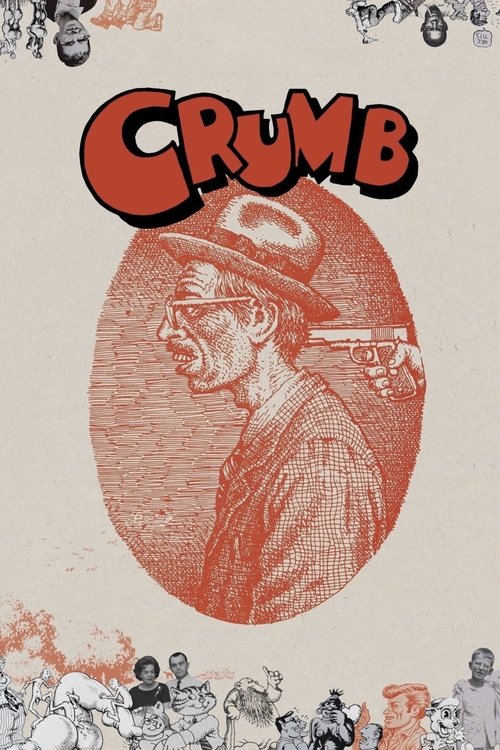
Crumb
1995 · Terry Zwigoff
For when you want a documentary that actually gets under the skin — a portrait of genius, damage, and family you'll be talking about for days. Not a light watch, but an endlessly fascinating one.
What it's about
A documentary portrait of Robert Crumb, the underground cartoonist behind 'Keep On Truckin'' and Fritz the Cat, filmed over years by a friend with total access. It follows him through interviews with his mother, his two brothers, his wife and ex-girlfriends, and through the obsessive, transgressive art itself. What starts as the story of a counterculture legend becomes something stranger and sadder: a study of three brothers raised in the same troubled house, and why only one of them made it out through his drawings.
The experience
Darkly funny, uncomfortable, and quietly devastating — it keeps making you laugh and then making you ashamed you laughed. The family scenes have an intimacy so raw you almost want to look away, and the film trusts you to sit with people it never excuses or condemns.
The craft
Zwigoff filmed his friend over roughly six years, and that patience shows in access no stranger could have gotten: the camera simply stays put while people say unforgivable things. The editing braids the art, the family history, and the critics' arguments about whether Crumb's work is satire or sickness, and refuses to settle the question for you.
Why it matters
Widely regarded as one of the greatest documentaries ever made, it raised the bar for what an artist portrait could be and launched Zwigoff's directing career. It also fixed Crumb's public image — genius, crank, and case study — for good.
Snapshot
Crumb is a portrait of the underground cartoonist Robert Crumb that turns, almost against its own will, into a study of a family. Terry Zwigoff spent roughly six years filming his friend — the two had played together in R. Crumb and His Cheap Suit Serenaders, and shared an obsessive collector's devotion to pre-war 78rpm records — and the intimacy shows in every register: the access, the tone, the willingness to sit still while a subject says something unforgivable. What begins as an art-world documentary about the man who drew "Keep On Truckin'" and Fritz the Cat becomes, by its midpoint, an account of three brothers raised in the same house, of whom one converted his damage into an internationally collected body of work and two did not. Charles Crumb, the eldest, who first drew comics and pulled his younger brother into the habit, is filmed in their mother's Philadelphia rowhouse on antidepressants and largely housebound; a title at the end of the film notes his death by suicide, roughly a year after the interviews. Maxon, the youngest, is filmed in a San Francisco residential hotel with his bed of nails and his meditation practice.
The film's argument is never stated, only assembled: that art is not redemption but a survival technique that happened to work for one man in a family where it did not work for the others. It premiered at Sundance in January 1995, won the Grand Jury Prize and the Cinematography Award in the documentary competition, and was released that spring by Sony Pictures Classics into an unusually receptive art-house market. Runtime is roughly two hours.
Industry & production
The production history is a small legend of American independent filmmaking, mostly because it was so nearly a disaster. Zwigoff had made one previous feature, Louie Bluie (1985), a portrait of the string-band musician and painter Howard Armstrong — also an artist-eccentric, also drawn from Zwigoff's record-collecting world. He spent years persuading Crumb to be filmed at all. Crumb, congenitally suspicious of publicity and of the culture industry that had made a franchise out of Fritz the Cat without him, consented largely as a favor to a friend; Zwigoff has said in interviews that he told Crumb how badly he was doing, and that Crumb agreed partly out of pity. Crumb was given a share in the film's proceeds.
Financing was hand-to-mouth across the entire shoot. Zwigoff has described living on a few hundred dollars a month, running up credit-card debt, and enduring crippling back pain through the production; he has spoken openly, and repeatedly, about being suicidal during those years. Lynn O'Donnell is credited as producer alongside Zwigoff, and the credit block is small by design — this was a film made by a handful of people over a very long time, not a commissioned unit production. Completion and distribution were helped decisively when David Lynch attached his name as presenter, a piece of borrowed prestige that opened doors the film could not open on its own.
Sony Pictures Classics released it, and it became one of the more commercially successful documentaries of the mid-1990s in specialty release — a period when a documentary crossing over at all was still treated as an event. Precise grosses vary by source and are not worth asserting here. What matters industrially is that Crumb arrived in the same short window as Hoop Dreams (1994) and Paris Is Burning (1990), the films that convinced distributors that character-driven nonfiction could carry a theatrical run. It also arrived at the peak of the Academy's documentary-branch credibility crisis: Crumb received no Best Documentary Feature nomination, an omission widely reported at the time as further evidence that the branch's nominating process was broken, and one of the proximate causes of its later reform.
Technology
Crumb was shot on 16mm color negative and blown up to 35mm for theatrical release — the standard economic path for independent documentary before digital video, and one that imposes real discipline. Film stock costs money per foot; a six-year shoot on 16mm means the director is choosing, constantly, whether a moment is worth the roll. The film's patience is partly an artifact of that constraint: Zwigoff waits, but he waits with the camera off, then commits.
The timing is historically pointed. Crumb is one of the last major American documentaries made entirely under the analog regime; Sony's consumer DV camcorders reached the market in 1995, and within five years the economics that had nearly destroyed Zwigoff would be gone. The film also visibly carries its own duration — stock, lighting conditions, and the subjects' ages shift across the material, so the image itself registers the years the way a family album does.
Technology is also the film's subject, negatively. Crumb's entire sensibility is an argument against the twentieth century after about 1935: he collects shellac 78s, draws with a pen on paper, and treats television, advertising, and mass-market design as a form of environmental poisoning. The film's closing movement — crates of records being packed for shipping as the family prepares to leave California for the south of France — makes the point without a word of commentary. A man whose living depends on the mechanical reproduction of his drawings has built his interior life around a technology that stopped being manufactured before he was born.
Technique
Cinematography
Maryse Alberti shot the film, and won Sundance's documentary cinematography prize for it — an award that reads oddly for a movie so committed to plainness until you watch how the plainness is constructed. Alberti works with available and minimally supplemented light in cramped interiors: the mother's rowhouse, Charles's bedroom with its stacks of paperbacks, Maxon's single-room-occupancy hotel. The camera is close but not aggressive, and it holds. In the long sequences with Charles, the framing does something quietly ethical — it stays at conversational distance, neither pushing in for the collapse nor retreating into safe medium shots.
The other cinematographic mode is the treatment of the artwork. Crumb's panels are shot as objects and as landscapes: slow lateral moves across a page, pulls into a detail, rack focus that discovers a face in the crosshatching. The drawings are never simply illustrated cutaways; they are given the same durational attention as the interviews, so that the film's two visual registers — photographed life and drawn life — start to comment on each other. Alberti went on to shoot Velvet Goldmine, The Wrestler, and Creed, and the instinct for bodies in unglamorous rooms is already fully formed here.
Editing
Victor Livingston's cut is the film's decisive authorial act. Years of material had to become a structure, and Livingston and Zwigoff rejected the obvious one: this is not a chronological life. The film moves associatively — from a drawing to a memory to a critic to a brother — and gains its force by withholding. The Charles material, in particular, is metered out rather than delivered in a block, so that the film's emotional center arrives late and retroactively reorganizes everything before it. The final title about Charles's death converts the preceding two hours into something the audience did not know it had been watching.
Livingston also solves the perennial problem of the artist documentary, which is how to cut between a static image and a talking person without producing a slideshow. Here the drawings interrupt the interviews at the moment a claim is made, functioning as evidence, contradiction, or joke — the cut supplies the irony the narration refuses.
Mise-en-scène / staging
Almost nothing is staged in the fiction sense, and yet the film is intensely attentive to setting-as-character. The Crumb family home is filmed as an archaeological site: the objects, the accumulation, the specific mid-century Catholic-military-suburban debris out of which three brothers made three incompatible responses. Zwigoff repeatedly puts Robert back into these rooms and lets the geography do the work, including a visit to the childhood house. Against this, the California sequences — the gallery party, the appraisal of original pages, the collectors — stage the art world as another kind of alien territory. The sketching-in-public sequences, where Crumb draws in the street among strangers, are the one place the film approaches performance, and they show the method: he looks, then he distorts.
Sound
There is no narration. Zwigoff's own voice is audible off-camera as an interviewer, and its familiarity — the tone of a friend rather than a journalist — licenses much of what the subjects say. The dominant sonic texture is Crumb's laugh, a high nasal giggle that punctuates the most alarming disclosures and that the film uses almost structurally, as a recurring signature of deflection.
The music is source-driven and period-obsessed: the pre-war jazz, blues, and string-band records at the center of Crumb's life, with additional piano performance by David Boeddinghaus in a ragtime and stride idiom. The score is therefore not commentary but continuous with the subject's mental furniture — we are hearing what he hears.
Performance
Documentary subjects perform, and Crumb is unusually alert to it. Robert performs a self — the hat, the Depression-era clothes, the affectless drawl, the willingness to say the unsayable with a grin — and the film neither endorses nor punctures it. Charles's flatness is the pharmacology of his medication and also, plainly, a lifetime's practiced containment; when he reads aloud from his adolescent notebooks, whose handwriting shrinks page by page into illegibility, the effect is of a performance that has outlasted its audience. Maxon's self-presentation is ceremonial, almost liturgical. Aline Kominsky-Crumb supplies comedic candor that keeps the film from suffocating; the mother supplies deflection; ex-partners including Dana Morgan and Dian Hanson supply the testimony that Robert's mythology can't quite absorb.
Narrative & dramatic mode
The film is a portrait that mutates into a tragedy of siblings. Its dramatic engine is comparison rather than progression: three men, one origin, three outcomes. Zwigoff refuses the redemptive arc of the standard artist biography, in which trauma is converted into achievement and the ledger balances. Here the conversion works for exactly one brother, and the film is honest that this is closer to luck than to virtue.
Crucially, Crumb also declines to adjudicate its subject. It introduces the most damning readings of Crumb's work — the racial caricature, the sexual violence, the misogyny — through articulate on-screen critics, notably the writer and former Mother Jones editor Deirdre English and the cartoonist Trina Robbins, and sets them against the art critic Robert Hughes, who in the film places Crumb in the lineage of Brueghel. The film does not resolve the argument. That refusal is its dramatic mode: the viewer is left holding both the work's power and its ugliness, which is precisely the condition Crumb's own drawings put a reader in.
Genre & cycle
It belongs to the artist-portrait documentary, but it inaugurated a harsher variant of it — the portrait that treats its subject as a case as well as a talent. It is simultaneously a countercultural history (Zap Comix, Haight-Ashbury, the underground press, the LSD period Crumb credits with his aesthetic breakthrough) and an American-grotesque family film. Within the mid-1990s independent documentary cycle, it sits alongside Hoop Dreams as proof of the feature-length observational portrait's theatrical viability, and it is the pivotal text of the "outsider artist" documentary that would proliferate in the following decade.
Authorship & method
Zwigoff's authorship here is inseparable from friendship and from shared obsession. He was not a journalist granted access; he was already inside the world — the record collecting, the string-band music, the antiquarian sensibility — which is why the film can be simultaneously admiring and merciless. His method is duration and trust: shoot for years, keep the crew tiny, use no narration, and let subjects run past the point where a professional interviewer would intervene.
The key collaborators are legible in the finished film. Alberti supplies the unhurried, low-light intimacy. Livingston supplies the withheld structure. Boeddinghaus and the 78 collection supply a sonic world contemporaneous with the subject's imagination rather than with the film's release date. There is no screenwriter; the film's "writing" is the edit.
The afterlife of the method is visible in Zwigoff's fiction features. Ghost World (2001), co-written with Daniel Clowes from his comic, is Crumb's companion piece — comics culture, record collecting, and a protagonist whose aesthetic refusal of the present is both principled and self-destructive. Bad Santa (2003) and Art School Confidential (2006) followed; none has the documentary's concentration.
Movement / national cinema
Crumb is American independent nonfiction in the post-direct-cinema mode: it inherits the observational patience and refusal of narration from the Maysles brothers and Frederick Wiseman, but abandons the fly-on-the-wall pretense of non-involvement. The obvious lineal ancestor is Grey Gardens (1975) — a family, a decaying house, a filmmaker's implication in what is being exhibited. It is also a San Francisco film, rooted in the specific West Coast underground that produced Zap Comix, and its distribution history places it firmly inside the Sundance–specialty-distributor ecosystem that defined 1990s American independence.
Era / period
The film is a mid-1990s reckoning with the 1960s. It arrives when the counterculture's canonization was being contested from several directions at once — by feminist critique of the underground's sexual politics, by the culture wars over representation and public art, and by the comics field's own bid for literary legitimacy following Art Spiegelman's Maus and its 1992 Pulitzer. Crumb enters that argument without taking a side, which is why it has aged better than most artifacts of the period. It also belongs to the moment when confessional and memoir forms were ascendant in American culture, and it applies that era's appetite for family disclosure to a subject who had spent thirty years disclosing compulsively in print.
Themes
The governing theme is sublimation: art as the metabolizing of rage, humiliation, and desire that would otherwise be unlivable. The film's brutal corollary is that sublimation is not available on request — Charles wrote and drew too, and it saved nobody. Around this cluster: inheritance, and the father's authoritarian regime (Charles Crumb Sr., a Marine who published a manual on managing people, appears as the family's absent architect); the ethics of looking, both the film's looking at the Crumbs and Crumb's looking at women; nostalgia as refusal, the retreat into pre-war America as a defense against the present; class and the specific desolation of mid-century suburban childhood; and the persistent question of whether transgressive art discharges or rehearses its own content. The film's honesty about the last of these — its refusal to let Crumb off, and its equal refusal to reduce him — is why it remains genuinely uncomfortable.
Reception, canon & influence
Critical reception was extraordinary. Roger Ebert named it the best film of 1995 and later admitted it to his Great Movies canon; it took the Sundance documentary Grand Jury Prize and cinematography award and swept a range of American critics' documentary honors that year. The Academy's failure to nominate it became a minor scandal, cited for years afterward as evidence for reform of the documentary branch. It has since been issued by the Criterion Collection and recurs on critics' polls of the greatest documentaries ever made.
Backward, its influences are direct cinema at its most domestically invasive — Grey Gardens above all — and the eccentric-portrait tradition of Errol Morris's Gates of Heaven (1978) and Vernon, Florida (1981), though Zwigoff withholds Morris's formalism and much of his irony. Zwigoff's own Louie Bluie is the true prototype: the same subject-type, the same record-collector's ethnography, at smaller scale.
Forward, the influence is broad and easy to trace. The cycle of documentaries about damaged or self-taught artists — American Movie (1999), The Devil and Daniel Johnston (2005), Marwencol (2010), Cutie and the Boxer (2013), Finding Vivian Maier (2013) — all work in the space Crumb opened, where the art and the pathology cannot be cleanly separated. Its family-implication mode fed Capturing the Friedmans (2003), Tarnation (2003), and Sarah Polley's Stories We Tell (2012). Werner Herzog's Grizzly Man (2005) shares its central problem: what to do with a subject whose self-narration the film cannot endorse. And within comics, Crumb did more than any single text besides Maus to make the medium's history legible to a general audience, helping create the conditions for the graphic-novel boom and for adaptations like Zwigoff's own Ghost World.
Its most durable legacy, though, is a posture rather than a subgenre: the documentary that loves its subject and indicts him in the same shot, and trusts the viewer to hold both.
A Deleuzian reading
A man sits on a bed in his mother's Philadelphia rowhouse, stacks of paperbacks around him, reading aloud from notebooks he filled as a teenager.
The full Deleuzian reading of Crumb →
Reception
An instant sensation — Sundance Grand Jury Prize winner in 1995, Gene Siskel's #1 film of the year — and unlike most 90s docs it never faded: it's still the fixture on 'greatest documentaries ever' lists, with the Academy's failure to even shortlist it looking worse every year.
How Crumb was received, from release to now →
How to watch Crumb: what to notice on a first viewing
- Watch the camera move slowly across a comic page. Alberti shoots Crumb's drawings with the same patience as the interviews: slow lateral moves across a page, pulls into one detail, rack focus finding a face in the crosshatching. The drawings get treated as real places to explore, not illustrations to cut away to.
- Listen for Crumb's high nasal laugh after hard questions. Crumb's giggle turns up right after his most alarming disclosures, again and again, until the laugh starts to feel less like amusement and more like a reflex. The laugh reads as a tell rather than a joke, once you notice when it actually arrives.
- Listen for scratchy prewar records instead of a film score. The music comes from Crumb's own collection of pre-war jazz, blues, and string-band 78s, so you are hearing what he listens to, not a score commenting on him. The soundtrack puts you inside his taste instead of narrating his life from outside it.
- Notice how the film lingers on objects in the house. Zwigoff keeps returning Robert to his mother's rowhouse and the childhood house, letting the camera sit with the clutter and furniture as if reading a dig site. The house becomes evidence about the family, not just a backdrop for the interviews.
- Watch how Robert dresses and talks in an old-fashioned style. Crumb wears the hat and vintage clothes and speaks in a flat, affectless drawl throughout, a consistent persona the film neither endorses nor undercuts. You are watching a performed self as much as a documentary subject, and the film lets both be true.
The whole guide to watching Crumb, with the keys for a rewatch →
Influences: the films it descends from and the films it influenced
- Grey Gardens (1975) — Establishes the mode Zwigoff inherits wholesale — camera parked inside a decaying family house, mother and adult child performing their co-dependence directly for the lens, the take held well past the point a polite crew would cut.
- Portrait of Jason (1967) — Gives a self-mythologizing subject unlimited running time in front of an off-screen filmmaker who occasionally prods, until the performance fissures — the exact dynamic of Zwigoff's off-camera questions to Charles and to Robert himself.
- Gates of Heaven (1978) — Eccentrics talk unbroken to camera with no narration, no reaction shots and no authorial verdict; Zwigoff keeps the withheld judgment and the monologue-as-structure while dropping Morris's frontal formalism.
- Vernon, Florida (1981) — Builds a portrait with no narrative armature at all — only speech and the objects filling a person's room — the method behind Crumb's reading of the Crumb household's clutter as biography.
- Louie Bluie (1985) — Zwigoff's own prototype: record-collector ethnography in which prior friendship rather than press access opens the door, and prewar string-band 78s score the film rather than a composed cue.
- The Blues Accordin' to Lightnin' Hopkins (1970) — Musician portrait shot in available-light kitchens and porches with a two-person crew, all music performed diegetically in frame — the antiquarian, source-music-only sound design Zwigoff adopts.
- Brother's Keeper (1992) — Films a set of siblings inside their unheated house as though the house were evidence, then declines to render the verdict the material invites — the refusal-to-adjudicate posture Crumb extends to a family's psychic damage.
- American Movie (1999) — Years of low-light domestic shooting on an obsessive outsider artist and the relatives enabling him, with comedy and pity held inside the same unbroken take rather than sorted by narration.
- Ghost World (2001) — Zwigoff transposes the documentary's world into fiction — 78 collecting, comics, a protagonist whose aesthetic refusal of the present is simultaneously principled and self-destructive — with Clowes's panel compositions governing the framing.
- American Splendor (2003) — Cuts drawn comic panels against live action and the real subject against his actor, industrializing Crumb's drawing-as-counterpoint device into a whole film's grammar (with Crumb himself a character in the underground-comix scene it reconstructs).
- Capturing the Friedmans (2003) — Uses a family's own home footage to implicate every person in the frame while withholding a ruling on the central accusation — Crumb's sibling-comparison structure applied to a criminal case.
- Tarnation (2003) — Assembles a family's audiovisual hoard into the artwork itself, so that the maker's pathology and his aesthetic are inseparable — the art-and-illness fusion Crumb refused to untangle, turned first-person.
- The Devil and Daniel Johnston (2005) — Draws its entire soundtrack and much of its imagery from the subject's own cassettes and drawings, so the record of the illness and the record of the work are literally the same tape.
- Grizzly Man (2005) — Constructs a portrait almost wholly from a subject's self-shot footage while explicitly declining to endorse his self-narration — Crumb's central formal problem, made audible through the director's dissent.
- Marwencol (2010) — Photographs the artist's miniature town at its own scale so the artwork occupies the screen as landscape rather than as illustrated evidence — the treatment Zwigoff and Alberti gave Crumb's panels, panned and held like locations.
- Stories We Tell (2012) — Interviews siblings separately about the same family and lets their incompatible accounts stand side by side without arbitration, structurally identical to Crumb's Robert/Charles/Maxon comparison.
- Cutie and the Boxer (2013) — Treats a cluttered artists' loft as an archaeological dig and animates one spouse's autobiographical drawings as counterpoint to the observed footage, splitting testimony between camera and pen as Crumb does.
- Finding Vivian Maier (2013) — Makes the collector's obsession co-equal with the artist's and reads a physical hoard — negatives, receipts, stored boxes — as the primary biographical document, Crumb's house-as-archive method turned on an absent subject.
- My Best Fiend (1999) — Zwigoff's method of allowing documentary evidence of an artist's severe psychological pathology to accumulate without editorial verdict — trusting the viewer to hold genius and dysfunction simultaneously — is the direct formal precedent for Herzog's irresolvable portrait of Kinski.
- Hoop Dreams (1994) — Shot over years of accumulated familiarity so that family members forget to perform, and released into the same 1994 theatrical moment that made a feature-length nonfiction film commercially viable at the box office.
Similar films
- Grizzly Man (2005) — influence & lineage
- American Splendor (2003) — influence & lineage
- Julien Donkey-Boy (1999) — shared sensibility
- Gummo (1997) — shared sensibility
- It's Such a Beautiful Day (2012) — shared sensibility
- Stroszek (1977) — shared sensibility
- The Tin Drum (1979) — shared sensibility
- Ratatouille (2007) — shared sensibility