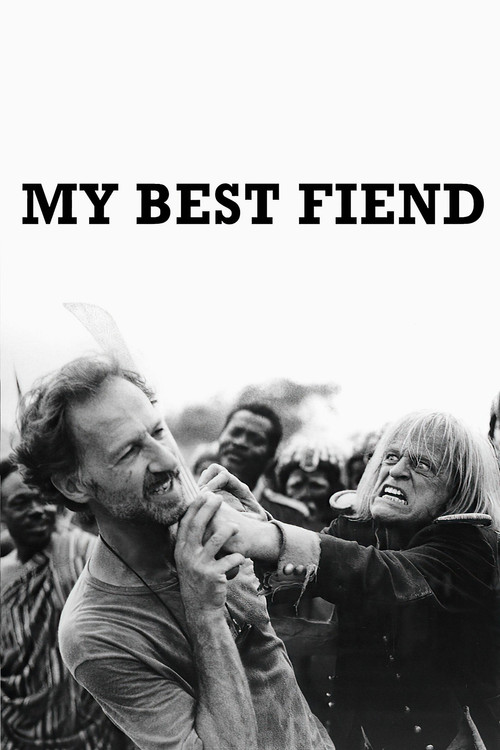
My Best Fiend
1999 · Werner Herzog
For when you want jaw-dropping true stories about obsession — the documentary equivalent of hearing a friend's wildest war stories over drinks. An easy, gripping watch that doubles as a portrait of why anyone makes art at all.
What it's about
Werner Herzog looks back at the five films he made with Klaus Kinski — an actor of volcanic talent and genuinely frightening rage — eight years after Kinski's death. Revisiting jungle locations in Peru and sifting through two decades of footage, Herzog tells the story of a partnership in which director and star each, at various points, seriously considered killing the other. It's a eulogy, a settling of scores, and a confession, often in the same breath.
The experience
Riveting and very funny in a can't-believe-he-just-said-that way — Herzog narrates outrageous stories in a calm, hypnotic deadpan while the archival footage shows Kinski erupting like a force of nature. Underneath the madness there's real tenderness, which is the strangest and most moving part.
Performances
Kinski, seen entirely in archival footage, is mesmerizing and terrifying — screaming fits, sudden charm, eyes like a storm warning. Herzog himself, on camera and in narration, gives one of the great unreliable-narrator turns in documentary.
The craft
Herzog builds the film as a personal essay rather than a standard biography: he returns to the actual locations, stands where the chaos happened, and lets his own voice carry the story. The mix of behind-the-scenes footage, film clips, and present-day pilgrimage makes the myth feel physically real.
Why it matters
It sealed the Herzog–Kinski collaboration as cinema's definitive love-hate legend and became a touchstone for documentaries about the cost of creative partnership.
Snapshot
Werner Herzog's My Best Fiend (Mein liebster Feind – Klaus Kinski) is an essay-documentary about the five-film collaboration between Herzog and the German actor Klaus Kinski, who died in November 1991. Shot across two decades of archival footage and newly filmed location visits to Peru and the Amazon basin, the film functions simultaneously as eulogy, settling of accounts, and self-portrait. It is perhaps the most searching examination any director has committed to film of the psychic cost of creative partnership, and it raised the myth of the Herzog-Kinski relationship — already extensively documented by others — into the realm of Herzog's own subjective, essayistic cinema. Running approximately 95 minutes, it is neither hagiography nor hatchet job, but something stranger: a filmmaker's attempt to understand a collaboration that produced some of cinema's most indelible images while consuming both men.
Industry & production
The film was produced under Werner Herzog Filmproduktion, the director's own Munich-based company, in co-production with Zephir Film, Lucki Stipetić (Herzog's longtime producer and brother-in-law), and Arte, the Franco-German public broadcaster whose involvement provided crucial funding for the European art-cinema market. The project was driven entirely by Herzog's personal impetus following Kinski's death; there is no record of significant studio interest or commercial pressure in its development. It was acquired for North American distribution by Anchor Bay Entertainment, a company then active in specialty home-video and theatrical releases for international and genre fare. The film premiered at the Cannes Film Festival in May 1999, where it played to considerable international attention, and received a limited theatrical release across Europe and North America thereafter.
The documentary's budget is not publicly documented at any authoritative level, and no reliable box-office figure has been published. Given its Arte backing and the modesty of its production needs — small crew, archival licensing, location travel — it was almost certainly a low-budget affair by any commercial standard, though the archival material (drawn from the original 35mm negatives of the joint features) would have required clearance costs.
Technology
My Best Fiend operates across two distinct technological registers. The archival material — comprising footage from Aguirre, the Wrath of God (1972), Nosferatu the Vampyre (1979), Woyzeck (1979), Fitzcarraldo (1982), and Cobra Verde (1987), as well as clips from Kinski's notorious 1971 Berlin theatrical tour Jesus Christus Erlöser — was originally photographed on 35mm and 16mm film stock, and its inclusion preserves the physical grain and color temperature of the original camera negative through transfer. The new material, comprising Herzog's talking-head reflections, location revisits, and interviews with collaborators including actress Claudia Cardinale and the actress Eva Mattes, was shot in a format consistent with late-1990s documentary practice; the precise format (16mm or early digital video) is not definitively established in published production documentation, and one should avoid overclaiming specificity here. What is evident in the film's visual texture is a deliberate contrast between the mythic scale of the archival 35mm material and the more intimate, rougher quality of the contemporary footage.
The archival licensing of the theatrical clips — particularly the Jesus Christus Erlöser footage, in which a progressively enraged Kinski loses control of his audience over hours of ranting — was central to the documentary's argument and required negotiation, the details of which are not publicly documented.
Technique
Cinematography
The new footage was shot by Peter Zeitlinger, the Austrian cinematographer who became Herzog's primary collaborator from the early 1990s onward, a partnership that continues to the present day. Zeitlinger's work here is subordinated, rightly, to the archival material, but his location photography in Peru — revisiting the Amazon tributaries and jungle locations of Aguirre and Fitzcarraldo — achieves a quietly elegiac quality. The landscapes are photographed with wide lenses that dwarf the human figure, echoing the visual grammar of the features they haunt. Zeitlinger does not attempt to match the expressionist grandeur of Thomas Mauch's work on Aguirre or Jörg Schmidt-Reitwein's on Nosferatu; instead, his images carry the reflective, slightly mournful register appropriate to a return visit.
Editing
The editing — whose specific credit should be verified against the film's main titles, as it is not uniformly reported across published sources — performs the film's central intellectual work: interweaving Herzog's present-tense narration with archival images in ways that consistently complicate easy moral readings. A characteristic move is to follow a story of Kinski's eruptions with an image of the actor achieving something transcendent on screen, or to juxtapose Herzog's rueful affection with footage that documents genuine menace. The rhythm is unhurried, essayistic, trusting the viewer to sit with the irresolvable.
Mise-en-scène / staging
Herzog's staging of his own on-camera segments — walking through locations, addressing the camera directly, or framing himself against the Amazon landscape — belongs to the tradition of the filmmaker-narrator, closer to Chris Marker or Orson Welles's self-inscribed documentaries than to standard interview-driven journalism. He appears alone in many of these sequences, which emphasizes both his authority and his solitude. The staging of interviews with collaborators (Cardinale, Mattes, and others) is conventional by documentary standards, shot against location or interior backgrounds without elaborate setup. The film reserves its visual ambition for the archival sequences and the Herzog-in-landscape passages.
Sound
The film's soundtrack weaves between diegetic location sound, excerpts from the original films' scores (including Florian Fricke/Popol Vuh's iconic music for Aguirre and Nosferatu), and Herzog's voiceover narration, which was recorded in German and delivered in Herzog's own English-language version for international release. The Popol Vuh material is used not as nostalgic quotation but as active emotional argument, its trance-like qualities resurfacing to frame Kinski's image with an otherworldly grandeur that Herzog clearly intends as sincere as well as ironic. The archival theatrical footage of Jesus Christus Erlöser preserves the ambient sound of a theater audience in open revolt, which is among the most unsettling acoustic sequences in the film.
Performance
Herzog's own performance as narrator and on-camera presence is the film's most unusual formal element. He is not a neutral interlocutor. His narration is frankly rhetorical, shaping the record toward his own interpretation while openly flagging its subjectivity. He recounts, for instance, the offer of local Campas people on the Aguirre set to kill Kinski on his behalf — a story he presents as his own memory, not as verified external record. Whether understood as confession, legend-building, or both, it exemplifies how My Best Fiend treats performance as inextricable from authorial self-presentation. The documentary's strongest formal insight is that its subject — Kinski's volcanic performing — can only be adequately addressed by a film that itself performs rather than merely reports.
Narrative & dramatic mode
The film is structured associatively rather than chronologically. Herzog moves between the five features, using them not as chapters in a career history but as occasions for thematic meditation: on mania, on the conditions of genius, on the ethics of exploitation (running in both directions), and on the strange tenderness that survived their mutual destructiveness. The dramatic tension is maintained by Herzog's refusal to resolve his account — he explicitly credits Kinski with certain performances of extraordinary power while also recounting episodes of violence toward crew members and allegations of abuse that he neither fully endorses nor dismisses. The result is a film that resists the conventional documentary closure of retrospective judgment.
Genre & cycle
My Best Fiend belongs to a tradition of filmmaker self-portraits and making-of documentaries, but distinguishes itself sharply from the standard promotional variety. Its nearest generic relatives are less the EPK-derived "behind the scenes" form than the essayistic filmmaker memoir: Agnès Varda's later autobiographical work, Wim Wenders's documentaries about collaborators, or the tradition of filmmakers documenting their own processes established partly by Herzog himself in films like La Soufrière (1977). The film also participates, more uneasily, in the director-as-auteur cult that surrounded New German Cinema figures, a cult My Best Fiend both feeds and interrogates.
Les Blank's Burden of Dreams (1982), which documented the production of Fitzcarraldo from an external perspective, is the documentary most directly in dialogue with My Best Fiend; Herzog's account covers much of the same ground from the inside, and the comparison between Blank's observational footage and Herzog's retrospective narration is illuminating.
Authorship & method
Herzog's authorship here is, characteristically, total and openly declared. He is subject, narrator, interviewer, and framing intelligence simultaneously. His essayistic approach to documentary — which he has theorized through his concept of "ecstatic truth," the idea that cinema should pursue a deeper emotional or visionary truth rather than mere factual accuracy — is explicitly operative in My Best Fiend. This creates a methodological tension at the heart of the film: its most celebrated anecdotes (the murder-plot symmetry, the Campas offer, the gun-to-the-head confrontation on Aguirre) come from a narrator with an acknowledged interest in myth-making and no independent corroboration in the film itself. Herzog neither apologizes for this nor hides it.
Zeitlinger's cinematographic partnership is essential but subordinate to the project's rhetorical architecture. The absence of a distinct compositional voice — relative to, say, the Thomas Mauch or Schmidt-Reitwein collaborations — is appropriate to the film's function as autobiographical meditation rather than visual manifesto.
Movement / national cinema
Herzog was a founding figure of New German Cinema, the loose movement that emerged in the wake of the 1962 Oberhausen Manifesto and dominated West German filmmaking through the 1970s and into the early 1980s alongside Rainer Werner Fassbinder, Wim Wenders, Volker Schlöndorff, and Margarethe von Trotta. By 1999, however, New German Cinema had long dissolved as an active movement (Fassbinder's death in 1982 is often cited as a turning point), and My Best Fiend is less an expression of that movement's energy than a retrospective artifact produced from within its legacy. The film is German-language in its original form, co-produced with French public television, and positioned firmly within the European art-cinema distribution network rather than any national-cinema industrial context.
Era / period
My Best Fiend arrives at the tail of the 1990s, a decade in which Herzog's international profile had dimmed considerably from its 1970s heights. The documentary mode had gained significant prestige through the decade — Michael Moore's commercial breakthroughs, Errol Morris's mainstream visibility, the documentary renaissance at Sundance — and Herzog's essayistic approach, which had never fit neatly into any documentary taxonomy, was gaining renewed critical attention. The film preceded by several years the more substantial Herzog documentary renaissance associated with Grizzly Man (2005) and subsequent work, and can be seen in retrospect as an early marker of that recovery.
Themes
The film's central preoccupation is the relationship between destructive intensity and artistic achievement — whether genius licenses or requires pathology, and who bears the cost. Kinski's behavior on set (documented through Herzog's accounts and those of collaborators) included episodes of violence toward crew members; Herzog's refusal to stop production is implicitly interrogated throughout. The film also meditates on mutual exploitation: Herzog acknowledges that he required Kinski's extremity to achieve the images he wanted, while the documentary suggests that Kinski's performances with Herzog constituted some of the only work that could contain and direct his volatility productively.
A secondary theme is the relationship between landscape and psychology. Herzog's return visits to the Amazon insist that these locations were not merely backdrops but active participants in the films' meaning — that the jungle absorbed and reflected the productions' extremity, and that revisiting them is a form of reckoning with that history.
The question of memory's reliability runs through the narration without being explicitly foregrounded. Herzog is scrupulous about presenting his accounts as his own, but the film's form — a single authoritative voice over carefully selected images — inevitably constructs rather than simply recalls the past.
Reception, canon & influence
My Best Fiend was received warmly by critics internationally following its Cannes premiere, praised for its candor and for the access it provided to the production histories of Herzog's most celebrated features. Roger Ebert's review was notably appreciative, and the film was widely included in retrospective best-of-year lists for documentary. It did not generate significant popular box-office activity, as was expected for a specialized documentary, but it performed solidly in art-house theatrical release and became a durable catalog title on home video.
Backward influences: The film draws explicitly on the archival record of the five Kinski features, on Blank's Burden of Dreams, and implicitly on a tradition of theatrical and literary portrait-making (Thomas Bernhard's corrosive portraits of collaborators and subjects are a distant analog). Herzog's own theoretical writing and interviews about Kinski — extensive throughout the 1970s and 1980s — provided a rhetorical foundation that the film consolidates and complicates.
Forward legacy: My Best Fiend substantially shaped the popular understanding of the Herzog-Kinski collaboration and of Herzog's filmmaking methods more broadly. Its anecdotes (the murder symmetry, the Campas offer) entered general cinematic discourse and are now among the most-cited stories in discussions of director-actor relationships. The film anticipated and arguably helped enable the wave of Herzog biographical and making-of journalism that accompanied his 2000s renaissance. It has become standard viewing in film school courses on documentary practice, authorial cinema, and the ethics of filmmaking. More broadly, it influenced a generation of documentaries about volatile creative partnerships — subsequent films examining difficult director-actor or director-subject relationships have had to reckon with My Best Fiend as a formal and ethical benchmark, even when disagreeing with its conclusions.
The film's most durable contribution may be methodological: its demonstration that a filmmaker can examine his own work and collaborators with rigor and something approaching honesty while fully inhabiting the subjective position, without pretending to neutral authority. Whether that demonstration ultimately serves truth or myth remains, appropriately, unresolved.
A Deleuzian reading
Somewhere on the *Aguirre* set, Herzog tells us, the Campas extras came to him with an offer.
The full Deleuzian reading of My Best Fiend →
Reception
Warmly received at Cannes 1999 as the definitive account of cinema's most volcanic director–actor feud, it now reads differently: Pola Kinski's 2013 revelations about her father made the 'lovable madman' framing feel far darker in hindsight.
How My Best Fiend was received, from release to now →
Influences: the films it descends from and the films it influenced
- F for Fake (1973) — Welles originated the essay-film device of the director appearing as an on-screen, partially unreliable narrator who constructs argument from assembled archival footage — the structural model for Herzog's self-inscribed narration and direct-address monologue.
- Fata Morgana (1971) — Herzog's earlier essay-film established the compositional grammar that My Best Fiend inherits: landscape photographed as a metaphysical participant rather than a setting, scored with Popol Vuh music to produce an incantatory, non-narrative documentary register.
- Don't Look Back (1967) — Pennebaker's backstage grammar for filming a volatile, charismatic artist's eruptions and onstage performances without editorial mediation is the observational template for the Kinski Jesus Christus Erlöser theater footage that forms My Best Fiend's documentary spine.
- Chronique d'un été (1960) — Rouch and Morin's strategy of confronting documentary subjects with footage of themselves — turning the camera into a self-examination instrument — is the structural ancestor of Herzog's use of archival Kinski footage as a form of posthumous moral confrontation.
- Sans Soleil (1983) — Marker's technique of building documentary argument through a voice-over that comments on rather than explains heterogeneous footage is the formal model for Herzog's essayistic interweaving of archival Kinski material with present-tense Amazonian location reflection.
- Burden of Dreams (1982) — Blank documented the same Fitzcarraldo production from an observational outside-eye stance; My Best Fiend is formally structured as an inversion of and response to Blank's film, replacing vérité observation with retrospective authorial narration that reclaims the same events from the inside.
- Germany in Autumn (1978) — This New German Cinema collective essay film established the first-person, self-implicating mode in which the filmmaker's own subjectivity and complicity become the documentary's central instrument — the NGC tradition within which Herzog's moral self-implication in Kinski's violence operates.
- Crumb (1994) — Zwigoff's method of allowing documentary evidence of an artist's severe psychological pathology to accumulate without editorial verdict — trusting the viewer to hold genius and dysfunction simultaneously — is the direct formal precedent for Herzog's irresolvable portrait of Kinski.
- Fitzcarraldo (1982) — Herzog's essay-film uses Fitzcarraldo footage as primary material to theorize the director-volatile-actor relationship, making explicit the formal strategy — managed unpredictability as generative force — that operates implicitly in the fiction films; the Fitzcarraldo ship sequence is re-examined as both production catastrophe and formal achievement.
- Grizzly Man (2005) — Herzog applies My Best Fiend's identical formal apparatus — essay-documentary structure, Zeitlinger cinematography, first-person narration over a subject's own archival footage — to examine another obsessive visionary's self-destruction, making this the most direct continuation of the method.
- Stories We Tell (2012) — Polley adopts Herzog's structural device of the director as narrator-investigator within their own documentary, interweaving home-movie archival footage with present-tense re-enactment and testimony to examine how family memory constructs and deforms personal myth.
- Cave of Forgotten Dreams (2010) — Inherits My Best Fiend's complete formal vocabulary — Zeitlinger's wide-lens cinematography, Herzog's on-camera address, landscape as metaphysical participant — applying it to the Chauvet cave paintings as an essay on the mythological imagination at the origin of human creativity.
- The Act of Killing (2012) — Oppenheimer extends the essay-documentary mode in which a director shapes moral argument through the strategic use of performance and re-enactment within non-fiction, directing perpetrators to stage their own histories — a formal inheritance from the Herzog tradition of author-positioned essay cinema.
- The White Diamond (2004) — Shares the complete formal vocabulary of My Best Fiend — Zeitlinger's wide-lens cinematography, Herzog's on-camera narration, a tropical landscape as metaphysical participant — and the same structural preoccupation with a male obsessive's dangerous vision examined from the inside.
- Lost in La Mancha (2002) — Fulton and Pepe use production footage and retrospective interviews to document a director's obsessive vision meeting catastrophic logistical reality — structurally the same essay-documentary question Herzog asks about the Herzog-Kinski productions, reframed as pure tragedy.
- Waltz with Bashir (2008) — Folman constructs an essay-documentary around a filmmaker's investigation of his own selective, self-protective memory — the 'memory and myth-making' formal problem that also structures My Best Fiend — ending with archival footage that shatters the reconstructed myth.
- Little Dieter Needs to Fly (1997) — Herzog applies his own interrogative-orchestration mode self-reflexively to his collaboration with Kinski, using archival footage and voiceover to construct a performative portrait that simultaneously documents and enacts the director-subject dynamic — the filmmaker as dramaturge, the subject as performer — that structures Little Dieter's formal logic.
Similar films
- Grizzly Man (2005) — influence & lineage
- Burden of Dreams (1982) — influence & lineage
- The Act of Killing (2012) — influence & lineage
- Aguirre, the Wrath of God (1972) — shared sensibility
- Woyzeck (1979) — shared sensibility
- Fitzcarraldo (1982) — shared sensibility
- Heart of Glass (1976) — shared sensibility
- Nosferatu the Vampyre (1979) — shared sensibility