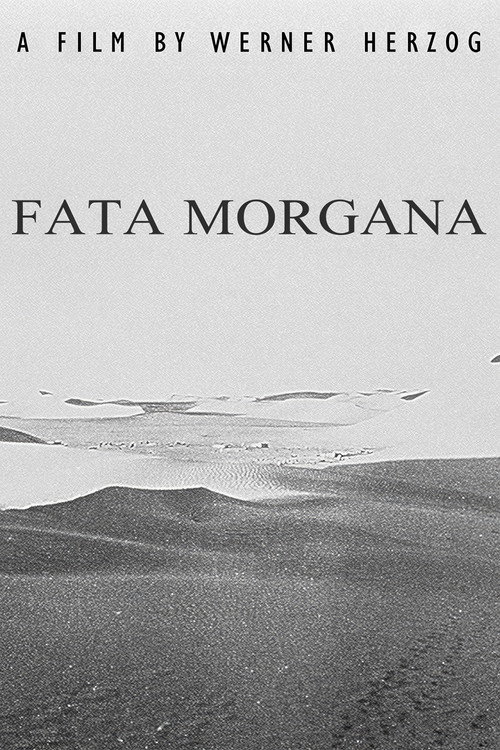
Fata Morgana
1972 · Werner Herzog
For a late night when you want to switch your brain into a different gear — not a story, but a trip. Definitely a challenge rather than comfort viewing: reach for it when you're patient, curious, and maybe a little sleepless.
What it's about
A wordless-in-spirit desert film shot across the Sahara and sub-Saharan Africa, loosely organized around a Mayan creation myth in three movements: Creation, Paradise, and The Golden Age. There is no story and no characters to follow — instead the camera drifts past shimmering mirages, wrecked planes rusting in the sand, and solitary people doing strange, unexplained things at the edge of the habitable world. It's a documentary about landscape as vision: what the desert shows you that isn't actually there.
The experience
Hypnotic and disorienting, closer to a trance or a fever dream than a documentary. The pace is glacial by design; you stop waiting for something to happen and start simply looking, and somewhere in there it turns quietly funny, then eerie, then strangely moving.
The craft
The whole film is images and sound in tension: long tracking shots across sand flats, heat-warped horizons where the mirages do the special-effects work for free, and narration reciting creation myth over footage that seems to contradict or mock it. Shot under brutal conditions, it treats the desert light itself as the subject. It rewards a big screen and total darkness — on a laptop with distractions it evaporates.
Why it matters
One of the most radical experiments of the New German Cinema of the 1970s, it staked out Herzog's lifelong territory — extreme landscapes, visionary excess, the blur between document and hallucination — and remains a touchstone for filmmakers who want documentary to do something other than inform.
Snapshot
A hallucinatory triptych filmed across the Sahara and sub-Saharan Africa, Fata Morgana organizes its desert footage under the structural framework of the Popol Vuh — the K'iche' Mayan creation epic — dividing the film into three parts: "Creation," "Paradise," and "The Golden Age." Over eighty minutes, the camera watches mirages shimmer above sand flats, planes rust in open fields, and isolated human figures perform inexplicable acts at the margins of inhabitable space. No conventional narrative connects these images; instead, Herzog wagers that sustained attention to landscape can become its own epistemological argument. The film occupies an unusual position even within the director's own catalog: neither fiction nor observational documentary, it remains one of the most radical attempts in German cinema of the 1970s to dissolve the distinction between found image and composed vision.
Industry & production
Principal photography took place across multiple expeditions between approximately 1968 and 1970, with locations concentrated in the Saharan regions of Libya and Chad as well as areas near the Cameroon border. The production was financed on an extremely limited budget, consistent with the self-organised, independent model Herzog pursued throughout his early career before any significant institutional backing. During production, Herzog and members of his crew were detained by Cameroonian authorities, who suspected the group of being mercenaries operating in a region destabilised by post-independence political turbulence; the detention lasted several weeks and significantly disrupted the shooting schedule. Herzog has described the imprisonment in several interviews, and it stands as one of the more documented production crises of the New German Cinema era.
The film was not conceived with its Popol Vuh framework from the outset. Herzog has stated in interviews that the original intent was something closer to a science-fiction premise: footage of what appeared to be an alien planet, an uninhabited or post-human world being surveyed by an unnamed observer. The Mayan creation mythology was imposed as a structuring text during post-production, a retroactive architecture that reframed raw footage whose accumulative logic had already exceeded its original premise. This inversion — landscape first, meaning second — is crucial to understanding how the film works and what kind of claim it makes on documentary practice.
Technology
Fata Morgana was shot on 16mm film, a format that at the time carried connotations of documentary immediacy and underground practice, and which imposed practical constraints on crew size and equipment weight that were advantageous for the extreme field conditions. The footage was subsequently blown up to 35mm for theatrical presentation, a process that introduced visible grain into the image — a textural quality that reinforces, rather than undermines, the film's atmosphere of heat, deterioration, and perceptual instability. Filming in temperatures reported to exceed 50 degrees Celsius required improvisation around equipment tolerances, and the characteristic haze and light flare in many shots reflects the literal optical conditions rather than stylistic affectation.
The extreme luminosity of desert environments presented particular challenges for exposure, and the mirage sequences required waiting for precise atmospheric conditions — typically occurring in the mid-morning hours when ground-level temperature inversions are most pronounced — to be captured at all. No detailed account of the specific lenses or camera models used has entered the published scholarly record, and the technical production documents, if preserved, have not been widely circulated.
Technique
Cinematography
Jörg Schmidt-Reitwein, who became one of Herzog's closest collaborators during this period, served as principal cinematographer. His work on Fata Morgana established the visual logic he and Herzog would refine across subsequent projects: a preference for long takes that allow events to develop at their own pace, a willingness to hold on landscape long past the point of narrative function, and a sensitivity to available light that resists the imposition of artificial structure on what is found. The camera is frequently static or operates on slow, nearly imperceptible pans that function less as reframings than as acts of sustained witness.
The mirage sequences are cinematographically central to the film's argument. A fata morgana — the complex superior mirage the film takes its name from, itself named after Morgan le Fay, the Arthurian enchantress said to lure sailors with illusory visions — is not a simple heat shimmer but a refractive phenomenon that can produce layered, inverted, and duplicated images of distant objects. Schmidt-Reitwein photographs these at length: aircraft hangars, structures, and figures appear to float above the ground plane, doubled and wavering. The result is an image that is photographically accurate while being visually impossible — documentary evidence of unreality.
Editing
Beate Mainka-Jellinghaus, who edited several of Herzog's early features including Aguirre, the Wrath of God (1972), is credited as editor. The editing rhythm in Fata Morgana is unlike anything in conventional documentary: sequences run long, transitions are abrupt rather than graduated, and there is no attempt to construct a visual argument through montage in the Eisensteinian sense. Instead, the cut often arrives as a kind of rupture — from vast empty landscape to close human absurdity — that generates meaning through juxtaposition rather than continuity. The film's overall tempo is processional, building a cumulative weight that depends on duration rather than incident.
Mise-en-scène / staging
What counts as staging in Fata Morgana is genuinely ambiguous. Many of the film's most striking images — abandoned aircraft, a man playing piano in open sand, discarded consumer goods in the desert — were found rather than arranged, yet the act of framing them transforms them into something compositionally intentional. Herzog has consistently refused the observational documentary's claim to transparent non-intervention, and Fata Morgana is an early statement of that refusal: if the camera is always a compositional act, then the distinction between found and arranged is philosophically unstable.
The human vignettes in "The Golden Age" section have a quality of performance — a man and woman lip-synching to music, a woman dancing without apparent audience — that sits uncomfortably between documentary encounter and staged absurdism. Whether these were directed or spontaneous encounters has not been fully clarified in the published record.
Sound
The sound design is among the film's most distinctive achievements. The score draws entirely on pre-existing recordings rather than commissioned music: Leonard Cohen's songs, principally from his albums Songs of Love and Hate and Songs of Leonard Cohen, recur throughout, their confessional, bare-bones folk arrangements creating an extraordinary tonal dissonance with the Saharan imagery. An aria from Mozart's Così fan tutte appears in one section, injecting operatic irony into the landscape. The disjunction between these culturally specific, emotionally intimate musical choices and the scale and otherness of the images they accompany produces an alienation effect that is the film's primary rhetorical tool.
The narration is drawn from the Popol Vuh text and was read in the German-language version by a female narrator (the precise identity of the German narrator is not consistently documented in the secondary literature I have consulted; some accounts attribute it to a collaborator associated with the Munich film community, but I cannot confirm a name without risk of error). The English-language version used in international distribution has a separately recorded narration. Herzog himself does not narrate in the way he would in later films.
Performance
There are no performances in any traditional sense. The human figures encountered in the film are not actors and are not directed toward any narrative function. They exist as found objects within the landscape, their presence intensifying the film's argument about the uncanny co-presence of humanity and inhospitable environment. In this respect Fata Morgana is closer to the observational traditions of ethnographic cinema than to drama, though it ultimately diverges from that tradition too by refusing any anthropological frame.
Narrative & dramatic mode
Fata Morgana has no narrative in the sense of causally linked events unfolding over time. Its structure is formally tripartite — "Creation," "Paradise," "The Golden Age" — but these titles function as ironic commentary rather than descriptive chapter headings. "Creation" shows a world that looks posthumous; "Paradise" is populated by evidence of ruin; "The Golden Age" presents a spectacle of human comedy in extremis. The Popol Vuh framework offers a grand cosmological arch without supplying story: what we receive is the feeling of creation myth without the myth's explanatory comfort.
The dramatic mode is closer to what Herzog would later call the "ecstatic truth" — a truth accessible not through factual accumulation but through the hypnotic, obsessive return to images that exceed their documentary occasion. Fata Morgana is an early laboratory for this concept before Herzog had formulated it in those terms.
Genre & cycle
The film belongs to no stable genre. It has been categorized variously as experimental documentary, essay film, avant-garde cinema, and visionary or lyrical non-fiction. Its closest relatives at the time of production are the essay films of Chris Marker — particularly La Jetée (1962) and Si j'avais quatre dromadaires (1966) — and the diary films and structural documentaries emerging from American avant-garde practice. However, Herzog's refusal of the self-reflexive intellectual address characteristic of Marker's work marks a significant temperamental difference. Fata Morgana does not position a speaking subject at its center; it positions landscape.
Within Herzog's own filmography it forms part of a cycle of early documentary and quasi-documentary works that includes Land of Silence and Darkness (1971) and anticipates The Great Ecstasy of Woodcarver Steiner (1974) and, much later, Lessons of Darkness (1992), which returns to desert and fire imagery in a context (burning Kuwaiti oil fields) that makes explicit what Fata Morgana leaves implicit: that industrial civilization leaves precisely this kind of ruin.
Authorship & method
Werner Herzog was twenty-five or twenty-six during the principal photography of Fata Morgana, and the film documents both the ambition and the productive recklessness of an early career. His method here — shoot what is extraordinary, apply a structure later, trust duration over argument — would remain a constant even as his films grew more formally controlled. The collaboration with Schmidt-Reitwein is central: their shared willingness to wait, to hold, to let the desert perform at its own pace, is what distinguishes the film's visual intelligence from mere landscape photography.
The choice to use the Popol Vuh rather than any European textual framework is significant and has not been fully theorized in the English-language scholarship. It is not ethnographic interest in Mayan culture per se; rather, the text's account of a failed first creation — beings made of mud, then wood, then finally maize — provides a cosmological grammar of inadequacy and revision that rhymes with what Herzog found in the desert: a world that looks like it did not succeed.
The band Popol Vuh — Florian Fricke's ensemble, whose name derives from the same Mayan text — had not yet become Herzog's regular musical collaborator at the time of Fata Morgana; that partnership began with Aguirre in 1972. The music here is deliberately sourced from elsewhere, its cultural mismatches part of the film's deliberate strategy of incongruity.
Movement / national cinema
Fata Morgana belongs to the New German Cinema (Neues Deutsches Kino), the loose generational formation announced formally by the Oberhausen Manifesto of 1962, which declared the death of the old German cinema and the birth of a new one made by young directors with full creative control. By the early 1970s, the movement had produced its major figures: Fassbinder, Wenders, Kluge, Schlöndorff, von Trotta. Herzog's particular strand within the movement was distinctive in its preference for extreme environments, non-European subjects, and a metaphysical rather than social-critical ambition.
Fata Morgana is in this sense the New German Cinema at its most eccentric remove from the Bundesrepublik: it contains no images of Germany, addresses no German social question, and makes no reference to the postwar condition that was the explicit or implicit subject of much of the movement's work. Its European context is primarily aesthetic and institutional rather than thematic.
Era / period
The film belongs to the period of international art cinema's greatest institutional confidence, roughly 1968–1976, when theatrical distribution for formally ambitious non-commercial film remained viable across European and American markets, and when festival culture (Cannes, Berlin, Venice, New York) could confer enough prestige on a difficult film to sustain its circulation. Fata Morgana was made in the aftermath of 1968 and shares something of that moment's refusal of established institutional forms — the conventional documentary, the feature film, the educational travelogue — without having any programmatic political content.
Themes
Illusion and perception. The fata morgana mirage is the film's governing metaphor: what the camera records is real, and what it shows is impossible. This is not a deficiency of the medium but its most honest condition. Cinema always shows what is not there.
Creation and aftermath. Drawing on the Popol Vuh's account of failed worlds preceding the successful one, the film presents a landscape of residue — what remains after or before inhabitation. The desert is not empty; it is full of evidence of presence and departure.
Modernity's detritus. The abandoned aircraft, rusting vehicles, and consumer goods scattered across the sand constitute an implicit critique of the European and American industrial presence in Africa without making that critique explicit or didactic. The objects are presented as ruins, their former purposiveness drained away.
The limits of the image. By filming something — the mirage — that is definitionally an optical illusion, Herzog raises the question of what it means to claim that cinema documents. Every image in the film is technically accurate and ontologically unstable simultaneously.
Endurance and the inhuman. The desert as landscape exceeds human scale. The film's long takes in empty space create a subjective experience of duration that foregrounds the viewer's embodied presence in a way that narrative cinema suppresses.
Reception, canon & influence
Fata Morgana received limited theatrical distribution on its initial release and circulated primarily through festivals and art-cinema venues. Commercial reception was negligible, and the film did not reach wide audiences in the manner of Herzog's subsequent fiction features. Early critical reception was mixed to respectful, with some critics noting the film's hypnotic qualities while others found its refusal of conventional documentary purpose frustrating. It did not immediately establish itself as a canonical work.
Influences on the film (backward): The Mayan Popol Vuh is the most explicit cultural source. Visually, the film is in dialogue with the tradition of landscape cinema running from Flaherty's Nanook of the North (1922) through the Italian neorealist use of non-studio exteriors and into the French essay film. The absurdist vignettes in "The Golden Age" show awareness of Buñuelian surrealism. The use of disjunctive found music on documentary image has precedents in Marker. The film's structural ambition — to build a cosmological argument from documentary materials — has some affinity with the Soviet documentary tradition, though no direct influence is documented.
Legacy and forward influence: Within Herzog's own work, Fata Morgana is the direct aesthetic ancestor of Lessons of Darkness (1992), which applies a similar mythological framework (using Pascalian and Revelation texts) to footage of the burning Kuwaiti oil fields, and which makes explicit the apocalyptic reading of industrial landscape that Fata Morgana leaves implicit. More broadly, the film contributed to the development of the essay-documentary as a recognized mode: its influence can be traced in the work of filmmakers who came to regard landscape duration and structural incongruity as legitimate documentary tools.
Scholars including Paul Cronin (who assembled the extensive Herzog interview collection Herzog on Herzog) and Timothy Corrigan (in his work on essay film) have placed Fata Morgana within the lineage of the lyrical documentary and the European essay film. Its critical standing has risen considerably since the 1980s, and it is now regarded as a foundational work of Herzog's early period and a significant if difficult document of what experimental non-fiction film could attempt. The film has been retrospectively grouped with the small number of works — alongside Marker's Sans Soleil (1983), Agnès Varda's early documentaries, and certain structural films from American avant-garde practice — that permanently altered the terms of what counts as documentary evidence and documentary truth.
A Deleuzian reading
Start with the shimmer.
The full Deleuzian reading of Fata Morgana →
Reception
Baffled audiences at its early-'70s screenings — Herzog himself sat on the footage for a couple of years, unsure the world wanted it — and it was widely dismissed as hippie-era desert abstraction. Now it's treasured as the Rosetta Stone of Herzog's whole project, the first full statement of his 'ecstatic truth' before the term existed.
How Fata Morgana was received, from release to now →
Influences: the films it descends from and the films it influenced
- Nanook of the North (1922) — Established the held-shot-until-the-environment-yields method — stationary camera waiting for landscape or subject to complete its own action at its own pace — which Herzog and Schmidt-Reitwein directly inherit for the processional Saharan sequences.
- Man with a Movie Camera (1929) — Established processional editing rhythm as cosmological argument — images linked by perceptual association rather than causal logic — the structural template for Fata Morgana's assembly of desert phenomena into a creation myth without narrative connective tissue.
- Las Hurdes (1933) — Pioneered the falsely empirical narration-against-image device: deadpan voiceover applied to surreal landscape imagery to generate cosmological irony — the technique Fata Morgana inherits for its 'Creations' section, where Lotte Eisner reads creation myth over wreckage.
- Stromboli (1950) — Established extreme-location available-light shooting in which a hostile landscape overwhelms its human subject with no studio mediation — the neorealist precedent for Schmidt-Reitwein's available-light photography in Saharan heat.
- Night and Fog (1955) — Established the literary voiceover applied to documentary landscape footage — text that exceeds mere description to build a cosmological argument — which Herzog inherits for the Popol Vuh narration that transforms anonymous desert into a failed first creation.
- Letter from Siberia (1957) — Invented the essay-film technique of incongruous commentary and disjunctive found music applied over documentary footage — the direct formal precedent for Fata Morgana's Leonard Cohen score playing against Saharan imagery of wreckage and mirage.
- Andrei Rublev (1966) — Established the extended landscape long-take as a vehicle for theological argument — shots held in harsh exteriors until duration itself becomes meaning — the cosmological use of camera patience that Fata Morgana inherits and redeploys in documentary materials.
- Koyaanisqatsi (1982) — Extends Fata Morgana's processional editing tempo and music/image disjunction into feature length — Ron Fricke's cinematography adapts the available-light landscape-first method to time-lapse and slow-motion while Philip Glass supplies the same cosmological scoring function.
- Sans Soleil (1983) — Extends the disjunctive found-music essay structure Marker had pioneered — and which Fata Morgana directly absorbed — into a tripartite global essay where cultural dissonance between image and commentary becomes the epistemic organizing principle.
- Lessons of Darkness (1992) — Directly extends Fata Morgana's mythological-framework-over-documentary-landscape by applying Pascal and Revelation texts to footage of burning Kuwaiti oil fields, making explicit the apocalyptic cosmological reading that Fata Morgana embeds within the Popol Vuh structure.
- Into Great Silence (2005) — Inherits the processional-tempo long-take and available-light patient observation method — extended duration shots of monastic space without narration or score — as the purest application of Fata Morgana's hold-and-wait documentary ethic in a later generation.
- Sweetgrass (2009) — Applies the landscape-first documentary method through available-light long-take cinematography to observe Montana shepherd migration without narrative intervention, extending Fata Morgana's processional editing rhythm to a purely durational ethnographic form.
- My Best Fiend (1999) — Herzog's earlier essay-film established the compositional grammar that My Best Fiend inherits: landscape photographed as a metaphysical participant rather than a setting, scored with Popol Vuh music to produce an incantatory, non-narrative documentary register.
- For All Mankind (1989) — Herzog assembled observational Sahara footage with ambient and classical music into a non-narrative lyrical triptych that resists explanation — the European essay-documentary model Reinert draws on when he refuses to let astronauts explain what they experienced.
- Zabriskie Point (1970) — Deploys American rock score (Pink Floyd, Grateful Dead) over Death Valley desert long takes to produce structural cultural dissonance — a near-simultaneous sibling deployment of the incongruous-Western-music-over-arid-landscape device.
- Walkabout (1971) — Uses available-light photography in the Australian outback with fragmented editing that organizes sequences by sensory duration rather than narrative momentum, making landscape epistemologically active — a parallel elaboration of the landscape-first method.
- La Région Centrale (1971) — Commits to purely mechanical landscape scanning — a programd camera traversing Quebec wilderness without human direction for three hours — as the structural-film extreme of the landscape-first method, removing even the subjective gaze Fata Morgana retains.
- Heart of Glass (1976) — Both films build entirely from associative visual logic—landscape sequences edited for rhythmic and atmospheric accumulation rather than narrative causality—with Popol Vuh's drone minimalism performing the same organizing function as the images themselves.
- Land of Silence and Darkness (1971) — Produced in the same period with Jörg Schmidt-Reitwein as cinematographer, sharing the same 16mm grammar, the same essayistic-cumulative structure without narrative resolution, and the same commitment to landscape and face as philosophical states; the two films constitute twin experiments in the mature Herzogian documentary mode.
Similar films
- Lessons of Darkness (1992) — influence & lineage
- Sans Soleil (1983) — influence & lineage
- Heart of Glass (1976) — shared sensibility
- Aguirre, the Wrath of God (1972) — shared sensibility
- Baraka (1992) — shared sensibility
- Burden of Dreams (1982) — shared sensibility
- Hitler: A Film from Germany (1978) — shared sensibility
- Land of Silence and Darkness (1971) — shared sensibility
All the films related to Fata Morgana →