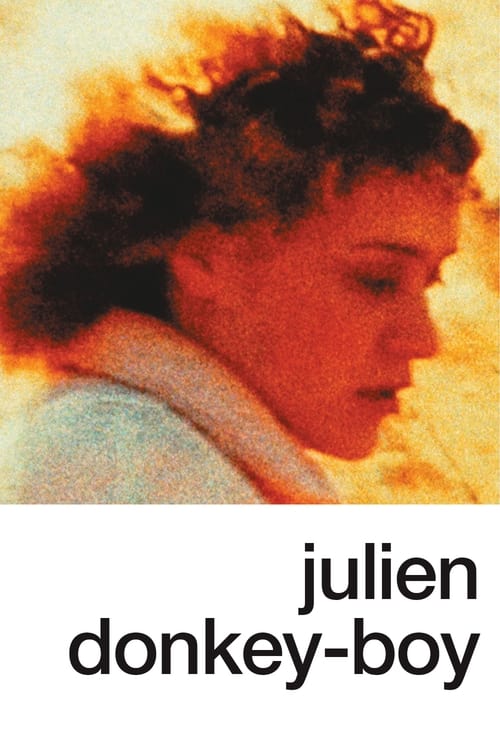
Julien Donkey-Boy
1999 · Harmony Korine
For when you want cinema at its most extreme and unfiltered — a challenge, not a comfort, best met when you're ready to be rattled and don't need a plot to hold your hand.
What it's about
In a cramped New Jersey house, a young man with untreated schizophrenia lives alongside his pregnant sister, a brother obsessed with becoming a wrestler, a gentle grandmother, and a domineering, German-accented father whose cruelty sets the household's temperature. There is barely a plot — instead the film drops you inside Julien's head and the family's daily rituals of tenderness, humiliation, and prayer, watching the pressure build.
The experience
Raw, disorienting, and often genuinely hard to sit with — images smear and fracture, voices overlap, and moments of strange beauty surface out of the murk. It's less a story you follow than a state you enter, and it leaves a residue of unease and pity that lingers.
Performances
Ewen Bremner disappears into Julien with a commitment that never feels like acting-class mimicry, and Werner Herzog — the legendary director, here acting — is unforgettable as the bullying father, funny and frightening in the same breath.
The craft
Korine shot on consumer digital cameras and then degraded the images further, producing a smeared, hallucinatory texture unlike anything else in American film — ugliness pushed until it becomes expressive. The sound is a dense weave of muttering, hymns, and ambient noise that does as much storytelling as the pictures. It rewards full attention and good speakers more than a big pristine screen; the roughness is the point.
Why it matters
One of the most notorious formal experiments to reach American art houses, it cemented Korine's reputation as the country's foremost provocateur-poet and showed a generation what cheap digital cameras could do expressively.
Snapshot
Julien Donkey-Boy is Harmony Korine's second feature, made two years after the succès de scandale of Gummo (1997), and it remains one of the most extreme experiments in form ever to reach American art-house screens. Its ostensible subject is a household pressurized to the point of collapse: Julien (Ewen Bremner), an untreated schizophrenic, lives in a New Jersey home with his pregnant sister Pearl (Chloë Sevigny), his wrestling-obsessed brother Chris, a gentle grandmother, and a tyrannical, German-accented father (Werner Herzog). But plot is almost beside the point. The film is built as a fractured, hallucinatory flow of textures — degraded digital images, overlapping voices, religious muttering, sudden violence — that attempts to render consciousness from the inside rather than observe it from without. Its place in history is secured by a single credential: it was certified Dogme 95 #6, the first American film admitted to the Danish back-to-basics movement founded by Lars von Trier and Thomas Vinterberg. That pairing of an avant-garde manifesto with a portrait of mental illness produced a work that critics found alternately visionary and exploitative, and which has aged into a touchstone for digital-era cinema's romance with rawness.
Industry & production
The film belongs to the late-1990s moment when American independent cinema, flush from the Sundance-Miramax boom, briefly underwrote genuinely transgressive work. Korine, then in his mid-twenties and already notorious as the teenage screenwriter of Larry Clark's Kids (1995), occupied a rare position: a young provocateur with enough cultural capital to command real, if modest, resources for uncommercial projects. Julien Donkey-Boy was produced through the orbit of producers including Cary Woods, who had shepherded Gummo, with Scott Macaulay and Robin O'Hara's Forensic Films involved in mounting the production; it was distributed by Fine Line Features, New Line's specialty arm, the same outfit that had released Gummo. The budget was small and the shooting conditions deliberately stripped-down, partly by ethos and partly by the demands of the Dogme framework. Exact production-cost and box-office figures are not reliably documented in the public record, and the film's theatrical release was a limited art-house affair rather than a commercial proposition; I won't invent numbers where the record is thin. What matters industrially is the gambit itself: a major-ish distributor backing a feature shot largely on consumer camcorders, with a non-professional grandmother and an art-cinema legend in lead roles, and submitting it for vetting by a foreign manifesto committee.
Technology
Technologically the film is a landmark, arriving at the precise hinge where prosumer digital video became cheap enough to make a feature look like nothing that had come before. Cinematographer Anthony Dod Mantle — fresh from shooting Vinterberg's The Celebration (1998), the Dogme film that proved low-resolution video could carry a theatrical feature — treated the era's small-format cameras as a painter's palette rather than a compromise. The production drew on a heterogeneous array of capture devices: Mini-DV camcorders, smaller surveillance-grade and toy cameras, and images re-photographed off television monitors to multiply grain, smear, and color bleed. Footage was then transferred to 35mm for projection, a blow-up process that further coarsened the image into something pitted and luminous. The much-repeated production lore that certain scenes were covered by a large bank of simultaneous hidden cameras speaks to the method's intent even where the precise count is hard to verify; the verifiable point is that Korine and Dod Mantle multiplied vantage points and formats to dissolve any single stable "camera." This was, in effect, an argument that digital video's defects — low resolution, automatic exposure hunting, compression artifacts — were expressive resources, and the film became an early proof of concept for an aesthetic that the next two decades would absorb wholesale.
Technique
Cinematography
Dod Mantle's images refuse classical legibility. Frames are smeared, over- or under-exposed, often pixelated into abstraction, and the handheld camera — mandated by Dogme — lurches and reframes restlessly. Faces loom and dissolve; light sources bloom into the lens. The varied capture formats mean the look shifts shot to shot, so that the film's visual grammar is itself unstable, a correlative for Julien's perception. This is cinematography as subjective weather rather than coverage, and its influence on the texture of subsequent low-budget and "elevated" art cinema is hard to overstate.
Editing
The cut, by the Icelandic editor Valdís Óskarsdóttir — who had also edited The Celebration and would later cut Eternal Sunshine of the Spotless Mind (2004) — is the film's secret engine. Rather than building scenes for continuity, Óskarsdóttir assembles bursts and loops, repeating gestures, jumping across the multi-camera material, letting sound and image drift out of sync. The associative, almost musical structure substitutes rhythm and accretion for narrative causality, and it is largely through editing that the film converts raw, often chaotic footage into a sustained altered state.
Mise-en-scène / staging
The Dogme prohibition on imported props and constructed sets pushed the staging toward found, lived-in spaces: a cluttered suburban house, a school for the blind where Julien works, an ice rink. Within these locations Korine stages tableaux of the grotesque and the tender side by side — Herzog's father in a gas mask, blind students reciting, Pearl skating in her advancing pregnancy. The staging favors the off-center and the unrepeatable, courting accident as an aesthetic principle.
Sound
Sound is dense, layered, and frequently the most disorienting element: muttered prayers, fragments of dialogue, ambient noise, and Julien's private monologues overlap into a near-continuous murmur. Dogme's vow that sound be recorded with the image, never added afterward, is honored in spirit even as the mix becomes a thick aural collage. The result privileges interiority — we are inside a head that cannot filter the world's input.
Performance
Performance is where the film's ethics and its power both concentrate. Bremner — the Scottish actor known as Spud in Trainspotting — gives a fully committed, near-unbroken embodiment of disordered consciousness, his Julien a churn of tics, religious incantation, and sudden warmth; reports that he prepared by observing people in institutional settings are consistent with the performance's specificity, though the details of his process are not exhaustively documented. Sevigny brings a grave stillness as Pearl. Korine cast non-professionals throughout, including his own grandmother, Joyce Korine, as the grandmother, lending several scenes a documentary uncanniness.
Narrative & dramatic mode
The film operates in an anti-narrative, lyrical mode. There is a loose situation — a family circling its own dysfunction, a pregnancy moving toward a catastrophic delivery — but Korine withholds exposition, motivation, and resolution. Events arrive without preparation and recede without consequence; the dramatic unit is the charged fragment rather than the developed scene. The closest thing to a through-line is the trajectory of Pearl's pregnancy, which ends in miscarriage and a final, devastating image of Julien cradling the dead infant in bed. This is melodrama's raw material — madness, family cruelty, a lost child — refracted through an experimental sensibility that denies the catharsis melodrama promises.
Genre & cycle
Dogme 95's manifesto explicitly forbade "genre," and Julien Donkey-Boy takes the prohibition seriously, sitting outside conventional categories. If it belongs to a cycle, it is the turn-of-the-millennium current of American transgressive realism — Clark's Kids and Bully, Korine's own Gummo — that fused documentary surfaces with extreme content and a fascination with the marginal. It also belongs, as a formal experiment in subjective mental illness, to a small tradition of films that attempt to film psychosis from within rather than diagnose it from without.
Authorship & method
The film is unmistakably Korine's: a continuation of the aesthetic he announced in Gummo — affection for outsiders and "freaks," a collage structure, a refusal of conventional taste, and a deeply personal substrate. Korine has connected the project to schizophrenia within his own family, which grounds the film's intimacy and complicates easy charges of exploitation. His method privileged improvisation, real locations, non-actors, and accident. The crucial collaborators amplify rather than dilute that vision. Dod Mantle's cinematography supplied the degraded-digital palette; Óskarsdóttir's editing imposed associative rhythm on the chaos; and the most inspired piece of casting, Werner Herzog as the father, brought another mythologized auteur into the frame as performer. Herzog — whom Korine openly revered — improvises much of his role, by turns absurd and menacing, and his presence functions as a kind of avant-garde lineage made flesh. On the question of a composer: Dogme's vow nominally bars non-diegetic music, and the film's sound design leans on diegetic and ambient material rather than a conventional score; I won't attribute a specific composer credit where I cannot confirm it. The writing, credited to Korine, is better understood as a scaffold for performance than a conventional screenplay.
Movement / national cinema
Though made in America with American money and an American setting, the film's defining affiliation is transnational: it is a Dogme 95 work, certified by the movement's Copenhagen-based brotherhood, and the first American film to earn that certificate. This makes it a fascinating hybrid — a New Jersey suburban nightmare shot under Danish rules, photographed by the British-born, Denmark-based Dod Mantle, and edited by an Icelander. It thus sits at the intersection of American independent cinema and the late-1990s Scandinavian new wave, and it helped export Dogme's low-fi gospel into the U.S. indie bloodstream just as digital tools were democratizing production.
Era / period
Julien Donkey-Boy is a quintessential artifact of 1999, a year now mythologized as a high-water mark for ambitious American filmmaking, and of the broader turn-of-the-millennium anxiety about authenticity in an increasingly mediated culture. It arrives precisely as digital video is poised to upend production economics — the same window that produced The Blair Witch Project and the early Dogme films — and it reads as both symptom and prophecy of that shift. Its degraded images and confessional rawness anticipate the aesthetic of the coming decade of camcorder confessionals, reality television, and eventually user-generated video.
Themes
The film's central preoccupation is consciousness itself — specifically, the attempt to render a mind that cannot organize the world into coherence. Mental illness here is neither pathologized nor romanticized so much as inhabited. Around that core cluster Korine's recurring concerns: the family as a site of love and damage indistinguishably entangled; the sacred and the profane forced into contact (Julien's incessant religiosity set against bodily degradation and cruelty); and a tenderness toward the marginal, the disabled, the "abnormal," that the film insists on even as its imagery courts the grotesque. The father's authoritarian demand that his children be "winners" introduces a satirical thread on American ideals of strength and success, embodied in the brother's pathetic wrestling regimen. Underlying all of it is the question the film cannot resolve and does not try to: whether radical empathy and aestheticized suffering can coexist.
Reception, canon & influence
Critical reception was sharply divided, and that division is itself part of the film's significance. Admirers championed its formal daring, its performances — Bremner's above all — and its uncompromising attempt to film a state of mind; detractors found it self-indulgent, incoherent, or exploitative in its handling of disability and mental illness. (Because the contemporary critical record contains many strongly worded but variously remembered notices, I'll characterize the consensus rather than attribute specific quotations I cannot verify.) The film was never a popular success and circulated as a cult and festival object rather than a crossover hit.
Looking backward, the influences ON the film are legible: the Dogme manifesto of von Trier and Vinterberg supplied its rules and Dod Mantle its grammar; Herzog's own cinema of ecstatic excess hovers over it, made literal by his casting; Cassavetes' raw domestic dramas and the structuralist collage of the avant-garde inform its anti-narrative drift; and Korine's own Gummo is its immediate parent. Looking forward, its legacy runs in two channels. Aesthetically, it was an early, influential demonstration that degraded digital imagery could be expressive rather than merely cheap — a lesson absorbed by mumblecore, by "elevated" American art cinema, and by a generation comfortable with low-resolution, found-footage, and phone-shot textures. And within Korine's own authorship it points directly forward to the further abstraction of Trash Humpers (2009) and the pop-saturated formalism of Spring Breakers (2012), confirming him as one of the few American filmmakers to build a coherent avant-garde career inside the commercial system. Julien Donkey-Boy endures less as a film people love than as one that filmmakers and scholars keep returning to: a hinge between the analog and digital eras, and one of the period's purest tests of how far empathy and experiment can be pushed at once.
A Deleuzian reading
Start with the murmur.
The full Deleuzian reading of Julien Donkey-Boy →
Reception
In 1999 it landed as another divisive Korine provocation — plenty of walkouts and pans, though Roger Ebert notably defended it — and it made little money. It's since been reappraised as one of the strongest films to come out of the Dogme 95 movement and a high-water mark of scuzzy late-'90s DV aesthetics, now that lo-fi digital texture reads as beautiful rather than broken.
How Julien Donkey-Boy was received, from release to now →
Influences: the films it descends from and the films it influenced
- Gummo (1997) — Korine's immediate self-parent: establishes the episodic collage structure, the casting of regional non-actors and 'outsiders,' and the refusal of plot in favor of vignette-as-tableau that Julien inherits wholesale.
- Festen (The Celebration) (1998) — Dogme #1 and the proof-of-concept for handheld consumer-digital shooting of a family imploding around abuse — and the source of Anthony Dod Mantle's degraded-DV grammar that he then carries directly into Julien.
- The Idiots (1998) — Dogme #2's confrontational staging of feigned/real disability and 'spassing' supplies Julien's model for filming altered minds with improvised non-actors and an ethics-baiting handheld proximity.
- Breaking the Waves (1996) — Its restless handheld camera bound to a woman's disordered, divinely-addressed inner speech pioneers the sacred-and-profane subjectivity Julien adopts for Ewen Bremner's schizophrenic monologues.
- A Woman Under the Influence (1974) — The template for improvised domestic agony filmed in long, raw takes where mental breakdown is performed from the inside without diagnostic distance — the Cassavetes method Korine builds the house and family on.
- Faces (1968) — Hand-held, available-light 16mm intimacy that lets actors run past comfort into ugliness, normalizing the abrasive close-quarters camerawork Julien pushes into prosumer digital.
- The Enigma of Kaspar Hauser (1974) — Herzog's casting of the non-actor Bruno S. — a genuinely traumatized man playing difference rather than impersonating it — is the precedent for Julien's whole non-professional, lived-experience casting logic, made explicit by Herzog appearing as the father.
- Even Dwarfs Started Small (1970) — Herzog's 'cinema of ecstatic excess' staged with marginalized performers as anarchic spectacle is the avant-garde lineage Korine reveres and literally embodies by putting Herzog in the frame.
- Meshes of the Afternoon (1943) — The American avant-garde's associative, dream-logic editing — image rhymes and repetitions over narrative causation — feeds the structuralist collage rhythm Sigurjón Birgir Sigurðsson... that editor Valdís Óskarsdóttir imposes on Julien's chaos.
- Trash Humpers (2009) — Korine pushes Julien's degraded-format aesthetic to its limit, shooting on worn VHS so the medium's decay becomes the subject — the logical extension of treating low-res texture as expressive material.
- Spring Breakers (2012) — Carries forward Julien's associative, music-driven collage editing and loop-repetition of voice-over fragments, now grafted onto saturated pop imagery — the same anti-narrative drift in commercial clothing.
- 28 Days Later (2002) — Anthony Dod Mantle weaponizes the same degraded-DV palette from Julien for a studio-scale feature, mainstreaming the lesson that prosumer digital's grain and smear could be a chosen aesthetic, not a budget compromise.
- Tarnation (2003) — A found-footage, software-collaged first-person account of family mental illness that extends Julien's aural/visual collage and 'illness from within' subjectivity into the autobiographical desktop-edited mode.
- Funny Ha Ha (2002) — Mumblecore's founding text directly absorbs Julien's demonstration that cheap digital, non-professional casting, and improvised mundane intimacy could constitute a serious American art-cinema grammar.
- Heaven Knows What (2014) — The Safdies cast a non-actor drawn from the life she portrays and film her disordered, addicted consciousness with anxious long-lens handheld proximity — Julien's lived-experience-casting and embodied-illness method extended to street realism.
- The Blair Witch Project (1999) — Released the same year, it independently proves that smeary consumer-camcorder imagery and ambient diegetic sound can carry dread and authenticity rather than read as merely cheap — the parallel 1999 digital-turn discovery.
- Mifune (1999) — Dogme #6 also shot by Anthony Dod Mantle, sharing the handheld available-light approach and a naturalistic portrayal of mental disability.
Similar films
- Gummo (1997) — influence & lineage
- The Idiots (1998) — influence & lineage
- Even Dwarfs Started Small (1971) — shared sensibility
- Dogville (2003) — shared sensibility
- Sweetie (1989) — shared sensibility
- Dogtooth (2009) — shared sensibility
- The Celebration (1998) — shared sensibility
- Eraserhead (1977) — shared sensibility
All the films related to Julien Donkey-Boy →