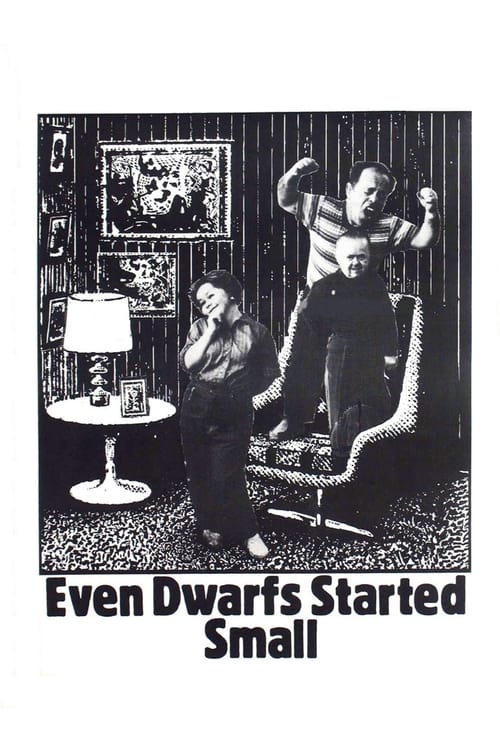
Even Dwarfs Started Small
1971 · Werner Herzog
For when you want cinema at its strangest and most confrontational — a film to argue about afterward, not to relax with. Strictly for the adventurous; approach it the way you'd approach a dare.
What it's about
At a bleak reform institution on a volcanic island, the inmates — the entire cast is made up of dwarfs — seize their moment when the warden barricades himself in his office with a hostage. What follows isn't an escape plan but a spree: smashed crockery, a driverless car circling the courtyard, animals and objects and every symbol of order dragged into an escalating carnival of destruction.
The experience
Genuinely disorienting — part deadpan comedy, part apocalyptic freak-out, shot in harsh black and white with laughter that curdles the longer it goes on. It's funny until it's frightening, and it includes scenes of animal cruelty that some viewers will find hard to take.
The craft
Herzog stages anarchy with eerie control: the barren volcanic landscape becomes a stage at the end of the world, and images like the endlessly circling car have a hypnotic, ritual quality no script could fake. The stark black-and-white photography and cackling, chanting soundtrack give it the texture of a transmission from nowhere.
Why it matters
One of the most notorious provocations of the New German Cinema, it announced Herzog as a filmmaker chasing images no one else would attempt, and it remains a touchstone for cinema of pure anarchic revolt.
Snapshot
A reform institution in a desolate volcanic landscape. The warden has gone inside to handle a disciplinary matter, leaving one inmate, Hombre, locked in his office as a kind of hostage while the remaining residents run loose on the grounds. What follows is not escape but escalating destruction: cockfights, a blinded camel stumbling in circles, a driverless car orbiting a courtyard without cease, the desecration of a flowering shrub, the mock crucifixion of a small monkey. At the end, Hombre stands alone in the dust, laughing — a paroxysm that goes on for minutes until it becomes unbearable to watch and then somehow continues further. Auch Zwerge haben klein angefangen is Werner Herzog's most nakedly anarchic film and one of the most genuinely strange objects in postwar European cinema. Every character — the rebels, the warden, the hostage — is a little person. The casting is not allegory in any simple sense; it is, rather, a formal decision that makes the familiar strange and the strange unbearable, hollowing out any stable position from which to watch.
Industry & Production
The film is a West German production, made under Herzog's own banner, Werner Herzog Filmproduktion, which he had established in 1963 at the age of twenty-one. This structure — self-produced, independent of the established studio apparatus — was typical of the New German Cinema generation and gave Herzog the autonomy to pursue material no conventional producer would touch. Shooting took place almost entirely on Lanzarote, in the Canary Islands, chosen for its lunar volcanic terrain: black lava fields, white-plastered walls, an absence of softening vegetation. The production was made on minimal resources; no reliable budget figure has been published, and the economics of this phase of Herzog's career were essentially hand-to-mouth. The entire cast was drawn from performers of restricted stature, recruited across Europe with considerable difficulty. Helmut Döring plays Hombre, the de facto leader of the insurrection; other principal roles were filled by Paul Glauer, Gisela Hertwig, Hertel Minkner, Gerhard Märtz, Brigitte Siebert, and Marianne Saar. None were established film actors. Herzog has described the casting process as exhausting and the shoot itself as physically hazardous — a set of conditions he treated as productive pressure rather than obstacle. The film premiered at the twentieth Berlin International Film Festival in 1970, where it received the Silver Bear Special Jury Prize, and received its wider release in 1971.
Technology
The film was shot in black-and-white 35mm, a choice that by 1970 carried a deliberate aesthetic statement: color was by then the industry default, and monochrome signaled a certain seriousness or austerity, a refusal of sensory comfort. The volcanic terrain of Lanzarote photographs with exceptional contrast in black and white — the dark basalt flows, the chalk-white institution walls, the bleached sky — producing an image that oscillates between documentary harshness and expressionist abstraction. The cinematographic equipment was lightweight for its era, permitting the hand-held mobility the film requires. No production technology beyond the standard 35mm sync-sound configuration is documented as distinctive to this shoot.
Technique
Cinematography
Thomas Mauch, who would go on to photograph Aguirre, the Wrath of God (1972) and several subsequent Herzog features, served as director of photography. Mauch's work here is observational in temperament but surrealist in effect. The camera often holds at a slight remove, watching with an almost clinical patience as events accumulate and deteriorate; it does not editorialize through rapid cutting or expressive angles but allows duration to do the unsettling work. Wide shots of the volcanic landscape place the institution and its inhabitants in a hostile, indifferent environment: nothing in the terrain encourages or redeems. Close observation of faces — particularly in the extended final sequence of Döring's laughter — is allowed to run well past the point of legibility, past comedy, into something closer to anguish or hysteria. The hand-held passages, especially during the more chaotic crowd sequences, are loose and responsive without becoming frenetic; they convey instability rather than excitement.
Editing
Beate Mainka-Jellinghaus, Herzog's primary editor across many of his films of this period and into the 1970s, cut the film. Her approach matches the material's rhythmic logic: scenes run long, jokes (if that is the word) are held until they curdle, and the structure refuses conventional narrative acceleration. The film has no proper climax in the dramatic sense — it accumulates and then stops. The final laughing sequence is the most conspicuous editorial decision: to simply let Döring laugh for an extended, increasingly unendurable take, with no cutaway relief, forces the audience into an experience they cannot intellectualize their way out of. The editorial tempo throughout suggests a world in which time is not organized by purpose or consequence but simply passes, marked by the repetitive orbit of the unmanned car.
Mise-en-scène / Staging
The institution is a physical maze of whitewashed corridors, bare courtyards, and sparse cells — an architecture of control rendered absurd by the failure of control. The volcanic landscape surrounding it functions as a visual argument: this is a terrain without memory, without the accumulated marks of human habitation, and within it the human institution appears arbitrary and temporary. Herzog stages the film's principal grotesque set pieces — the cockfighting, the deliberate blinding of a pig, the circular car, the crucified monkey, the systematic destruction of a prized potted plant — with a straight-faced, almost ceremonial patience that refuses easy signals about how to receive them. The humor, when it is legible as humor, is pitch-black and does not invite laughter so much as a kind of queasy recognition. The staging of authority — the warden addressing his captive from a position of structural superiority while himself trapped in a room, speaking to someone on the other side of a locked door — renders every hierarchy in the film contingent and ridiculous.
Sound
The film eschews a conventional score. The soundtrack is almost entirely diegetic: animal noises, footsteps, the ceaseless mechanical sound of the orbiting car's engine, the sounds of things being broken. This is a world without music in the redemptive or organizing sense; sound here is environmental, accidental, frequently unpleasant. The sustained auditory presence of the circling car is one of the film's most effective techniques — a loop of mechanical repetition that becomes a kind of drone, the film's unconscious rhythm. Silence is used sparingly and with force, most notably in moments that in a conventional film would be underscored for emphasis.
Performance
Herzog has spoken at length about working with non-professional or unconventional performers by creating real conditions of physical and psychological pressure rather than simulating them. With this cast — none of whom had substantial film experience — he reportedly relied on endurance, repetition, and provocation rather than on actorly technique. Döring's performance as Hombre is the film's center of gravity: not a heroic rebel but a small, intense, enigmatic figure whose motivations are never psychologically explained. The other performers operate at the level of behavioral truth rather than character interiority; they run, they laugh, they destroy things, they watch. Herzog has described, in various interviews, the extreme conditions of the shoot — the heat, the physical difficulty of working in the volcanic terrain — and has noted that at one point he jumped into a cactus bed as a demonstration of commitment intended to persuade the cast to accept difficult demands. This anecdote, often repeated, is consistent with Herzog's general method of treating filmmaking as a form of ordeal.
Narrative & Dramatic Mode
The film refuses story in the conventional sense. It has a situation — an institution, a rebellious population, a hostage, escalating disorder — but no arc, no revelation, no resolution. The mode is closer to accumulation: events pile up, each feeding the next in no causal sequence that feels governed by logic. The insurrection does not build toward a goal; it dissipates energy through increasingly purposeless and ritualistic destruction. This places the film in a lineage of anti-narrative European cinema — closer to Beckett than to Brecht, closer to entropy than to dialectic. If there is dramatic tension, it lies in the sustained suspension of the question: when will the center collapse entirely? The answer turns out to be: it already has, and the film merely continues until the characters run out of things to break.
Genre & Cycle
Even Dwarfs Started Small inhabits no established genre comfortably. It has been described as black comedy, grotesque, allegory, and surrealist film. The comedy label is accurate insofar as the film provokes a laughter that is immediately destabilized by discomfort; the grotesque label captures the visual and situational register more precisely. It belongs loosely to a cycle of European art cinema in the late 1960s and early 1970s that treated social institutions — the asylum, the school, the reformatory — as sites for political and existential analysis: a cycle that includes works by Miloš Forman, Marco Ferreri, and Rainer Werner Fassbinder. The casting decision places it in proximity to Tod Browning's Freaks (1932), a precursor in the use of physically atypical performers to interrogate normalcy, though Herzog's register is entirely different. The film is also clearly part of a post-1968 European cinema of disenchantment — films that dramatize the failure of revolutionary energy to produce transformation.
Authorship & Method
Herzog's authorship of this film is total in the sense typical of the New German Cinema's auteur ethos: he wrote, produced, and directed, working from an original screenplay with no literary source. The collaboration with Thomas Mauch was central to establishing the visual grammar that would persist into Aguirre. Beate Mainka-Jellinghaus's editorial sensibility — her willingness to hold and to let images outlast their welcome — is equally constitutive of the film's effect. No composer is credited in the conventional sense; the sound design is functional rather than expressive in the traditional way, underscoring Herzog's interest in the natural world's sonic texture as a dramatic element in itself. The production context — self-financed, independently distributed — reflects a working method in which institutional constraints are treated as the enemy of authenticity.
Movement / National Cinema
The film is a foundational document of the New German Cinema (Neues Deutsches Kino), the movement catalyzed by the 1962 Oberhausen Manifesto, in which a generation of filmmakers declared the death of the conventional German feature film and their intention to build a new national cinema on radically different premises. Herzog, Fassbinder, Wim Wenders, Volker Schlöndorff, and Alexander Kluge were its principal figures, though they shared little beyond the rejection of the prevailing commercial cinema and a commitment to directorial authority. The movement drew heavily on the French New Wave's lessons — the legitimacy of personal filmmaking, location shooting, minimal production apparatus — while processing a specifically German postwar situation: the weight of the Nazi past, the new prosperity of the Federal Republic, and the political upheaval of the late 1960s. Even Dwarfs Started Small occupies an eccentric position within this movement: it lacks the social-realist tendencies of some New German Cinema and refuses the political explicitness of others, opting instead for allegory so oblique as to approach pure abstraction.
Era / Period
The film is datable with precision to the aftermath of 1968. The student revolts, the failure of the left to achieve transformation, and the spectacle of institutional power reasserting itself after apparent crisis shaped the cultural atmosphere in which the film was made. An insurrection that destroys a plant collection and sends a car in circles is a precise image of revolutionary energy without direction or object; the warden who is imprisoned but remains in control is a precise image of authority that survives its own destabilization. Whether Herzog intends this political reading as primary or incidental to a more existential vision of human absurdity is a question the film deliberately refuses to answer. The volcanic Lanzarote landscape — ancient, inhuman, indifferent — pushes the reading toward the existential: whatever these small figures are doing, the world that contains them predates and will outlast their institution and their insurrection alike.
Themes
The film's persistent obsessions include: the grotesque inadequacy of institutional authority; the entropy that sets in when constraint is removed; the impossibility of purposeful rebellion; the humiliation of the body and the spectacle of suffering turned to something indistinguishable from comedy; the relationship between the marginal and the mainstream — between the dwarf and the norm, the inmate and the warden, the subject and the structure. There is also a consistent interest in the animal: live chickens, pigs, a camel, a monkey, insects — creatures whose presence destabilizes the boundary between human behavior and the merely animal, and who frequently serve as the film's most disturbing objects of attention. The blinding of the pig, the crucifixion of the monkey, the cockfighting all suggest a cruelty that is not aberrant but structural, a violence that the institution both suppresses and embodies.
Reception, Canon & Influence
Backward influences. The most frequently cited precursor is Tod Browning's Freaks, from which the film inherits the provocation of casting physically atypical performers while radically departing from its melodramatic framework. The Buñuelian grotesque — in particular the anarchic destruction sequences and the deadpan staging of blasphemy — is legible throughout: The Exterminating Angel (1962) is a suggestive comparison point, a film in which a social gathering becomes inexplicably trapped and social ritual degrades into chaos. The theater of cruelty, as theorized by Antonin Artaud, has been invoked by some commentators, though Herzog has rarely aligned himself directly with Artaud in public statements. Samuel Beckett's structural influence — entropy as dramatic principle, language stripped of purposive meaning, endurance as the fundamental act — is pervasive even if undeclared.
Critical reception. The Silver Bear at Berlin 1970 established the film's seriousness within the European art cinema world. Critical responses, particularly in German-speaking territories and in France, recognized the film as a significant if deeply uncomfortable work; English-language critical attention came more slowly, partly because of limited distribution. The film has historically divided viewers between those who regard it as a genuine masterpiece of radical filmmaking and those who find its extremity pointlessly provocative. The charge of exploiting its cast — of treating little people as inherently grotesque spectacle — has been raised and debated. Herzog's own position, articulated across decades of interviews, is that the casting creates a world in which normalcy is radically defamiliarized and questions of who is marginal and who is central are genuinely suspended; critics of the film have not always found this argument persuasive.
Forward influence and legacy. The film's most direct legacy is within Herzog's own body of work: the themes of impossible authority, landscape as existential condition, and the endurance-as-performance approach to direction recur through Aguirre, Stroszek (1977), Fitzcarraldo (1982), and the documentaries. More broadly, the film has been a touchstone within art cinema for filmmakers drawn to the grotesque and to institutional allegory. It is studied in film programs as a paradigm case of the radical auteur film, of the limits of performance ethics, and of the relationship between the political and the absurd. The unanswered question it poses — what is the difference between a rebellion and a tantrum, between a critique of power and a demonstration of destruction for its own sake — has proved generative precisely because it refuses resolution.
A Deleuzian reading
Start with the car.
The full Deleuzian reading of Even Dwarfs Started Small →
Reception
On release it scandalised audiences — accused of mocking its all-dwarf cast and dismissed as a provocation — but it's since been reclaimed as one of Herzog's purest, most anarchic works, championed by later generations of filmmakers.
How Even Dwarfs Started Small was received, from release to now →
Influences: the films it descends from and the films it influenced
- Freaks (1932) — Browning casts little people as a self-contained social world whose internal hierarchies are treated as normative, using physical atypicality as a defamiliarization device — Herzog inherits this casting logic while stripping away Browning's melodramatic containment entirely.
- Germany Year Zero (1948) — Rossellini deploys a non-professional child performer within actual ruins using diegetic-only sound and hand-held observation, establishing the grammar of location-as-existential-condition — landscape not as backdrop but as a force that overwhelms character agency — that Even Dwarfs inherits directly.
- Stromboli (1950) — Rossellini's active volcanic island functions as existential antagonist rather than setting — the terrain's indifference to human drama defines the film's moral texture — directly prefiguring Herzog's choice of Lanzarote's volcanic landscape as the condition under which institutional collapse plays out.
- Accattone (1961) — Pasolini's black-and-white 35mm filming of non-professional performers enacting physical degradation and endurance in socially marginal space establishes the grammar of the unidealized body as political-aesthetic statement — the refusal to make suffering legible as either tragedy or critique — that Even Dwarfs carries forward.
- The Exterminating Angel (1962) — Buñuel stages a captive social group whose ritual behavior degrades through compulsive repetition with a deadpan camera that refuses to editorialize — this formal stance of institutional collapse observed without commentary is the direct model for Even Dwarfs' anti-climactic structure and its refusal to assign satirical meaning to destruction.
- The House Is Black (1963) — Farrokhzad observes a non-professional cast of lepers in black-and-white with extended takes and diegetic sound, treating ritual ceremony through formal distance rather than sympathy — the closest formal precedent for Even Dwarfs' defamiliarization of atypical bodies without the redemptive frame that documentary convention usually imposes.
- Titicut Follies (1967) — Wiseman applies strict observational duration with diegetic-only sound to institutional subjects performing degrading ceremony, using formal refusal of commentary as the political stance itself — the documentary grammar Even Dwarfs absorbs into fiction, where the camera's non-intervention becomes its most radical act.
- Signs of Life (1968) — Herzog's debut with cinematographer Thomas Mauch establishes the formal vocabulary Even Dwarfs inherits: black-and-white hand-held observation, ambient mechanical drone as oppressive soundscape, and a narrative structure in which institutional authority collapses under existential landscape pressure without dramatic resolution.
- Chronicle of Anna Magdalena Bach (1968) — Straub-Huillet enforce diegetic-only sound as a strict formal rule with extended takes that refuse editorial intervention — duration itself becomes the expressive instrument — establishing the New German Cinema discipline that Even Dwarfs applies to its own material as an act of anti-spectacular rigor.
- Aguirre, the Wrath of God (1972) — Thomas Mauch carries his hand-held grammar directly from Even Dwarfs into the Amazon; the physical ordeal method — subjecting the cast to actual extreme conditions as an extension of Herzog's direction — and the anti-narrative structure of entropy accumulation are unbroken formal continuations of Even Dwarfs' laboratory.
- Eraserhead (1977) — Lynch extends Even Dwarfs' diegetic mechanical drone into a sustained industrial soundscape — not score but ambient machinery maintained at threshold-of-endurance levels — while the grotesque ceremony in an institutional setting and the anti-narrative entropy that refuses catharsis continue the formal project Even Dwarfs established.
- Stroszek (1977) — Editor Beate Mainka-Jellinghaus — whose willingness to hold images past audience comfort was constitutive of Even Dwarfs — shapes Stroszek's anti-narrative entropy, while casting Bruno S. as himself continues Even Dwarfs' method of using non-professional performers as instruments of their own authentic endurance.
- Woyzeck (1979) — Herzog extends Even Dwarfs' staging of institutional ritual as grotesque theater: military ceremony as a mechanism of degradation, physical ordeal performance extracted from the lead actor under documented production duress, and anti-climactic structure that refuses to convert suffering into dramatic catharsis.
- Fitzcarraldo (1982) — The physical ordeal method reaches documentary extreme — the actual movement of a ship over a mountain is a direct extension of Even Dwarfs' ethics of performance-as-ordeal — and the impossible institutional project executed in an extreme landscape is the same allegorical structure: authority as self-consuming absurdity.
- Gummo (1997) — Korine applies Even Dwarfs' entropy-accumulation structure — destruction replacing drama, anti-climax replacing resolution — to American social grotesque, with non-professional performers in marginal space refusing the film's own capacity to distinguish critique from spectacle, the same ethical indeterminacy Herzog refused to resolve.
- Julien Donkey-Boy (1999) — Herzog's 'cinema of ecstatic excess' staged with marginalized performers as anarchic spectacle is the avant-garde lineage Korine reveres and literally embodies by putting Herzog in the frame.
- Punishment Park (1971) — Watkins uses hand-held pseudo-documentary observation with non-professional cast and diegetic-only sound to stage institutional authority brutalizing subjects across an extreme landscape — the same formal vocabulary as Even Dwarfs, though applied to an explicitly politicized mode where Even Dwarfs sustains allegorical indeterminacy.
Similar films
- Aguirre, the Wrath of God (1972) — influence & lineage
- The Exterminating Angel (1962) — influence & lineage
- Woyzeck (1979) — influence & lineage
- Stroszek (1977) — influence & lineage
- Fitzcarraldo (1982) — influence & lineage
- The Enigma of Kaspar Hauser (1974) — shared sensibility
- Heart of Glass (1976) — shared sensibility
- Julien Donkey-Boy (1999) — shared sensibility
All the films related to Even Dwarfs Started Small →