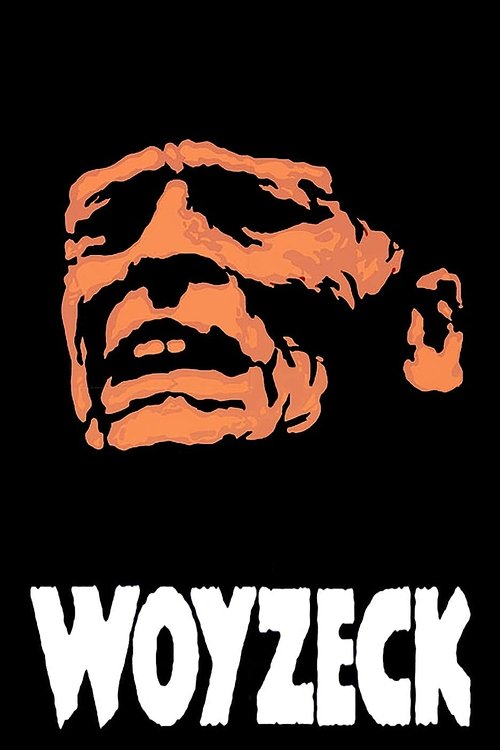
Woyzeck
1979 · Werner Herzog
For when you want cinema at its most raw and unflinching — a short, hard watch for a serious night, not a comfort film. Reach for it when you're ready to feel something bleak and true.
What it's about
Franz Woyzeck is a poor soldier in a small German garrison town, scraping together extra money for Marie, the woman he loves, and their infant son. He shaves his condescending captain, submits to a local doctor's degrading medical experiments — a diet of nothing but peas — and absorbs humiliation from every direction. As his body and mind fray, whispers about Marie and a strutting drum major begin to reach him.
The experience
Stark, stripped-down, and quietly devastating — 82 minutes with no cushioning, watching a man ground down by everyone entitled to use him. It's less a story unfolding than a pressure building, and it leaves a bruise.
Performances
Klaus Kinski, usually cinema's great volcano, plays it eerily contained — trembling, hollow-eyed, radiating damage — in what many consider the most disciplined and harrowing work of his career. Eva Mattes won a prize at Cannes for her tender, doomed Marie.
The craft
Herzog shot it in eighteen days in a perfectly preserved baroque town, in long, unblinking takes that give the actors nowhere to hide — some scenes play out in a single merciless shot. The austerity is the point: no score to soothe you, no cutting to relieve the pressure.
Why it matters
Made back-to-back with Herzog's other 1979 film, it distills the Herzog–Kinski partnership to its essence and stands as the definitive screen version of Büchner's foundational play about the crushed common man.
Snapshot
Werner Herzog's Woyzeck is a taut, deliberately austere adaptation of Georg Büchner's unfinished proto-expressionist play, starring Klaus Kinski in what many consider among the most disciplined and harrowing performances of his career. Running approximately 82 minutes, the film compresses Büchner's fragmentary dramatic text into a linear tragic arc: an impoverished soldier is systematically degraded by the institutions of class, medicine, and military authority until jealousy and madness drive him to murder. Shot in eighteen days in Telč, Czechoslovakia — a baroque-preserved UNESCO town that doubles as the timeless German garrison world of Büchner's imagination — the film arrived in 1979 alongside Herzog's Nosferatu the Vampyre, making that year one of the most concentrated expressions of the director's sensibility in any filmmaker's career. Within New German Cinema, Woyzeck occupies a specific niche: where Herzog's other late-1970s work reaches toward myth and obsession at operatic scale, this film is chamber-sized, almost punishingly compressed, its violence intimate and sociological rather than cosmic.
Industry & production
Woyzeck was produced by Werner Herzog Filmproduktion, Herzog's own production company, which had underwritten most of his major work since Aguirre, the Wrath of God (1972). The film was a modest production by any standard — budgetary specifics are not well documented in the public record — financed largely through German television money, a common arrangement within the New German Cinema infrastructure of the era, where the public broadcaster ZDF and later ARD co-productions subsidized filmmakers who would otherwise have found no commercial backing. The choice of Telč as location was a characteristic Herzog pragmatism: the Bohemian town's intact baroque square provided a ready-made historical environment requiring no expensive set construction, and its visual density — cobblestoned plazas, colonnaded arcades, a sense of enclosure — rhymes with the social trap Büchner's play describes. Shooting in Czechoslovakia required negotiating access during the late Communist period, though the specifics of that negotiation are not extensively documented in production histories. The eighteen-day shoot is among the shortest of any major film in Herzog's catalog, and the director has cited the brevity as enabling rather than constraining, arguing that speed prevented the accumulation of self-consciousness that longer schedules produce in actors — particularly Kinski.
Technology
The film was shot in 35mm by Jörg Schmidt-Reitwein, Herzog's frequent cinematographer throughout the 1970s, who brought a recognizable cold clarity to the image. Schmidt-Reitwein's approach in Woyzeck resists the expressive chiaroscuro one might expect from a film about madness and murder; the lighting is often flat and even, even clinical — suggesting the documentary neutrality of a sociological case study rather than gothic horror. This choice aligns with Büchner's own anti-romantic project. The production does not appear to have deployed unusual or experimental filmmaking technology; the discipline lies in restraint rather than innovation, using the full frame of 35mm photography to hold characters in their social space rather than isolating them in tight close-up.
Technique
Cinematography
Schmidt-Reitwein and Herzog frame Woyzeck consistently within his environment rather than extracting him from it. Wide and medium shots predominate in the garrison and town sequences, placing Klaus Kinski's small, twitching figure against the large geometric spaces of the baroque town — an architectural vocabulary designed for civic authority and display, in which the individual soldier appears correspondingly diminished. The camera rarely performs. There are few of the vertiginous or expressively tilted compositions one associates with madness in mainstream cinema; instead, the geometry is orthogonal, almost severe, and the occasional handheld movement draws attention through its rarity. This restraint makes the violence, when it arrives, feel less like cinematic climax than like a fact that was always waiting in the frame.
Editing
The editing, credited to Beate Mainka-Jellinghaus — Herzog's regular editor through much of this period — is spare and functional. Scenes play at length; there is little intercutting within sequences. The film's structure follows the chronological narrative shape Herzog imposed on Büchner's fragment rather than the episodic, non-linear ordering that some theatrical productions and scholarly editions propose. The relative lack of cutting within scenes reinforces the sense of duration — of Woyzeck's oppression as an ongoing, unrelenting condition rather than a series of dramatic peaks. The pacing is closer to theatrical time than to Hollywood continuity editing, a choice that honors the play's origins while maintaining the film's distinctive flatness of affect.
Mise-en-scène / staging
The staging is among the most deliberate of Herzog's career. Unlike the documentary spontaneity that characterizes films like Stroszek (1977) or Fitzcarraldo (1982), Woyzeck is composed with an almost theatrical formality: characters enter and exit scenes with a stage-like awareness of the frame's edges; the blocking is precise and non-improvisational. Herzog has described shooting the film in chronological sequence — an unusual production choice designed to map Kinski's physical and psychological deterioration in real time, so that the actor's body in later scenes would carry the genuine accumulation of earlier ones. The result is a performance that achieves its authenticity not through naturalistic improvisation but through controlled cumulation.
Sound
The film's sound design and music favor pre-existing material rather than a commissioned original score, a practice common across Herzog's work of this period. Folk music and period-appropriate instrumentation appear during social scenes — the tavern, the carnival — and carry the weight of Büchner's original irony: festivity and communal joy rendered as instruments of Woyzeck's exclusion and humiliation. Specific music attributions beyond these general characteristics are not reliably documented in the sources available, and it would be inaccurate to specify composers or pieces without firmer grounding. What is clear is that the sound world is deliberately non-operatic — in pointed contrast to Alban Berg's famous 1925 opera Wozzeck, which draws on the same source material and which saturates the drama in high expressionist musical emotion. Herzog strips that affect away.
Performance
Klaus Kinski's Franz Woyzeck is a performance of compacted, barely contained disintegration. Where Kinski's collaborations with Herzog frequently run toward grandiosity — his Aguirre, his Fitzcarraldo — here he plays miniature: a man whose interiority flickers across a face composed mostly of anxiety and animal alertness. The twitching, the avoidance of eye contact, the posture of a man perpetually flinching from blows already absorbed — all of it reads as the somatic memory of class violence rather than theatrical madness. Eva Mattes as Marie brings warmth and a quality of ordinary sensuality that makes her destruction genuinely tragic; she was an established actress of the New German Cinema, known for her collaborations with Rainer Werner Fassbinder, and her presence here imports that tradition's attention to female experience within systems of masculine violence. The supporting performances — Wolfgang Reichmann as the Captain, Willy Semmelrogge as the Doctor, Josef Bierbichler as the Drum Major — are deliberately stylized, even grotesque: caricatures of institutional authority that push against naturalism and toward the social-allegorical mode Büchner's text encodes.
Narrative & dramatic mode
Büchner's play presents a fundamental editorial problem: the manuscript exists in multiple drafts and fragment clusters, with no authoritatively established scene order, since Büchner died in 1837 at twenty-three before completing or organizing the text. Different theatrical productions have imposed different orderings and filled different lacunae. Herzog's adaptation opts for narrative coherence — a clear causal chain from Woyzeck's economic degradation through the doctor's experiments to his discovery of Marie's infidelity and his act of murder — which smooths the play's more radical disjunctions. This is a considered interpretive choice, not an oversight: Herzog makes Woyzeck a tragedy of determination rather than a Brechtian demonstration of alienated social mechanism. The audience is positioned to feel Woyzeck's tragedy rather than to analyze its systemic causes from a safe distance, even as the staging's formalism creates a certain cool distance throughout. The film ends without coda or redemption, following the play's refusal of catharsis.
Genre & cycle
Woyzeck belongs to the tradition of literary adaptation within art cinema — specifically to the long European project of bringing canonical stage drama into cinematic form without subordinating film to theatrical conventions. It sits alongside Ingmar Bergman's theater adaptations, Peter Brook's King Lear (1971), and the Straub-Huillet school of filmed theater in its willingness to let the source material's formal properties shape the film rather than translating drama into cinematic spectacle. Within Herzog's own filmography, it represents one pole of his practice — the contained, literary, classical — against the other pole of the documentary-inflected, expansive, location-driven work. It participates in the broader New German Cinema cycle of the 1970s and its systematic re-examination of German cultural heritage, including both the classical literary tradition and the social structures that tradition encodes.
Authorship & method
Herzog has described Woyzeck as a film he approached with genuine reverence for Büchner's text, treating the adaptation as an act of fidelity rather than appropriation. His working method with Kinski — by 1979 already a volatile, legendary collaboration extending through Aguirre and Nosferatu — is documented in Herzog's own retrospective accounts and, more pointedly, in the later documentary My Best Fiend (1999), which suggests that the brevity of the Woyzeck shoot was partly a practical management strategy for containing Kinski's intensity. Jörg Schmidt-Reitwein's cinematography consistently served Herzog's instinct for landscape and social space as expressive material; across their collaborations, Schmidt-Reitwein developed an eye for the sublime that in Woyzeck is deliberately suppressed in favor of the claustrophobic. Beate Mainka-Jellinghaus's editing gave the film its austere rhythm. The screenplay credit belongs to Herzog himself, working from existing translations and scholarly editions of Büchner's text.
Movement / national cinema
Woyzeck is a product of New German Cinema — the movement loosely associated with the Oberhausen Manifesto of 1962 and consolidated through the 1970s around directors including Herzog, Fassbinder, Wim Wenders, Volker Schlöndorff, and Margarethe von Trotta. New German Cinema was institutionally enabled by public broadcasting investment and by the state film funding mechanisms of the Federal Republic, and was aesthetically defined by its rejection of the commercial Heimatfilm tradition and its engagement with both European art cinema (Italian neorealism, the French New Wave) and questions of German historical and social identity. Woyzeck's engagement with Büchner — a canonical figure of nineteenth-century German literary radicalism — participates in the movement's broader project of reclaiming a suppressed or marginalized German cultural tradition against the nationalist appropriations of the Nazi period.
Era / period
The late 1970s in West Germany were a period of acute political anxiety — the years of the Red Army Faction, the kidnappings and murders of 1977 (the "German Autumn"), and a prevailing atmosphere of state surveillance and social suspicion. Several New German Cinema filmmakers responded directly to this atmosphere; Herzog's response was characteristically oblique, retreating into historical or mythological material that nonetheless encoded contemporary social violence. Woyzeck's subject — a powerless man destroyed by institutional authority, subjected to medical experimentation without consent, offered no recourse against the economic and erotic humiliations visited on him — carried evident contemporary resonance even in its nineteenth-century costume.
Themes
The film's central preoccupations are class, institutional power, and the body as site of both oppression and revolt. Woyzeck is controlled at every register: his time belongs to the military, his body belongs to the doctor's experiment, his sexuality is threatened by the drum major's superior social status and physical authority. Büchner — himself a medical student, a political radical, and a materialist who understood human behavior in physiological terms — designed the play as a demonstration that madness is produced by social conditions, not by innate pathology; Herzog's film inherits this thesis and carries it through the casting of Kinski, whose Woyzeck is visibly being unmade by his circumstances. The jealousy that drives him to murder is legible as the one domain of interiority — of feeling — that his oppressors have not colonized, and its violent expression is both horrifying and, in the play's and film's logic, almost inevitable. Questions of free will are suspended by the film's deterministic structure: Woyzeck does not choose his fate so much as arrive at it.
Reception, canon & influence
Woyzeck received respectful critical attention upon its release, though it was frequently discussed in the shadow of Nosferatu the Vampyre, which arrived in the same year and drew more international press interest through its explicit engagement with German cinematic history and its larger visual scale. Klaus Kinski received the German Film Award (Filmband in Gold) for Best Actor, recognizing a performance that, unlike many of his more flamboyant turns, subordinates charisma to psychological precision. The film has since been absorbed into the canonical account of New German Cinema and into the critical literature on literary adaptation.
The film's primary influence on it is, of course, Büchner's play — by the late 1970s, one of the most frequently produced works in the German theatrical repertoire and the subject of substantial scholarly edition and debate. Alban Berg's opera Wozzeck (1925) stands as the most famous prior adaptation and a kind of ongoing interlocutor; Herzog's decision to pursue a cool, anti-operatic mode can be read as a deliberate counter-statement to Berg's expressionist saturation. Earlier film adaptations of the play exist — including a 1947 East German version directed by Georg C. Klaren — but these are relatively little-studied works and it is unclear how directly they informed Herzog's approach. The theatrical tradition, particularly productions that emphasized Büchner's proto-Marxist social critique, was almost certainly more formative.
Looking forward, Woyzeck contributed to the cultural work of making Büchner's play available to international audiences not already familiar with the theatrical tradition, and Kinski's performance influenced subsequent screen portrayals of psychic disintegration under social pressure. The film's strategy — literary fidelity combined with formal austerity and a refusal of psychological melodrama — has been practiced by subsequent filmmakers working with canonical dramatic sources. Within the Herzog canon, Woyzeck is often read alongside The Enigma of Kaspar Hauser (1974) as a diptych on state violence against marginal, vulnerable individuals, and both films have been significant in the scholarly reassessment of Herzog as a political filmmaker rather than merely a romantic primitivist. The film's reputation has grown steadily in retrospective critical literature, though it remains less cited in general film culture than the more spectacular productions of the same period.
A Deleuzian reading
Start with the peas.
The full Deleuzian reading of Woyzeck →
Reception
Overshadowed on release by Nosferatu the Vampyre — which it followed into theaters the same year — Woyzeck was long treated as the 'minor' Herzog–Kinski film; it's since been reclaimed as one of their most quietly devastating collaborations.
How Woyzeck was received, from release to now →
Influences: the films it descends from and the films it influenced
- Woyzeck (1947) — Klaren's DEFA adaptation, which Herzog knew and rejected as a model, uses expressionist lighting and non-linear episodic sequencing faithful to Büchner's fragmentary drafts; Herzog's counter-response is to flatten both the photography and the structure, linearizing the same source into continuous tragic causality.
- M (1931) — Lang's wide-shot staging places the hunted body within geometric urban interiors — stairwells, courtyards, offices — where architectural depth encodes the impossibility of escape from social institutions; Schmidt-Reitwein and Herzog transpose this compositional grammar directly to Telč's baroque plazas.
- Au Hasard Balthazar (1966) — Bresson's mechanically staged parade of social cruelties — flat even lighting, scenes played at theatrical duration, non-expressive model performances — provides the structural precedent for Herzog's sociological rather than psychological approach to a subject whose suffering is a product of social mechanism, not individual fate.
- Gertrud (1964) — Dreyer's final film uses the flattest, most evenly lit cinematography of his career, with scenes sustained in long takes and frontal theatrical blocking that refuses shot-reverse-shot convention — the same grammar of formal distance that Schmidt-Reitwein deploys in Woyzeck to prevent psychological identification with the subject.
- Chronicle of Anna Magdalena Bach (1968) — Straub-Huillet structure their film around pre-existing Bach performances used non-illustratively against frontal theatrical staging and zero intercutting within musical sequences — the precise model for Herzog's deployment of pre-existing Bavarian folk songs over Woyzeck's scenes rather than a commissioned or operatic score.
- Aguirre, the Wrath of God (1972) — Aguirre establishes the Herzog-Kinski production protocol in which wide environmental framing places Kinski's volatile physicality as a small, diminished figure within overwhelming architectural scale — a compositional relationship Woyzeck directly reproduces using the enclosing baroque geometry of Telč's garrison town.
- Every Man for Himself and God Against All (1974) — The Kaspar Hauser film codifies the grotesque institutional caricature that Woyzeck extends: scientists, pedagogues, and authority figures played with comic monstrous rigidity as social mechanisms rather than characters — the performance register Herzog then assigns to Woyzeck's military doctor and captain.
- Even Dwarfs Started Small (1971) — Herzog extends Even Dwarfs' staging of institutional ritual as grotesque theater: military ceremony as a mechanism of degradation, physical ordeal performance extracted from the lead actor under documented production duress, and anti-climactic structure that refuses to convert suffering into dramatic catharsis.
- Woyzeck (1994) — Szász's Hungarian adaptation of the same Büchner fragment restores the episodic fragmentation that Herzog's linearization suppressed, treating Herzog's imposed chronological causality as a formal argument to contest — while retaining the wide environmental framing that places the soldier's diminished body within oppressive institutional space.
- The Seventh Continent (1989) — Haneke inherits the flat clinical lighting, long-take theatrical pacing, and minimal intercutting of the NGK observational mode — applying the same forensic distance from psychological interiority that defines Woyzeck's approach to watching social mechanism produce human destruction from within the everyday.
- La Vie de Jésus (1997) — Dumont's flat northern French light, wide shots placing inarticulate working-class figures against provincial architecture, and non-professional performance achieving grotesque social particularity without psychological motivation directly inherits the Schmidt-Reitwein/Herzog clinical-sociological mode, applying it to the same link between institutional marginalization and violence.
- Beau Travail (1999) — Denis compresses Melville's Billy Budd into a military chamber tragedy using theatrically precise blocking, wide environmental framing of uniformed bodies against Djibouti's landscape, and pre-existing music used non-illustratively — adapting Woyzeck's model of literary compression into architecturally determined social fate.
- Nosferatu the Vampyre (1979) — Produced simultaneously with the same crew — cinematographer Jörg Schmidt-Reitwein, editor Beate Mainka-Jellinghaus, star Klaus Kinski — and staged in comparable historically preserved Central European baroque architecture, Nosferatu shares Woyzeck's method of externalizing psychological states through architectural framing rather than expressionist lighting.
- In a Year with 13 Moons (1978) — Fassbinder scores the film's extreme degradation sequences with pre-existing recordings used non-illustratively — deliberately anti-operatic in refusing to aestheticize suffering — while the chamber staging and clinical observation of institutional destruction parallel Woyzeck's mode; both films treat their subject's collapse as social product, not psychological mystery.
- The Tin Drum (1979) — Schlöndorff's adaptation of Grass compresses a multi-episode novel into continuous causality through the same NGK literary-compression strategy, while deploying grotesque institutional figures — Nazi bureaucrats, petty bourgeois townspeople — as social determinants of a protagonist whose madness is diagnosed by the institutions that produce it.
- From the Life of the Marionettes (1980) — Bergman, living and working in West Germany at the time, adopts the flat clinical lighting and forensic analytical distance of the NGK institutional mode to examine a man's descent into murder — the same refusal to psychologize violence through expressionist shadow that Schmidt-Reitwein applies throughout Woyzeck.
- Fitzcarraldo (1982) — Shot back-to-back with Fitzcarraldo using the same Kinski collaboration, Woyzeck is where Herzog perfects the staging method of absorbing rather than directing Kinski's on-set volatility — converting psychological instability into a formal principle that Fitzcarraldo then deploys at maximum industrial scale.
Similar films
- Nosferatu the Vampyre (1979) — influence & lineage
- Aguirre, the Wrath of God (1972) — influence & lineage
- My Best Fiend (1999) — shared sensibility
- The Enigma of Kaspar Hauser (1974) — shared sensibility
- Heart of Glass (1976) — shared sensibility
- The Painted Bird (2019) — shared sensibility
- The Marriage of Maria Braun (1979) — shared sensibility
- Revanche (2008) — shared sensibility