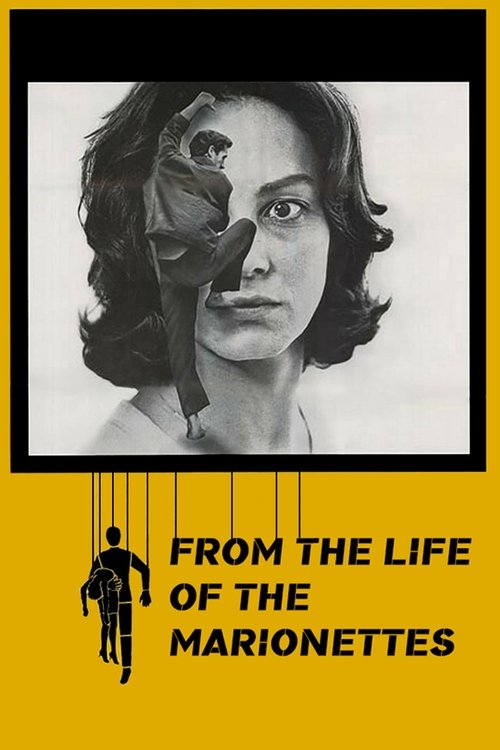
From the Life of the Marionettes
1980 · Ingmar Bergman
For when you want to stare into the abyss of a marriage and a mind — demanding, adult, and deliberately uncomfortable. Reach for it when you're ready to be challenged, not soothed.
What it's about
A prosperous Munich businessman commits a shocking murder in the film's opening minutes — and everything after is an excavation of why. Through police depositions, dreams, letters, and confessions from his wife, his psychiatrist, and others who knew him, the film pieces together the strained marriage and buried torments behind an act no one saw coming.
The experience
Cold, stark, and quietly devastating — a film that examines rather than consoles, in austere black and white. It's gripping the way a case file is gripping, and it leaves a chill that lingers.
Performances
Robert Atzorn is unnervingly convincing as a man whose polished surface conceals something coming apart, and the ensemble around him testifies with a candor that feels almost intrusive.
The craft
Ingmar Bergman structures the film as a mosaic of interrogations and dreams, framed in severe black-and-white close-ups that turn faces into evidence. The clinical form — testimony after testimony circling an unexplainable act — is itself the point, and it's executed with surgical control.
Why it matters
One of the darkest works of Bergman's career, made during his exile from Sweden, and a key late statement in his lifelong anatomy of bourgeois marriage and repression.
Snapshot
A West German television co-production shot almost entirely in black and white, Aus dem Leben der Marionetten opens with an eruption of color: Peter Egermann (Robert Atzorn), a prosperous Munich businessman, strangles and then sexually assaults the corpse of a young prostitute named Ka (Rita Russek) in a back room of a sex club. Everything that follows is aftermath and archaeology — a mosaic of depositions, dreams, and confessionals assembling what the opening scene cannot explain. Shot in Munich with a German-speaking cast and produced during Bergman's self-imposed Swedish exile, the film belongs formally to the tradition of the psychiatric case study while drawing emotionally on the same vein of bourgeois marital anguish Bergman had opened in Scenes from a Marriage (1973). The result is one of his most austere and clinically pitiless works: 104 minutes that interrogate whether causation can ever account for catastrophe.
Industry & production
The film was financed and produced by Personafilm GmbH in association with Sender Freies Berlin (SFB), the West German public broadcaster, and received both a theatrical release and television broadcast in 1980. It belongs to the middle section of what is loosely called Bergman's "German exile" — the period running from his abrupt departure from Sweden in 1976, following a traumatic tax investigation, to his eventual return in the early 1980s. The exile films — The Serpent's Egg (1977), Autumn Sonata (1978), and From the Life of the Marionettes — form a loose triptych of dislocation, each bearing the pressure of a filmmaker working outside his native language and institutional support system.
For Marionettes, Bergman assembled an almost entirely German-language cast, foregrounding the degree to which his themes — marital combat, psychological disintegration, the violence latent within respectable social arrangements — were portable across national contexts. The budget was modest by international art-cinema standards, which suited the film's deliberate constriction of setting. Most of the action unfolds in a handful of interiors: the sex club, an apartment, a psychiatric facility, an office. Bergman and his collaborators worked under the production discipline characteristic of high-end television drama, and the result has the tightly controlled, slightly airless quality of a chamber film designed for intimate viewing.
Technology
The most immediately striking technical decision is the deployment of color and monochrome as moral and ontological registers rather than mere period-authenticity markers. The murder prologue is rendered in saturated, slightly lurid color — flesh tones overexposed, the red of Ka's dress aggressive against the squalid setting. Once the title card appears, the film shifts into cold, high-contrast black and white and does not return to color until a brief, deeply unsettling fantasy sequence near the film's end in which Peter imagines a tender domestic idyll with Katarina, shot in the same warm palette as the murder. The implication is stark: desire and violence share a chromatic register; quotidian gray life lies between them.
The film was shot on 35mm under the demanding low-light conditions typical of Sven Nykvist's work with Bergman. The format supports the deep focus and long-held close-ups that anchor the film's interrogative sequences. No significant optical effects beyond the colour/monochrome split are deployed; the technology is placed entirely at the service of the film's psychological logic.
Technique
Cinematography
Sven Nykvist, Bergman's cinematographer of record from the early 1960s onward, shot the film. Nykvist's lighting scheme for the black-and-white sections is characteristically severe — sources are identified, shadows fall hard, faces carry the full weight of what is being said. In the interview sequences, where a character speaks almost directly to camera, Nykvist frames heads with minimal negative space, the background falling rapidly into darkness, producing a quality closer to a police mugshot than to conventional cinematic portraiture. This creates the documentary illusion that the film is exploiting without ever fully endorsing. In the color sequences, by contrast, Nykvist pushes warmth into the image, the lighting flattening depth and making surfaces glow with an unnerving allure.
Editing
The editing is structured around the case-study logic of the screenplay: discrete chapters, each titled with a character name and their relation to Peter, unfold sequentially but are interrupted by anachronistic intrusions — dream fragments, the murder scene revisited in detail, Peter's earlier recurring fantasy of killing Katarina. The effect is less discontinuous than it might sound; the episodic rhythm is legible and deliberate, closer to a clinical dossier than to the associative montage of art cinema. The cutting respects the full duration of conversations and does not seek rhythm through brevity. Scenes end when their psychological content has been extracted.
Mise-en-scène / staging
Bergman stages the interview sequences with the frontal flatness he developed through decades of theater direction and had been refining on film since at least Winter Light (1963). Characters sit, speak, and occasionally turn away; the spatial world around them barely exists. The sex club murder scene is an exception: Bergman allows the camera brief mobility, following Peter through the labyrinthine corridors of a tawdry venue before closing in for the act itself. The editing and staging here carry something close to genre violence, which is precisely the point — the horror is legible before it becomes explicable. The psychiatrist's office, Tim's apartment, and the institutional corridors are rendered with a specificity of texture (fabric, glass, overhead fluorescence) that gives weight to what would otherwise risk becoming purely schematic.
Sound
Sound design is deliberately stripped of atmospheric fill. Ambient noise is minimal; silence between lines of dialogue is allowed to accumulate without underscoring. There is no original composed score in the conventional sense, though pre-existing music appears diegetically at the sex club. This refusal of musical cushioning is consistent with Bergman's practice in his most austere work and denies the viewer the emotional cuing that would soften the film's forensic quality.
Performance
The performances work within the close-up-and-stillness grammar that Bergman established as a house style. Robert Atzorn as Peter conveys a permanent low-grade tension — a man for whom ordinary social exchange carries the strain of sustained suppression. Christine Buchegger as Katarina is given the film's most complex register: alternating between aggression and tenderness, she is neither victim nor simply co-perpetrator of the marriage's toxicity. Walter Schmidinger's Tim — Peter's business partner and confidant, clearly in love with Peter — is allowed a degree of explicit irony and social self-awareness that provides the film's occasional breath of dark humor. Rita Russek's Ka exists almost entirely in the opening color sequence and is therefore denied the psychological excavation afforded to every other character, a formal choice that the film does not resolve with complete comfort.
Narrative & dramatic mode
The narrative unfolds in what might be called the interrogative mode: each section poses a question about cause and withholds a simple answer. The film opens with the murder as an irreducible fact, then retreats into explanation — psychiatric interview, marital confession, recorded dreams — without ever producing an explanation that feels adequate. This is deliberate. Bergman's interest is less in the psychology of the perpetrator than in the epistemological limits of the case study itself: the form that promises understanding while producing only accumulation. The structure owes something to Brecht in its distancing titles and interrupted chronology, but the affect it generates is not Brechtian cool — it is cumulative dread produced by proximity.
Genre & cycle
The film sits at the intersection of psychological drama, crime film, and the European tradition of the psychiatric case-study narrative. Its closest formal relatives are less the thriller than films like Bergman's own Face to Face (1976) or, beyond his work, the mode of investigation-as-character-study practiced by filmmakers such as Rainer Werner Fassbinder, whose productions occupied some of the same West German institutional space. The film also belongs to a cycle of late-1970s European art cinema concerned with the pathology of bourgeois domesticity — a cycle that includes Fassbinder's The Marriage of Maria Braun (1978) and Claude Chabrol's intermittent contributions to the same territory. It is not, strictly speaking, a thriller: suspense has been emptied out by the film's first five minutes, and what replaces it is the more uncomfortable tension of explanation that refuses to become consolation.
Authorship & method
Bergman wrote the screenplay himself, as he did throughout his career. The script belongs to the tradition of his stage-derived chamber plays — compact, dialogue-heavy, structured around revelation rather than action. The idea of characters as marionettes controlled by forces they cannot name or resist is entirely consistent with the determinist streak that runs through his work from the 1960s onward, sharpened here by his encounter with German psychoanalytic culture during the exile years. Sven Nykvist's contribution as cinematographer is inseparable from the film's visual logic; their collaboration by 1980 was so established that choices about lighting and framing carried a shared vocabulary. There is no credited composer for an original score, consistent with Bergman's increasing tendency in his mature work to work in musical near-silence or to deploy found music.
Movement / national cinema
The film occupies a complicated position within national cinema histories. It is neither Swedish nor properly German: it is a Swedish auteur's work, produced in Germany, in the German language, with German performers and German institutional funding. It does not engage with German history or German social specificity in the way that the New German Cinema of the 1970s — Fassbinder, Wenders, Herzog, Schlöndorff — was doing contemporaneously. It is, rather, a universalist chamber drama that happens to have been made in exile, and its Germanness is primarily logistical. Within Bergman's own filmography, it sits in the second tier of his German productions, less widely discussed outside specialist circles than The Serpent's Egg or Autumn Sonata, partly because it never had a major Swedish-language identity and partly because its subject matter — without the star casting of those films — made it a harder sell in retrospective canonization.
Era / period
The film belongs to the final phase of European art cinema's high prestige in international theatrical distribution — the period running roughly from 1968 to the mid-1980s when a Bergman, Tarkovsky, or Fassbinder film could be expected to receive serious critical attention across multiple countries. It also, however, reflects the increasing migration of ambitious European filmmaking toward television co-production, a structural shift that would accelerate through the 1980s. In that sense the film is period-symptomatic: a major director using television funding to make work that would previously have been conceived strictly for the cinema. The formal austerity is consistent with this context.
Themes
The title's controlling metaphor — marionettes as humans yanked by strings they cannot see — organizes the film's thematic landscape. Peter acts; the film asks what acted through him. The marriage between Peter and Katarina is the primary site of investigation: a relationship of mutual cruelty, dependency, and failed communication in which both parties recognize the dysfunction and are unable to exit it. The film is interested in the violence that polite social performance requires to be suppressed and what happens when the suppression fails. The Tim character introduces the theme of homosexual desire and repression in a period-specific context; his unexpressed love for Peter complicates any simple analysis of Peter's violence as purely marital in origin.
The psychiatric frame raises without resolving the question of whether psychoanalytic language — with its vocabulary of transference, repression, and childhood wound — can genuinely explain a catastrophic act or merely redescribe it in more elaborate terms. This epistemological skepticism about the healing or explanatory power of psychiatry is consistent with Bergman's treatment of therapy in Face to Face and elsewhere. Guilt, shame, and the impossibility of self-knowledge are layered through every scene. The film does not offer redemption.
Reception, canon & influence
Critical reception. The film received respectful but not rapturous responses on its 1980 release. Critics recognized it as serious Bergman but tended to rank it below his canonical Swedish-language work of the 1960s and early 1970s. Its German-language context and absence of major international stars (compared to Autumn Sonata) limited its profile in non-German markets. Subsequent critical reassessment has been modest; the film occupies a recognized but secondary position in Bergman scholarship, appreciated more fully by scholars working on the full arc of his career than by general audiences approaching his work selectively.
Influences on the film. August Strindberg's dramaturgy of marital combat is the deepest structural influence, as it is across Bergman's career; the psychological battlefield of The Father and The Dance of Death is directly legible here. Carl Theodor Dreyer's use of the sustained facial close-up as a primary instrument of psychological revelation shapes the film's visual grammar. The fragmented case-study structure reflects Bergman's engagement with Brecht's dramaturgy of interruption, and there is some evidence, consistent with the exile context, that German psychiatry and particularly the psychoanalytic discourse of the period influenced the screenplay's architecture. The format of the inquiry film, where truth is constructed through accumulating testimonies, connects to the broader European tradition of investigative narrative running from Rashomon-influenced post-war cinema through the political films of the 1970s.
Legacy. Direct traceable influence is difficult to establish with precision, as is common for films that sit outside the most-cited Bergman canon. What can be said is that the film anticipates, in its coldly analytical treatment of bourgeois domestic violence, the concerns that would become central to Michael Haneke's work in the 1990s and 2000s — the refusal of psychological consolation, the implication of the audience's voyeurism, the use of structural interruption to prevent identification. Whether Haneke engaged directly with this film is not established in the critical record and should not be asserted as fact. Within Bergman studies, the film is read as a crucial diagnostic document of the exile years: a filmmaker pushing his thematic preoccupations into a new linguistic and cultural context and discovering that the furniture of marital despair translates with uncomfortable ease.
A Deleuzian reading
It begins in color, and the color is the first thing the film withdraws.
The full Deleuzian reading of From the Life of the Marionettes →
Reception
Dismissed and barely seen on release in 1980 — the low point of Bergman's unhappy German exile period — it has since been reappraised by cinephiles as one of his darkest and most underrated films, a verdict Bergman himself anticipated by defending it as some of his strongest work.
How From the Life of the Marionettes was received, from release to now →
Influences: the films it descends from and the films it influenced
- The Passion of Joan of Arc (1928) — Dreyer's mugshot-style sustained frontal close-up held beyond dramatic comfort as the primary instrument of psychological revelation — the specific technique Bergman and Nykvist inherit and codify into their shared vocabulary.
- Gertrud (1964) — Theater-derived frontal staging with long unbroken dialogue scenes that Dreyer refuses to cut within, establishing the full-duration scene integrity and near-static observation mode Bergman adopts directly.
- Persona (1966) — Nykvist's low-light depth-prioritising framing of faces in score-absent passages — the specific visual grammar of psychological event conveyed through image alone, which Marionettes then applies to a forensic rather than mythic context.
- Scenes from a Marriage (1973) — Chapter-titled partition of a bourgeois marriage's dissolution, with Nykvist's frontally composed close-up vocabulary and full-duration scene cuts establishing the structural template Marionettes inherits and redirects into criminal case-study form.
- M (1931) — The interrogative case-study mode in which a violent act is forensically reconstructed through institutional procedures and multiple conflicting testimonies, treating murder as a structural premise for social anatomy rather than as dramatic event.
- Rashomon (1950) — Truth assembled from irreconcilable testimonies without narrative resolution — the inquiry film form the dossier cites as the broader tradition Bergman draws on when structuring the film's accumulating witness accounts.
- Who's Afraid of Virginia Woolf? (1966) — Theatrical marital combat preserved in near-real-time with long uncut takes and stage-derived blocking; the model for containing Strindbergian verbal warfare within a cinematic frame without dissolving it into montage.
- Europa (1991) — Color/monochrome moral split deployed with structural rather than decorative function — selective color against a B&W analytical field, carrying direct formal debt to Bergman's technique of color for the primal event and black-and-white for the forensic aftermath.
- Breaking the Waves (1996) — Chapter-titled intertitle structure partitioning narrative into discrete inquiry units, with extended frontal close-up sequences held in ambient-only silence — von Trier absorbing and radicalizing Bergman's case-study editing grammar.
- Funny Games (1997) — Structural interruption of spectator identification through formal devices that refuse psychological consolation for bourgeois domestic violence — the analytical refusal the dossier traces to Marionettes' precedent.
- The Piano Teacher (2001) — Analytical frontal close-up stillness grammar applied to bourgeois psychological pathology without consolation or explanatory frame, with a score-minimal soundscape mirroring the forensic silence Bergman established.
- Dogville (2003) — Chapter-titled case-study architecture with explicitly theater-derived staging on a marked bare floor — von Trier literalising the theater-derived staging device Bergman kept latent, and applying it to the same systematic forensic exposure of communal pathology.
- Caché (2005) — Forensic inquiry structure in which a violent event is reconstructed through evidence and conflicting testimonies, with structural interruption preventing audience identification — the interrogative case-study mode applied to bourgeois guilt with Bergman's analytical coldness.
- A Separation (2011) — Interrogative case-study mode assembling truth through institutional testimony procedures, with an irresolvable violent act as the structural premise from which all moral anatomy radiates — the inquiry film form Bergman inherits from Kurosawa extended into domestic legal space.
- The Serpent's Egg (1977) — First film of the German-exile triptych: shares the German-language production context, Nykvist collaboration, and Bergman's method of transplanting his bourgeois pathology chamber-drama form into a foreign cultural setting.
- Autumn Sonata (1978) — Immediately preceding exile film, establishing the mugshot-framing of the face, score-absent passages, and theatrical two-hander staging that Marionettes then applies to a criminal rather than purely familial anatomy.
- Woyzeck (1979) — Bergman, living and working in West Germany at the time, adopts the flat clinical lighting and forensic analytical distance of the NGK institutional mode to examine a man's descent into murder — the same refusal to psychologize violence through expressionist shadow that Schmidt-Reitwein applies throughout Woyzeck.
Similar films
- Persona (1966) — influence & lineage · same viewing thread
- Autumn Sonata (1978) — influence & lineage · same viewing thread
- Face to Face (1976) — same viewing thread
- Cries and Whispers (1972) — same viewing thread
- Through a Glass Darkly (1961) — same viewing thread
- The Silence (1963) — same viewing thread
- Scenes from a Marriage (1974) — shared sensibility
- Hour of the Wolf (1968) — shared sensibility
All the films related to From the Life of the Marionettes →
Watch it with: curated runs of related films
- The Fractured Self — A run of art films where identity, memory, and sanity refuse to stay solid — watch them near each other and the faces, silences, and doublings start to rhyme.