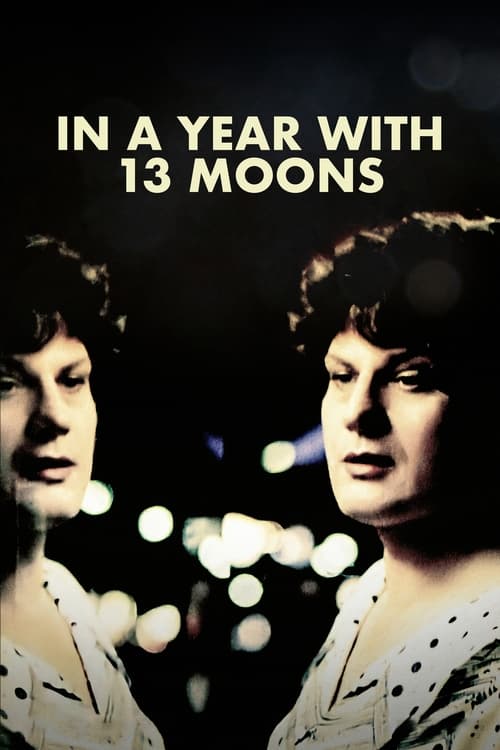
In a Year with 13 Moons
1978 · Rainer Werner Fassbinder
When you're ready to be wrecked — this is a challenge watch for a night when you want cinema at maximum emotional stakes, not comfort. Absolutely not background viewing.
What it's about
Elvira Weishaupt was once Erwin, a burly Frankfurt butcher, until the man she loved remarked that things might have been different if she were a woman — and she took the joke as a command, undergoing surgery for a love that then abandoned her. Over a handful of days, Elvira moves through the city revisiting the people and places of both her lives: a confidante from the streets, an estranged wife and daughter, the convent where she was raised, and finally the man himself, trying to assemble an account of who she is and what was done to her.
The experience
Harrowing and raw — long confessional monologues, brutal images, and moments of unexpected black comedy, all charged with grief that feels personal because it was: Fassbinder made it in the wake of a lover's suicide. It's one of the most emotionally naked films ever made, and it does not let you keep a safe distance.
Performances
Volker Spengler's Elvira is staggering — hulking and fragile at once, delivering enormous autobiographical monologues with a wounded dignity that holds the whole film together.
The craft
Fassbinder wrote, directed, shot, edited, and designed the film almost single-handedly, and the result is ferociously controlled: garish city light, mirrored interiors, scenes staged in merciless long takes, and a sound design that layers narration, music, and ambient noise into something close to a requiem. One early sequence set in a slaughterhouse is justly notorious — fair warning — and the whole thing lands hardest seen without distractions.
Why it matters
Among the most personal works of the New German Cinema and a touchstone of queer film history, its portrait of a trans woman failed by everyone around her has only grown in stature and in the intensity of debate it provokes.
Snapshot
In a Year with 13 Moons (In einem Jahr mit 13 Monden) traces the last five days in the life of Elvira Weishaupt, once Erwin, a Frankfurt butcher who underwent gender reassignment surgery after the man she loved — the real-estate speculator Anton Saitz — remarked offhandedly that things might have been different "if only you were a girl." Elvira took the joke as a life sentence. The film opens on her, dressed as a man, being beaten by hustlers in a riverside cruising ground when they discover her body, and it follows her decline through a sequence of encounters — with her prostitute confidante Red Zora, her estranged wife and daughter, a nun who narrates her orphaned childhood, a suicidal stranger, and finally Saitz himself — toward a lonely death. It is among the most nakedly personal films Fassbinder ever made, produced in the immediate aftermath of the suicide of his lover Armin Meier, and one of the very few for which the director himself served as cinematographer and editor as well as writer and producer. Formally austere and emotionally scalding, it fuses Brechtian distance with the melodramatic register Fassbinder inherited from Douglas Sirk, and remains a touchstone — and a point of contention — in discussions of trans representation on screen.
Industry & production
The film was made through Fassbinder's own production entity, Tango-Film, the vehicle through which he retained authorial control over his most personal projects rather than working under the larger German television and film co-production structures that funded works like Berlin Alexanderplatz or The Marriage of Maria Braun. It belongs to Fassbinder's astonishingly prolific late-1970s output — the same broad window that produced Despair and Maria Braun — and was shot quickly and cheaply, in a mode closer to his early theatrical-troupe filmmaking than to his prestige literary adaptations.
The impetus is inseparable from biography: Fassbinder made the film in reaction to Armin Meier's suicide, and its concentration on a body sacrificed for an indifferent love reads as an act of grief and self-examination. By taking on the roles of writer, director, producer, cinematographer, and co-editor, Fassbinder collapsed the production apparatus into himself, which suited both the film's confessional character and its modest means. Precise budget and box-office figures are not something the popular record reliably preserves for a project of this kind, and it would be inventing detail to cite them; what is clear is that this was a small, independent, author-controlled production rather than a commercial venture, and it circulated primarily through the art-house and festival channels that carried Fassbinder's reputation abroad.
Technology
The film was shot on 35mm in color, in the standard practice of West German feature production of the period, and finished at a conventional theatrical aspect ratio. There is no evidence of unusual technical apparatus; the interest lies in how ordinary tools were deployed. Fassbinder operating (or closely directing) the camera himself lends the images a hand-guided, sometimes searching quality. The soundtrack layers pre-existing recordings — pop songs, classical music, radio and television audio — into the diegesis, a technique that depends on nothing more exotic than a tape recorder within the fiction and careful post-synchronization, but which becomes one of the film's defining devices. The most notorious "technology" in the film is arguably the slaughterhouse itself: the abattoir sequence was filmed on location amid actual industrial slaughter, so the documentary reality of the machinery of killing supplies the scene's unbearable charge rather than any special-effects contrivance.
Technique
Cinematography
Fassbinder is credited as his own cinematographer here, a rarity in his filmography, and the film's look bears the mark of that fusion of eye and authorial intent. The compositions are dense and mediated: characters are repeatedly framed through doorways, windows, banisters, and reflected in mirrors, so that Elvira is often walled off from the viewer by the architecture of her own surroundings. Deep, cluttered interiors and hard divisions of the frame keep her boxed in. Against this, Fassbinder deploys extended takes — most famously the slaughterhouse walk and the convent-garden monologue — where the camera travels alongside a speaker delivering a long, near-unbroken block of testimony. The visual strategy oscillates between claustrophobic entrapment and these durational tracking movements that give grief and confession room to unspool in real time.
Editing
Fassbinder co-edited the film (he is associated with the cutting, working in the collaborative manner he maintained with the editors of his late period). The editing favors long-held shots and abrupt tonal juxtaposition over conventional continuity smoothing. Scenes are allowed to run past comfort; the cutting logic serves emotional and thematic association — the pairing of slaughter and self-narration, of tenderness and violence — rather than pace. The film's overall five-day structure gives it a countdown architecture, so that individual scenes accumulate as stations on the way to a foregone death.
Mise-en-scène / staging
Staging is where the film's Sirkian inheritance is most visible. Interiors are crowded with objects, kitsch, and signifiers of a life; surfaces reflect and refract the characters. Elvira's apartment, the arcade offices of Saitz, the convent, the empty streets — each is composed as an expressive environment rather than neutral backdrop. Fassbinder repeatedly stages figures at angles to one another, isolated within the frame even when together, physicalizing the film's thesis that intimacy is a series of missed connections. The much-discussed sequence in Saitz's office, in which his henchmen break into an incongruous choreographed routine, exemplifies the director's willingness to rupture realism with stylized, quasi-theatrical performance.
Sound
Sound is one of the film's essential expressive layers. Fassbinder floods scenes with mediated audio — songs, orchestral music, and above all the chatter of radio and television running under and over the drama. This second stream of voices frequently comments on, ironizes, or drowns out the human speech in the foreground, producing a sense that the characters live saturated in a culture that will not stop talking at them. The device culminates in the ending, where Elvira's own recorded voice on a tape machine narrates while the living arrive too late — the self reduced to a playback, speaking to a room that can no longer answer.
Performance
Volker Spengler's performance as Elvira is the film's center and one of the great achievements of Fassbinder's stock company. Spengler plays a heavy, physically imposing figure whose bulk is set against extreme emotional vulnerability, and the role demands both the butcher's remembered brawn and Elvira's present fragility. The performance is large and unguarded, moving between comedy, abjection, and stillness. Around Spengler, Fassbinder deploys his familiar ensemble in a deliberately varied register — some players naturalistic, others heightened — so that Elvira's raw feeling is continually met by the mannered surfaces of those around her. Ingrid Caven, Fassbinder's former wife, appears as Red Zora and brings a chanteuse's stylization; Gottfried John plays Saitz as a figure of casual, oblivious power; and Fassbinder cast his own mother (billed as Lilo Pempeit) as the nun who delivers Elvira's origin story.
Narrative & dramatic mode
The film is structured as a countdown — five titled days — moving inexorably toward Elvira's death, so that suspense is displaced from what happens onto how it will be endured. Within that frame, the narrative proceeds by long confessional set-pieces: the slaughterhouse monologue in which Elvira recounts her past over the killing floor; the nun's extended account, delivered in a convent garden, of the orphaned boy Erwin; the tape-recorded testimony at the close. This is a dramaturgy of retrospection, in which the story is repeatedly told rather than shown, and the present tense of the film is largely a matter of listening. The prologue supplies the interpretive key: an on-screen text about "moon years" and years with thirteen moons being especially perilous for people governed by their emotions, framing Elvira's fate as astrologically overdetermined — a fatalism that sits, characteristically for Fassbinder, in ironic tension with the concrete social and economic causes the film also lays bare.
Genre & cycle
Formally the film is a melodrama — a story of love, sacrifice, and suffering — pushed to an extremity and stripped of consolation. It belongs recognizably to Fassbinder's cycle of "melodramas of the socially damned," alongside films like Fox and His Friends and The Bitter Tears of Petra von Kant, in which desire becomes an instrument of self-destruction and love an economy of exploitation. But 13 Moons is the most anguished and least generically comforting of these: it borrows melodrama's emotional maximalism while refusing its catharsis, and it sits at the far, most personal end of the cycle, closer to a requiem than to the ironic social studies elsewhere in his work.
Authorship & method
This is Fassbinder in his most total authorial mode. He wrote, directed, and produced the film, shot it, and shared in its editing — a concentration of roles that makes it perhaps the purest single-authored work in a career built on collaboration. His method here draws on the resources he had cultivated over a decade: the loyal ensemble of the anti-teater and Tango-Film years, the aesthetic devotion to Douglas Sirk, and a working speed that let him convert immediate emotional crisis into finished cinema. Among his key collaborators, Ingrid Caven and Gottfried John belonged to his long-standing troupe, and his casting of his own mother deepens the film's autobiographical charge. Peer Raben, Fassbinder's regular composer across many films, is associated with the film's music; the score sits within the broader sound design's collage of borrowed and original material. The salient point about authorship is that Fassbinder was not adapting or interpreting here so much as bleeding directly onto film, and the near-elimination of the usual division of labor is itself part of the work's meaning.
Movement / national cinema
13 Moons is a landmark of the New German Cinema (Neuer Deutscher Film), the movement of directors — Fassbinder, Wenders, Herzog, Kluge, von Trotta among them — who reinvented West German filmmaking from the 1960s onward. Within that movement Fassbinder was the most prolific and the most engaged with genre and melodrama, and the film exemplifies the movement's commitment to confronting the unhealed wounds of German society. Its concern with a Jewish survivor's place in postwar Frankfurt, with the commodification of bodies, and with the psychic costs of the "economic miracle" ties it to the movement's larger project of national self-reckoning. At the same time, its intense subjectivity marks Fassbinder's particular strand of that cinema, in which the political is always routed through the intimate and the erotic.
Era / period
The film is a product of the late 1970s, a moment when Fassbinder's international standing was at its height and when West Germany was living through the tense years surrounding domestic terrorism and the anxieties memorialized in the collective film Germany in Autumn. It carries the period's atmosphere of political and psychic unease. It is also a film about the recent German past pressing on the present — the Holocaust and the postwar reconstruction both haunt Saitz's story — so that its 1978 present tense is layered with historical memory. As an artifact of Fassbinder's own biography, it belongs to the final, feverishly productive phase of a career that would end with his death only a few years later, which has led many to read it retrospectively as a work shadowed by mortality.
Themes
At its core the film is about the body as the site where love, economics, and identity collide. Elvira has literally remade her flesh for another person's approval, and the film relentlessly connects that sacrifice to other regimes of bodily exchange: the butcher's trade, the slaughterhouse, prostitution, and the real-estate speculation that turns even people into property. Love appears not as redemption but as annihilation — a demand that consumes the one who feels it while leaving the beloved untouched. Loneliness and the failure of communication run throughout, literalized in the film's saturation of mediated voices that never quite reach anyone. Identity, gender, and self-invention are examined without sentimentality: the film refuses to present Elvira's transition as either triumph or simple tragedy, insisting instead on the specific social cruelty that surrounds her. And beneath it all runs a current of German history — the Jewish survivor's return, the moral economy of the postwar boom — that ties private suffering to national guilt.
Reception, canon & influence
Critically, 13 Moons has long been regarded as one of Fassbinder's major and most harrowing achievements, frequently singled out for Spengler's performance and for the extraordinary slaughterhouse and convent sequences, even as its bleakness has kept it a more forbidding entry in his filmography than the crossover success of The Marriage of Maria Braun. It is a fixture in serious assessments of his work and in retrospectives, though claims about specific awards or contemporaneous box-office performance should be treated cautiously, as the reliable public record on those points is thin for a film of this scale and I will not manufacture figures.
Looking backward, the film's influences are the ones Fassbinder openly professed and practiced: the Hollywood melodramas of Douglas Sirk, whose emotional excess and expressive mise-en-scène Fassbinder repurposed for social critique; the theatrical estrangement of Bertolt Brecht; and the modernist example of Godard and the European art cinema of his formation. Looking forward, its legacy is twofold. Within Fassbinder's own oeuvre it stands as the deepest expression of the melodrama-of-the-damned mode he pursued across the decade. More broadly, it became a recurring reference point in the development of queer and trans cinema and its criticism — cited, argued over, and reckoned with by later filmmakers and scholars precisely because it places a trans protagonist at the tragic center of a serious art film decades before such representation was common, while also drawing scrutiny for the terms of that representation. Its formal audacity — the fusion of documentary horror and confessional monologue, the collage soundtrack, the death narrated by a machine — has continued to mark it as one of the boldest experiments in the New German Cinema.
A Deleuzian reading
A woman walks through a slaughterhouse, talking about her childhood.
The full Deleuzian reading of In a Year with 13 Moons →
Reception
Seen on release as almost unwatchably bleak even by Fassbinder standards, it's since climbed to the top tier of his forty-odd films — now routinely named alongside Berlin Alexanderplatz and the BRD Trilogy as his most personal masterpiece.
How In a Year with 13 Moons was received, from release to now →
How to watch In a Year with 13 Moons: what to notice on a first viewing
- Watch how often Elvira is framed through doorways, windows, or mirrors. Fassbinder, shooting the film himself, keeps placing furniture and architecture between Elvira and the camera, boxing her inside her own surroundings. The rooms themselves keep her at a distance from you, long before anyone else does.
- Listen for the radio or television running under nearly every scene. Fassbinder floods the soundtrack with songs and broadcast chatter that comment on or drown out what the characters are actually saying. You feel a world that will not stop talking at Elvira, even when no one is listening to her.
- Watch how long the camera stays with someone telling their own story. Fassbinder holds on speakers well past ordinary scene length, walking beside them through a single unbroken block of testimony rather than cutting between listener and speaker. You are given nothing to do but listen, the same as everyone Elvira talks to.
- Notice how rarely two people in a room face each other directly. Fassbinder stages characters at angles to one another, each isolated inside the frame even during a shared conversation. The blocking itself argues that intimacy here keeps missing its target.
The whole guide to watching In a Year with 13 Moons, with the keys for a rewatch →
Influences: the films it descends from and the films it influenced
- All That Heaven Allows (1955) — The template Fassbinder openly copied: expressive mise-en-scène where cluttered domestic interiors, reflective surfaces and framing devices imprison the protagonist, turning décor itself into social critique rather than backdrop.
- Written on the Wind (1956) — Sirk's chromatic melodrama-of-excess emotion staged without moral resolution — the model for Fassbinder's melodrama-without-catharsis, where heightened feeling is denied any redemptive release.
- Vivre sa vie (1962) — Godard's episodic tableau structure and Brechtian distanciation — chaptered life-in-decline narration with intertitular framing — feeds Fassbinder's five-day-countdown segmentation and confessional retrospection.
- Blood of the Beasts (1949) — Franju's serene documentary filming of a Paris abattoir is the direct formal precedent for Fassbinder's unflinching real-slaughterhouse sequence overlaid with confessional monologue.
- Gertrud (1964) — Dreyer's austere long-held takes of figures isolated and averted within severe interiors — emotion frozen into architectural stillness — anticipates Fassbinder's anti-continuity, long-take framing of Elvira through doorways and voids.
- The American Soldier (1970) — Early Tango-Film work where a tape-recorded/recited monologue delivers backstory in flat affect against genre pastiche — the germ of 13 Moons' tape-recorded-voice endings and mixed-register performance.
- Querelle (1982) — Fassbinder's final total-auteur work pushes the same body-as-commodity and stylized-artificial-interior melodrama into wholly abstracted studio space, extending the isolated-figure staging of 13 Moons.
- Poison (1991) — Haynes fuses documentary-styled horror, confessional voice-over and Genet-inflected melodrama in fractured segments — a direct inheritance of Fassbinder's collage of registers around a stigmatized queer body.
- Far from Heaven (2002) — Haynes routes Sirk explicitly through Fassbinder: framing figures through architecture and windows in melodrama-without-catharsis to expose social violence, the exact Sirkian-critique method 13 Moons codified.
- A Fantastic Woman (2017) — Places a trans protagonist (played by a trans performer) at the tragic melodramatic center of a serious art film, framed through glass and isolating interiors — the representational and formal lineage 13 Moons pioneered.
- Great Freedom (2021) — Sets the template of the suffering queer body as the film's primary text and the Austro-German art cinema's institutional pessimism about how the state grinds down criminalized desire.
- The Bitter Tears of Petra von Kant (1972) — Fassbinder's own chamber melodrama of erotic humiliation, staged in a single cluttered interior with figures blocked in static, isolating tableaux — the Sirkian-interior method that 13 Moons extends.
- Ali: Fear Eats the Soul (1974) — The clearest working-out of Fassbinder's Sirk debt: characters framed and trapped through doorways, banisters and window frames, held in stillness while the camera watches from a distancing remove.
- The Marriage of Maria Braun (1979) — Made the same period, it shares the collage soundtrack of layered radio/mediated audio and the melodrama-as-postwar-German-reckoning mode, with Peer Raben's scoring and the anti-teater ensemble.
- Fox and His Friends (1975) — Fassbinder himself plays a body/love commodified and destroyed by economic exchange — the theme-of-body-as-commodity and the tragic queer protagonist at a serious film's center that 13 Moons pushes furthest.
- Effi Briest (1974) — Its literary voice-over narration read against composed, mirror-and-frame tableaux establishes the mediated-narration-over-static-image device that culminates in 13 Moons' machine-narrated death.
- Chelsea Girls (1966) — Warhol's underground placement of a trans/drag performer at the confessional center of long-take, real-time monologue — a precedent for Spengler's Elvira as the tragic subject of extended unbroken duration.
- Aguirre, the Wrath of God (1972) — A New German Cinema companion sharing the era's late-1970s German-Autumn milieu and the long-take, real-location intensity where the camera holds on a disintegrating figure without dramatic cutaway.
- The Third Generation (1979) — Contemporaneous work built on a dense mediated-audio collage of overlapping broadcast/recorded sound as ambient texture — the same sound-design strategy that layers 13 Moons' soundtrack.
- Woyzeck (1979) — Fassbinder scores the film's extreme degradation sequences with pre-existing recordings used non-illustratively — deliberately anti-operatic in refusing to aestheticize suffering — while the chamber staging and clinical observation of institutional destruction parallel Woyzeck's mode; both films treat their subject's collapse as social product, not psychological mystery.
Similar films
- The Bitter Tears of Petra von Kant (1972) — influence & lineage
- The Marriage of Maria Braun (1979) — influence & lineage
- Ali: Fear Eats the Soul (1974) — influence & lineage
- Fox and His Friends (1975) — influence & lineage
- Gertrud (1964) — influence & lineage
- Sound of Falling (2025) — shared sensibility
- Nymphomaniac: Vol. I (2013) — shared sensibility
- Last Tango in Paris (1972) — shared sensibility