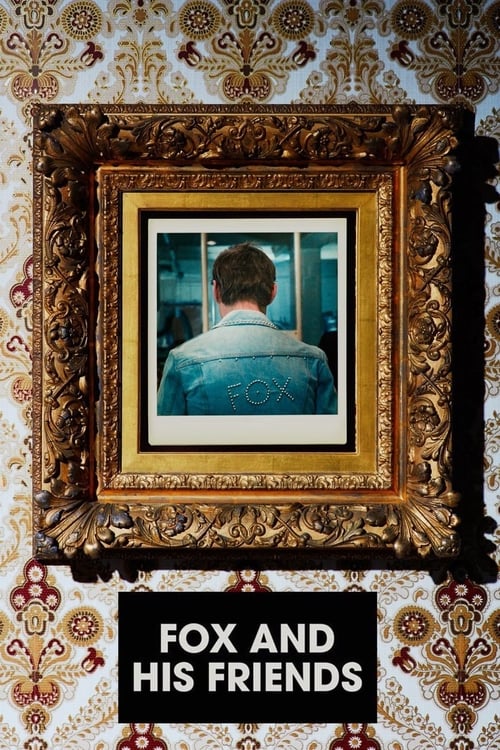
Fox and His Friends
1975 · Rainer Werner Fassbinder
When you're up for a hard, clarifying film — not a comfort watch, but the kind of merciless social drama you'll be arguing with for days.
What it's about
Fox, a working-class carnival performer in Munich, wins half a million marks in the lottery — and suddenly finds himself welcomed into a circle of wealthy, cultivated gay men, including the elegant industrialist Eugen, who becomes his lover. What looks like a fairy tale of luck and love is really a study of class: how money, taste, and manners are used to absorb, drain, and diminish a man who never learned the rules. Fassbinder himself plays Fox.
The experience
Cold-eyed and quietly brutal — you watch the exploitation happen in plain sight, at dinner parties and furniture showrooms, and the film refuses to look away or soften it. It leaves a bruise that lasts.
Performances
Fassbinder's own performance as Fox is the film's raw center — one of the rare times he cast himself in a lead, and he plays the character's eagerness and vulnerability with almost painful openness.
The craft
The direction is precise and unsparing: immaculately composed frames of apartments, boutiques, and vacation resorts that turn bourgeois good taste into a kind of trap. Every scene of generosity doubles as a transaction, and the script keeps a cold ledger of who pays for what.
Why it matters
A landmark of both New German Cinema and queer film — provocative in its day for insisting that a gay milieu could be shown without piety, as a place where class cruelty operates just like anywhere else.
Snapshot
Fox and His Friends (original title Faustrecht der Freiheit, literally "the fist-right of freedom" — a bitterly ironic phrase for the law of the jungle) is Rainer Werner Fassbinder's dissection of class exploitation staged inside a gay milieu. Franz Biberkopf, nicknamed "Fox the Talking Head," is a working-class carnival performer who wins half a million Deutschmarks in the lottery and is promptly absorbed, drained, and discarded by his lover Eugen and the affluent gay circle around him. Fassbinder himself plays Fox — one of the very few times the director cast himself in a full leading role — which lends the film an autobiographical charge and a physical vulnerability rare in his output. The film matters because it insists, against the grain of both gay-liberation optimism and the melodrama of doomed love, that homosexuality confers no exemption from capitalism's predations: the rich exploit the poor even, or especially, among the marginalized. It remains one of the touchstone works of the New German Cinema and one of the earliest films to treat gay life as a social field structured by money rather than a subject of pathos or scandal.
Industry & production
The film was produced in 1974 and released in 1975, during the most prolific stretch of Fassbinder's career, when he was completing multiple features a year alongside television work and theater. It was made through his own production apparatus — Fassbinder worked repeatedly with the label Tango Film, his personal production vehicle — and, like most of his mid-1970s features, on a compressed schedule and a modest budget. Precise budget and box-office figures are not reliably documented in the standard English-language literature, and I will not invent them.
The production is inseparable from the ensemble Fassbinder built around himself, essentially a repertory company drawn from his years in the Munich anti-teater. He surrounded himself with recurring collaborators — actors, technicians, and intimates — and worked fast, a method conditioned by the funding structures of West German cinema in the period, which combined television co-financing (through broadcasters such as WDR and ZDF) and the Film Subsidy system. Fassbinder's speed and reliability within that system are the reason he could sustain such an enormous output; Fox and His Friends is a product of that industrial rhythm as much as of any single creative decision. The dedication of the film to Armin Meier and others in Fassbinder's orbit points to how tightly the professional and the personal were braided in his working life.
Technology
Fox and His Friends was shot on 35mm color film, the standard theatrical format for a Fassbinder feature of this scale, as distinct from the 16mm he sometimes used for more marginal or televisual projects. There is no significant technological novelty to claim for the film — it uses no unusual process, optical trick, or format innovation — and its interest lies entirely in the deployment of conventional means. What is worth noting technologically is the disciplined use of color and the controlled studio-and-location interiors that the format afforded: Fassbinder and his cinematographer exploited the saturated palette of 1970s color stock to render the bourgeois interiors as arenas of glassy, reflective surfaces. Beyond that, honesty requires saying the film is technically unremarkable by design; its power is compositional and performative, not mechanical.
Technique
Cinematography
The cinematography, by Michael Ballhaus — Fassbinder's most important camera collaborator of the period, and later a major Hollywood cinematographer for Scorsese and others — is central to the film's meaning. Ballhaus and Fassbinder repeatedly frame Fox through doorways, banisters, shop windows, and furniture, so that the mise-en-scène literally cages him within the possessions and architecture of the wealthy. The camera favors deep, cluttered compositions in which foreground objects — flowers, glassware, décor — press between the viewer and the characters, visualizing how Fox is surrounded by commodities that are never his. Ballhaus's controlled reframings and his use of reflective surfaces turn the bourgeois apartments into vitrines. The overall look is deliberately cool and composed rather than expressionistically distorted, which allows the cruelty of the story to read as ordinary and social rather than gothic.
Editing
The editing is credited to Thea Eymèsz, a frequent Fassbinder collaborator. The cutting is measured and observational, holding shots long enough to let humiliation accumulate in real time rather than accelerating for effect. The film progresses through a series of discrete social scenes — the win, the courtship, the shopping, the dinners, the collapse — and the editing lets each play as a near-tableau, so the drama emerges from the arrangement of people within a shot as much as from the joining of shots. This restraint is a deliberate melodramatic strategy: by refusing to cut away from Fox's degradation, the film implicates the viewer as witness.
Mise-en-scène / staging
Mise-en-scène is arguably where Fassbinder's authorship is most legible. The film contrasts two material worlds — Fox's cramped, gaudy origins (the fairground, the working-class bar, the shabby flat) and the tasteful, expensive interiors of Eugen's class — and stages the plot as Fox's passage from one into the other, and his expulsion back out. Objects carry the theme: the apartment Fox pays for and decorates, the tailored clothes, the car, the antiques all function as instruments of class translation that ultimately reject him. Fassbinder repeatedly stages characters at social distances that encode power — Fox physically lower, off-center, or excluded from the composition's dominant space. The theatrical precision of the blocking reflects Fassbinder's stage training and gives the interactions a ritualized, almost sociological legibility.
Sound
The film's sound design is naturalistic and unshowy, keyed to dialogue and the ambient textures of bars, apartments, and streets. Music is used sparingly rather than as a wall-to-wall emotional guide; Fassbinder generally avoided drenching this film in score, preferring the flatter, more exposing acoustic of spoken exchange, which suits the film's clinical view of exploitation. I do not have reliable documentation of a single credited composer to attribute a distinctive musical signature to, and I will not invent one.
Performance
Performance is the film's engine. Fassbinder's own portrayal of Fox is remarkable for its openness — coarse, needy, physically ungainly, and utterly without vanity. He plays Fox as someone whose warmth and gullibility are precisely what make him exploitable, so that the audience's affection for him becomes a kind of complicity. Peter Chatel plays Eugen with a cold, well-mannered contempt that never tips into caricature; the cruelty is delivered in the register of good taste. The supporting ensemble — drawn from Fassbinder's stock company — performs in the slightly stylized, affectless mode characteristic of his direction, which keeps the melodrama from becoming sentimental and instead renders emotional violence as social routine.
Narrative & dramatic mode
The film operates in the mode of social melodrama, a form Fassbinder consciously reworked from the Hollywood domestic melodramas of Douglas Sirk, whom he revered. Its dramatic architecture is that of the tragic rise-and-fall: an innocent granted sudden fortune, courted, elevated, systematically fleeced, and destroyed. But Fassbinder strips the form of catharsis. The narrative is linear and legible, almost parable-like, moving through clearly demarcated stages of Fox's exploitation. The naming of the protagonist Franz Biberkopf — the name of the doomed proletarian hero of Alfred Döblin's Berlin Alexanderplatz, which Fassbinder would later adapt at monumental length — signals that this is a story about a decent man ground down by a merciless social order, a modern naturalist tragedy in melodramatic dress. The mode is anti-illusionist enough to keep the viewer analytical while emotional enough to make the ending genuinely devastating.
Genre & cycle
Generically the film sits at the intersection of the melodrama and the social-realist critique of West German society. Within Fassbinder's own output it belongs to the cycle of films examining how power circulates through intimate relationships — a preoccupation running from The Merchant of Four Seasons (1971) and The Bitter Tears of Petra von Kant (1972) through Ali: Fear Eats the Soul (1974) and onward. In each, love is shown to be structured by inequality — of class, gender, ethnicity, or age. Fox and His Friends is the entry in that cycle that maps the mechanism onto class within a gay world. It is also, historically, part of an emerging body of 1970s films addressing gay life, though it deliberately refuses the consciousness-raising or affirmational register that some contemporaries expected of such a film.
Authorship & method
Fassbinder is the film's writer-director and star, and it bears his authorship on every axis. The screenplay is credited to Fassbinder, working from his own story (with Christian Hohoff associated with the writing, per the standard credits). His method was collaborative-autocratic: a fixed repertory of actors and technicians, extremely rapid shooting, and total control of tone. The key collaborators are the pillars of his mid-1970s work — cinematographer Michael Ballhaus, whose framing gives the film its caged, vitrine-like look; editor Thea Eymèsz, whose patient cutting sustains the film's observational cruelty; and the ensemble cast, including Peter Chatel as Eugen and Karlheinz Böhm (the former star of Powell's Peeping Tom) among the surrounding figures. Fassbinder's decision to play Fox himself is the defining authorial gesture: it fuses director and victim, and it has invited persistent (though necessarily speculative) autobiographical reading, given Fassbinder's own turbulent relationships. Where such biographical inference goes beyond the documented record, it should be flagged as interpretation rather than fact.
Movement / national cinema
The film is a canonical work of the New German Cinema (Neuer Deutscher Film), the movement of the 1960s–70s that revitalized West German filmmaking through auteurs including Fassbinder, Wim Wenders, Werner Herzog, Volker Schlöndorff, and Margarethe von Trotta. That movement grew out of the 1962 Oberhausen Manifesto's rejection of the commercially exhausted "Papa's cinema" and was sustained by state and television subsidy structures. Fassbinder was its most prolific figure, and Fox and His Friends exemplifies the movement's ambition to use accessible narrative forms for a searching critique of the Federal Republic — its class hierarchies, its postwar prosperity, and the persistence of exploitation beneath the surface of the "economic miracle." The film's fusion of Sirkian melodrama with a coldly analytical eye is a signature New German Cinema strategy: popular form repurposed for social diagnosis.
Era / period
Made in mid-1970s West Germany, the film is a document of a society enriched by the postwar boom and uneasy about the costs of that affluence. Its world of lottery windfalls, boutique shopping, antique dealers, and foreign holidays is the consumer landscape of the Wirtschaftswunder generation. The period's loosening of censorship and the partial decriminalization of homosexuality in West Germany (the reform of Paragraph 175 in 1969) form the necessary backdrop: a gay social world can be depicted openly, in public bars and apartments, in a way that would have been impossible a decade earlier. Fassbinder uses that new visibility not to celebrate but to show that legal tolerance does nothing to dissolve economic predation. The film thus belongs precisely to its moment — a post-liberation, high-consumer West Germany where the old class order simply migrates into new social spaces.
Themes
The governing theme is that class exploitation is total and survives every form of solidarity. Fassbinder's central provocation is to show the rich exploiting the poor within a shared minority identity: being gay does not make Eugen and his circle Fox's allies; it merely provides the setting for the same old robbery. Related themes include the commodification of love — affection extended and withdrawn in exact proportion to money; the impossibility of buying one's way into a class that regards one as raw material; and the loneliness of the exploited, dramatized in an ending of complete abandonment. There is also a sustained critique of "good taste" as a weapon, the way refinement and manners are used to humiliate and to launder cruelty. Underlying all of it is Fassbinder's characteristic pessimism about human relationships as fields of power, in which tenderness is nearly always a transaction.
Reception, canon & influence
Critically, Fox and His Friends has come to be regarded as one of Fassbinder's essential films and a landmark in the cinematic representation of gay life. It provoked debate on its release — notably within gay and left circles — over whether its portrait of a predatory gay bourgeoisie was clear-eyed or unflattering, a debate Fassbinder invited by refusing any redemptive or affirmational gesture. That the film treats homosexuality as unremarkable in itself, and locates its tragedy in class rather than in sexuality, was itself a significant departure from the era's dominant modes of gay representation.
Looking backward, the film's most important influence is Douglas Sirk, whose Hollywood melodramas Fassbinder had studied and written about, and whose lesson — that melodrama can carry ruthless social critique — organizes the whole project; the naming of the hero after Döblin's Franz Biberkopf ties it to the German naturalist-tragic literary tradition as well.
Looking forward, the film helped establish a template for queer cinema that treats gay life within ordinary social structures — class, money, work — rather than as a special case, an approach later developed by filmmakers associated with the New Queer Cinema of the late 1980s and 1990s. Fassbinder's broader influence on directors who cite him is well documented; among cinematographers, Michael Ballhaus carried the visual discipline honed on films like this one into a major international career. Precise attributions of specific later films to Fox and His Friends as a direct source are difficult to substantiate individually, and I will not manufacture them; what can be said securely is that the film remains a fixture of Fassbinder retrospectives and of the canon of politically serious cinema about sexuality and class, studied as the clearest single statement of his conviction that exploitation follows the exploited everywhere.
A Deleuzian reading
In the expensive apartments there is nearly always something in the way.
The full Deleuzian reading of Fox and His Friends →
Reception
On release it stirred real anger — parts of the gay press accused Fassbinder of airing a hostile, self-loathing picture of gay life. Half a century on it's been fully flipped: now it's canonized as a foundational queer-cinema text and one of the most loved entries in the Fassbinder catalog.
How Fox and His Friends was received, from release to now →
How to watch Fox and His Friends: what to notice on a first viewing
- Watch what's placed between the camera and Fox in Eugen's apartment. Ballhaus repeatedly frames Fox through doorways, banisters, and foreground clutter like flowers or glassware, so something is almost always in the way. The apartments are staged like display cases, and Fox is displayed inside them like the other objects.
- Watch where Fox stands in a room compared to everyone else. Fassbinder's blocking keeps him lower, off-center, or outside the frame's dominant space, using theatrical positioning instead of dialogue to show who has power. You can read who's winning the relationship from where people are seated, before anyone says a cruel word.
- Watch the objects Fox buys: the apartment, the car, the clothes. Fassbinder tracks each purchase as a step in Fox's passage into Eugen's world, objects meant to translate him into a different class. Everything he buys to belong ends up belonging to someone else's idea of him instead.
- Notice how long the film holds on Fox's embarrassment. Eymèsz's editing refuses to cut away, letting each humiliation finish happening in real time rather than accelerating past it. The film makes you a witness to the humiliation instead of sparing you from it.
- Watch how calm and well-mannered Eugen stays while being cruel. Peter Chatel delivers contempt in the register of good taste, never raising his voice or tipping into an obvious villain. The cruelty reads as ordinary because it's delivered so politely, which is exactly the point.
The whole guide to watching Fox and His Friends, with the keys for a rewatch →
Influences: the films it descends from and the films it influenced
- All That Heaven Allows (1955) — The foundational model: Fassbinder lifts Sirk's method of using bourgeois interiors, furniture and objects as visible instruments of class judgment so that melodrama's excess becomes cold social critique rather than sentiment.
- Written on the Wind (1956) — Sirk's mirror-and-glass compositions that frame characters as trapped decorative objects feed directly into Ballhaus's vitrine framing and the film's use of reflective surfaces to encode entrapment within wealth.
- Imitation of Life (1959) — Sirk's tragedy-of-social-climbing structure, where a character is exploited and discarded by those they aspire to join, is the exact narrative skeleton Fassbinder reuses with money-and-class replacing race.
- Berlin Alexanderplatz (1980) — The Franz Biberkopf lineage explicitly continued — Fassbinder returns to Döblin's naturalist-tragic everyman-crushed-by-milieu, the literary source whose name he had already borrowed for Fox.
- Querelle (1982) — Extends the treatment of gay desire as a transactional economy of power rather than a special case, staged in stylized tableaux where money and dominance drive the erotic exchange.
- The Marriage of Maria Braun (1979) — Ballhaus's Wirtschaftswunder-era class critique perfected: objects-as-status-markers and reflective framing chart a character consumed by postwar Germany's economic-miracle transactions.
- GoodFellas (1990) — Ballhaus carried his Fassbinder-honed technique here — the long fluid observational take and reflective/glass framing that watches a protagonist absorbed and finally discarded by a status hierarchy.
- The Age of Innocence (1993) — Ballhaus's cinematography makes objects, table settings and interiors the literal architecture of class exclusion, the vitrine aesthetic he developed shooting Fassbinder's melodramas.
- Poison (1991) — Inherits the New Queer Cinema template Fox established — gay life examined through social structure and cruelty rather than affirmation, with a deliberately anti-redemptive stance.
- Far from Heaven (2002) — The Sirk-through-Fassbinder chain closed: Haynes revives Sirkian melodrama as social critique the way Fassbinder taught, using period objects and framing to expose class and sexual exclusion.
- My Own Private Idaho (1991) — Extends Fox's insight that queer desire is inseparable from class and money, following a hustler exploited across a stratified social economy without moralizing redemption.
- Happy Together (1997) — Descends from Fox's model of gay relationships as sites of economic and emotional exploitation staged through reflective surfaces and claustrophobic interiors rather than as a coming-out narrative.
- 120 BPM (Beats per Minute) (2017) — Carries forward the political-serious approach to gay life inside collective social structures — money, institutions, work — that Fox pioneered against the affirmational mode.
- Destiny (2006) — The strategy of constructing an obsession-and-entrapment narrative using melodrama's structural chassis while systematically removing its affective release mechanisms — leaving desire and destruction to register as social inevitability rather than individual tragedy — is the evacuated melodrama form Demirkubuz applies to Turkish urban reality.
- Great Freedom (2021) — Blueprint for reading gay life through class and confinement, with restrained framing that isolates the protagonist within social architecture rather than dramatizing him through melodrama.
- The Bitter Tears of Petra von Kant (1972) — Fassbinder's own tableau staging and blocking-as-power made explicit — a single-set chamber melodrama where physical position and props map dominance, the technique Fox extends into naturalist exteriors.
- Ali: Fear Eats the Soul (1974) — The immediately prior Sirk-remake exercise: doorway and stairwell framings that pin lovers behind foreground obstructions, plus the affectless ensemble stares, are carried straight into Fox.
- Effi Briest (1974) — Shares Ballhaus's reflective-surface and long-take observational discipline, treating naturalist literary tragedy as a study of a person destroyed by the social codes they cannot read.
- Beau Travail (1999) — Shares the affectless-ensemble performance register and tableau staging where blocking silently encodes hierarchy and desire, treating homoerotic power without expository psychology.
- In a Year with 13 Moons (1978) — Fassbinder himself plays a body/love commodified and destroyed by economic exchange — the theme-of-body-as-commodity and the tragic queer protagonist at a serious film's center that 13 Moons pushes furthest.
- The Place Without Limits (1978) — A gay protagonist destroyed by class and money, filmed as melodrama-as-tragedy — the parallel project of anchoring a serious film on a queer figure exploited by feudal-economic power.
- Mother Küsters Goes to Heaven (1975) — Runs the same thesis — the powerless are devoured by their own social milieu — through melodrama, made the same year with the identical exploitation-of-the-innocent structure.
- I Only Want You to Love Me (1976) — Extends the identical diagnosis — that love has become a monetary transaction and the confusion is lethal — into a lottery-winner's exploitation, the closest thematic twin to this film's core equation.
Similar films
- The Bitter Tears of Petra von Kant (1972) — influence & lineage
- The Marriage of Maria Braun (1979) — influence & lineage
- Ali: Fear Eats the Soul (1974) — influence & lineage
- Great Freedom (2021) — shared sensibility
- In a Year with 13 Moons (1978) — shared sensibility
- I Only Want You to Love Me (1976) — shared sensibility
- Au Revoir les Enfants (1987) — shared sensibility
- The Phantom of Liberty (1974) — shared sensibility