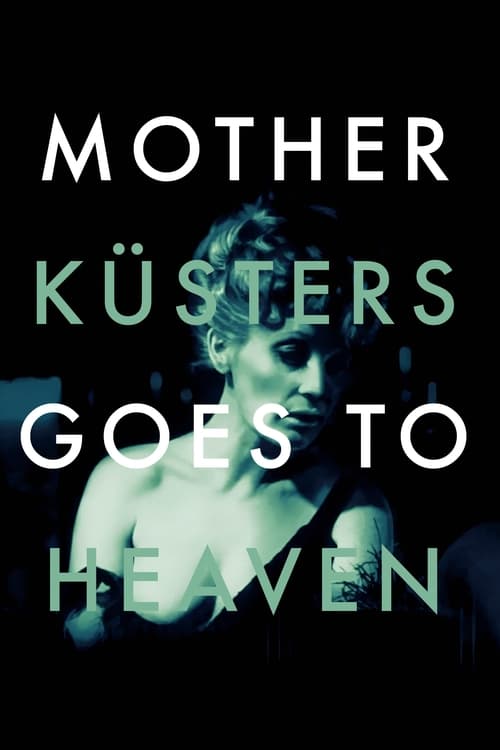
Mother Küsters Goes to Heaven
1975 · Rainer Werner Fassbinder
For when you're feeling cynical about media and politics and want a film that's as clear-eyed as you are — a talky, sardonic evening for viewers who like their satire dry and their sympathies complicated.
What it's about
Emma Küsters is cooking dinner in her ordinary Frankfurt kitchen when the news arrives: her factory-worker husband has killed an executive at his plant and then himself. Suddenly everyone wants a piece of the widow — a tabloid reporter hunting a monster story, a polished Communist couple, a cell of anarchists — each claiming to speak for her dead husband while using her grief for their own ends.
The experience
Bitterly funny and quietly enraging — a deadpan satire that keeps a straight melodramatic face while everyone on screen behaves appallingly. It builds a slow, sad anger rather than big emotions, and its sympathy for Emma never wavers.
Performances
Brigitte Mira is the whole film as Emma — a masterclass in ordinary decency slowly comprehending how thoroughly she's being used, played without a single sentimental note.
The craft
Fassbinder disguises a political pamphlet as a domestic melodrama, nodding to Weimar-era working-class cinema while skewering 1970s West Germany's press and left alike. The staging is precise and unshowy, letting the ironies land through framing and dead-level performance rather than editorializing.
Why it matters
One of Fassbinder's most pointedly political films, it scandalized the very left it depicted and stands as a key example of how the New German Cinema turned genre melodrama into social critique.
Snapshot
Mother Küsters Goes to Heaven (Mutter Küsters' Fahrt zum Himmel) is one of Rainer Werner Fassbinder's most pointedly political films: a bitter social satire disguised as a domestic melodrama. Its premise is a small apocalypse in an ordinary Frankfurt kitchen — an aging factory worker kills a company executive and then himself, leaving his widow, Emma Küsters, to face a world that suddenly wants something from her. Over the film, Emma is passed hand to hand among people who claim to speak for her dead husband and her class: a sensationalist tabloid reporter, a well-heeled Communist couple, and finally a cell of anarchists. Each promises solidarity; each instrumentalizes her grief. The film is at once an homage to the Weimar-era proletarian cinema Fassbinder admired and a caustic critique of the West German left of his own moment. Anchored by Brigitte Mira's extraordinary performance and shot by Michael Ballhaus, it is a compact, acidic, deeply humane picture — minor-key by Fassbinder's own maximalist standards, but among his sharpest statements about how the powerless are consumed even by their supposed champions.
Industry & production
The film belongs to the most feverishly productive stretch of Fassbinder's career. In the mid-1970s he was completing several features a year while also working in television and theater, sustained by a repertory-company mode of production: a stable troupe of actors, technicians, and creative collaborators who worked fast, cheaply, and repeatedly together. Mother Küsters was made in this workshop spirit — economical shooting, largely interior and location-based settings, and a reliance on the ensemble Fassbinder had built across films such as Ali: Fear Eats the Soul (1974), Effi Briest (1974), and Fox and His Friends (1975).
The project is a loose contemporary reworking of Mutter Krausens Fahrt ins Glück (Mother Krause's Journey to Happiness, 1929), the Weimar proletarian film directed by Piel (Phil) Jutzi and rooted in the milieu associated with the artist Heinrich Zille and the era's leftist film culture. Fassbinder's title deliberately echoes and inverts its model — swapping "Krause" for "Küsters" and "journey to happiness" for the mordant "journey to heaven." The homage situates the film within a specific German tradition of committed working-class cinema even as Fassbinder redirects that tradition's politics toward critique.
The screenplay is credited to Fassbinder and his longtime collaborator Kurt Raab, and the production drew on his usual creative circle. The film premiered in the orbit of the 1975 Berlin International Film Festival, where its treatment of the organized left made it immediately controversial (see Reception). Precise budget and box-office figures are not reliably part of the public record and are not asserted here.
Technology
The film was made on 35mm color stock in the conventional manner of West German feature production of the period. There is nothing technologically experimental about the apparatus; the interest lies entirely in how ordinary tools are deployed. This is important context for Fassbinder's method: his innovations were almost never a matter of new equipment but of intensified, self-conscious use of standard resources — framing, blocking, mirrors, controlled camera movement, and a heightened, artificial color palette absorbed from Hollywood melodrama. By 1975 Fassbinder and Ballhaus had already experimented with elaborate camera choreography elsewhere (the celebrated circular tracking of Martha, 1974), so the relative restraint of Mother Küsters reads as a deliberate stylistic choice rather than a limitation of means.
Technique
Cinematography
Michael Ballhaus, Fassbinder's principal cinematographer of the period, shot the film. His work here favors composed, frequently frontal or tableau-like framings, doorways and thresholds that box characters within the apartment, and reflective surfaces that split and double the image — recurring devices in the Fassbinder–Ballhaus grammar for showing people trapped inside social arrangements. The camera is disciplined rather than flamboyant; movement, when it comes, tends to reframe power relations within a scene rather than to dazzle. The domestic spaces are rendered with the slightly airless, over-composed quality that turns naturalistic settings into stages. Ballhaus would later become one of Hollywood's most sought-after cinematographers, and the precision visible here is continuous with that career.
Editing
The cutting serves the film's satirical structure, which is essentially episodic: Emma is delivered successively into new hands, and each "episode" is a fresh negotiation over who owns her husband's death. The editing keeps scenes legible and lets performances breathe, favoring sustained takes and clear spatial logic over montage. Fassbinder was known throughout his career for editing his own films under the pseudonym "Franz Walsch" (an homage to Raoul Walsh) and for working closely with regular cutters within his team; the specific editing credit on this title is a matter for the film's own records rather than something to be asserted from memory here.
Mise-en-scène / staging
Staging is the film's real engine. Fassbinder blocks his actors so that the geometry of a room encodes the politics of a scene: who sits and who stands, who is centered and who is pushed to the frame's edge, who looks and who is looked at. The Küsters apartment — cramped, ordinary, defined by the kitchen where the film opens — becomes a set that outsiders keep invading. When the bourgeois Communist couple receives Emma in their comfortable home, the contrast in décor does the ideological argument silently: the people who speak for the proletariat live nothing like it. This is Fassbinder's Sirkian inheritance operating at full strength — the conviction that furniture, costume, and spatial arrangement carry meaning as forcefully as dialogue.
Sound
The score is the work of Peer Raben, Fassbinder's near-constant musical collaborator of the era, whose contributions typically lean on melodrama's emotional register while maintaining an ironic distance from it. The soundtrack thus participates in the film's double game: it can lend Emma's suffering genuine pathos while framing that pathos as something the film's other characters are eager to exploit. Dialogue and ambient sound are handled with the plain functionality characteristic of Fassbinder's fast production style.
Performance
Performance is where the film is richest. Brigitte Mira, whom Fassbinder had directed the previous year as the widow Emma in Ali: Fear Eats the Soul, again plays an ordinary older woman named Emma — a deliberate echo that makes her a kind of figure for the abused, decent working-class subject across his cinema. Mira gives Emma an unglamorous dignity and a slightly bewildered receptivity: she keeps trying to believe the people who court her. Around her, the ensemble plays with the stylized, faintly Brechtian coolness typical of Fassbinder's troupe — Ingrid Caven as the daughter who converts family tragedy into a nightclub act, Margit Carstensen and Karlheinz Böhm as the polished Communist pair, Gottfried John as the tabloid journalist, and Irm Hermann as the sharp-edged daughter-in-law. The gap between Mira's warmth and the surrounding performances' calculated poise is itself a dramatic argument.
Narrative & dramatic mode
The film operates as a political melodrama built on a structure of serial exploitation. After the opening catastrophe, the narrative advances through a sequence of would-be rescuers who each reframe the dead man to suit their agenda. The tabloid press casts him as a deranged killer; the daughter monetizes the notoriety; the Communists rehabilitate him as a martyr of the working class; the anarchists want a symbol for direct action. Emma, seeking only to have her husband remembered as the good man she knew, is the constant against which each self-interested reading is measured.
Famously, the film exists in two endings. The German-release version closes bleakly, with Emma drawn into an anarchist occupation of the newspaper offices that ends in disaster and her death — a downbeat resolution partly conveyed through terse closing information rather than a fully staged spectacle. For international distribution Fassbinder prepared a second, gentler and more ironic ending, in which a sympathetic night watchman at the newspaper takes pity on Emma and the two simply leave together. The coexistence of the two endings is one of the film's most discussed features: the "happy" export version reads as an almost sardonic comment on audience appetites, while the bleak version drives home the film's thesis that Emma has no place to stand. The exact handling of each ending is documented in the film's release history; the essential point is that the difference is itself part of the film's meaning.
Genre & cycle
Mother Küsters sits at the intersection of two lineages. It is a melodrama in the Douglas Sirk mold that Fassbinder had made his own — a genre of ordinary women, domestic spaces, and socially produced suffering. It is simultaneously a revival of the German "proletarian film," explicitly invoking Jutzi's 1929 Mutter Krausens Fahrt ins Glück and, behind it, the Weimar tradition of cinema made in solidarity with the working class. Fassbinder's move is to fuse the two and then turn the political genre against the contemporary left: the film uses the proletarian-film template to indict the very institutions that claim its heritage. Within Fassbinder's own output it belongs to his cycle of mid-1970s films about the wounds capitalism and social hierarchy inflict on individuals, alongside Ali, Fox and His Friends, and Fear of Fear (1975).
Authorship & method
The film is unmistakably Fassbinder's in its combination of melodramatic feeling and analytic coldness, its sympathy for the exploited, and its refusal to let any political faction off the hook. His method — the repertory troupe, the rapid shooting, the reuse of actors and names across films — is on full display, and the recurrence of Mira as "Emma" is a signature authorial gesture linking this film to Ali.
The key collaborators are central to the result. Michael Ballhaus's cinematography supplies the controlled, mirror-laced image world; his later Hollywood career (including a long partnership with Martin Scorsese) makes this period a formative chapter in one of the great cinematographic careers. Peer Raben's music provides the ironic emotional scoring that lets the film feel and critique feeling at once. The screenplay, written with Kurt Raab, translates Jutzi's source into a contemporary satire. The ensemble — Mira above all, with Caven, Carstensen, Böhm, John, and Irm Hermann — functions less as a set of individual turns than as an instrument Fassbinder plays. Editing credit and certain technical attributions belong to the film's own records; where I am not certain of a specific name, I have declined to assign one.
Movement / national cinema
The film is a landmark document of the New German Cinema (Neuer Deutscher Film), the movement of the 1960s–70s in which Fassbinder, alongside figures such as Wim Wenders, Werner Herzog, and Volker Schlöndorff, remade postwar German filmmaking as a personal, critical, internationally ambitious art. Fassbinder's particular contribution — the marriage of Hollywood melodrama with a coldly analytic reckoning with German society — is fully present here. By explicitly reaching back to the proletarian cinema of the Weimar Republic, Mother Küsters also positions New German Cinema as an heir to, and critical reviser of, an earlier committed German film culture.
Era / period
Released in 1975, the film is inseparable from the political temperature of mid-1970s West Germany. This was the era of left-wing radicalism and, on its violent fringe, the terrorism associated with the Red Army Faction, which would culminate in the crisis of the "German Autumn" of 1977. The film's depiction of anarchists who see in Emma's tragedy an opportunity for spectacular action tapped directly into contemporary anxieties about political violence, while its portrait of a comfortable, doctrinaire Communist establishment spoke to debates about the credibility and class character of the organized left. The film's contested endings likewise reflect a moment in which the question of whether meaningful change was possible, or whether the ordinary person was simply trapped, felt genuinely urgent.
Themes
The film's governing theme is the appropriation of grief and, through it, the instrumentalization of the working class. Emma's dead husband becomes a blank surface onto which everyone — press, family, party, radicals — projects a usable story, and the tragedy is that no one is interested in the modest truth she wants to preserve. Related concerns run throughout: the media's manufacture of sensation and its indifference to persons; the hypocrisy of a bourgeois left that admires the proletariat without living among it; the futility and self-regard of romantic radicalism; and the profound loneliness of the ordinary woman, a figure Fassbinder returns to with unusual tenderness. Beneath the satire is a melodramatic core — the longing for genuine solidarity and human recognition, and its repeated betrayal.
Reception, canon & influence
On its appearance the film was immediately and predictably controversial. Its unflattering portrait of institutional Communists as bourgeois manipulators drew objections from the organized left, and its handling of anarchist violence made it a lightning rod in a tense political climate; the two endings became part of the discussion in their own right, with the gentler export ending read by some as a concession and by others as an additional layer of irony. Critical reception over time has treated the film as a strong, characteristic entry in Fassbinder's canon — not among the towering titles like Ali: Fear Eats the Soul, The Marriage of Maria Braun, or Berlin Alexanderplatz, but valued precisely as his most direct and unsparing engagement with contemporary left politics.
Its lines of influence run backward and forward. Backward, the film is openly indebted to Jutzi's Mutter Krausens Fahrt ins Glück and the Weimar proletarian tradition, and, on the level of form, to the Hollywood melodramas of Douglas Sirk that shaped Fassbinder's entire aesthetic. Forward, the film sits within Fassbinder's own thematic web — the "Emma" figure and the melodrama-as-social-critique method that culminate in the BRD Trilogy and his late masterpieces — and it belongs to the body of work through which Fassbinder taught later filmmakers how genre feeling could be turned to political analysis. The continuing influence of his cinematographer Michael Ballhaus, whose visual thinking was honed on films like this one before his prominent American career, is a further, concrete thread of legacy. Where the detailed reception record is thin or dependent on specific contemporary reviews, this account refrains from inventing particulars; the film's standing rests securely on its place as Fassbinder's sharpest cinematic argument about who gets to speak for the dispossessed.
A Deleuzian reading
A woman is arguing about canned sausages.
The full Deleuzian reading of Mother Küsters Goes to Heaven →
Reception
On release it scandalised the German left — Fassbinder, supposedly one of their own, skewered Communists and anarchists as coolly as the tabloid press, and leftist critics were furious. Today that even-handed cruelty is exactly why it's rated among his sharpest political films.
How Mother Küsters Goes to Heaven was received, from release to now →
Influences: the films it descends from and the films it influenced
- Mutter Krausens Fahrt ins Glück (1929) — Supplies the exact narrative armature Fassbinder updates — a working-class mother destroyed by family catastrophe and then picked over by those around her — preserving the Weimar proletarian-tragedy structure of the woman's downward journey.
- All That Heaven Allows (1955) — Establishes the model of saturated domestic melodrama that frames its heroine trapped behind glass and within decor to indict social conformity, the Sirkian mise-en-scène Fassbinder consciously adopted as his house style.
- Imitation of Life (1959) — Fuses the suffering-mother figure with a critique of how grief and spectacle are commercialized, and pioneers the ironic scoring register in which the film both feels and dissects melodramatic emotion.
- Written on the Wind (1956) — Deploys mirrors and reflective surfaces to fracture and double the bourgeois family image — the mirror-laced visual grammar Michael Ballhaus later builds his compositions around.
- Kuhle Wampe (1932) — Brecht-scripted proletarian film that embeds overt political debate inside melodramatic situations and uses episodic, distanciated construction — the Brechtian blocking-as-politics Fassbinder inherits.
- The Marriage of Maria Braun (1979) — Culminates the melodrama-as-BRD-history method and the female-survivor figure, with Ballhaus's now-mobile camera reading postwar Germany through one woman's exploited endurance.
- Berlin Alexanderplatz (1980) — Extends the episodic-serial editing structure and the Weimar proletarian source material (Döblin) at monumental length, deploying the full Brechtian ensemble.
- Goodfellas (1990) — Ballhaus carries the fluid, reflection-conscious camerawork he honed on Fassbinder into his Scorsese partnership, where the restless mobile frame is a direct legacy of this formative period.
- The Age of Innocence (1993) — Ballhaus applies the Sirkian-Fassbinder melodramatic mise-en-scène — framing social entrapment through decor, glass, and reflection — to American period melodrama.
- Far From Heaven (2002) — Explicitly revives the Sirk-via-Fassbinder method, using meticulous melodrama pastiche and reflective framing as overt social critique rather than nostalgia.
- Phoenix (2014) — Berlin School heir who reworks Fassbinder's cool postwar-German melodrama and the reconstructed female-survivor figure, retaining the analytic distance beneath genre feeling.
- The Merchant of Four Seasons (1971) — Fassbinder's breakthrough in translating melodramatic feeling into cold social diagnosis, built from Ballhaus's static frontal tableaux that pin characters within their milieu.
- The Bitter Tears of Petra von Kant (1972) — Showcases Ballhaus's mirror-laden chamber staging and blocking as an explicit choreography of power and dependency within a single set.
- Ali: Fear Eats the Soul (1974) — Direct companion sharing the repertory method and the recurring Brigitte Mira 'Emma,' with the same Sirkian framing of figures through doorways and stairwells to stage social exclusion.
- Effi Briest (1974) — Pushes the Ballhaus mirror-reflection grammar and Brechtian distancing (intertitles, tableau) furthest, treating the frame itself as a device of estrangement.
- Fox and His Friends (1975) — Runs the same thesis — the powerless are devoured by their own social milieu — through melodrama, made the same year with the identical exploitation-of-the-innocent structure.
Similar films
- The Marriage of Maria Braun (1979) — influence & lineage
- Ali: Fear Eats the Soul (1974) — influence & lineage
- The Bitter Tears of Petra von Kant (1972) — influence & lineage
- Fox and His Friends (1975) — influence & lineage
- La Cérémonie (1995) — shared sensibility
- Waiting for the Hearse (1985) — shared sensibility
- Hitler: A Film from Germany (1978) — shared sensibility
- I Only Want You to Love Me (1976) — shared sensibility