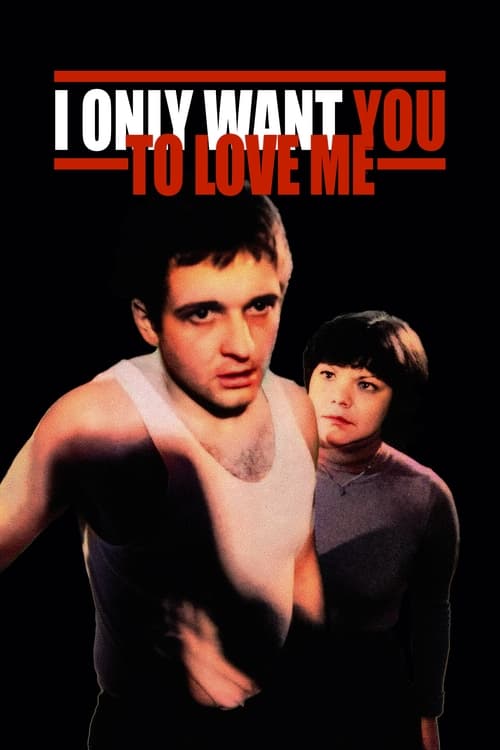
I Only Want You to Love Me
1976 · Rainer Werner Fassbinder
For when you're up for a bleak, clear-eyed character study that doubles as social critique — a film to argue about afterward, not to unwind with.
What it's about
Peter, a young bricklayer raised without affection during West Germany's postwar boom, has absorbed one lesson: love is something you purchase. He showers his parents and his wife Erika with gifts he can't afford, taking on extra work and mounting debt to keep the presents flowing — a system that can only hold for so long. Told in retrospect, it's the anatomy of a man trying to buy what was never for sale.
The experience
Cold, methodical, and quietly heartbreaking — you watch a decent, inarticulate man walk toward disaster one installment payment at a time. The dread is economic rather than violent, and it's suffocating.
The craft
Fassbinder, working for television at the peak of an inhumanly prolific decade, strips the story to its transactional bones: every relationship is framed as an exchange, every kindness has a price tag. The plainness of the style is the point — it makes the emotional starvation impossible to look away from.
Why it matters
A key film of the New German Cinema's reckoning with the 'economic miracle' — the argument that postwar prosperity was built on emotional deprivation, made by its most prolific and unsparing chronicler.
Snapshot
Ich will doch nur, daß ihr mich liebt is a made-for-television feature that Rainer Werner Fassbinder directed in 1976, during the most concentrated stretch of an already inhumanly prolific decade. It follows Peter, a young bricklayer raised in the emotional cold of the West German "economic miracle," who has absorbed one lesson from a loveless childhood: affection is bought and sold like anything else. He showers his parents and his wife, Erika, with gifts he cannot afford, takes on distant construction work and mounting debt to sustain the flow of presents, and — when the arithmetic finally collapses — kills a publican in a sudden, almost inarticulate act of despair. The story reaches us as retrospect: Peter narrates it from prison. The film is minor Fassbinder only by the standard of a filmography crowded with masterpieces; on its own terms it is a lucid, controlled study of how capitalism colonizes the interior life, and it rehearses in miniature the great subject of the later BRD Trilogy.
Industry & production
The film was produced for West German public television — the record consistently associates it with WDR (Westdeutscher Rundfunk), the Cologne-based broadcaster that was among the essential patrons of the New German Cinema. This is the decisive industrial fact about the picture. From the late 1960s onward, television commissions and the "Film/Fernsehen" funding arrangements underwrote a generation of directors who could not have survived on theatrical returns alone. Fassbinder, more than any of his peers, treated television not as a lesser platform but as a working method: fast schedules, modest budgets, and a guaranteed broadcast slot allowed him to make films almost continuously.
Ich will doch nur, daß ihr mich liebt belongs to a year of extraordinary output. In 1976 Fassbinder also completed the caustic Satansbraten (Satan's Brew) and the chamber piece Chinese Roulette, among other work — evidence of a production tempo sustained by his repertory model, in which a familiar crew and a stable of actors could move from one project to the next with minimal ramp-up. The screenplay is Fassbinder's own, adapted from documentary source material: a case drawn from published interviews with prisoners, credited to Klaus Antes and Christiane Ehrhardt. (I flag this attribution with mild caution: the film's grounding in "protocol" literature about incarcerated men is well established, but readers should verify the exact source citation against the print's credits.) Precise budget figures and viewership numbers for the original broadcast are not part of the reliably documented record, and I will not invent them.
Technology
This is a 16mm/35mm-era analog television production, shot photochemically and finished for broadcast; nothing about its technology is exotic. What matters technologically is the medium's constraint rather than any innovation. Television framing of the period assumed a small screen and the boxy 1.33:1 aspect ratio, and Fassbinder's compositions here are legible in those terms — faces and domestic interiors organized for a set in a living room rather than a proscenium. The economy of the format — lightweight lighting packages, interiors that could double as studio and location, a shooting schedule measured in weeks — shaped the look as surely as any aesthetic decision. Fassbinder's genius was to convert these limits into a style: the television budget becomes an argument about the claustrophobia of petit-bourgeois life.
Technique
Cinematography
The cinematography is credited to Michael Ballhaus, Fassbinder's principal cameraman across the middle 1970s (their collaboration ran through such films as Martha, Chinese Roulette, and, later, The Marriage of Maria Braun). Even within television's constraints, the hallmarks of that partnership are visible: a taste for compositions that frame characters through doorways, windows, and reflective surfaces, so that people appear boxed, partitioned, or watched. The camera tends to observe Peter with a cool, held gaze rather than chase his feeling; distance is the point. Where the eye expects the melodrama to move closer at moments of crisis, the image frequently holds back, and that withholding is itself expressive.
Editing
The film is built on a fundamental temporal cut — between the prison "present," where Peter recounts his life, and the reconstructed past that his account summons. The editing therefore does structural rather than merely rhythmic work, threading confession and enactment so that we always understand the story as already finished, its ending foreknown. On the specific editorial credit I will be candid: Fassbinder worked in this period with a small circle of cutters (he had earlier taken editing credit himself under the pseudonym "Franz Walsch"), and I cannot from memory reliably attribute this particular film's cut to a named editor. Readers should confirm the credit rather than trust an invented name.
Mise-en-scène / staging
Mise-en-scène is where the film is most obviously Fassbinderian. Interiors are furnished with the acquisitions that Peter's spending buys — the lamp, the appliances, the "nice things" that are supposed to stand in for love — so that the décor literalizes the film's thesis. Objects accumulate as tokens of affection and as evidence of debt. Staging favors stiff, frontal arrangements of the family group, bodies held apart within the frame, gestures of giving and receiving that feel transactional rather than warm. The domestic set functions as a vitrine: everyone is on display, and everyone is being appraised.
Sound
On sound and music I must be careful. Fassbinder's regular composer was Peer Raben, whose scores are central to films like Ali: Fear Eats the Soul and the later trilogy, but I cannot confirm from memory that Raben supplied an original score for this television film, and several Fassbinder TV works lean on source music and spare, functional sound design rather than a lush orchestral track. What is safe to say is that the film's soundscape serves the same distancing project as its images: dialogue delivered flatly, silences left to sit, and music (where present) used as commentary on feeling rather than as an amplifier of it.
Performance
Vitus Zeplichal plays Peter, and the performance is the film's quiet engine — boyish, eager to please, wounded in a way he cannot name, his violence when it comes all the more shocking for erupting from such softness. Elke Aberle plays Erika, his wife, the nearest recipient of his ruinous generosity. Around them Fassbinder deploys the acting register he favored: performances pitched slightly below naturalism, affect kept under a lid, so that emotion registers as pressure rather than display. This is Brechtian playing in a domestic key — actors who show us characters rather than dissolve into them, which keeps the audience analytic even as the story turns tragic. (I name only the two leads with confidence; supporting casting I leave unspecified rather than risk error.)
Narrative & dramatic mode
The dramatic mode is confessional and retrospective — a framed narration that hands us the catastrophe as fait accompli and then reconstructs the road to it. This is melodrama routed through a documentary conceit: the "protocol" of a prisoner explaining himself. The structure produces a peculiar double consciousness. Because we know Peter ends in a cell, every gift, every loan, every overtime shift reads as another turn of a tightening screw; suspense is replaced by a grim inevitability, which is exactly the register of tragedy. The film refuses the exculpation of a single villain. Peter is neither monster nor pure victim; he is a man executing, faithfully, the emotional logic his society taught him. The murder is not a rupture in that logic but its conclusion.
Genre & cycle
The film sits at the intersection of the social-problem drama and the melodrama of the family, both filtered through 1970s German "protocol" realism — the documentary-literary vogue for transcribed testimony from workers, women, and prisoners (the lineage of Erika Runge's Bottroper Protokolle stands behind that sensibility). Within Fassbinder's own output it belongs to the cycle of studies of ordinary, put-upon Germans crushed by the machinery of exchange — kin to Ali: Fear Eats the Soul (1974), Fox and His Friends (1975), and Mother Küsters Goes to Heaven (1975), films in which love, money, and social class are never separable. As a television film about a working-class man's downfall, it also participates in the broader European current of the sober, class-conscious social drama.
Authorship & method
Fassbinder is the total author here — director, screenwriter, and the shaping intelligence behind the ensemble — and the film exemplifies his method. He built films quickly around a repertory of collaborators, using recurrence itself as a tool: the same faces, the same cameraman, the same visual grammar, deployed across dozens of films so that each new work arrived pre-loaded with the resonance of the others. His acknowledged masters were Douglas Sirk, whose Hollywood melodramas taught him that stylized artifice could carry the deepest social critique, and Bertolt Brecht, whose theory of distanciation underwrites the flat performances and observing camera. The synthesis — Sirkian feeling held at Brechtian arm's length — is the Fassbinder signature, and it is fully operative in this small film. Among the collaborators, Michael Ballhaus's cinematography is the most identifiable authorial contribution beyond Fassbinder himself; the composer and editor credits I have flagged as uncertain above and decline to overstate.
Movement / national cinema
The film is a product of the New German Cinema (Neuer Deutscher Film), the movement whose founding gesture was the 1962 Oberhausen Manifesto's declaration that "the old cinema is dead." Alongside Werner Herzog, Wim Wenders, Volker Schlöndorff, Margarethe von Trotta, and Alexander Kluge, Fassbinder was its most productive figure, and arguably its central one. Crucial to the whole movement — and to this film specifically — was the symbiosis with public television: broadcasters like WDR and ZDF supplied the money and the audience that the theatrical market denied. Ich will doch nur, daß ihr mich liebt is therefore not a marginal footnote to the movement but a representative artifact of its actual economic base. Its subject — the psychic damage of postwar West German prosperity — is likewise a defining New German Cinema preoccupation, the generation's reckoning with the country their parents rebuilt.
Era / period
The film is set and made in the long shadow of the Wirtschaftswunder, the postwar economic miracle that rebuilt West Germany into an affluent consumer society. That prosperity is the film's true antagonist. Peter is explicitly a child of the miracle — materially provided for, emotionally starved — and the movie reads his private catastrophe as the return of the repressed cost of that boom. Made in the mid-1970s, after the boom's first cracks and amid the political tension of the West German "leaden years," the film participates in a national mood of disenchantment: the suspicion that the promised prosperity had bought comfort at the price of feeling. It is a period piece about its own moment, diagnosing the emotional accounting of a society that had learned to measure everything.
Themes
The governing theme is the commodification of love — the conversion of affection into a transaction, of relationships into ledgers of giving and owing. Peter's tragedy is that he cannot conceive of being loved except through purchase, and so he spends himself, literally, into ruin and violence. Radiating from this are the film's other concerns: the reproduction of emotional deprivation across generations, as a loveless childhood breeds a man incapable of any other grammar of care; the alienation of labor, as Peter must physically leave home and family to earn the money that is supposed to buy their closeness; the suffocations of the petit-bourgeois family, that vitrine of appearances; and the quiet violence coiled inside respectability. Fassbinder's insistence is structural rather than moralizing: Peter is not a bad man who does a terrible thing, but an ordinary man faithfully obeying a terrible system.
Reception, canon & influence
On contemporary reception I must be honest about the thinness of the record. As a mid-1970s German television film, Ich will doch nur, daß ihr mich liebt did not generate the volume of criticism attached to Fassbinder's theatrical features, and reliable, specific accounts of its original broadcast reception — particularly in English — are sparse. I will not manufacture reviews or figures to fill that gap. In the longer view, the film has been reclaimed by the serious critical reassessment of Fassbinder's work, especially in the scholarship that treats the whole corpus as a single sustained project (Thomas Elsaesser's study of Fassbinder's Germany is the standard reference point), and by the retrospectives and home-video releases that have made even the television films available to later audiences.
Its influences run backward to the sources already named: Sirkian melodrama, Brechtian theater, and the German "protocol" literature of transcribed working-class and carceral testimony that gave the film both its material and its documentary conscience. Its forward influence is felt most clearly within Fassbinder's own trajectory. The film's core equation — that in postwar Germany love and money have become indistinguishable, and that this confusion is lethal — is the seed of The Marriage of Maria Braun (1979) and the rest of the BRD Trilogy, where the same diagnosis is elevated to national allegory and international acclaim. Seen from that vantage, this modest television picture is a crucial workbook: the place where Fassbinder rehearsed, in the story of one bricklayer, the argument he would soon make about a whole republic.
A Deleuzian reading
Start with the lamp.
The full Deleuzian reading of I Only Want You to Love Me →
Reception
Made quickly for West German television in Fassbinder's insanely prolific mid-70s stretch, it went almost unseen outside Germany for decades — and has since been reappraised, via retrospectives and restoration, as one of his most tender and underrated films.
How I Only Want You to Love Me was received, from release to now →
Influences: the films it descends from and the films it influenced
- All That Heaven Allows (1955) — The template Fassbinder studied for framing lovers behind windows, banisters and doorframes so that domestic architecture literally cages desire — the threshold-as-prison compositions run straight into this film.
- Written on the Wind (1956) — Sirk's lesson that lacquered artifice and hysterical color can carry the sharpest class critique underwrites Fassbinder's method of holding melodramatic feeling at a stylized, critical distance.
- Imitation of Life (1959) — Its equation of maternal/romantic love with economic transaction, staged as glossy melodrama, is the direct model for the film's thesis that in postwar society love and money have become indistinguishable.
- Kuhle Wampe (1932) — Brecht's own screen experiment in epic-theater distanciation — flat delivery, the spectator kept analytically outside the drama — is the cinematic root of the film's anti-naturalistic performance and observing camera.
- Vivre sa vie (1962) — Godard's frontal, chaptered tableaux and clinical framing of a woman's life as a series of transactions modeled the Brechtian confessional structure Fassbinder adopts for retrospective testimony.
- The Merchant of Four Seasons (1971) — The earlier study of a working man crushed by petit-bourgeois expectation and unrequited affection establishes the exact suffocation-unto-death arc that Peter's bricklayer repeats.
- The Bitter Tears of Petra von Kant (1972) — Ballhaus's gliding camera across mirrored, theatrically frontal tableaux, treating an interior as a claustrophobic stage, is the same visual grammar carried into this film's cramped domestic frames.
- Effi Briest (1974) — Shares the Academy-ratio, fades-to-white, and distanced literary-testimonial voice — the register of citation over immersion that keeps the audience reading rather than weeping.
- Ali: Fear Eats the Soul (1974) — The explicit Sirk remake made the same year, framing characters through doorways and stair-rails to fix them in place, is the sibling experiment in Sirkian-Brechtian threshold staging.
- Fox and His Friends (1975) — Extends the identical diagnosis — that love has become a monetary transaction and the confusion is lethal — into a lottery-winner's exploitation, the closest thematic twin to this film's core equation.
- The Marriage of Maria Braun (1979) — The direct descendant: this television 'workbook' rehearses, in one bricklayer, the love-equals-money argument that Maria Braun elevates into full national allegory as the BRD Trilogy's opening.
- Lola (1981) — Second BRD-Trilogy panel that inherits the Wirtschaftswunder setting and the commodified-love thesis, now saturated in candy-colored Sirkian lighting as economic-miracle satire.
Similar films
- The Marriage of Maria Braun (1979) — influence & lineage
- The Bitter Tears of Petra von Kant (1972) — influence & lineage
- Ali: Fear Eats the Soul (1974) — influence & lineage
- Fox and His Friends (1975) — influence & lineage
- In a Year with 13 Moons (1978) — shared sensibility
- Mother Küsters Goes to Heaven (1975) — shared sensibility
- A Short Film About Love (1988) — shared sensibility
- The Seventh Continent (1989) — shared sensibility