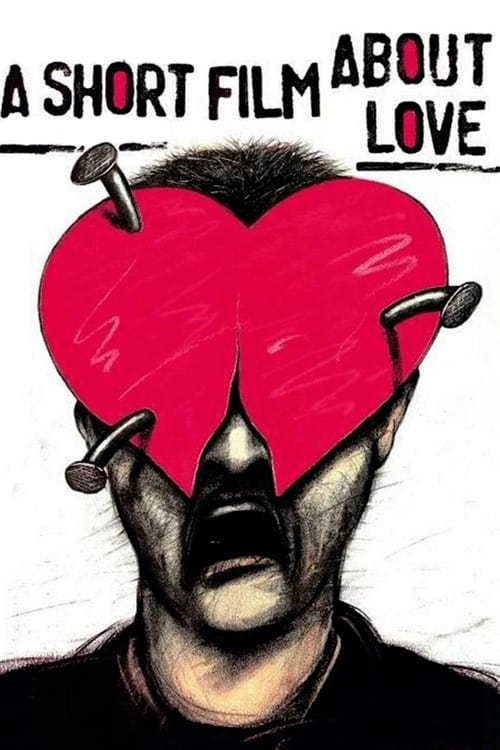
A Short Film About Love
1988 · Krzysztof Kieślowski
For a contemplative night when you want an intimate two-hander about love and loneliness that treats both with complete seriousness — the kind of film you sit with in silence afterward. More ache than comfort, but a gentle ache.
What it's about
Tomek, a lonely nineteen-year-old postal clerk in a Warsaw housing estate, spends his nights watching Magda, a worldly artist in her mid-thirties, through a telescope across the courtyard. When he finally confesses and the two meet, the film upends everything you expect from that setup — he believes in love without sex, she has stopped believing in love at all, and each unsettles the other's certainties.
The experience
Quiet, tender, and quietly devastating — it takes a premise that sounds sordid and turns it into something grave and compassionate. It watches its two people with such patience that by the end you feel implicated in their loneliness.
Performances
Grażyna Szapołowska and Olaf Lubaszenko carry nearly the whole film between them — her guarded weariness against his raw, undefended sincerity — and the shifting balance of power between them is the drama.
The craft
Kieślowski expanded this from an episode of his ten-part Dekalog cycle, and the telescope premise lets him build the film around watching itself — framings through windows and lenses that make you feel the distance between people. Zbigniew Preisner's mournful score does a lot of quiet work.
Why it matters
One of the films that carried Kieślowski from Polish television to international acclaim, it stands with the Dekalog as a peak of late-communist Polish cinema and a model for turning a moral question into intimate drama.
Snapshot
A Short Film About Love (Krótki film o miłości) is the theatrical, feature-length expansion of the sixth episode of Krzysztof Kieślowski's ten-part television cycle Dekalog, keyed to the commandment against adultery. It transforms what might have been a lurid premise — a nineteen-year-old postal clerk, Tomek, systematically spies through a telescope on Magda, an older woman across the courtyard of a Warsaw housing estate — into a grave, tender inquiry into the difference between looking and loving. When the watcher finally forces a meeting, the film inverts its own voyeur-thriller machinery: it is the innocent boy who believes in love without sex, and the worldly woman who has learned to expect the reverse. Made in the last years of communist Poland, it is at once one of Kieślowski's most intimate two-handers and one of his most rigorous moral experiments, staged almost entirely across the narrow, unbridgeable gap between two apartment windows.
Industry & production
The film emerged from the extraordinary production circumstance of the Dekalog project, developed for Polish television and produced through the Tor film unit (Zespół Filmowy "Tor") in the second half of the 1980s. Kieślowski and his co-writer, the lawyer Krzysztof Piesiewicz, conceived ten roughly hour-long films, each loosely inspired by one of the Ten Commandments and set in and around a single Warsaw apartment block. From the outset, two episodes — the fifth (killing) and the sixth (adultery/love) — were planned to exist additionally as expanded theatrical features, a strategy that helped finance the whole undertaking and gave the cycle an international cinema profile. The result is that A Short Film About Love and its companion A Short Film About Killing (Krótki film o zabijaniu) circulated in art houses and festivals while the full Dekalog remained, for a time, a television object.
Production took place under the constraints of the late People's Republic of Poland — material scarcity, a state-supervised industry recovering from the political traumas of martial law earlier in the decade. The blokowisko (prefabricated housing-estate) setting is not incidental local color but a direct expression of the physical and social world available to the filmmakers. The precise budget and box-office figures are not something I can reliably state, and I will not invent them; what is secure is that the Dekalog venture was a modestly resourced television commission whose ambition vastly exceeded its means.
Technology
Technically the film belongs to the world of late-1980s 35mm European production: photochemical color negative, largely available and practical light, direct location shooting in real and constructed interiors, with post-synchronized sound in the standard Polish practice of the period. There is no reliance on optical spectacle. The one piece of "technology" that matters dramatically is diegetic: the optical instruments through which Tomek watches — first opera glasses or binoculars, then a purloined astronomical telescope — which turn the ordinary apparatus of magnification into the film's central metaphor and its principal narrative device. The camera, in effect, is doubled by the instrument inside the story, so that the film's own act of looking is continually thematized by the character's.
Technique
Cinematography
The cinematography, by Witold Adamek, is disciplined and unshowy, in deliberate contrast to the stylized green-filtered imagery Sławomir Idziak brought to the companion A Short Film About Killing. Adamek's compositions are organized around the geometry of watching: the telescope's circular masked view, the framing of Magda within her window as if within a screen, the shot/reverse-shot across the void of the courtyard that stands in for the whole relationship. Interiors are close and often dim; the palette runs to muted institutional colors — the post office, the milk-bar, the two flats. The camera privileges the point of view, repeatedly aligning the spectator with Tomek's optic so that we are made complicit in the surveillance, then, crucially, withdrawing that alignment as the film's sympathies migrate. The circular vignette of the telescopic image is the film's signature visual figure.
Editing
Cut by Ewa Smal, who worked across the Dekalog cycle, the film's editing is patient and observational rather than propulsive. Its rhythm is built on the interval — the waiting, the watching, the small rituals of Tomek's day (sorting mail, delivering milk, returning to the window at the appointed hour). The most consequential editorial choice is structural rather than local: the feature version reorganizes and extends the television episode, most significantly around the ending, replacing the bleaker close of Dekalog VI with a more consoling, ambiguous coda in which Magda, now the one who looks, is granted a vision of comfort. The comparison between the two versions is itself a lesson in how editing shapes meaning.
Mise-en-scène / staging
The staging is a study in constraint. Two apartments face each other across a courtyard; nearly the entire drama is generated by the distance between them and the few points at which it collapses — the post office counter, the milk delivery, Magda's flat when Tomek is finally admitted. Kieślowski and Adamek exploit thresholds obsessively: windows, doorways, the service hatch, the counter grille. The housing block is staged as both prison and observatory. Within Magda's flat, the mise-en-scène of adult romantic life — men, wine, the spilled milk that soaks the table in one celebrated scene — is set against the ascetic bareness of Tomek's room, so that the two spaces read as opposed moral atmospheres.
Sound
Sound is spare and functional, dominated by the muffled acoustics of the estate and the intimate quiet of solitary rooms. Against this restraint, Zbigniew Preisner's music enters sparingly but decisively, lending certain passages the elevated, quasi-liturgical gravity that would become a hallmark of his collaboration with Kieślowski. The film generally trusts silence and ambient sound to carry the loneliness of both characters, reserving score for moments of emotional crystallization.
Performance
The film rests almost entirely on two performances. Olaf Lubaszenko plays Tomek with an unguarded, almost painful sincerity — the whole conception of the character depends on our believing that his obsessive watching is not predatory but yearning, and Lubaszenko sustains that fragile reading. Grażyna Szapołowska's Magda is the film's more complex achievement: initially armored in worldly cynicism, she moves through cruelty, curiosity, guilt, and finally something like tenderness. The pivot of the drama — her humiliating "seduction" of the boy to prove that love is only sex, and the devastation that follows — requires an actress who can be both merciless and wounded, and Szapołowska modulates the turn with great control. A supporting presence, the elderly godmother in whose flat Tomek lodges, grounds the boy's loneliness in a small register of domestic care.
Narrative & dramatic mode
The dramatic mode is chamber tragedy inflected with moral parable. The narrative is deceptively simple and almost classically symmetrical: watcher pursues watched; watched discovers and humiliates watcher; the positions then reverse, and the one who scorned love is left looking through the same telescope for the one she has broken. This chiasmus — the exchange of the gaze — is the film's engine. Kieślowski withholds easy resolution; the feature's ending is calculatedly ambiguous, a gesture of imagined consolation rather than a plot outcome. The film advances less by event than by the accretion of small acts of watching and the slow moral education of both characters, so that its "suspense" is entirely ethical: not what will happen, but what love, if anything, means here.
Genre & cycle
Nominally a drama-romance, the film sits pointedly athwart genre. Its premise belongs to the voyeur-thriller lineage — the immobilized watcher at the window — but it systematically drains that lineage of menace and titillation, redirecting the apparatus toward metaphysics of love and loneliness. It belongs first and most importantly to a cycle: Dekalog, the ten-film meditation on the commandments, within which this is the sixth panel. As one of the two episodes given theatrical life, it functions both as a standalone art-house feature and as a movement in a larger symphonic structure, and it is best understood in that double membership.
Authorship & method
The film is a signal instance of Kieślowski's mature method and of the collaborative "workshop" around him. The screenplay is co-authored with Krzysztof Piesiewicz, the lawyer who became Kieślowski's essential writing partner from No End (1985) onward and through the Dekalog and the Three Colours trilogy; Piesiewicz's juridical and moral cast of mind is felt in the film's structure as a kind of case study in the ethics of looking. The cinematographer Witold Adamek realizes the film's optics of surveillance. The composer Zbigniew Preisner, Kieślowski's recurring musical voice, supplies the sparing, exalted score. The editor Ewa Smal shapes the cycle's patient rhythm. Kieślowski's own method — moving from a documentary practice he grew increasingly wary of toward fiction that could observe interior life without violating it — is legible throughout: the film is, among other things, a self-conscious reflection on the very act of watching real people that had defined his early career.
Movement / national cinema
A Short Film About Love belongs to Polish cinema in the crucial hinge years before 1989. Kieślowski came out of the documentary tradition and the ferment of the 1970s "Cinema of Moral Anxiety" (Kino moralnego niepokoju), the loosely defined movement — associated also with Andrzej Wajda's circle and figures like Agnieszka Holland — that used realist fiction to probe the ethical compromises of life under state socialism. By the time of the Dekalog, Kieślowski had largely turned from the overtly political toward the metaphysical and the intimate, but the film retains the movement's grounding in ordinary Polish social texture: the housing estate, the post office, the small economies of a scarce society. It is national cinema at the point of turning inward, from the collective to the soul.
Era / period
The film is a document of the very end of the communist era in Poland (made in 1988, on the eve of the 1989 transformations), though it registers that moment obliquely rather than through explicit politics. The estate, the institutional interiors, the sense of confined lives are the period's residue. In the arc of Kieślowski's career it sits at the threshold between his Polish television and feature work and the internationalized art cinema of The Double Life of Véronique (1991) and Three Colours (1993–94); the Dekalog is the great pivot, and this film is one of its two most visible faces.
Themes
The governing theme is the gulf between looking and loving — voyeurism reimagined not as violation but as a form of impossible desire. The film asks whether the watcher, who has idealized Magda from across the void, knows her better or worse than her actual lovers; and it stages the tragedy of a woman who has reduced love to sex encountering someone who insists it can be otherwise. Around this cluster loneliness, the isolation engineered by modern urban architecture, the ethics of the gaze, humiliation and grace, and the possibility of consolation. The commandment against adultery is treated not legalistically but as a question about the nature and cost of love. Watching, throughout, is figured as both a sin and a devotion.
Reception, canon & influence
Critically, A Short Film About Love was received internationally as a work of unusual moral seriousness and formal control, and it played a part — alongside A Short Film About Killing — in establishing Kieślowski's reputation in Western Europe just before his international breakthrough. It was recognized on the festival circuit, notably at the 1988 San Sebastián International Film Festival, where it was among the honored films; I would rather flag that the exact roster of prizes is something to verify than risk misstating the specific awards. What is not in doubt is that the film, together with its darker companion and the full Dekalog, has entered the canon of world cinema, frequently cited among the finest achievements of European filmmaking in its era.
Looking backward, the film's most obvious ancestor is the voyeur-cinema of the immobilized watcher — Hitchcock's Rear Window is the inescapable reference — which Kieślowski invokes precisely in order to overturn it, substituting spiritual longing for the thriller's suspense and guilt. It also grows from Kieślowski's own earlier preoccupation with watching, most directly Camera Buff (1979), his study of an amateur filmmaker consumed by the act of recording others. Looking forward, its concerns with the gaze, doubling, chance, and metaphysical connection flow directly into The Double Life of Véronique and the Three Colours trilogy, and its collaborative core — Piesiewicz, Preisner — carried into that later work. More broadly, the film stands as a touchstone for subsequent art cinema interested in surveillance and desire, and it remains a reference point in critical discussion of the ethics of the cinematic look. Its precise influence on individual later filmmakers is more diffuse than documentable, and I will not overstate specific lines of descent; its enduring stature, however, rests securely on its own austere perfection.
A Deleuzian reading
A circle of light in the dark.
The full Deleuzian reading of A Short Film About Love →
Reception
A festival darling from the start — it took prizes at San Sebastián in 1988 as part of Kieślowski's international breakthrough — but the streaming/Letterboxd era turned it from 'the other Dekalog spin-off' into one of the highest-rated romances on the platform, routinely out-scoring far more famous love stories.
How A Short Film About Love was received, from release to now →
How to watch A Short Film About Love: what to notice on a first viewing
- Watch for the circular mask of the telescope framing everything. Adamek repeatedly shows us Magda through Tomek's round telescopic view, aligning the camera with his optic. You are made complicit in the watching.
- Notice how many scenes happen across a counter or through a window. Kieślowski stages the post office counter, the milk hatch, and the two apartment windows as the only points where the distance between Tomek and Magda ever collapses. The housing block works as both prison and observatory, and every threshold measures how close he can actually get.
- Compare what fills Magda's room to what fills Tomek's. Her flat holds men, wine, and a table soaked in spilled milk, while his room stays bare and ascetic, two spaces set as opposed moral atmospheres. The rooms argue the whole difference between them before either character opens their mouth.
- Listen for how rarely, and how solemnly, music ever enters. Preisner's score enters sparingly but decisively, giving certain passages an almost liturgical gravity against long stretches of ambient silence. Silence carries the loneliness here, and the music is saved for the moments that need to feel sacred.
- Notice how much of the film is simply Tomek waiting. Smal's editing is built on the interval, the small daily rituals, sorting mail, delivering milk, returning to the window at the appointed hour. The waiting itself is the film's real subject, not a pause between more important scenes.
The whole guide to watching A Short Film About Love, with the keys for a rewatch →
Influences: the films it descends from and the films it influenced
- Rear Window (1954) — Builds an entire film from a housebound man's telephoto POV surveillance, establishing the watcher-then-watched shot/reverse-shot grammar that Kieślowski adopts wholesale and then inverts by draining out suspense.
- Vertigo (1958) — Converts voyeuristic pursuit into romantic obsession — the gaze that idealizes and remakes the beloved — modeling the emotional overturning of thriller mechanics that Tomek's longing enacts.
- Peeping Tom (1960) — Makes looking through a lens the explicit moral subject, indicting the apparatus of the gaze and the spectator alongside it — the ethics-of-the-look Kieślowski foregrounds.
- Camera Buff (1979) — Kieślowski's own portrait of an amateur cameraman whose compulsion to record others corrodes his relationships — the self-critique of watching that seeds this film's guilty voyeur.
- Blow-Up (1966) — A watcher who enlarges his surveillance images into an epistemological crisis, dramatizing the optics of looking as unreliable knowledge rather than mastery.
- The Conversation (1974) — A surveillance professional consumed by guilt and intimacy toward his subject — the operator whose observational distance collapses into feeling, prefiguring Tomek's arc.
- Persona (1966) — The sustained chamber two-hander built on merging and doubling faces, whose austere intensity around two people's mutual gaze underwrites the film's chiasmus of exchanged looking.
- No End (1985) — The first film written with Piesiewicz and scored by Preisner, founding the moral-juridical writing workshop and the sparse exalted sonic voice this film inherits.
- The Double Life of Véronique (1991) — Extends the doubling, chance, and metaphysical-connection motifs with Preisner's score and Piesiewicz's writing continuing the same workshop into the international period.
- Three Colours: Red (1994) — A retired judge's eavesdropping on his neighbors' phone calls becomes an explicit ethics-of-the-gaze parable, directly extending the looking-versus-loving inquiry into surveillance as care.
- Three Colours: Blue (1993) — Structures the narrative around Preisner's score as a co-narrating authorial voice, maturing the composer-as-collaborator method rehearsed here.
- Caché (2005) — Turns anonymous surveillance footage into an engine of moral accusation, implicating the spectator in the ethics of watching that Kieślowski made his subject.
- The Lives of Others (2006) — An Eastern-bloc watcher is morally transformed by prolonged observation of his subject — the surveillance that curdles into love and conscience, transposed to the Stasi state.
- One Hour Photo (2002) — A lonely watcher assembles counterfeit intimacy from other people's images, extending the pathology of the loving voyeur who mistakes observation for relationship.
- A Short Film About Killing (1988) — Its twin Dekalog episode expanded to feature length via the same theatrical-recut method, sharing the single-commandment moral-parable case-study structure and filtered-telephoto vignetting.
- Dekalog (1988) — The parent cycle supplying the observational-interval editing rhythm and the one-commandment moral-parable framing from which this film is directly enlarged.
- Decalogue I (1989) — Drawn from Decalogue VI, it extends the same Warsaw-estate threshold framing and reflective-surface voyeurism (telescope, window glass) across courtyard sightlines within the shared housing-block geography.
Similar films
- A Short Film About Killing (1988) — influence & lineage · same viewing thread
- Camera Buff (1979) — influence & lineage · same viewing thread
- The Double Life of Véronique (1991) — influence & lineage
- The Lives of Others (2006) — influence & lineage
- Interrogation (1989) — same viewing thread
- Cold War (2018) — shared sensibility
- Decalogue V (1989) — shared sensibility
- Decalogue I (1989) — shared sensibility
All the films related to A Short Film About Love →
Watch it with: curated runs of related films
- Behind the Iron Curtain — A run of Eastern Bloc films where one ordinary person — a hobbyist filmmaker, a cabaret singer, a drifter, a student — is quietly ground down by the machinery of the communist state.