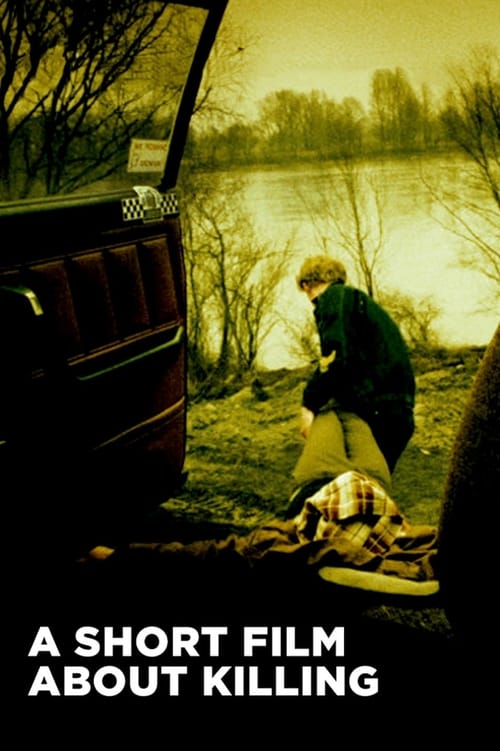
A Short Film About Killing
1988 · Krzysztof Kieślowski
For when you want cinema as moral confrontation — a film to chew on for days, not comfort viewing. Reach for it when you're ready to be challenged and have the conversation it demands afterward.
What it's about
In a gray, grimy late-1980s Warsaw, three strangers' paths converge: a rootless young drifter wandering the city, a taxi driver going about his rounds, and an idealistic lawyer on the day of his bar exam. The drifter commits a brutal, apparently motiveless murder — and the film then follows, with the same unblinking attention, the machinery of law and punishment that answers it.
The experience
Punishing, deliberate, and impossible to shake — Kieślowski refuses to look away from violence or to make it exciting, and the film's cold moral clarity lands like a physical weight. You come out shaken, arguing with yourself.
Performances
Mirosław Baka makes the young killer horribly human without ever excusing him, and Krzysztof Globisz gives the lawyer a wounded decency that becomes the film's conscience.
The craft
Sławomir Idziak shot it through sickly green filters and heavy vignetting, turning Warsaw into a jaundiced, decaying world where darkness literally creeps in at the edges of the frame. The two acts of killing are staged with agonizing, unglamorous duration — craft used to make violence unbearable rather than thrilling.
Why it matters
Expanded from the fifth episode of Kieślowski's Dekalog, it won at Cannes, announced him to the world, and is credited with fueling the debate that preceded Poland's abolition of the death penalty — few films have so directly entered a moral and political argument.
Snapshot
A Short Film About Killing (Krótki film o zabijaniu) is Krzysztof Kieślowski's austere, physically punishing argument against capital punishment: a film built on a deliberate symmetry between two killings — a young drifter's protracted, motiveless murder of a taxi driver, and the state's methodical execution of that drifter by hanging. Shot through Sławomir Idziak's jaundiced green filters and heavy vignetting in a grimy, late-communist Warsaw, it stands both on its own and as the theatrical expansion of Dekalog: Five, the fifth part of Kieślowski's ten-film television cycle on the commandments — here, "Thou shalt not kill." The film's power lies in refusing to console: it renders both deaths as brutal, clumsy, and morally identical, and in doing so mounts one of cinema's most sustained indictments of judicial killing. It won the Jury Prize at the 1988 Cannes Film Festival and the inaugural European Film Award for Best Film, and is widely regarded as a turning point in Kieślowski's career and in the international recognition of Polish cinema in the late 1980s.
Industry & production
The film originates in Telewizja Polska's commission of Dekalog, a ten-part series loosely organized around the Ten Commandments, produced through the Tor film unit (Zespół Filmowy "Tor") with which Kieślowski was long associated. Recognizing exceptional material in two of the episodes, the production expanded Dekalog: Five and Dekalog: Six into standalone theatrical features — A Short Film About Killing and A Short Film About Love — shot alongside and around the television versions. This dual-track production was a pragmatic response to the constrained economics of Polish state cinema in the 1980s: financing that could support a television series could, with careful planning, also yield feature-length works for international distribution and festival exposure.
The theatrical version runs roughly 84 minutes, somewhat longer than its television counterpart, and treats the murder and the execution at greater length and with fewer concessions than a broadcast cut would allow. The production unfolded under the material conditions of a Poland still inside the Soviet bloc — the film predates the 1989 collapse of communist rule — and that context is legible in nearly every frame: the drab apartment blocks, the shabby institutional interiors, the sense of a society worn down. Made cheaply by Western standards, the film converted its poverty of means into an aesthetic of exhaustion and decay.
Technology
The film was shot on 35mm color stock using conventional late-1980s Polish production equipment, but its distinctive look derives less from any technological novelty than from an aggressive, almost sculptural use of optical filtration. Idziak deployed a large number of handmade and graduated filters — greens and yellows predominating — often masking or darkening the edges of the frame so that the image seems to rot inward from its corners. This is a photochemical, in-camera strategy rather than a laboratory or post-production one: the "poisoned" palette is largely achieved at the moment of exposure. Where the record on precise technical counts is thin, it is safest to say only that filtration was used extensively and expressively rather than to cite exact figures. The result is a world that looks physically toxic, as though the light itself were spoiled.
Technique
Cinematography
Idziak's photography is the film's signature and among the most celebrated in Kieślowski's body of work. The green-tinged, sickly palette bleeds the city of any warmth; skies are curdled, interiors are stained. The vignetting — darkening or smearing the periphery of the frame — produces a tunnel-vision effect that isolates faces and gestures while suggesting a world contracting toward a single point of violence. The camera favors oblique angles, obstructed sightlines, and compositions in which characters are partly hidden or pushed to the margins. During the murder, the framing turns claustrophobic and unstable; in the execution sequence, it becomes coldly procedural. Idziak's images do not editorialize through movement so much as through poisoned color and blocked vision — a moral atmosphere rendered optically.
Editing
Ewa Smal's cutting is defined above all by its patience during the two killings. The murder of the taxi driver is notorious for its length and its refusal of elision: rather than cutting away at the conventional dramatic beats, the film holds on the ugliness and duration of the act, forcing the viewer to register how difficult, prolonged, and physically graceless killing actually is. The execution is treated with a parallel deliberateness — the bureaucratic choreography of the gallows unfolds in near-real time. This durational strategy is the film's central formal argument: by matching the length and physical detail of the two deaths, the editing insists on their equivalence. Elsewhere, the cutting is restrained and observational, letting scenes breathe in the grim Warsaw light.
Mise-en-scène / staging
The film's world is built from institutional and urban decay: peeling walls, functional courtrooms, a taxi rank, a public toilet, the cramped geometry of the city. The three principal figures — the drifter Jacek, the taxi driver Waldemar, and the young lawyer Piotr — are introduced in parallel, their paths converging with a sense of grim inevitability. Kieślowski stages the early sections with a mosaic of small, seemingly incidental cruelties and indifferences (a dead animal, casual meanness, indifferent passersby) that accrete into a portrait of a society coarsened at every level. The staging refuses to grant the murder a motive or a catharsis: violence arrives without the psychological scaffolding conventional drama would supply.
Sound
Zbigniew Preisner's score is sparing and grave, used in isolated, weighted interventions rather than as continuous underscore. Much of the film rests instead on ambient sound — traffic, institutional hum, the labored physical noise of the murder — which heightens the sense of unmediated reality during the violence. Preisner's musical restraint means that when the score does enter, it carries considerable emotional and elegiac charge, particularly around the film's meditations on mortality and judgment. The soundscape, like the image, is stripped of comfort.
Performance
Mirosław Baka plays Jacek, the young killer, with a sullen, closed-off blankness that resists both sympathy and easy condemnation; the performance withholds the interiority that would let an audience "understand" the crime, and only in the film's later stretches — as execution approaches — does a frightened, ordinary humanity surface. Jan Tesarz's taxi driver, Waldemar, is drawn as neither innocent nor villain but as a coarse, ordinary man, a choice that pointedly denies the murder any moral alibi. Krzysztof Globisz plays Piotr, the idealistic young defense lawyer whose conscience becomes the film's moral center; his anguish over his failure to save his client channels the film's thesis. The performances are uniformly unshowy, calibrated to the film's refusal of melodrama.
Narrative & dramatic mode
The film operates in a mode of moral realism edged with parable. Its structure is built on parallelism and convergence: three lives are tracked separately before they intersect at the murder, after which the narrative narrows to the machinery of trial, sentence, and execution. Kieślowski deliberately strips the crime of motive and the drama of suspense — we know the murder will happen, we know the sentence will be death — so that the film's tension is displaced from what happens onto how it is done and what it means. The lawyer's arc supplies the explicit ethical frame: his examination and his despair bracket the story with the question of whether the state's killing differs in kind from the murderer's. The dramatic engine is not plot but juxtaposition — the demand that the viewer hold two killings side by side and judge them by the same measure.
Genre & cycle
Nominally a crime drama, the film is better understood as a moral tragedy or philosophical polemic in narrative form. It belongs to the tradition of the anti-capital-punishment film, but it withholds the humanist warmth that usually softens such works: there is no sympathetic, wrongly-condemned innocent here, only a repellent crime answered by a repellent punishment. As part of the Dekalog cycle, it also participates in Kieślowski's larger project of secular moral inquiry — episodes that take the commandments not as religious law but as occasions to examine conscience, chance, and responsibility in ordinary modern lives. Within that cycle it is the darkest and most polemical entry, the one most directly aimed at a social institution.
Authorship & method
The film is a product of Kieślowski's mature method and of several sustained collaborations. The screenplay was written with Krzysztof Piesiewicz, a practicing lawyer whose legal knowledge and moral preoccupations shaped the entire Dekalog project; the courtroom and execution material bears the imprint of that professional perspective. Kieślowski, who had come out of Polish documentary before turning to fiction, brought an observational rigor and a distrust of easy sentiment that pervade the film's refusal to editorialize through motive or music.
The cinematographer Sławomir Idziak is arguably co-author of the film's meaning: the poisoned green light and inward-rotting frame are inseparable from its ethical vision. Composer Zbigniew Preisner — a defining voice of late Kieślowski, through Dekalog, The Double Life of Véronique, and the Three Colors trilogy — supplies the grave, sparing score. Ewa Smal edited. The collaboration of director, writer, cinematographer, and composer here constitutes a coherent authorial signature: austere, morally serious, formally controlled, and committed to making abstraction physically felt.
Movement / national cinema
The film belongs to Polish cinema in its late-communist twilight, and to the specific institutional world of the Tor unit and Telewizja Polska. Kieślowski emerged from the documentary tradition and the ferment associated with the "cinema of moral anxiety" (kino moralnego niepokoju) of 1970s Poland — a movement of socially critical fiction films probing the compromises of life under the system. By 1988 Kieślowski had moved past overt political critique toward a more universal, metaphysical register, but the film retains that movement's ethical seriousness and its unblinking attention to institutional grayness. It is among the works that carried Polish cinema to renewed international prominence at the very end of the communist era, on the eve of 1989.
Era / period
Made and set in 1988, the film is a document of the last full year of communist Poland. The physical texture — the worn apartment blocks, the shabby offices, the general atmosphere of scarcity and fatigue — locates it precisely in that moment. The film also coincided with a live national debate over capital punishment: the death penalty remained on the books in Poland, and the late 1980s saw a moratorium take hold. Poland would go on to abolish the death penalty in the following decade. A Short Film About Killing is frequently cited as a contribution to that debate; while direct causal claims about legislation should be made cautiously, the film's engagement with the death penalty was contemporaneous with, and widely understood to bear upon, Poland's turn away from execution.
Themes
The central theme is the moral equivalence of murder and judicial execution — the film's structural insistence that the state, in killing deliberately and procedurally, does the same thing the murderer does, and perhaps does it more coldly. Around this core cluster several others: the impossibility of understanding or fully redeeming an act of violence; the failure of institutions — law, family, society — to prevent or answer cruelty; the physical, un-cinematic ugliness of killing, stripped of the choreography that popular film lends it. The lawyer's conscience embodies the theme of individual moral responsibility within a system that diffuses it. Underlying all of this is a bleak vision of a coarsened social world in which small cruelties and large ones share a continuum. The film is not consoling and offers no redemption; its ethics are argued through refusal.
Reception, canon & influence
Critically, the film was a landmark. It won the Jury Prize at the 1988 Cannes Film Festival and was named Best Film at the first European Film Awards later that year, results that announced Kieślowski to the international art-cinema audience and helped catalyze the wider acclaim that Dekalog and his subsequent French-language films would receive. It is routinely counted among the essential achievements of Polish cinema and of the anti-capital-punishment film, and among the peaks of the Dekalog project as a whole.
Its influences run backward to the socially engaged Polish documentary and fiction traditions from which Kieślowski came, to the "cinema of moral anxiety," and, in its metaphysical austerity, to the broader European art-film lineage of directors preoccupied with conscience and mortality. Its collaboration with Idziak and Preisner set patterns that would define Kieślowski's celebrated later work.
Looking forward, the film — together with A Short Film About Love and Dekalog — helped establish Kieślowski internationally as a major moral filmmaker and paved the way for The Double Life of Véronique and the Three Colors trilogy. Its uncompromising treatment of violence and punishment, and its use of the same durational and juxtapositional strategy to equate crime and penalty, have made it a touchstone in debates about how cinema should represent killing. It endures as a work invoked whenever film confronts the death penalty — an argument made not in words but in the unbearable, matched length of two deaths.
A Deleuzian reading
The light is wrong before anyone does anything.
The full Deleuzian reading of A Short Film About Killing →
Reception
It stormed Cannes in 1988 — Jury Prize, FIPRESCI — and won the very first European Film Award ever handed out; today it's held up as one of Kieślowski's peaks and maybe the most devastating anti-death-penalty film ever made.
How A Short Film About Killing was received, from release to now →
How to watch A Short Film About Killing: what to notice on a first viewing
- Notice the sickly green tint over every scene. Idziak shoots through jaundiced green filters and heavy vignetting, draining the city of warmth and darkening the frame's edges throughout. The verdict is built into the light itself, before a single line of dialogue argues anything.
- Watch how long the murder scene runs without a cut away. Smal refuses to cut at the moments a film normally would, holding on the physical difficulty and clumsiness of the act rather than smoothing past it. The duration itself forces you to register how hard and graceless killing a person actually is.
- Watch for small cruelties in the early scenes. A dead animal, casual meanness, indifferent passersby accumulate before the murder, without any of them functioning as a plot clue. These moments establish a coarsened world rather than setting up a mystery to solve.
- Notice the peeling walls and cramped institutional interiors. Courtrooms, a taxi rank, a public toilet, and worn apartment blocks build a late-communist Warsaw of visible decay throughout the film. The decayed setting makes the coldness the film describes feel material, not just implied.
- Watch Jacek's face for signs of a motive. Baka plays the young killer closed off and sullen, withholding any interiority that would let you understand why he acts as he does. The blankness refuses the comfort of an explanation, which is the point the film is making about violence.
The whole guide to watching A Short Film About Killing, with the keys for a rewatch →
Influences: the films it descends from and the films it influenced
- L'Argent (1983) — Kieślowski borrows Bresson's chain of transactional moral causation ending in an off-hand, de-dramatized murder, plus the affectless 'model' performance that withholds all interior motive.
- In Cold Blood (1967) — Conrad Hall's documentary-cold rendering of both the killing and the gallows — famously the rain streaking the condemned man's face like tears — is the precedent for equating crime and execution as two matched, unbearable deaths.
- El Verdugo (The Executioner) (1963) — Stages capital punishment as a bureaucratic machine that drags an ordinary man to the garrote, the anti-death-penalty argument made through the physical mechanics of the procedure rather than through speeches.
- The Passion of Joan of Arc (1928) — Establishes the trial-to-execution structure carried by austere close framing of a suffering face, spiritual judgment tracked without expository dialogue.
- Winter Light (1963) — Model for the metaphysical austerity Kieślowski inherits — conscience and mortality examined in near-silence, refusing musical consolation, the sparing-score ethic Preisner would formalize.
- Ashes and Diamonds (1958) — The Polish School precedent Kieślowski grew from: killing rendered with expressive chiaroscuro and institutional weight, violence charged with moral and national reckoning.
- Camouflage (1977) — A founding text of the cinema of moral anxiety — institutional life dissected as a moral trap, the observational scrutiny of conscience under late-communist bureaucracy that Kieślowski shares.
- A Man Escaped (1956) — Prototype for durational realism inside institutional confinement — process shown in matched, patient real-time so that mechanism itself carries suspense and meaning.
- The Butcher (1970) — Extends Chabrol's proof that murder can be filmed as tragedy and social indictment, not shock — a cold, jaundiced cinematographic tone treating the killer as a socially produced, still-human figure.
- The Double Life of Véronique (1991) — Sławomir Idziak carries forward his saturated green-gold filtration, vignetting and obstructed foreground framing as an authorial cinematographic signature born on this film.
- Three Colors: Blue (1993) — Extends the Preisner partnership into score-as-structure and the color-filtered image as moral atmosphere, the durational-immersive style matured for the French trilogy.
- Gattaca (1997) — DP Idziak transplants the poisoned green-amber filtration and inward-rotting vignette wholesale into science fiction — a direct transfer of the cinematographer's optical method.
- Dead Man Walking (1995) — Builds its anti-capital-punishment argument by forcing the viewer to witness the execution in patient near-real time, the duration-as-indictment strategy Kieślowski pioneered.
- Elephant (2003) — Withholds all motive for its killings and lets long, drifting takes accumulate dread — the suspense-refusal and de-editorialized violence extended into contemporary form.
- 4 Months, 3 Weeks and 2 Days (2007) — Sustained long takes inside decaying communist-era institutions produce moral tragedy through observed process, inheriting the durational, unsentimental gaze under state authority.
- Benny's Video (1992) — Directly interrogates the ethics of filming a killing, adopting the clinical refusal to supply feeling or motive so that the act's representation itself becomes the moral subject.
- Leviathan (2014) — Renders institutional decay and the crushing of the individual by the state as austere moral tragedy, the muted palette and withheld interiority descending from Kieślowski's ethical frame.
- Ida (2013) — Kieślowski's ascetic moral seriousness and filtered, desaturated Polish image — withholding judgment while staging questions of complicity and conscience — is the immediate domestic forebear.
- Graduation (2016) — Models the morally-probing study of compromised lives in a corrupt state, including the desaturated, filtered muted palette (Idziak's green-tinged framing) that Graduation's restrained color scheme echoes.
- Corpus Christi (2019) — Kieślowski's model of building a whole film around moral judgment of a condemnable act — filmed through cool, filtered desaturation and confrontational close-ups — is the ethical and visual template Komasa inherits for staging Daniel's contested standing.
- Revanche (2008) — Redirects a genre murder into an austere ethical dossier through desaturated compositions and a refusal of the thriller's cathartic beats — the same 'use genre to indict genre' method.
- A Short Film About Love (1988) — Twin Dekalog expansion shot the same season with Piesiewicz, applying the identical austere-observational method and withheld interiority to obsession instead of killing.
- Dekalog (1989) — The parent cycle sharing the Piesiewicz screenwriting collaboration, the interlocking-lives housing-block staging, and the refusal to editorialize through motive or music.
- Decalogue I (1989) — Expanded from Decalogue V within the same cycle, Sławomir Idziak's green and amber filters and vignetting push the desaturated-cold palette toward an even more aggressively jaundiced moral light.
Similar films
- A Short Film About Love (1988) — influence & lineage · same viewing thread
- 4 Months, 3 Weeks and 2 Days (2007) — influence & lineage · same viewing thread
- Ashes and Diamonds (1958) — influence & lineage
- The Double Life of Véronique (1991) — influence & lineage
- L'Argent (1983) — influence & lineage
- Interrogation (1989) — same viewing thread
- Camera Buff (1979) — same viewing thread
- The Passion of Joan of Arc (1928) — influence & lineage · often watched together
All the films related to A Short Film About Killing →
Watch it with: curated runs of related films
- Behind the Iron Curtain — A run of Eastern Bloc films where one ordinary person — a hobbyist filmmaker, a cabaret singer, a drifter, a student — is quietly ground down by the machinery of the communist state.