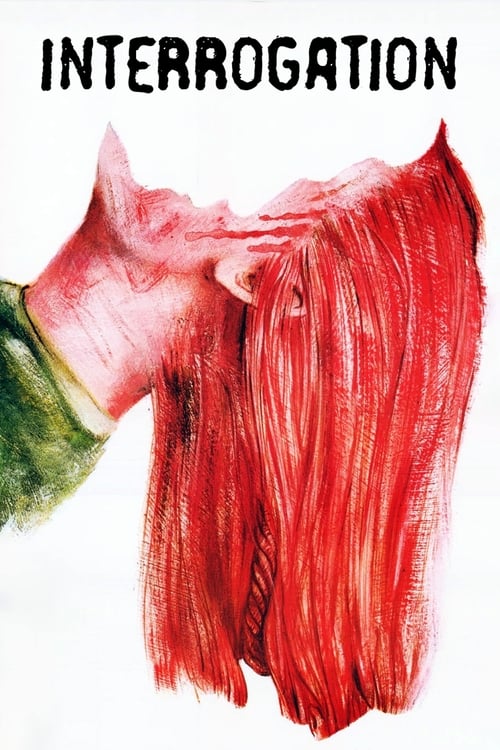
Interrogation
1989 · Ryszard Bugajski
For when you want a film that costs something and pays it back — a story of resistance to watch when you're ready to be challenged rather than comforted. Not a casual pick; a galvanizing one.
What it's about
In early-1950s Stalinist Poland, a cabaret singer goes out drinking with friends and wakes up in a political prison, accused of nothing she can understand. The security service wants her to sign a false confession implicating a man she barely knew; the film follows her years inside as interrogation, humiliation and isolation try to break a woman who refuses to lie.
The experience
Harrowing and unrelenting — a claustrophobic endurance test that puts you in the cell with her — yet what stays with you is defiance, even flashes of reckless humor, not just suffering. It's heavy, honest, and genuinely hard to shake.
Performances
Krystyna Janda is volcanic — funny, raw, and unbreakable by turns — in a role that runs from cabaret glitter to physical ruin. The performance won her the Best Actress prize at Cannes and remains one of the most celebrated in Polish cinema.
The craft
Made inside the system it indicts, the film strips the political prison drama down to faces, cells and interrogation rooms, and finds its power in duration — how long a will can hold out. Its unblinking directness is the craft: no rescue fantasy, no softening, just a body and a state machine in a locked room.
Why it matters
Completed in 1982, banned immediately, and circulated underground until the regime's collapse finally allowed its 1989 release, it became the most famous of Poland's suppressed 'shelf films' and a symbol of cinema outlasting censorship.
Snapshot
Interrogation (Polish: Przesłuchanie) is one of the most notorious "shelf films" of the Polish People's Republic — a picture completed in 1982 and immediately locked away by the communist authorities, which did not reach public screens until the regime that suppressed it had begun to collapse at the end of 1989. Directed by Ryszard Bugajski for Andrzej Wajda's celebrated production unit, it follows Antonina "Tonia" Dziwisz, a second-rate cabaret singer who, after a night of drinking, wakes to find herself imprisoned as a political enemy in early-1950s Stalinist Poland. She has done nothing; the security apparatus wants her to sign testimony implicating a man she barely knew, and the film becomes an endurance test of a body and a will against a machine designed to break both. Krystyna Janda's performance in the role won the Best Actress prize at the 1990 Cannes Film Festival. The film's dual identity — as artwork and as political event — is inseparable from its history: banned, smuggled on videocassette through the 1980s underground, and finally released as a document of crimes that had suddenly become speakable.
Industry & production
Interrogation was produced within Zespół Filmowy "X" ("Film Unit X"), the production collective led by Andrzej Wajda that had, only a year or two earlier, delivered Man of Iron (1981). Under the Polish state-socialist model, filmmaking was organized into semi-autonomous units operating within a nationalized industry; Unit X had become the most politically charged of these, closely aligned with the Solidarity moment. That alignment sealed the film's fate. Shooting took place in 1982, in the immediate aftermath of the declaration of martial law on 13 December 1981 — a crackdown that shattered Solidarity's legal existence and hardened cultural policy. A film dramatizing the torture of an innocent woman by the Stalinist secret police was, in that climate, intolerable to the authorities, and the completed picture was suppressed rather than released. Wajda's Unit X was itself dissolved by the authorities in 1983, an institutional casualty of the same reaction.
The suppression did not end the film's life; it transformed it. Przesłuchanie became one of the most famous of the półkowniki — the "shelved" films consigned to storage — and, more unusually, circulated clandestinely on pirated VHS cassettes throughout the 1980s. This underground video distribution gave it a semi-legendary status before it had ever been legally shown, so that its eventual official premiere at the very end of 1989 functioned less as an introduction than as a public vindication. Bugajski himself, unable to work under the conditions the ban implied, emigrated to Canada in the mid-1980s. The film's post-release honors — Janda's Cannes award in 1990, recognition at the Polish festival circuit — arrived for a work that was by then nearly a decade old, a temporal dislocation that is central to how it must be read.
Technology
Technologically, Interrogation is a conventionally photochemical production of its moment: 35mm color film, studio and location shooting, optical post-production, the standard apparatus of the Polish state industry circa 1982. There is nothing avant-garde in its tools, and it would mislead to claim otherwise. The genuinely significant technological dimension of the film lies not in its manufacture but in its distribution: it is a landmark case of the videocassette functioning as a samizdat medium. The spread of home VCRs in 1980s Poland created a channel the state could not fully police, and Przesłuchanie is among the clearest examples of cinema escaping censorship through consumer video technology. That fact belongs as much to media history as to film history, and it is the aspect of the film's "technology" that most repays attention.
Technique
Cinematography
The photography — the cinematography is generally credited to Jacek Petrycki, a cameraman closely associated with the documentary and fiction work of Krzysztof Kieślowski and Agnieszka Holland — is built for confinement and duress. The film's visual world is overwhelmingly interior: cells, corridors, interrogation rooms, the closed institutional spaces of a prison. The palette is drained and grayed, lit to feel underground and airless. The camera favors proximity to Janda's face and body, so that the audience is held at the same claustrophobic distance from escape that the character is. Where the film opens out — the early cabaret scenes, flashes of the world before arrest — the contrast underscores how completely that world has been amputated. This is a cinematography of pressure rather than spectacle, its expressive means the tight frame, the hard institutional light, and the refusal of relieving space.
Editing
The editing serves duration and attrition. Interrogation is structured to make the audience feel the passage of years — the wearing-down of a person across an open-ended imprisonment — and its cutting tends to hold on ordeal rather than accelerate past it. The film does not spare the viewer the length of a beating or the stalemate of a confrontation; its rhythm is the rhythm of endurance. The specific editorial credits and cutting choices are less thoroughly documented in the accessible English-language record than the film's political history, and I will not invent them, but the governing principle is legible on screen: time is the film's instrument of cruelty, and the montage administers it.
Mise-en-scène / staging
The staging is dominated by the interrogation room and the cell, and by the choreography of bodies within institutional power. Bugajski constructs the prison as a total environment, its authority expressed through doors, thresholds, guards, and the ritualized procedures of questioning. The most memorable staging is corporeal: the humiliations and tortures — including a notorious sequence in which Tonia is subjected to near-drowning — are staged with an unblinking physicality that was precisely what the censors could not permit. Against this, the film sets the intimate, almost domestic spaces of coercion, where interrogators sit close and speak softly, and where the line between torturer and confessor becomes disturbingly porous. The mise-en-scène insists on the human scale of the machinery: this is not abstract terror but rooms, hands, and faces.
Sound
Sound in Interrogation works along two axes. The first is the diegetic music of Tonia's world — the cabaret songs of her profession, which return as fragments of an identity the prison is trying to erase, and which lend the film moments of bitter, ironic lyricism against the surrounding brutality. The second is the acoustic texture of the institution: the slam of cell doors, the echo of corridors, the pressured quiet of the interrogation room where a raised voice becomes an event. I do not have a reliable attribution for a dedicated composer to set down here, and rather than manufacture one I will note that the film's most striking musical presence is the source-music of the cabaret stage, sung within the world of the story.
Performance
Performance is where Interrogation achieves greatness, and the achievement is overwhelmingly Krystyna Janda's. Already a defining face of Polish cinema through Wajda's Man of Marble (1977) and Man of Iron (1981), Janda gives here a performance of total physical and emotional commitment: Tonia is by turns defiant, terrified, coarse, tender, and finally unbreakable, and Janda charts the erosion and hardening of the character across years of captivity without ever letting her collapse into pure victimhood. It is a performance about the refusal to sign — the stubborn, almost animal insistence on one's own innocence — and Janda makes that refusal thrilling. The Cannes Best Actress prize in 1990 recognized what audiences had already sensed on smuggled tapes. The supporting work sustains her: Adam Ferency as an interrogating officer whose feelings toward his prisoner become genuinely, dangerously complicated, and Janusz Gajos among the security men, giving the apparatus individual human faces rather than a uniform mask.
Narrative & dramatic mode
The narrative mode is that of the ordeal or captivity drama, compressed into a nearly unremitting present tense of imprisonment. The inciting event is deliberately arbitrary — Tonia is arrested for no reason she can identify, the paranoid logic of the Stalinist state requiring no coherent cause — and the drama that follows is not a mystery to be solved but a pressure to be withstood. The central dramatic engine is the confession: the state needs Tonia's signature on a false testimony, and her refusal to provide it is the spine of the film. This turns the picture into a moral endurance test structured around a single sustained "no." Around that spine, Bugajski develops the far more unsettling material of intimacy under coercion — the way sustained proximity between captive and captor breeds a relationship that is neither simple hatred nor Stockholm-syndrome surrender, but something the film refuses to resolve cleanly. The mode is realist, physical, and unsparing, with the flashback glimpses of the pre-arrest world serving mainly to sharpen the sense of a life foreclosed.
Genre & cycle
Interrogation sits at the intersection of the prison drama, the political thriller, and the historical reckoning film. Within Polish cinema it belongs to the broad orbit of the kino moralnego niepokoju — the "Cinema of Moral Anxiety" of the late 1970s and early 1980s associated with Wajda, Kieślowski, Zanussi, and Holland — and it shares that cycle's confrontation of the individual conscience with state power, as well as its central star in Janda. But it pushes past the cycle's characteristic mode of contemporary moral inquiry into direct historical indictment: where the moral-anxiety films typically dramatized compromise and complicity in the socialist present, Interrogation returns to the Stalinist past to depict outright torture, and does so with a bluntness the earlier films tended to avoid. It thus stands both inside that cycle and at its furthest, most transgressive edge — which is exactly why it could not be shown when it was made.
Authorship & method
Ryszard Bugajski (1943–2019) directed Interrogation as a young filmmaker within Wajda's protective institutional orbit, and the film is his defining work — the picture whose suppression drove him into exile in Canada, where he worked in television before returning to Poland after the transition to make later historical films such as General Nil (2009). His method here is one of confrontation: an insistence on showing what the system did, at the level of the body, without the mediating irony or allegory that let other films slip past the censor. That directness is the film's authorial signature. Among his key collaborators, cinematographer Jacek Petrycki — a figure central to the Polish documentary tradition and to the work of Kieślowski and Holland — gives the film its pressured, institutional look. The screenplay is Bugajski's own (developed within Unit X's collaborative culture; where co-writing credits are concerned the accessible record is thinner than for the film's political history, and I flag that rather than overstate it). The decisive collaboration, though, is with Krystyna Janda, whose performance is so total that authorship of the film feels genuinely shared between director and star.
Movement / national cinema
The film is inseparable from Polish national cinema and from the specific institutional world of the state-socialist industry — the production units, the censorship regime, and the political fault lines of the Solidarity era. It emerges from the late phase of the Cinema of Moral Anxiety and from Wajda's Unit X, the most politically committed corner of that industry. More than most films, Interrogation also belongs to a distinctly Polish category with no exact Western equivalent: the półkownik, the shelved film, whose meaning is constituted partly by its suppression. Its history — banned, circulated on underground video, released at the moment of regime change — makes it a near-perfect index of Polish cinema's entanglement with the Polish state, and of the transition of 1989 as experienced by the film industry itself.
Era / period
Two eras press on the film at once. Its setting is the Stalinist period of the early 1950s, the years of the security apparatus at its most arbitrary and violent, and it reconstructs that world with deliberate specificity — the cabaret milieu, the prison, the machinery of forced confession. But its moment is doubled and split: made in 1982 under martial law, released in 1989 as communism fell. This gap is the film's defining condition. Almost no other major film so cleanly embodies the difference between when a work was made and when it could be seen. To watch Interrogation is to watch a film addressed to one historical moment (the crackdown of the early 1980s) that finally spoke in another (the collapse), and whose subject (the terror of the 1950s) was chosen to illuminate both.
Themes
The film's central theme is the integrity of the individual conscience against a state that demands the lie — the refusal to sign a false confession elevated into an act of existential resistance. Around it cluster the themes of arbitrary power and the paranoid logic of totalitarian justice, in which guilt is assigned before any crime and truth is whatever the apparatus requires. The film is preoccupied with the body as the site of politics: coercion here is physical, and dignity is defended in the flesh. Its most morally complex theme is the intimacy between victim and interrogator — the way that total power over another person distorts, but does not extinguish, human feeling on both sides, so that the relationship between Tonia and her captors becomes genuinely, uncomfortably ambiguous. Underlying all of it is a theme of memory and testimony: the film is itself an act of bearing witness to a history the state wished to keep unspeakable.
Reception, canon & influence
Because of its suppression, Interrogation's reception has an unusual shape. Before any official release it had already acquired an underground reputation through pirated videocassettes, so that its legal premiere at the close of 1989 confirmed rather than created its stature. The single most consequential recognition came at Cannes in 1990, where Krystyna Janda won the Best Actress award — a prize that carried the film's, and Poland's, reckoning with Stalinism onto the international stage. Domestically it has been received as a landmark, both as artwork and as historical document, and it endures as a canonical account of the terror of the early communist years and as the emblematic case of the Polish "shelf film."
Its influences run backward into the Cinema of Moral Anxiety and Wajda's tradition of politically engaged Polish filmmaking, and into the broader lineage of the prison and interrogation drama; Janda's presence explicitly links it to the Wajda films that made her a national figure. Forward, its legacy is twofold. As a career event it launched the international recognition of Bugajski's work and cemented Janda among the great screen actresses of her generation. As a cultural artifact it became a reference point for the post-1989 Polish cinema of historical reckoning — the wave of films confronting the crimes of the communist past — and a permanent case study, in film and media history alike, of how a work outlives its censorship. The record on precise, quantifiable measures of its reception (contemporary box office, exact festival tallies beyond the Cannes award) is thin in the accessible English-language literature, and I have not invented figures to fill it; but on the questions that matter — its artistic achievement and its historical weight — the consensus is unambiguous.
Reception
Shot in 1982 and immediately banned by Poland's martial-law censors, it spent seven years as the country's most notorious 'shelf film' — circulating on bootleg VHS — before finally premiering in 1989 as communism collapsed, arriving already a legend.
How Interrogation was received, from release to now →
Influences: the films it descends from and the films it influenced
- The Passion of Joan of Arc (1928) — Establishes the interrogation as a spiritual endurance test held almost entirely on a woman's face, and the model of total-commitment female performance under coercion refusing to recant that Janda's Tonia inherits.
- Rome, Open City (1945) — Stages Gestapo interrogation and torture in rooms adjacent to ordinary life with documentary immediacy, founding the treatment of the body as a political site broken by a police state.
- The Trial of Joan of Arc (1962) — Builds a whole film from transcript-based interrogation exchanges in drained, austere framing, dramatizing refusal-to-confess as procedural repetition rather than melodrama.
- The Battle of Algiers (1966) — Films systematic torture as bureaucratic method in newsreel-gray, pairing the extraction apparatus with the prisoner's refusal to give names.
- The Confession (1970) — Dramatizes the exact Stalinist show-trial machinery Interrogation depicts — confession extracted through sleep deprivation and physical collapse — as a durational procedural ordeal of the body.
- Man of Marble (1977) — Made Janda a national figure and codified the Cinema of Moral Anxiety's investigative structure within Wajda's Unit X orbit — the institutional culture that produced and shielded Bugajski.
- Camouflage (1977) — Sets the Moral Anxiety template of the chamber confrontation, individual conscience cornered by institutional power through dialogue in enclosed interior space.
- Death and the Maiden (1994) — A single-location captivity two-hander in which a torture survivor reverses the interrogation, extending the study of intimacy under coercion and the body's disputed testimony.
- The Lives of Others (2006) — Opens by teaching interrogation as an instructable technique and builds the conscience-versus-state drama out of the communist surveillance apparatus Interrogation anatomized.
- Katyń (2007) — Belongs to the post-1989 Polish cinema of historical reckoning confronting Stalinist crimes — the wave Interrogation seeded by naming the terror of the early communist years.
- Ida (2013) — Reckons with the Stalinist 1950s through austere, drained monochrome and institutional stillness, carrying forward Interrogation's restrained visual confrontation with that past.
- Cold War (2018) — Uses diegetic folk and cabaret performance as ironic counterpoint to Stalinist repression, echoing Interrogation's diegetic cabaret songs set against the prison's coercion.
- Camera Buff (1979) — Shares cinematographer Jacek Petrycki, whose documentary-pressured, institutional look — flat light and drab interiors — gives both films their surveillance-state texture.
- Man of Iron (1981) — Extends Janda's politically engaged screen persona into Solidarity-era engaged filmmaking, the immediate context against which her Interrogation role reads as continuation.
- Blind Chance (1981) — Fellow Polish 'shelf film' suppressed under martial law and released only after 1989, sharing Interrogation's condition of censored production and delayed reception.
- 4 Months, 3 Weeks and 2 Days (2007) — Renders a communist-era ordeal in drained palette and near-real-time duration, sustaining dread through long takes with the body as the site where the police state acts.
Similar films
- 4 Months, 3 Weeks and 2 Days (2007) — influence & lineage · same viewing thread · often watched together
- Ida (2013) — influence & lineage
- Cold War (2018) — influence & lineage
- Camera Buff (1979) — influence & lineage · same viewing thread
- A Short Film About Killing (1988) — same viewing thread
- Corpus Christi (2019) — often watched together
- Possession (1981) — shared sensibility
- It Was Just an Accident (2025) — shared sensibility
All the films related to Interrogation →
Watch it with: curated runs of related films
- Behind the Iron Curtain — A run of Eastern Bloc films where one ordinary person — a hobbyist filmmaker, a cabaret singer, a drifter, a student — is quietly ground down by the machinery of the communist state.