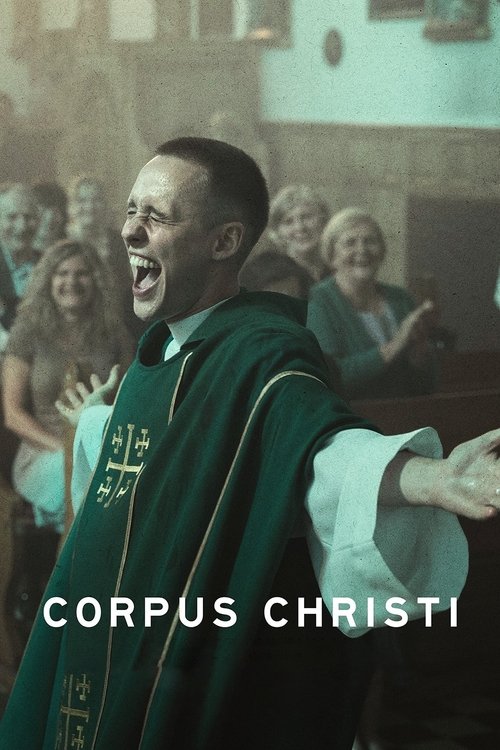
Corpus Christi
2019 · Jan Komasa
When you want a film to chew on for days — a serious, absorbing drama for a night you're up for big questions about forgiveness and second chances. Demanding company, richly rewarding.
What it's about
Daniel, twenty years old and fresh out of a juvenile detention center, has found genuine faith behind bars — but his record bars him from seminary. Sent to work at a small-town sawmill, he impulsively passes himself off as a priest and, through a misunderstanding, ends up running the local parish. The town he's now ministering to is still raw with grief from a road accident that killed several of its young people, and his unorthodox, electric way of preaching starts to reach them in ways the institution never did.
The experience
Tense in the way great impostor stories are — you're braced for exposure in every scene — but what lingers is how sincere it is about faith, guilt, and whether a broken person can do holy work. It's gripping, morally knotty, and quietly devastating.
Performances
Bartosz Bielenia is extraordinary as Daniel — gaunt, live-wire, with pale eyes that flip between street menace and genuine transcendence, sometimes within a single shot. It's the kind of performance that announces an actor.
The craft
Jan Komasa directs with cool, wintry precision, framing Daniel's improvised sermons so that you feel both the fraud and the grace at once. The screenplay, drawn from real Polish cases of fake priests, refuses easy verdicts on anyone. Austere to look at, but every composition is doing work.
Why it matters
An Oscar nominee for Best International Feature, it became one of the most acclaimed Polish films of its era and a touchstone for how national cinema can interrogate the church without cheap shots.
Snapshot
Corpus Christi (Polish: Boże Ciało, literally "God's Body," the Feast of Corpus Christi) is a Polish drama directed by Jan Komasa from a screenplay by Mateusz Pacewicz. It follows Daniel, a twenty-year-old released on parole from a juvenile detention center, who experiences a genuine spiritual awakening under the prison chaplain but is barred from seminary by his criminal record. Assigned to labor at a rural sawmill, he impulsively passes himself off as a priest, is mistaken for the parish's expected replacement cleric, and finds himself ministering to a small town still convulsed by grief over a fatal road accident that killed several of its young people the year before. The premise is not fanciful invention: Pacewicz drew on documented Polish cases in which impostors assumed clerical duties, and the film's power derives partly from how plausibly it renders an imposture that could, in the right vacuum of authority, actually hold. Premiering at the 2019 Venice Film Festival and later nominated for the Academy Award for Best International Feature Film, it became one of the most internationally visible Polish films of its decade and a signature vehicle for its lead, Bartosz Bielenia.
Industry & production
The film was produced primarily by Aurum Film, with Leszek Bodzak and Aneta Hickinbotham among the producing figures, and stands as a Poland–France co-production — a financing structure typical of ambitious European art films seeking festival reach beyond national borders. It benefited from the support of the Polish Film Institute (Polski Instytut Sztuki Filmowej), the state body that has underwritten much of the Polish cinema renaissance of the 2010s. Precise budget figures are not part of the well-established public record, and I will not invent them; the production reads as modest but resourced, shot on real rural and parish locations rather than sets.
Its festival trajectory was central to its industrial life. Corpus Christi played in the Giornate degli Autori (Venice Days) sidebar at Venice in 2019, where it was well received and collected recognition within that section. Poland selected it as its official submission for the Best International Feature Film Oscar; it advanced through the shortlist to a final nomination at the 92nd Academy Awards, competing in a field ultimately won by Parasite. That nomination materially expanded its distribution: it received arthouse theatrical release in numerous territories, with Film Movement handling North American distribution. The film was also a strong presence at the Polish Film Awards (Orły / Eagles), where it and its collaborators were among the leading nominees of their cycle. Beyond the numbers, the production's significance is reputational — it confirmed a generation of Polish talent, both in front of and behind the camera, as festival-circuit fixtures.
Technology
Documentation of the film's specific capture technology — camera systems, lenses, format — is not robustly established in the public record, and I will not fabricate technical specifications. What can be said with confidence is aesthetic rather than instrumental: the image has the fine-grained, low-light-capable, naturalistic look consistent with contemporary digital acquisition, and the film exploits available and practical light sources — candlelight and votive glow in the church, overcast rural exteriors, the fluorescent flatness of institutional interiors — rather than heavily stylized lighting. The palette runs cold and desaturated, favoring blues, grays, and the muted greens of the Polish countryside, punctuated by the warmer tones of liturgical settings. This restraint is a technological choice as much as an artistic one: the film's realism depends on an image that never announces its own construction.
Technique
Cinematography
The cinematography is credited to Piotr Sobociński Jr., who carries a resonant Polish lineage — the surname belongs to a distinguished family of Polish cinematographers, and the association with the tradition of Kieślowski's collaborators lends the film an inherited gravity. Sobociński's camera favors intimacy: close and mid-range framings that hold on Bielenia's face, handheld mobility that binds the viewer to Daniel's improvised, precarious performance, and a documentary-adjacent immediacy in the crowd and congregation scenes. The color grade — cool, overcast, institutional — refuses the golden warmth that religious subjects often invite, keeping grace visually austere. Crucial dramatic beats are staged in the church interior, where the play of candlelight against shadow does double duty as atmosphere and theme: the sacred rendered as something flickering, provisional, humanly lit.
Editing
Przemysław Chruścielewski is credited with the editing. The cutting sustains a controlled tension between two registers: the observational patience of the small-town scenes, which lets discomfort and communal silence accumulate, and the sharper, more kinetic rhythm of Daniel's inner volatility — his clubbing, his flashes of violence and appetite, the adrenaline of nearly being exposed. The film's suspense is fundamentally editorial: much of its grip comes from the timing of near-discovery, the withheld reaction shot, the cut that lets us wonder whether an impersonation has been seen through. The pacing tightens markedly toward the final act as the imposture's consequences converge.
Mise-en-scène / staging
The film's staging is organized around a central irony — a man in the costume of authority who does not possess its warrant — and mise-en-scène carries that irony everywhere. The cassock, the collar, the borrowed vestments function as both disguise and, paradoxically, as instruments of real ministry. Komasa stages the liturgy carefully: Daniel's improvised sermons and rites are blocked so that his uncertainty and his charisma are simultaneously legible. The rural parish, the sawmill, the roadside memorial to the accident victims, and the modest domestic spaces of the presbytery are rendered with unfussy specificity, grounding a near-parable in tangible Polish provincial life. The recurring visual motif of the roadside shrine and the photographs of the dead anchors the town's unresolved mourning as a physical presence.
Sound
The sound design leans toward realism and restraint. Liturgical sound — hymns, congregational responses, the acoustics of the church — is a structuring element, since so much of Daniel's performance is vocal and public. Against this, the film uses the abrasive textures of Daniel's other life: club music, engine noise, the ambient roughness of the sawmill and the detention environment. Regarding the musical score, the film uses music sparingly and to pointed effect rather than as continuous emotional underlining; I would rather flag that the composer credit is not something I can attribute with full certainty from memory than risk misattributing it. The most important "score," in any case, is diegetic and sacred — the sound of worship that Daniel both counterfeits and, in some register, means.
Performance
The film is built on Bartosz Bielenia's performance as Daniel, a breakout that drew wide international notice. Bielenia — with his pale, arresting stare — plays the role as a study in genuine contradiction: predatory and tender, calculating and abandoned to feeling, a delinquent whose faith is not a con even as his priesthood is. He makes the impersonation credible precisely because Daniel half-believes in it. The supporting ensemble grounds him: Aleksandra Konieczna as the parish housekeeper who grows suspicious, Eliza Rycembel as a young local woman drawn to him, and the townspeople whose collective grief the film treats with seriousness rather than condescension. The performances collectively sustain the film's central wager — that a fraudulent priest might do more authentic pastoral good than a credentialed one.
Narrative & dramatic mode
The dramatic mode is realist parable — a scenario just this side of allegory, executed with the textures of social realism. The narrative is a single-protagonist arc structured around escalating dramatic irony: the audience always knows what the town does not, and the film converts that gap into sustained moral suspense. It is also a redemption narrative that refuses easy redemption; Daniel's ministry produces real healing (he pushes the traumatized community toward forgiveness of a scapegoated figure) even as his own foundation is a lie destined to collapse. The film withholds tidy judgment, staging instead a genuine ethical paradox: authenticity of feeling versus legitimacy of office, private grace versus institutional sanction. Its ending resists catharsis, returning Daniel to violence and rupture rather than resolution.
Genre & cycle
Generically the film sits at the intersection of the social-realist drama, the religious/spiritual drama, and the impostor narrative — the long tradition of stories about a man who assumes an identity not his own and is transformed, and transforms others, by the fiction. It belongs to a European art-cinema cycle preoccupied with faith, doubt, and clerical figures, and specifically to a contemporary strand of films examining the Catholic Church's authority and its fissures. Within Polish cinema of the 2010s it participates in a cycle of internationally successful, austere, morally serious dramas that traveled the festival circuit and reached the Oscar conversation.
Authorship & method
Jan Komasa emerged from the Polish film school system and had, before Corpus Christi, directed the youth-suicide drama Suicide Room (2011) and the large-scale wartime film Warsaw 44 (Miasto 44, 2014); shortly after, he made The Hater (2020), a study of online manipulation. Across this body of work, Komasa's abiding subject is the young person navigating institutions that fail them — the internet, the state, the war, the Church — and Corpus Christi is arguably his most fully realized fusion of social critique with character intimacy.
The authorship is genuinely collaborative. Screenwriter Mateusz Pacewicz is the film's conceptual originator, having developed the material from real Polish cases of clerical impersonation; the screenplay's refusal of caricature — treating both Daniel's faith and the town's grief with respect — is central to the film's tone. Cinematographer Piotr Sobociński Jr. supplies the cold, intimate realism; editor Przemysław Chruścielewski calibrates its suspense and its silences. The method throughout is one of grounded plausibility: real locations, an ensemble that reads as a genuine community, and a lead performance permitted to hold contradiction without resolving it.
Movement / national cinema
Corpus Christi belongs unmistakably to the resurgent Polish national cinema of the 2010s — the same wave that produced Paweł Pawlikowski's Ida (2013) and Cold War (2018) and Małgorzata Szumowska's religiously and socially inflected dramas. More deeply, it is an heir to the Polish "cinema of moral anxiety" (kino moralnego niepokoju) associated with Krzysztof Zanussi and the early Krzysztof Kieślowski — a tradition that placed ethical dilemmas, institutional pressure, and questions of conscience at the center of realist drama. The film's serious, unsentimental engagement with Catholicism as both a genuine spiritual resource and a compromised institution is a distinctly Polish preoccupation, reflecting the Church's singular weight in Polish national identity. The Sobociński lineage further ties the film, at the level of craft, to the Kieślowski tradition.
Era / period
Made and set in the late 2010s, the film is a contemporary portrait of provincial Poland, and its concerns are of its moment: it arrived amid intensifying public debate in Poland about the Catholic Church's authority, its entanglement with the state, and — in the broader European and Polish context — scandals and crises of clerical legitimacy. Without overstating documentary intent, the film's premise that a community might scarcely distinguish, or scarcely wish to distinguish, an impostor from an ordained priest reads as a pointed comment on the era's tension between inherited religious authority and lived, individual faith. It is a film of the smartphone age too — Daniel's two worlds, the sacred and the profane, coexist within a recognizably present-day Poland.
Themes
The film's governing theme is the tension between authenticity and legitimacy — whether grace resides in the sincerity of the believer or the sanction of the institution. Around this cluster: redemption and its limits; the possibility that genuine good can issue from a lie. Communal trauma and mourning form the second great theme, embodied in the town's inability to grieve, forgive, and bury its dead; Daniel's most consequential act is forcing a reckoning with the scapegoating of a man blamed for the fatal accident. Further threads include impersonation and performance as routes to a truer self; class and criminality, and society's refusal to grant the marked man a second chance (the very refusal that drives Daniel's fraud); and a searching, ambivalent meditation on institutional Catholicism in Poland — reverent toward faith, skeptical toward the apparatus that administers it.
Reception, canon & influence
Critically, Corpus Christi was strongly received on the international festival and arthouse circuit, praised for the moral seriousness of its script, the assurance of Komasa's direction, and above all Bielenia's performance, which was frequently singled out as a discovery. Its Best International Feature Film Oscar nomination — reaching the final five in a landmark year — was the decisive marker of its critical standing and gave it a canonical foothold as one of the notable Polish films of its decade.
Looking backward, the film's influences are legible: the Polish moral-cinema tradition of Kieślowski and Zanussi in its ethical structure; the long European lineage of clerical dramas and crisis-of-faith cinema; and, at the level of craft, the Sobociński cinematographic heritage. Its screenplay's roots in real reportage tie it to a documentary impulse within Polish realism. Looking forward, its clearest legacy is as a career-defining showcase: it elevated Bartosz Bielenia to international attention and consolidated Jan Komasa's standing as a Polish director of global reach, feeding the ongoing prestige of Polish cinema on the festival circuit. As a specific stylistic influence on subsequent filmmakers, the record is still young and thin — the film is recent enough that its downstream influence is better described as reputational and industrial than formal. What it demonstrably shaped is the visibility of its makers and the continued international appetite for morally rigorous Polish drama.
Reception
A festival breakout from Venice 2019 that snowballed into a shock Best International Feature Oscar nomination — the little Polish drama that snuck into the category the year Parasite ate everything. It's since settled in as one of the defining Polish films of its era, still gaining viewers by word of mouth.
How Corpus Christi was received, from release to now →
How to watch Corpus Christi: what to notice on a first viewing
- Watch Bielenia's eyes in every close-up on his face. Sobociński's camera stays close and handheld on Daniel through sermons and streets alike, binding you to his improvised, precarious performance rather than pulling back to judge it. The camera never gives you the distance to simply watch him lie; you stay as close to the risk as he is.
- Notice the cold, gray-blue light outside the church. Komasa and Sobociński keep the color grade overcast and institutional everywhere except the candlelit church interior, refusing the warm, golden light religious films usually reach for. Grace here looks flickering and provisional, not glowing, so the film never tells you in advance whether to trust it.
- Watch how deliberately the film shows him dressing as a priest. The cassock and collar work two ways at once: they are Daniel's disguise, and the same vestments are what let him actually minister to the town. The costume is not just a lie. It becomes the thing that lets him do real good.
- Listen to how much of the film is sung or chanted. Hymns and congregational responses structure whole scenes, set against the rougher noise of Daniel's other life, clubbing, engines, the sawmill, whenever he is away from the church. The film barely scores itself. The sound of actual worship is doing the emotional work instead of music telling you what to feel.
- Watch for the roadside shrine with photographs the film keeps returning to. The memorial to the accident victims recurs across the film, a fixed point the camera and the characters keep coming back to whether or not a scene needs it. The town's grief is given a physical place to live, so you can see it even in scenes that are not about the accident.
The whole guide to watching Corpus Christi, with the keys for a rewatch →
Influences: the films it descends from and the films it influenced
- A Short Film About Killing (1988) — Kieślowski's model of building a whole film around moral judgment of a condemnable act — filmed through cool, filtered desaturation and confrontational close-ups — is the ethical and visual template Komasa inherits for staging Daniel's contested standing.
- Three Colors: Red (1994) — Shot by Piotr Sobociński Sr., whose warm-yet-clinical, restlessly intimate handheld camera is the literal paternal craft inheritance carried into Corpus Christi by his son and DP Piotr Sobociński Jr.
- Camouflage (1977) — A cornerstone of the cinema-of-moral-anxiety two-hander, structuring drama as an unresolved ethical dialectic between authenticity and institutional cynicism — the argumentative moral architecture Corpus Christi adopts.
- Man of Marble (1977) — Founding text of the Polish cinema of moral anxiety, pairing documentary-grained realism with an anatomy of how state institutions manufacture and betray legitimacy — the institutional-critique lineage Komasa extends to the Church.
- Diary of a Country Priest (1951) — The originating crisis-of-faith clerical drama: an unworldly young cleric dropped among a wounded, hostile parish, rendered with ascetic restraint that refuses to sentimentalize either faith or the flock.
- Winter Light (1963) — Bergman's use of the full liturgical service as diegetic sonic and structural spine for a pastor's spiritual doubt anticipates Corpus Christi's reliance on real liturgy performed by an unqualified celebrant.
- Léon Morin, Priest (1961) — Melville's portrait of a priest whose spiritual authority is inseparable from personal charisma and physical magnetism prefigures Daniel's counterfeit-yet-compelling pastoral presence.
- Rosetta (1999) — The Dardennes' shoulder-mounted pursuit camera glued to a single desperate working-class protagonist establishes the handheld, available-light social-realist grammar Sobociński Jr. applies to Daniel.
- The Son (2002) — Sustains suspense by withholding a character's true identity and moral stakes from the frame, building dread through tight handheld proximity — the same concealed-identity dramatic irony that drives Corpus Christi.
- Ida (2013) — A young novice confronting the Church and secular Poland through austere, cool-palette framing; the film that reopened the international festival appetite for morally rigorous Polish drama that Corpus Christi rode.
- Beyond the Hills (2012) — Films priesthood as impersonation-by-procedure — the rites are learned as physical routines and the camera stays at working distance during them — extending the treatment of ritual as labor performed by fallible institutional staff.
- The Hater (2020) — Komasa's immediate follow-up reruns the same craft — a young outsider infiltrating and manipulating an institution through performed identity, shot in cold handheld realism — completing his impostor-in-a-failing-system diptych.
- Good Boy (2026) — Komasa's own device of an impostor performing a rite sincerely enough to produce real change, carried in tight handheld close-ups on a young man's face, is here run in reverse: legitimate carers administering an illegitimate correction.
- Clergy (2018) — Released a year earlier, it interrogates the Polish Catholic institution from the inside with mordant social realism, making it the direct contemporary counterpart in the religious-drama-as-national-critique vein.
- Cold War (2018) — Extends the desaturated, formally controlled Polish-prestige aesthetic and foregrounds diegetic song/liturgical music as emotional structure, sharing Corpus Christi's Oscar-circuit positioning.
- First Reformed (2017) — Schrader's contemporary revival of Bresson's transcendental style around a compromised clergyman — spare framing, withheld interiority, a faith tested to breaking — runs parallel to Komasa's crisis-of-legitimacy priest.
- Catch Me If You Can (2002) — A pure impostor-plot engine: sustained dramatic irony of an unlicensed young man convincingly performing a credentialed professional role, the same suspense mechanic of imposture Corpus Christi runs in a sacred register.
- Suicide Room (2011) — Komasa's own earlier study of a young person destroyed by an institution that fails to hold him, establishing the authorial subject — youth versus failing institution — that Corpus Christi perfects.
- The Girl with the Needle (2024) — Cinematographer Michał Dymek shot both films: the visual language he developed here — desaturated, materially weighted imagery with motivated insufficient lighting and an emphasis on the photographed world's physical texture — was carried directly into the von Horn collaboration, making this the immediate photographic ancestor of The Girl with the Needle's look.
Similar films
- Ida (2013) — influence & lineage
- Diary of a Country Priest (1951) — influence & lineage
- Silence (2016) — often watched together
- Fjord (2026) — often watched together
- Interrogation (1989) — often watched together
- Conclave (2024) — shared sensibility
- The White Ribbon (2009) — shared sensibility
- La Grazia (2025) — shared sensibility