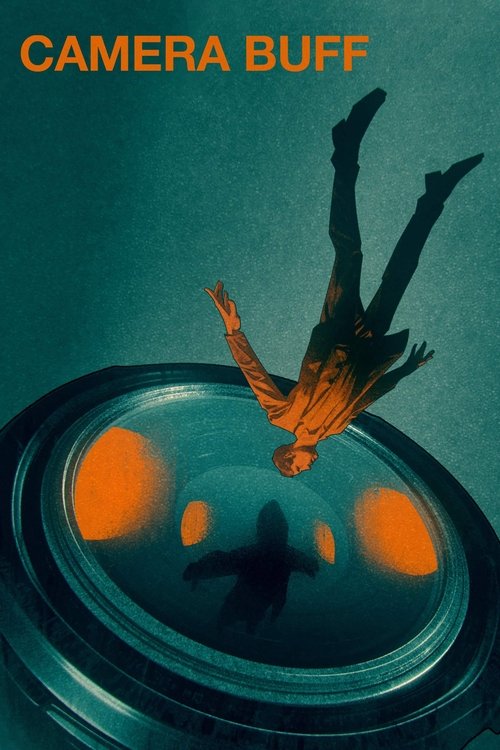
Camera Buff
1979 · Krzysztof Kieślowski
When you want a film to think about for days — about art, honesty, and what your work costs the people you love. A challenge, but a humane and often funny one.
What it's about
Filip, a factory worker in provincial Poland, buys an 8mm camera to film his newborn daughter — and because it's the only camera in town, the local Party boss drafts him as the plant's official chronicler. Prizes at amateur film festivals follow, and so does trouble: the more Filip points his lens at the world around him, the more he sees what the authorities would rather stay unfilmed, and the more his marriage and conscience strain under the obsession.
The experience
Quiet, wry, and steadily more troubling — it starts as a gentle workingman's comedy about a hobby and becomes a genuinely searching film about what cameras do to the people on both ends of them. It leaves you chewing on questions rather than answers.
Performances
Jerzy Stuhr is superb as Filip, charting the drift from doting new father to consumed filmmaker with a rumpled, ordinary-guy credibility that keeps the parable grounded in a real man.
The craft
Kieślowski, a documentarian turning to fiction, builds the film from his own crisis of conscience: every scene tests what filming flatters, exposes, or wounds. The plain realist surface is deceptive — the writing keeps folding the film back on itself, a movie about moviemaking that never feels academic.
Why it matters
Kieślowski's breakthrough fiction feature and a defining work of Poland's Cinema of Moral Anxiety, it set the ethical questions he'd pursue all the way to his later, world-famous work.
Snapshot
Camera Buff (Polish: Amator, literally "The Amateur") is Krzysztof Kieślowski's breakthrough fiction feature, a self-reflexive drama about a factory worker who buys an 8mm camera to film his newborn daughter and is slowly consumed by the medium. Filip Mosz (Jerzy Stuhr) becomes the local plant's semi-official chronicler, then a prize-winning amateur, and in the process discovers that a camera is never neutral: it flatters, exposes, distorts, and wounds. The film is at once a modest realist study of provincial Polish life under state socialism and a philosophical parable about the ethics of looking — a filmmaker's confession dressed as a workingman's tragicomedy. It stands as one of the defining works of the Polish "Cinema of Moral Anxiety" and the clearest statement of the documentary crisis that pushed Kieślowski toward fiction. It won the Grand Prix (Golden Prize) at the 1979 Moscow International Film Festival, cementing his international standing.
Industry & production
Amator was made within the Polish state film system, produced by the Film Unit "Tor" (Zespół Filmowy "Tor"), one of the semi-autonomous production collectives through which Polish cinema operated. Tor was associated with Krzysztof Zanussi, whose presence in the film's DNA is more than administrative — Zanussi appears on screen as himself and his 1977 film Camouflage (Barwy ochronne) figures within the story, folding the real Cinema of Moral Anxiety into the fiction. The picture came at a pivotal moment for Kieślowski, who had spent the 1970s as a documentarian at the Warsaw Documentary Film Studio (WFD) and had made only a handful of fiction works for television and cinema before this. Working inside a censored, subsidized industry shaped the film profoundly: its plot turns on what may and may not be shown, on the Party functionary who commissions and then edits Filip's work, and on the compromises that attend any image made in a controlled society. Precise budget and box-office figures for the film are not part of the reliably documented record, and I won't invent them; what is well attested is its festival success and its rapid canonization as a landmark of the period.
Technology
The film is, unusually, about film technology, and treats amateur equipment as both plot engine and metaphor. Filip's entry point is a small-gauge amateur camera (a Soviet-bloc 8mm consumer model of the kind marketed to hobbyists), bought for a private, domestic purpose. Poland in this era supported an organized network of amateur film clubs (the Amatorski Klub Filmowy movement), state-sponsored precisely because amateur cinema was seen as a wholesome cultural pursuit — and the film draws on that real infrastructure of clubs, contests, and regional festivals. As Filip's ambition grows, so does his access: to better equipment, to editing tables, to a projector and screening room, to the possibility of getting his footage onto television. The film is attentive to the physical facts of the medium — the whir of the projector, the splice, the reversal of footage, the ability to run an image backward to resurrect a dead colleague on screen. These are not decorative touches; the mechanical properties of film become moral properties, because the power to cut, reorder, and repeat is exactly the power Filip must learn to fear.
Technique
Cinematography
The camerawork, by Jacek Petrycki — a key Kieślowski collaborator from the documentary years — is deliberately unshowy, rooted in the observational, available-light realism of the WFD documentary tradition. Interiors are drab and functional (the plant, the cramped flat, the club rooms), lit to look lived-in rather than composed. This restraint is a strategy: the film's "beautiful" or self-conscious images are largely the ones Filip shoots, so the surrounding fiction adopts a plainer register against which his amateur footage can register as an aesthetic act. The result is a productive doubling — we watch a camera watching a man learning to use a camera — and Petrycki keeps the outer frame sober enough that the inner frame's discoveries feel like discoveries.
Editing
Cut by Halina Nawrocka, the film's editing is transparent and rhythmically patient, favoring scene-length observation over montage flourish. Editing is also, pointedly, the film's subject: the drama's ethical crisis is an editing crisis. When Filip's material is trimmed by his superiors, and when he grasps that his own choices about what to keep and cut can cost a colleague his livelihood, the act of cutting is dramatized as a moral event. The famous final movement — Filip turning the camera on himself — is a structural rhyme with the opening, closing the film on the image of its own making.
Mise-en-scène / staging
Kieślowski stages the film in the textures of everyday provincial life: the factory floor, bureaucratic offices, the maternity ward, the domestic apartment. Compositions are undramatic and frontal, built around ordinary spaces and the small social rituals of work and family. The staging repeatedly places Filip behind or beside his camera, so that the apparatus becomes a physical wedge between him and the people he films — most painfully his wife, Irka. The recurring motif of framing within the frame (Filip's viewfinder, the projected image on a wall, the television screen) organizes the mise-en-scène around the theme of mediated seeing.
Sound
The soundscape is naturalistic — factory noise, domestic sound, the intrusive mechanical presence of the camera and projector. The score, by Krzysztof Knittel, is used sparingly, in keeping with the film's realist surface; music does not underline emotion so much as punctuate it. As with the imagery, the film distinguishes between diegetic sound and the constructed soundtrack, reinforcing its interest in how recording and reproduction reshape lived experience.
Performance
The film belongs to Jerzy Stuhr, whose Filip is a landmark of Polish screen acting. Stuhr — a major stage actor and a defining face of the Moral Anxiety cycle — plays Filip as an ordinary, decent, slightly comic everyman whose growing obsession curdles enthusiasm into a kind of blindness. The performance modulates from boyish delight (the first footage of his baby, the thrill of a festival prize) to bewildered anguish as his marriage collapses and he understands what his images do to others. Stuhr is credited with contributing to the film's development, and the naturalism of the ensemble around him — the Party boss, the club members, the wife — sustains the documentary-adjacent texture. The final image asks the actor to perform the collapse of the boundary between the man and the camera, and Stuhr carries it with quiet devastation.
Narrative & dramatic mode
The dramatic mode is realist tragicomedy with a strong parabolic undertow. Structurally the film is a rise-and-reckoning arc: acquisition of the camera, ascent through the amateur circuit, and a moral fall in which every gain as a filmmaker is a loss as a husband, colleague, and citizen. The narrative advances through a series of ethical tests — filming a coworker, filming the town, deciding what to hand to the authorities, deciding whether to keep filming at all — each raising the stakes of Filip's dawning awareness that representation has consequences. The tone shifts deftly between gentle humor and genuine pathos, and the ending's turn inward converts the whole story into a meditation on the filmmaker's self-implication. It is a bildungsroman about the birth of an artistic conscience, in which the education is chiefly an education in guilt.
Genre & cycle
Camera Buff is a social-realist drama, but its most meaningful generic home is the "Cinema of Moral Anxiety" (Kino moralnego niepokoju), the late-1970s Polish current that used realist stories of individuals inside institutions to probe the ethical compromises of life under state socialism. Alongside Andrzej Wajda's Man of Marble (1977), Zanussi's Camouflage (1977), and Feliks Falk's Top Dog (Wodzirej, 1978), Kieślowski's film scrutinizes careerism, complicity, and the space for individual integrity. Within that cycle Amator is distinctive for making the act of filmmaking itself the arena of moral testing — a film-about-film that belongs equally to the reflexive lineage of movies about their own medium.
Authorship & method
The film is a personal work of authorship for Kieślowski, who directed and wrote it (Jerzy Stuhr is generally credited with collaborating on dialogue and shaping the role). Its origins lie in Kieślowski's own biography as a documentarist. Through the 1970s he made observational documentaries and grew increasingly troubled by the genre's intrusions — the sense that pointing a camera at real people could expose and harm them, and that some private realities (the phrase associated with him is the fear of filming "real tears") ought not be captured at all. Camera Buff transposes that crisis into fiction: Filip's discovery that his footage can ruin a colleague, and his ultimate turning of the lens on himself, dramatize the very doubts that were pushing Kieślowski from documentary toward the moral and eventually metaphysical fictions of his later career.
His collaborators here recur across his filmography: cinematographer Jacek Petrycki was a frequent documentary partner, and the realist craft of the WFD studio underwrites the film's look and method. The score is by Krzysztof Knittel and the editing by Halina Nawrocka; the writing is Kieślowski's own. The presence of Zanussi (as himself and via Camouflage) doubles as an authorial gesture — Kieślowski situating his film inside a living community of Polish filmmakers grappling with the same questions.
Movement / national cinema
This is quintessential Polish national cinema of the late People's Republic, produced within the state's collective-unit system and shaped by its censorship. It is a central document of the Cinema of Moral Anxiety, a movement that flourished in the years just before the rise of Solidarity and the imposition of martial law (1981) — a window in which Polish filmmakers pressed hard against the limits of permissible critique. The film's institutions (the Party functionary, the plant, the sanctioned amateur clubs, the controlled airwaves) are inseparable from that specific national and political context, and its subject — who controls the image — was an urgent question in a society where the image was a state instrument.
Era / period
1979 sits at the tail end of the Gierek decade, a period of accumulated economic strain and eroding official legitimacy that would culminate in the strikes of 1980 and the founding of Solidarity. The Cinema of Moral Anxiety captured this mood of disillusionment, and Camera Buff embodies its late-70s texture: gray provincial modernity, bureaucratic gatekeeping, and a hunger for authenticity chafing against official narrative. The film's preoccupation with what a camera may show and to whom reads directly against the media conditions of the era.
Themes
The film's governing theme is the ethics of representation — the recognition that to record is to intervene, and that the filmmaker bears responsibility for what the image does to its subjects. Around this cluster several others: the seduction of art and the way vocation can hollow out ordinary life and love (Filip's marriage is the casualty of his awakening); the conflict between individual truth-telling and institutional control, and the compromises of working within a censoring system; the tension between private and public seeing (a camera bought for a baby becomes a public instrument); and, in the final turn, self-knowledge — the artist compelled at last to look at himself. Underlying all of it is a question that would preoccupy Kieślowski for the rest of his career: what right does an image have to exist, and what does it cost the people caught inside it.
Reception, canon & influence
Camera Buff was Kieślowski's decisive breakthrough. Its Grand Prix (Golden Prize) at the 1979 Moscow International Film Festival gave him international visibility, and critics have consistently placed the film among the essential works of the Moral Anxiety cycle and among the finest films ever made about the act of filmmaking. Its reputation has only grown as Kieślowski's later stature — Dekalog, The Double Life of Véronique, the Three Colours trilogy — sent audiences back to his origins; Amator is routinely read as the Rosetta stone of his artistic development, the moment his documentary conscience became a fictional method.
Looking backward, the film draws on the observational Polish documentary tradition Kieślowski came from, on Italian neorealism's attention to ordinary working life, and on the broader modernist lineage of reflexive cinema about cinema. It is in explicit dialogue with the contemporaneous Moral Anxiety films — Wajda's and Zanussi's especially — and it literally incorporates Zanussi and Camouflage into its fabric.
Looking forward, its legacy is twofold. Within Kieślowski's own work it prefigures the ethical and metaphysical concerns that define his mature films, and its themes of surveillance, mediation, and moral responsibility anticipate Blind Chance, No End, and the Dekalog. More broadly, it has become a touchstone for the international genre of the film-about-filming and a frequent teaching text on documentary ethics — a work invoked whenever the question of the camera's power over its subjects is at stake. Its precise commercial reach in its day is not something the reliable record quantifies, but its critical afterlife and its standing in the Kieślowski canon are beyond dispute.
A Deleuzian reading
A man buys a movie camera because his daughter has just been born.
The full Deleuzian reading of Camera Buff →
Reception
It won the Grand Prix at the 1979 Moscow Film Festival and made Kieślowski's international name, but for years it lived in the shadow of Dekalog and Three Colours — now it's widely rediscovered as the skeleton key to everything he did after, the moment the documentarian turned the camera on himself.
How Camera Buff was received, from release to now →
How to watch Camera Buff: what to notice on a first viewing
- Notice the viewfinder, the projector screen, frames inside the frame. Kieślowski keeps returning to images seen through Filip's viewfinder, a projected wall, or a television, so you are always watching someone else watching. You stop simply seeing and start noticing the act of being shown something.
- Notice how much plainer the outer film looks than Filip's own footage. Petrycki shoots the surrounding fiction in drab, available light, so the images Filip actually films stand out as the only designed, beautiful ones. The film hides its own craft so that an amateur's discoveries can look like discoveries.
- Watch the camera sit physically between Filip and his wife. Kieślowski repeatedly places Filip behind or beside his own camera, the apparatus becoming a literal wedge between him and the people he loves. You can watch a marriage strain just from where the man chooses to stand.
- Watch Filip trim his own footage down for his bosses. Editing decisions, what stays and what gets cut, appear on screen as literal actions with consequences for the people being filmed. The film treats a splice as a decision with a victim, not just as grammar.
- Notice the small, hobbyist 8mm camera he starts with. Filip buys the camera to film his newborn daughter, an ordinary consumer object that gradually takes over every part of his life. A gift for a baby turns, step by step, into a public instrument.
The whole guide to watching Camera Buff, with the keys for a rewatch →
Influences: the films it descends from and the films it influenced
- The Cameraman (1928) — An ordinary man's acquisition of a movie camera and his amateur fumbling with the apparatus is itself the plot engine — the same 'a hobbyist gets a camera and his life reorganizes around it' machine Kieślowski runs with Filip's newsreel outfit.
- Man with a Movie Camera (1929) — Founds the reflexive mode in which the act of shooting, cutting, and the cameraman himself become the on-screen subject rather than a neutral window — the frame-within-frame self-consciousness Amator inherits.
- Bicycle Thieves (1948) — Neorealism's on-location attention to a working man's unglamorous provincial routines and non-star faces supplies the observational surface texture of Filip's factory town.
- Peeping Tom (1960) — Dramatizes the camera as a predatory instrument that damages the people in front of it, staging the exact ethics-of-the-lens crisis — filming can harm your subject — that Filip discovers when his footage ruins a colleague.
- 8½ (1963) — The template of the film-about-a-filmmaker's-crisis, where the artist turns the apparatus on his own doubts and paralysis, resolved through a self-reflexive address that Amator's final shot of Filip filming himself directly echoes.
- Blow-Up (1966) — Makes mediation itself the subject: the recorded image reveals a truth the naked eye missed and then implicates the man who recorded it — the epistemology of the lens Kieślowski moralizes.
- David Holzman's Diary (1967) — A fictional first-person documentary of a man who films his own life until the camera devours his relationships — the precise gesture of turning the lens on oneself that closes Camera Buff.
- No End (1985) — Carries Amator's documentary-conscience realism of everyday Polish life forward into overtly moral-metaphysical fiction, the pivot the earlier film first performed by pushing Kieślowski from documentary into ethics.
- Blind Chance (1987) — Extends Filip's discovery that a small choice reshapes a life into a formal branching-fate structure, keeping the same Jerzy-Stuhr-era observational texture of provincial bureaucratic Poland.
- Dekalog (1989) — Transposes the observational realism of provincial apartment-block life into ten moral-dilemma fictions — the mature ethical cinema Amator is routinely read as prefiguring.
- Close-Up (1990) — Blurs documentary and fiction around a man's consuming obsession with cinema, foregrounding the camera's power over real, non-actor subjects — Kieślowski's ethics-of-representation problem rebuilt as form.
- Man Bites Dog (1992) — Makes a documentary crew's escalating complicity with the subject it films the moral engine of the piece, weaponizing Amator's insight that pointing a camera is never a neutral act.
- Benny's Video (1992) — An amateur's home-video camera mediates, replays, and deadens moral reality for its young owner — the corrupting apparatus Filip flirts with, taken to its cold conclusion.
- Caché (2005) — Surveillance footage indicts the person watching and the person who shot it, extending the film's central question of the camera's power and culpability over the people it records.
- 4 Months, 3 Weeks and 2 Days (2007) — Austere observational long takes and naturalistic diegetic sound rendering drab Eastern-bloc daily life inherit the WFD-documentary/neorealist realism that underwrites Amator's look and method.
- Decalogue I (1989) — Kieślowski's own bridge from state-documentary realism into moral fiction—observational, behaviorally exact, ethically interrogative—is the immediate authorial precursor to the Dekalog method.
- Europa Europa (1990) — Shot by Jacek Petrycki in the handheld, documentary-realist Polish idiom Holland imported wholesale for Europa Europa's grounding gravity.
- A Short Film About Love (1988) — Kieślowski's own portrait of an amateur cameraman whose compulsion to record others corrodes his relationships — the self-critique of watching that seeds this film's guilty voyeur.
- Three Colors: White (1994) — Source of the moral-anxiety casting logic White reuses literally: Jerzy Stuhr as the ordinary Pole whose face registers institutional pressure without commentary, filmed with a documentary-registration camera that observes workplaces rather than composing them.
- Man of Marble (1977) — A Moral Anxiety cycle contemporary built on a documentarian's investigation and film-within-film footage that interrogates official truth, sharing Amator's use of the documentary act as both method and moral subject.
- Camouflage (1977) — Literally embedded inside Amator (Zanussi and the film appear on screen); shares the Moral Anxiety cycle's dialogue-driven ethical arguments staged inside dreary institutional settings.
- Interrogation (1989) — Shares cinematographer Jacek Petrycki, whose documentary-pressured, institutional look — flat light and drab interiors — gives both films their surveillance-state texture.
Similar films
- Close-Up (1990) — influence & lineage
- Man with a Movie Camera (1929) — influence & lineage
- Man Bites Dog (1992) — influence & lineage
- 8½ (1963) — influence & lineage
- 4 Months, 3 Weeks and 2 Days (2007) — influence & lineage · same viewing thread
- A Short Film About Love (1988) — same viewing thread
- A Short Film About Killing (1988) — same viewing thread
- Interrogation (1989) — same viewing thread
All the films related to Camera Buff →
Watch it with: curated runs of related films
- Behind the Iron Curtain — A run of Eastern Bloc films where one ordinary person — a hobbyist filmmaker, a cabaret singer, a drifter, a student — is quietly ground down by the machinery of the communist state.