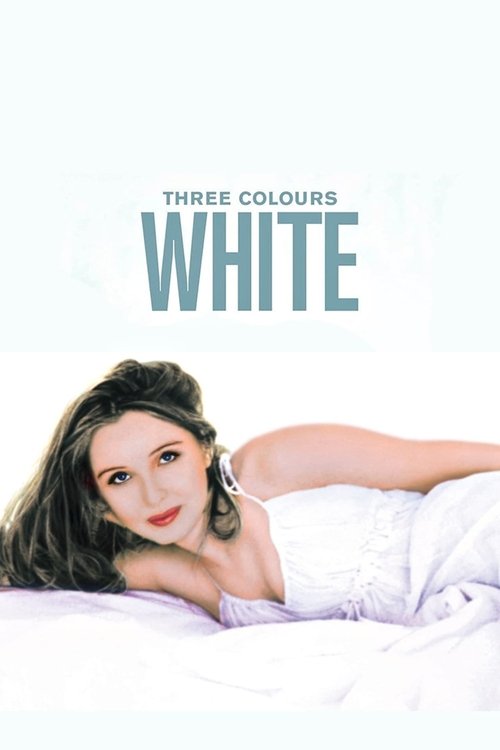
Three Colors: White
1994 · Krzysztof Kieślowski
When you want something clever to chew on that's also genuinely entertaining — a wry, ironic evening rather than a heavy one, though it leaves a lasting ache.
What it's about
Karol, a Polish hairdresser in Paris, loses everything in the space of a courtroom scene: his French wife divorces him over a failed marriage bed, and with her go his salon, his papers, and his last shred of dignity. Reduced to busking in the Métro, he gets himself smuggled home to Warsaw in a suitcase and sets about rebuilding — first a living, then a fortune in the wild new post-communist economy, and finally an elaborate scheme aimed at the woman who humiliated him. It's a revenge story where revenge and love keep trading places.
The experience
Drier and funnier than you expect — a deadpan black comedy of humiliation and comeback that keeps a bruise under every joke. It moves briskly, stings quietly, and ends on a note that will have you arguing about what equality between two people actually means.
Performances
Zbigniew Zamachowski gives Karol a Chaplinesque sad-sack grace that slowly hardens into something more formidable, and Julie Delpy makes Dominique glacial and wounded in equal measure — you're never allowed to settle on who's the victim.
The craft
The middle panel of Kieślowski's Three Colours trilogy, built around the idea of equality and shot with a palette of overexposed whites — snow, wedding veils, pale Warsaw light — that turns the theme into imagery. Zbigniew Preisner's score gives the comedy an undertow of tango-like longing.
Why it matters
As the comic hinge of one of the most celebrated trilogies in world cinema, it caught the absurdity of post-communist Poland's overnight capitalism like few films of its moment, and it deepened Kieślowski's reputation in the final act of his career.
Snapshot
Three Colours: White (Trois couleurs: Blanc / Trzy kolory: Biały) is the middle panel of Krzysztof Kieślowski's final work, a triptych organized around the colors of the French tricolour and the revolutionary slogan attached to them — liberté, égalité, fraternité. Where Blue (1993) took liberty as a study in grief and Red (1994) took fraternity as a metaphysical romance, White takes equality and turns it into a joke with a knife in it. Karol Karol, a Polish hairdresser living in Paris, is divorced by his French wife Dominique on grounds of non-consummation, stripped of his salon, his residence papers and his dignity, and reduced to busking in the Métro. Smuggled home to Warsaw inside a suitcase, he reinvents himself as a speculator in the raw post-communist market and engineers an elaborate revenge: he fakes his own death, wills his fortune to Dominique, and has her imprisoned for his murder.
It is the trilogy's comedy, and it has always been the trilogy's problem child — the film most often described as the slightest of the three, and the one whose reputation has risen most as the historical moment it documents receded into history. Premiering at the Berlin International Film Festival in February 1994, it won Kieślowski the Silver Bear for Best Director. It is also the most Polish thing he made after Dekalog, and the only film of the trilogy in which the collapse of the world he had spent his career filming is the actual subject rather than the background.
Industry & production
The trilogy exists because two industries changed at once. After 1989, the Polish state film system — the studio units, the guaranteed funding, the production apparatus within which Kieślowski had worked his entire career — came apart. His home base, the Tor unit headed by Krzysztof Zanussi, survived, but the money did not. Simultaneously, Kieślowski's international standing after Dekalog (1988–89) and the French-Polish The Double Life of Véronique (1991) made him bankable in the European co-production system then consolidating around producers like Marin Karmitz.
White was produced by Karmitz's MK2 in a French-Polish-Swiss configuration, with French television participation and Tor on the Polish side — the standard architecture of early-1990s European art cinema, in which national funding bodies and broadcasters were assembled into a single financing stack. The three films were developed together and shot in overlapping campaigns across 1992–93, with Kieślowski notoriously cutting one while preparing or shooting another. The practical consequence for White is visible on screen: it is the film that most exploits the co-production's binational structure, because half of it is set in Paris and half in Warsaw, and the seam between them is the story.
The trilogy's screenplays were written with Krzysztof Piesiewicz, a Warsaw defense lawyer who had become Kieślowski's writing partner on No End (1985) and stayed through Dekalog, Véronique and the colors. The scale of the enterprise — three features, three cinematographers, three countries, one composer and one writer — is unusual, and its unity is administrative as much as aesthetic: an authorial project financed as a slate.
Technology
White was made on 35mm in the last years before the digital intermediate, and this matters more than it sounds. The trilogy's celebrated color schemes were achieved photochemically and in front of the lens: filtration, gels, lighting, and above all production design and costume, then finished through laboratory timing. There was no grading suite in which a Paris interior could be pushed toward blue-white after the fact. When White blooms into its recurring flare — the near-total whiteout that swallows the frame as Karol remembers Dominique on the church steps in her wedding dress — that effect is a photographic event, produced by overexposure and diffusion and carried through optical work, not painted on afterward. The specific laboratory procedures are not well documented in the published record, and I won't guess at them; what is certain is that the film's whites are the product of a pre-digital craft economy of filters, stocks and timing lights.
The film also has a subject that is itself technological, in the broad sense: it is about infrastructure. The airport baggage system that opens the film and later carries Karol home; the telephone that humiliates him when Dominique holds the receiver to the bed; the fax and mobile phone that mark his ascent into business; the two-franc coin he keeps as a talisman, a piece of hard currency rendered worthless by a border. White is unusually attentive to the machinery of money and movement, and it treats that machinery as comic apparatus — a man posted as freight, a fortune assembled from a tip-off about a land purchase.
Later, the trilogy became a showcase for restoration technology in its own right: Criterion's 2011 box set consolidated the three films for high-definition, and subsequent 4K reissues have kept them in circulation. The irony is worth noting — films whose palettes were hand-built in a lab are now most often seen through digital pipelines that could have produced them far more easily.
Technique
Cinematography
Each film in the trilogy has a different cinematographer, a deliberate refusal of visual continuity: Sławomir Idziak on Blue, Piotr Sobociński on Red, and on White Edward Kłosiński — a major figure of Polish cinema whose credits include Andrzej Wajda's Man of Marble and Zanussi's Camouflage. The choice reads as a statement. Idziak's Blue is saturated, filtered, aggressive; Kłosiński's White is comparatively plain, and its plainness is the point.
The Paris material is cool and enclosed: arcades, corridors, the cramped salon, a courtroom, the tiled tunnels of the Métro. The Warsaw material opens out into slush, unfinished construction, gray blocks, a rubbish tip under a wide sky. White itself is deployed less as an overall tint than as an intrusion — snow, a bust of a woman in pale stone, bedsheets, the wedding dress, and the flaring overexposures that arrive like a wound reopening. Where Blue filters nearly everything, White keeps a documentary evenness and lets white break in. That restraint is consistent with Kłosiński's background in a Polish tradition that came out of documentary and distrusted decoration.
Editing
The cut is credited to Urszula Lesiak, working within the shaping habits Kieślowski had refined across Dekalog — elliptical transitions, close inserts that isolate an object at the moment a character's attention lands on it, and a willingness to jump over exposition entirely. White is markedly brisker than Blue. Where the earlier film uses fades to black that hold, suspending time inside grief, White cuts on comic beats and lets whole reversals of fortune pass in a few shots. The whiteouts function structurally, as flash-transitions that puncture the present with the same memory each time, so that the film's one lyrical device is also its running gag about obsession.
Mise-en-scène / staging
The staging is built on a systematic contrast of scale and posture. In Paris, Karol is small in the frame, hunched, backed into corners, filmed through glass and grilles; he is also, crucially, mute in French, so blocking does the work that dialogue cannot — he is positioned as an object being discussed. In Warsaw he straightens, takes the center of rooms, acquires a desk. The recurring frames-within-frames — windows, the hotel door, and finally binoculars trained on a prison window — organize the whole film around the act of looking at a woman who cannot be reached.
Objects carry more narrative weight than in most comedies: the two-franc coin, the plaster bust smashed by the thieves who steal Karol's suitcase, the comb wrapped in paper, the suitcase itself. Kieślowski's habit of granting things a quasi-agency, familiar from Dekalog, here becomes the engine of a farce.
Sound
Zbigniew Preisner's score leans on tango — a Polish tango, specifically, the interwar popular idiom that Karol busks in the Métro on a paper-wrapped comb, playing the pre-war standard "To ostatnia niedziela." The choice is precise: a music of ironic melancholy, of a Poland that predates both communism and the market, deployed for a man whose nationality has become his handicap. Preisner's cues are terse, sardonic, and often withhold the swell a revenge plot would normally get.
The sound design does its sharpest work in the smuggling sequence, where the world is heard from inside a suitcase, and in the language politics that run throughout: French Karol cannot follow, a court interpreter mediating his own divorce, and the celebrated moment in which a cry through a hotel door tells staff exactly what the film's title has been circling.
Performance
Zbigniew Zamachowski's Karol is a stage-trained physical performance built on posture and timing — the small comic degradations of the Paris section (a pigeon, a locked door, a refused card) played straight, with no mugging. Julie Delpy's Dominique is deliberately opaque, a cold surface; the film gives her almost no interiority, and whether that is a flaw or the entire design has been the most durable critical argument about the film. She is what Karol projects, until the final shot forces her to become a person again.
Janusz Gajos brings genuine weight as Mikołaj, the suicidal bridge player whose commissioned death Karol converts into a gift of life — the scene in which the first bullet turns out to be a blank is the film's moral hinge. Jerzy Stuhr, the emblematic face of Poland's Cinema of Moral Anxiety, plays Karol's brother as comic pragmatism incarnate, a casting joke about what became of that generation.
Narrative & dramatic mode
The structure is a rise-and-revenge fable: humiliation, exile, accumulation, retribution. It is closer to Balzac or Dumas than to anything in Kieślowski's earlier work, and the film knows it — the fortune is built on a piece of insider knowledge about land, the revenge is a legal contrivance, and the resolution turns on a corpse purchased for the purpose.
But the mode is deadpan rather than satirical. Kieślowski stages catastrophe without underlining, so the comedy arrives cold: a man beaten and dumped on a landfill looks out over Warsaw and reflects that he is home at last. Two registers run in parallel throughout — a farce of degradation and a genuinely unresolved love story — and the ending refuses to let either win. Karol has won everything and weeps, watching through binoculars as an imprisoned Dominique signs that she will marry him again. That is not a punchline and not a reconciliation. It is the trilogy's characteristic gesture: the ideal in the title has been achieved and found unbearable.
Genre & cycle
White is a black comedy, a revenge tale, and a transition-era social film at once, and it fits none of those categories comfortably — which is why it sat awkwardly in the trilogy's reception. Within the trilogy it functions as the tonal fulcrum: Blue is tragedy, Red is romance, White is the low mode between them, and its coarseness is structural.
It also belongs to a small, largely unnamed cycle: films made in Central and Eastern Europe in the early 1990s about what happened when the state withdrew and the market arrived unregulated. White renders that moment as picaresque — dollars in briefcases, warehouses bought cheap, bodyguards and translators and men who know a man. Kieślowski, who had spent the 1970s and 80s making films about how socialist institutions deform individuals, filmed the successor system with exactly the same eye.
Authorship & method
Kieślowski's method by this point was fixed and collaborative. Scripts came from years of work with Piesiewicz, whose legal practice supplied both the case-file structure of Dekalog and the courtroom mechanics of White. Preisner had scored his films since the mid-1980s and worked in an unusual forward direction, with themes composed early enough to shape a scene rather than decorate it — a working relationship most visible in Blue, where the music is the plot, but audible in White's tango motif as well.
The rotating cinematographers are the trilogy's distinctive authorial decision. Rather than imposing a house look, Kieślowski hired three of the strongest Polish DPs of their generations and let each film's photography argue with the others. Kłosiński's assignment to White brought a documentary-trained sensibility to the Warsaw half, and the film's refusal of prettiness in Poland is inseparable from that choice.
Kieślowski on Kieślowski, the book-length interview edited by Danusia Stok, remains the primary account of his own thinking, in which he consistently framed the trilogy as an ironic interrogation of the three revolutionary ideals rather than a celebration of them. He announced his retirement after Red and died in March 1996, aged 54, following heart surgery. The trilogy is therefore not merely late work but terminal work, and White's bleak joke about getting even acquires a different weight in that light.
Movement / national cinema
Kieślowski came out of the Łódź Film School and a decade of documentary practice, then into the kino moralnego niepokoju — the Cinema of Moral Anxiety — alongside Zanussi, Wajda's later work, Agnieszka Holland and Feliks Falk, a movement built on close observation of institutional hypocrisy under late socialism. Camera Buff (1979) and Blind Chance (1981) belong to that formation; martial law and the shelving of films marked its end.
White is where the Polish inheritance re-enters the French trilogy. Its casting is a roll-call of that cinema — Stuhr and Gajos in particular — and its Warsaw is filmed with the unglamorous specificity of someone who had documented the city for twenty years. The trilogy as a whole marks Kieślowski's absorption into a pan-European art cinema; White is the film in which he uses French money to look hard at what had happened to Poland.
Era / period
The film is precisely dated: 1993–94, four years after the transition, in the middle of shock therapy. Warsaw is a construction site; commercial land is changing hands ahead of the people who own it; hard currency is a fetish object; the professional classes are improvising careers. Karol's arc — hairdresser to import-export operator to man with an office — is the era's characteristic biography compressed into ninety-one minutes.
The Paris half is equally of its moment: a Europe in which a Polish citizen's residency, work and legal standing are all contingent, and in which not speaking the language is a material disability. The film's account of impotence is inseparable from that geography. Karol cannot perform in the country where he cannot speak, and recovers his potency the night he has finally engineered his own advantage. Whether one reads that as a sardonic parable about East and West or as a somewhat schematic one, it is the film's controlling idea.
Themes
Equality, in White, means getting even — and the film's argument is that the ideal, taken seriously, is grotesque. Nobody in the film wants equality; everyone wants an advantage, and the balance Karol finally achieves with Dominique is a mutual imprisonment. This is consistent with the trilogy's design, in which each revolutionary term is tested and found to describe an impossible condition.
Secondary threads: humiliation and its conversion into capital; language as power; nationality as a wound; the persistence of love after every reason for it has been destroyed. And running under all of it, the suicidal Mikołaj — the trilogy's quiet reminder that the alternative to wanting something is wanting nothing, and that Karol's ridiculous vengefulness is also, in its way, an appetite for life.
The recurring reading of Karol as a Chaplinesque figure is well established in the critical literature — the small humiliated man, the sight gags, the suitcase, the name that in Polish is simply Charles, twice. Whether Kieślowski intended the allusion is less firmly documented than the fact that critics have found it useful.
Reception, canon & influence
Backward. The film's inheritances are legible: Polish documentary observation, the Cinema of Moral Anxiety's institutional skepticism, the interwar tango as an emotional shorthand, silent-comedy staging, and the nineteenth-century revenge novel's plot architecture. Formally, its debts are to Kieślowski's own Dekalog, which established the elliptical construction and object-attentiveness the trilogy refines.
Contemporary reception. White won the Silver Bear for Best Director at Berlin in 1994 and was released internationally on the back of Blue's success. It was widely, and from the beginning, treated as the trilogy's lesser entry — drier, thinner, less beautiful, with a female lead many found underwritten. That consensus has softened considerably. The film's portrait of predatory early capitalism now reads as documentary in a way it could not in 1994, and its formal restraint looks deliberate rather than deficient. The pattern is common enough for middle panels of triptychs, but here the reappraisal has real content behind it.
Forward. White's influence is hardest to trace individually, and it would be dishonest to claim a school. Its legacy is largely as part of the trilogy, whose model — a color-coded, thematically linked set of features released in sequence, with shared crew and cross-film cameos — became a reference point for how art cinema could be packaged as an event. Those cameos are themselves part of the design: Julie from Blue strays into the courtroom at the start of White, and Karol and Dominique surface among the survivors at the end of Red, a knot that ties the three films into one system.
Kieślowski's broader influence is easier to document. Tom Tykwer has been explicit about his debt and directed Heaven (2002) from a Kieślowski–Piesiewicz script; Danis Tanović filmed L'enfer (2005) and Stanisław Mucha Hope (2007) from the same posthumous cycle. Later Polish directors, Paweł Pawlikowski and Małgorzata Szumowska among them, work in a register the trilogy helped make internationally legible. For the actors, the trilogy was a threshold: Julie Delpy went almost directly into Before Sunrise (1995), and Zamachowski's Karol remains one of the defining Polish screen performances of the decade.
White itself endures less as a template than as a document — the one film in a French-financed meditation on European ideals that stops to look at what those ideals cost a man from the other side of the border.
A Deleuzian reading
A man kneels in a Paris Métro tunnel with a comb wrapped in paper pressed to his lips.
The full Deleuzian reading of Three Colors: White →
Reception
In 1994 it was received as the trilogy's minor, lighter middle chapter — the palate-cleanser between Blue and Red — but decades of reappraisal have turned 'White is actually underrated' into near-consensus, with its bone-dry revenge comedy now championed as the trilogy's secret weapon.
How Three Colors: White was received, from release to now →
How to watch Three Colors: White: what to notice on a first viewing
- Watch how the camera boxes Karol in: glass, grilles, corners, doorways. In Paris he is positioned as an object other people discuss rather than a man who speaks. Blocking does work his lack of French cannot. The framing tells you he has no power in the room before anyone explains why.
- Watch the objects Karol carries: a coin, a comb. Small things carry unusual narrative weight throughout: a two-franc coin, a comb wrapped in paper. The comb becomes a busking instrument, the coin a talisman he cannot spend. These objects hold meaning that his own circumstances have been stripped of.
- Listen for a court interpreter speaking Karol's words for him. A court interpreter mediates his own divorce hearing, passing his words through another mouth so he cannot speak for himself in his own life. You hear him losing control of his own story in a language he cannot speak.
- Watch for the screen to flare into total white without warning. The image blooms into overexposure around the same memory each time, then the film cuts away before it resolves into anything. The recurring flash is the one thing in Karol's story that never resolves into use for him.
- Watch Zamachowski play every small humiliation completely straight. A pigeon, a locked door, a refused card: small degradations get real reactions, never mugging or exaggeration. Playing it straight makes you supply the laugh, and the laugh catches in your throat.
The whole guide to watching Three Colors: White, with the keys for a rewatch →
Influences: the films it descends from and the films it influenced
- Dekalog (1989) — Established the trilogy's working grammar wholesale — Piesiewicz's legal case-file dramaturgy, the elliptical cut that omits the act and resumes at its consequence, and objects tracked as narrative agents — with Kłosiński shooting Part Two and Part Ten's Zamachowski/Stuhr brother double-act functioning as a straight rehearsal for Karol and Jurek.
- No End (1985) — First Preisner collaboration and the origin of the forward-composed score — themes written early enough to dictate scene rhythm rather than underline it, the method that lets White's interwar tango motif behave as a character's inner voice; it also runs the same Warsaw courtroom procedure and a dead husband who keeps acting on the plot.
- The Double Life of Véronique (1991) — Proved that photochemical color could be an authorial system rather than decor — Idziak's gold filtration splitting Poland and France into two incompatible emulsions — which is exactly the argument White continues by giving Kłosiński a bleached, prettiness-refusing Warsaw against a cooler Paris.
- Camera Buff (1979) — Source of the moral-anxiety casting logic White reuses literally: Jerzy Stuhr as the ordinary Pole whose face registers institutional pressure without commentary, filmed with a documentary-registration camera that observes workplaces rather than composing them.
- Man of Marble (1977) — Kłosiński's DP method in its formative state — handheld registration inside institutional interiors, available-light flatness, refusal of the flattering key — which is precisely the sensibility he imports into White's Warsaw half.
- The Promised Land (1975) — Kłosiński (one of three DPs) already photographing predatory raw capitalism as physical texture — money, contracts and property shot as greasy material fact — the visual argument White reactivates for post-1989 Warsaw with the same cameraman.
- Camouflage (1977) — The Cinema of Moral Anxiety's core device: a scene built as a rigged procedure in a flatly lit institutional room, where a predatory operator instructs a naïf in how the system actually pays — the dramaturgy of White's courtroom opening and its currency-exchange scams.
- L'Argent (1983) — The template for objects-as-agents: banknotes, hands and a suitcase carry causality while faces withhold it, and the cut arrives before the deed so the audience infers the crime — the identical logic behind White's two-franc coin, comb, and the trunk Karol is shipped in.
- City Lights (1931) — Silent-comedy staging White borrows intact — the little man held in unbroken medium-long shot so the body, not the cutting, delivers the joke and the pathos in the same beat, which is how Zamachowski's métro busking and hairdressing-contest humiliation are blocked.
- The Count of Monte Cristo (1934) — The nineteenth-century revenge-novel architecture in film form: staged death and burial, resurrection under a new identity, accumulation of capital, then a legal-financial trap that ruins the betrayer — White's plot beat for beat, compressed into farce.
- Run Lola Run (1998) — Tykwer's explicit transposition of Kieślowski's chance-architecture and object-triggered causality into kinetic form — the coin, the bag of money and the near-miss as plot engines — before he inherited the Kieślowski–Piesiewicz material outright.
- Heaven (2002) — Directed from an actual Kieślowski–Piesiewicz screenplay, carrying forward the legal-procedural spine (interrogation, translation, a two-language courtroom) and the language-barrier device White weaponizes in Dominique's divorce hearing.
- L'enfer (2005) — Second film from the posthumous Piesiewicz cycle, preserving the method of building a moral fable from case-file structure and small recurring physical objects rather than psychological exposition.
- Hope (2007) — Third of the posthumous cycle and the one closest to White's mechanics — a Warsaw plot in which a single contested object (a stolen painting) drives blackmail, restitution and moral accounting, staged in the same unglamorous Polish interiors.
- Cold War (2018) — Rebuilds White's Paris/Warsaw contrast as two distinct photographic registers, cuts elliptically across years so consequences arrive without their causes, and uses a single reworked folk-into-cabaret standard the way White uses its interwar tango — as portable emotional shorthand for a Pole who cannot be at home on either side of the border.
- Three Colors: Blue (1993) — Runs the same interruption device from the opposite pole — Blue's mid-scene fade to black that returns to the identical frame is answered by White's overexposed whiteout flash — and shares the Preisner forward-composed score plus the courtroom cameo that knots the two films together.
- Three Colors: Red (1994) — Piotr Sobociński's third variation on the rotating-DP scheme, pushing the frames-within-frames staging White uses (doorways, car windows, the courtroom's glass) into full surveillance-by-glass, and closing the system by surfacing Karol and Dominique among the ferry survivors.
Similar films
- Three Colors: Blue (1993) — influence & lineage
- Three Colors: Red (1994) — influence & lineage
- The Double Life of Véronique (1991) — influence & lineage
- Cold War (2018) — influence & lineage
- Camera Buff (1979) — influence & lineage
- A Short Film About Killing (1988) — shared sensibility
- Ashes and Diamonds (1958) — shared sensibility
- Stolen Kisses (1968) — shared sensibility