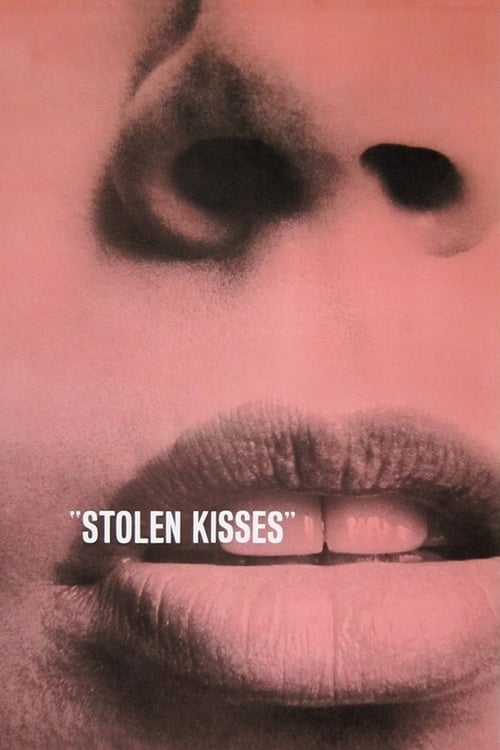
Stolen Kisses
1968 · François Truffaut
For a cozy night when you want to fall a little in love with Paris and with being young and hopeless — easy, warm company rather than a challenge, ideal when you need something gentle that still has wit.
What it's about
Antoine Doinel, freshly and dishonorably discharged from the army, tumbles through Paris and a series of jobs he's spectacularly bad at — hotel night clerk, private detective's trainee, television repairman — while trying to win over Christine, the sensible girl whose family half-adopts him. Then an undercover assignment at a shoe shop puts him in the orbit of the owner's wife, a woman so effortlessly elegant she scrambles his brain entirely.
The experience
Light on its feet, funny, and unexpectedly tender — a comedy of a young man failing upward through jobs and love, played in a loose, wandering register where the charm is in the detours. It leaves you smiling with a small ache attached.
Performances
Jean-Pierre Léaud is pure comic music as Antoine — all jitters, bad ideas, and sudden gallantry — and Delphine Seyrig, as the unattainable Madame Tabard, gives one of cinema's great portrayals of poise meeting a besotted boy; Claude Jade is quietly winning as the girlfriend who sees through him and likes him anyway.
The craft
Truffaut shoots wintry Paris with offhand grace, letting scenes breathe like anecdotes told by a friend, and the script turns job interviews, surveillance jobs, and mirror pep-talks into little comic set pieces. It's filmmaking that feels tossed off and is anything but.
Why it matters
The heart of the Doinel cycle — the rare experiment of following one actor playing one character across twenty years of films — and a touchstone for every bittersweet comedy about drifting twenty-somethings since.
Snapshot
Baisers volés is the third station in the Antoine Doinel cycle, arriving nine years after The 400 Blows (1959) and six after the "Antoine et Colette" episode of the omnibus L'amour à vingt ans (1962). Antoine (Jean-Pierre Léaud), dishonorably discharged from military service, drifts through a series of jobs — night clerk at a shabby hotel, trainee at the Blady detective agency, television repairman — while orbiting two women: Christine Darbon (Claude Jade), the well-brought-up girlfriend whose family half-adopts him, and Fabienne Tabard (Delphine Seyrig), the unreachably poised wife of a shoe-shop owner who has hired the agency to find out why nobody likes him.
The film is a comedy of apprenticeship in which the apprentice never quite qualifies at anything, least of all love. It was shot in Paris in the winter and early spring of 1968, in the middle of the Langlois Affair, and opens on the shuttered gates of the Cinémathèque française at Chaillot with a dedication to Henri Langlois — the only overtly political gesture in a film otherwise famous for its refusal to acknowledge the year that produced it. It became one of Truffaut's most beloved works: a French popular success, winner of the Prix Louis-Delluc for 1968, and a nominee for the Academy Award for Best Foreign Language Film. Its reputation has only hardened since, largely on the strength of three or four sequences — the mirror incantation, the breakfast table, the pneumatic letter, the final bench — that are among the most quoted in postwar French cinema.
Industry & production
By 1968 Truffaut was no longer an insurgent but a proprietor. Les Films du Carrosse, the company he founded in 1957 and named for Renoir's The Golden Coach, produced the film with Les Productions Artistes Associés, the French arm of United Artists — the same alliance of artisanal ownership and American distribution money that had underwritten Fahrenheit 451 and The Bride Wore Black. Marcel Berbert, Truffaut's long-serving production manager and business partner, produced.
The context matters. Fahrenheit 451 (1966) had been a difficult English-language shoot; The Bride Wore Black, released in April 1968, met a divided reception, its Hitchcockian machinery read by some as pastiche. Stolen Kisses was conceived and executed as a corrective: small, fast, Parisian, shot on locations Truffaut had known since childhood, with a company of collaborators he trusted and a lead actor he had effectively raised on film. It is a "minor" film by deliberate design, and the modesty is a production strategy as much as an aesthetic one.
Shooting began in early February 1968. Within days André Malraux's ministry moved to remove Henri Langlois from the Cinémathèque, and Truffaut — with Godard, Chabrol, Rivette, Resnais and much of the French film world — threw himself into the defense committee, the street demonstrations at Chaillot, and the international campaign of solidarity that eventually forced Langlois's reinstatement. Truffaut would go on that May to help shut down the Cannes Film Festival. That a nostalgic romantic comedy was being filmed by the same man in the same weeks is one of the durable ironies of French film history, and the opening shot of the padlocked Cinémathèque is the film's acknowledgment of it: the barricade appears once, in an image, and then the film goes about its business.
Casting was consequential. Claude Jade, a young stage actress, was making her screen debut; she and Truffaut were briefly engaged during and after the production, a biographical fact that has colored readings of Christine ever since. Delphine Seyrig arrived carrying the aura of Resnais's Last Year at Marienbad and Muriel — the most rarefied performer in French cinema, deposited into a shoe shop. Michael Lonsdale, Daniel Ceccaldi, Harry-Max and André Falcon filled out a bench of character actors playing the film's several varieties of unhappy male. Marie-France Pisier makes a fleeting reappearance as Colette from the 1962 episode, a serial-fiction wink that assumes the audience has been following along.
Technology
The film was shot on 35mm in Eastmancolor at 1.66:1, the standard European wide format of the period, and runs roughly ninety minutes. Technologically it sits at a comfortable plateau rather than a frontier. The equipment innovations that had made the New Wave possible a decade earlier — the lightweight Éclair and Arriflex cameras, faster color stocks, the portable Nagra recorder — were by 1968 simply the ordinary furniture of French production. Stolen Kisses uses them without fuss: real Paris interiors, hotel corridors, staircases, streets and shopfronts, lit to the level available rather than rebuilt on a stage.
Color is the real technical shift within the Doinel cycle. The 400 Blows and "Antoine et Colette" were black-and-white; here Paris arrives in a muted, autumnal Eastmancolor register — browns, ochres, grays, the warm dinginess of cheap rented rooms — that reads less as spectacle than as weather. French production practice of the era leaned heavily on post-synchronization, and the film's dialogue has the slightly forward, close-miked clarity characteristic of that workflow rather than the raw ambient texture of direct-sound documentary.
One sequence is an explicit technology piece: the journey of Antoine's pneumatique, the express letter propelled by compressed air through the tube network under Paris. Truffaut follows the petit bleu down the chutes and through the machinery in near-documentary fashion, turning a piece of municipal infrastructure — obsolete within two decades — into a comic delivery system for a declaration of love. The film is now, incidentally, a record of a communications technology that no longer exists.
Technique
Cinematography
Denys Clerval, shooting his first feature for Truffaut (he would return for Mississippi Mermaid), gives the film a soft, unemphatic surface. The camera prefers medium shots and modest reframings to the athletic set-pieces of the early New Wave; there is far less of the whip-pan, freeze-frame and hand-held bravura of 1959–62. What remains is a documentary alertness to Paris — Léaud shot walking real streets among real passers-by — combined with an almost classical willingness to hold still when a scene is working.
The film's most discussed image is a mirror: Antoine, alone in his room, staring at his reflection and chanting the three names — "Fabienne Tabard, Christine Darbon, Antoine Doinel" — over and over until the words dissolve into sound. The staging is simple and the duration does the work; the shot is a portrait of a young man trying to establish, by repetition, that he and his desires exist.
Editing
Agnès Guillemot, who cut several Truffaut films in this period and was simultaneously Godard's principal editor, gives the picture a brisk, elliptical rhythm suited to its picaresque construction. Scenes are entered late and left early; jobs begin and end within a few shots; the film ellipses over whole weeks of Antoine's life without announcement. The transitions are unshowy — cuts and fades rather than the iris flourishes of Shoot the Piano Player — and the effect is of a novel being skimmed at exactly the right speed. The comedy depends on this cutting: most of the gags are structural, a matter of how quickly a humiliation is allowed to arrive and how quickly it is dropped.
Mise-en-scène / staging
The detective agency is a machine for generating vignettes, and Truffaut uses it as such. Surveillance provides pretexts to enter apartments, shops, magic-shows and strangers' lives, so the film can be episodic without being formless. Doors, thresholds, corridors and staircases organize the space: Antoine is perpetually being admitted somewhere he does not belong and shown out again.
Two sequences show the staging at its most controlled. Fabienne's visit to Antoine's room is played as a reversal of the seduction he has fantasized — she arrives, speaks with great precision about not being an apparition but a woman, proposes terms, and departs having reduced his romantic delirium to a single afternoon. And the breakfast scene with Christine, after their first night together, is conducted almost entirely without dialogue: two people buttering toast, passing things, negotiating a new arrangement of bodies at a table. It is the most conventional domestic staging in the film and the most quietly radical thing in it.
Sound
Charles Trenet's 1943 song "Que reste-t-il de nos amours?" supplies both the title — baisers volés, rêves mouvants, stolen kisses, shifting dreams — and the film's recurring musical signature, an act of deliberate anachronism that places a 1968 love story inside a wartime chanson's memory of loss. Antoine Duhamel's score works around it in light, wistful figures. The rest of the soundtrack is unshowy: Paris traffic, telephone bells, the hiss of the pneumatic tubes, the murmur of shops.
Performance
Léaud's Antoine is by this point a fully developed comic instrument — hands jammed in pockets, sudden pivots, a formal politeness that keeps collapsing into panic, a voice that races ahead of its thoughts. He plays sincerity as a kind of physical affliction. Against him, Seyrig deploys an entirely different acting language, the slow, over-articulated diction of Marienbad, and the collision of registers is the film's best joke and its saddest note: he cannot reach her because they are not in the same movie. Claude Jade's Christine is watchful and unsentimental, harder than the ingénue role suggests. Lonsdale plays Georges Tabard's misery deadpan, and Harry-Max's veteran detective, who dies abruptly on the job, briefly opens a hole in the comedy through which real mortality is visible.
Narrative & dramatic mode
The film is picaresque rather than dramatic: a sequence of employments and infatuations rather than a conflict driven to resolution. Antoine wants things — a job, Fabienne, Christine, adulthood — but there is no antagonist, no reversal, no third act in the conventional sense. Truffaut's model here is the serial novel, Balzac in particular, whose returning characters he had loved since childhood; the Doinel films work as chapters, each assuming the last, none concluding.
The coda is where the mode declares itself. On a park bench, the silent stranger who has been shadowing Christine through the film approaches and announces an absolute, permanent, "definitive" love, in contrast to all the provisional people around them. Christine's verdict — the man is mad — closes the film on an unresolved chord: the stranger says exactly what Antoine cannot, and it is monstrous. Romantic comedy's promise of the definitive is voiced only by someone who has come unglued.
Genre & cycle
Formally this is a romantic comedy in a specifically French line — Renoir's warmth, Sacha Guitry's verbal play, and above all Lubitsch, whose comedies of manners Truffaut revered and whose technique of letting the essential happen behind a closed door surfaces repeatedly here. The detective plot is a mild parody of the American private-eye picture, drained of danger: surveillance becomes an occasion for embarrassment rather than revelation, and Truffaut, fresh from the long Hitchcock interviews published in 1966, treats the voyeur's apparatus as comic infrastructure rather than moral crisis.
Within Truffaut's own work the film belongs to the "Doinel cycle," continued in Bed and Board (1970) and closed with the compilation-film Love on the Run (1979). Across those five works the cycle constitutes something almost unprecedented at the time: a serial autofiction filmed over twenty years with the same actor, aging in real time.
Authorship & method
Truffaut wrote the screenplay with Claude de Givray and Bernard Revon, longtime collaborators; the detective-agency material reportedly grew out of research into real Paris agencies and their casework, which accounts for the film's affectionate, procedural texture — the filing, the reports, the dreary surveillance of people who are only mildly unfaithful. The dialogue was built for Léaud, whose speech rhythms Truffaut had been studying since 1958, and the character remains a triangulation of three people: the director's adolescence, the actor's temperament, and a fictional construct belonging to neither.
The key collaborators define the film's texture: Clerval's unforced photography, Guillemot's rapid ellipses, Duhamel's light score in dialogue with Trenet's chanson, Claude Pignot's plain interiors, René Levert's clear, close sound, and Marcel Berbert's production discipline, which kept the picture small enough to remain free. Truffaut's method throughout was preservationist rather than experimental — he had spent the winter fighting to save a film archive, and the film he made that winter is itself a small act of conservation, of a city, a song, a boy, and a way of making movies.
Movement / national cinema
Stolen Kisses is a New Wave film made a decade into the New Wave, when the movement had ceased to be a movement. The Cahiers du cinéma generation had by 1968 diverged irreconcilably: Godard toward political rupture and the Dziga Vertov Group, Rivette toward duration and theatrical experiment, Rohmer toward the moral tales, Truffaut toward a classicism the young Truffaut had polemicized against. The film's tenderness and craft were read by some as apostasy — a "cinéma de papa" made by the critic who invented the insult.
Its national identity is unusually literal. This is a Paris film in the way Renoir's or Carné's were: arrondissements, hotel rooms, a shoe shop, the pneumatic post, the Cinémathèque at Chaillot. And its politics are entirely cinephile politics. Truffaut's cause in 1968 was an archive and its director, not the state; the dedication to Langlois locates the film within a specifically French institution of film culture rather than within the general upheaval.
Era / period
The film is a document of France on the eve of May 1968 and famously refuses to be one. Antoine's discharge from peacetime conscription, the Darbons' comfortable bourgeois apartment, the consumer surfaces of the Gaullist boom, the loosening but still-policed sexual mores of hotel rooms rented by the hour — all of this is precisely observed. The student occupations, the general strike, the barricades: absent. Contemporary critics on the left noted the omission sharply, and it remains the standard charge against the film.
The defense is that Truffaut is filming a different clock. Trenet's 1943 song, the Balzacian serial form, the dying old detective, the shuttered archive: the film's real subject is what persists and what is lost, and it looks backward on purpose while the streets outside look forward. Both readings are available and the film has survived both.
Themes
Apprenticeship without graduation is the governing theme: Antoine acquires skills, uniforms and titles, and is expelled from each. Vocation and love are treated as the same problem — the question of what one is qualified for.
Looking is the second. The detective is a licensed voyeur, and the film's erotics are almost entirely optical: Antoine watches Fabienne through shop glass, writes her name, repeats it, and is undone the moment she becomes a person who speaks. Truffaut's persistent interest in fetish — the woman as image, the leg, the shoe, the shop full of them — is here handled comically but not innocently.
Third, writing and mediation. Letters, reports, the pneumatic tube, the telephone, the television set Antoine repairs: desire in this film almost always travels through a device, and the film's one moment of unmediated presence — the breakfast table — is nearly wordless.
Finally, the provisional against the definitive. Antoine's serial improvisations, Fabienne's one-afternoon contract, Christine's practical claim, and the stranger's terrifying absolutism form a spectrum, and the film declines to place itself on it.
Reception, canon & influence
The film was a substantial popular success in France on its September 1968 release — one of Truffaut's most widely seen works domestically — and won the Prix Louis-Delluc for 1968. Submitted as the French entry, it received an Academy Award nomination for Best Foreign Language Film. Anglophone critics received it warmly on its 1969 U.S. release, generally as a return to the charm of The 400 Blows after the colder exercises of the mid-sixties. The dissenting line, then and after, was that the film was slight, evasive and politically asleep — a charge made most pointedly by critics aligned with Godard, whose break with Truffaut would become public and permanent a few years later.
Backward, the film's debts are legible and were acknowledged by Truffaut throughout his career: Renoir's humane ensemble playing; Lubitsch's economy and discretion in the comedy of manners; Guitry's verbal lightness; Hitchcock's grammar of the watcher, freshly cataloged in Truffaut's own 1966 interview book and here defused into farce; Balzac's returning characters and the nineteenth-century novel's tolerance for digression; and Trenet's chanson, which supplies the film's emotional key before a frame of narrative has begun.
Forward, its influence runs along three lines. First, the serial-character autofiction it consolidated: filming one actor as one character across decades is now a recognized form, visible in Arnaud Desplechin's Paul Dédalus films and, in a different key, in Richard Linklater's Before trilogy and Boyhood. Second, Léaud's persona itself became a transferable cinematic object — Bertolucci, Eustache, Kaurismäki, and Tsai Ming-liang all cast him partly as a citation, Tsai's What Time Is It There? (2001) turning the reference into the film's subject. Third, the tonal register — comic melancholy, episodic structure, sincerity treated as a form of clumsiness — passed into a wide strain of later art-house comedy, with Wes Anderson among the most explicit inheritors of Truffaut generally.
Institutionally, the film's canonization has run through the cycle rather than alone: The Adventures of Antoine Doinel has been packaged and re-packaged as a set, most influentially in the Criterion Collection's box, which reframed Stolen Kisses as the pivot of a five-film novel rather than a standalone comedy. Its scenes have outlived arguments about its politics. The mirror, the toast, the tube, the bench: the film is remembered in pieces, which is roughly how it was built.
A Deleuzian reading
Two people at a table, buttering toast.
The full Deleuzian reading of Stolen Kisses →
Reception
A hit in France and an Oscar nominee for Best Foreign Film on release, though some 1968 critics side-eyed Truffaut for making a featherlight romance in the year of the barricades; today that lightness is the point, and it's widely embraced as the most charming entry in the Doinel cycle.
How Stolen Kisses was received, from release to now →
How to watch Stolen Kisses: what to notice on a first viewing
- Watch Antoine chant three names at his own reflection. Alone in his room, he repeats Fabienne Tabard, Christine Darbon, Antoine Doinel until the words dissolve into pure sound, the camera simply holding on him. He needs to conjure himself into existence as much as he needs the two women he names.
- Notice how scenes start late and end before you expect. Guillemot's editing skips entire weeks without announcement, entering each new job or infatuation already underway and leaving before it resolves. Antoine's life reads like a novel being skimmed at exactly the right speed.
- Watch two people share breakfast almost entirely without words. The morning after their first night together, Antoine and Christine pass butter and jam in near silence, negotiating a new arrangement of bodies at the table. Nothing gets decided out loud, and it is the plainest, most truthful scene in the film.
- Watch a letter travel through the pneumatic tubes under Paris. The film follows the petit bleu through the compressed-air tube system in near-documentary detail, tracking a message technology that no longer exists. The one system in the film that works perfectly is a piece of obsolete municipal plumbing.
- Notice how many separate jobs Antoine drifts through and loses. Night clerk, detective trainee, television repairman: each position begins and ends within a few shots, with no single thread pulling the story forward. Wanting something here never has the power to actually produce it.
The whole guide to watching Stolen Kisses, with the keys for a rewatch →
Influences: the films it descends from and the films it influenced
- The 400 Blows (1959) — Established the working contract Stolen Kisses simply resumes — dialogue written to Léaud's own speech rhythms, and the fixed-camera question-and-answer confessional of the psychologist interview, which returns here as the mirror monologue delivered straight at the lens.
- Antoine and Colette (1962) — The sketch-length installment that proved the serial device: same actor, same character, no expository recap, with the gap between films carried entirely by the visible change in Léaud's body and voice rather than by dialogue.
- Shoot the Piano Player (1960) — Truffaut's own prototype for clashing registers — slapstick, criminal menace and lyric melancholy cut against each other inside a single scene, with a chanson used as emotional index rather than underscore.
- The Rules of the Game (1939) — Renoir's servant/master architecture of doors, corridors and half-overheard trysts — comedy generated by who crosses which threshold and when — is the staging grammar of both the Blady agency and the Tabard apartment.
- Trouble in Paradise (1932) — The Lubitsch ellipsis: erotic business transacted behind a closed door or inside a cut, so that discretion itself becomes the joke — Truffaut's cutaways around Fabienne Tabard's bedroom are a direct application of the device.
- The Story of a Cheat (1936) — Guitry's raconteur construction — a picaresque told as a chain of digressive episodes, image subordinated to spoken lightness — licenses the film's substitution of anecdote for plot and its tolerance for scenes that lead nowhere.
- Vertigo (1958) — The hired-tail premise and its shot grammar — walk, look, reverse, pursuit through a real city — reused by Truffaut fresh from the 1966 interview book, with the dread drained out and the watcher's fixation replayed as farce.
- Lola (1961) — Demy's Balzacian conceit of characters recurring across a filmography, fused with a chanson-keyed location city — the same two operations Truffaut performs with Trenet's 'Que reste-t-il de nos amours' over Paris exteriors.
- Masculin Féminin (1966) — The immediately prior use of Léaud as a fixed comic instrument — the earnest young man interrogating and being interrogated in real Parisian cafés and flats, assembled in numbered episodes over post-synchronized dialogue.
- Bed and Board (1970) — Built by the same method one film later: a courtyard of minor recurring players, gags generated by the job (dyeing carnations in place of the shoe shop), and a marriage rendered as elliptical domestic rituals rather than dramatic scenes.
- Love on the Run (1979) — Closes the cycle by treating the earlier films as raw footage — flashbacks cut directly from Stolen Kisses — making twenty years of one actor's face the literal editing material of a new picture.
- Last Tango in Paris (1972) — Casts Léaud as a New Wave director filming his own fiancée, using the Doinel persona as a ready-made citation and cutting his hand-held, crew-cluttered register against Brando's naturalism.
- The Mother and the Whore (1973) — Takes the same actor and the same café-and-staircase Paris, then inverts the central technique — Truffaut's elisions replaced by unbroken real-time monologue — so the charm of the persona is exposed as evasion.
- What Time Is It There? (2001) — Turns the Léaud citation into the film's actual subject — casting him in a Paris cemetery and playing The 400 Blows on a hotel television — so the actor operates as found footage rather than as a character.
- My Sex Life... or How I Got Into an Argument (1996) — Extends the serial-autofiction form by carrying one performer as one character (Amalric's Paul Dédalus) across separate films, structuring romantic indecision as digressive chapters and letters instead of a causal plot.
- Boyhood (2014) — Pushes the Doinel wager to its limit: the same performer shot across years so that biological time, not narrative causality, supplies the continuity between elliptically cut episodes.
- Rushmore (1998) — Restages Doinel's occupation-and-enthusiasm montages and his courtly crush on an unavailable older woman as chaptered deadpan comedy, with a period pop needle-drop performing exactly the emotional-key function Trenet's chanson performs here.
- I Killed My Mother (2009) — Extends the recurring Doinel surrogate across a body of work, modeling the practice of a filmmaker returning to the same fictionalized self that Dolan adopts and later revisits in Mommy.
- Chloé in the Afternoon (1972) — The identical subject built with opposite tools: a married man's drift toward another woman staged in long location takes with first-person voice-over, where Truffaut uses ellipsis and gag rhythm to skip the same interior deliberation.
Similar films
- The 400 Blows (1959) — influence & lineage
- Shoot the Piano Player (1960) — influence & lineage
- Trouble in Paradise (1932) — influence & lineage
- Lola (1961) — influence & lineage
- Masculin Féminin (1966) — influence & lineage
- Last Tango in Paris (1972) — influence & lineage
- The Mother and the Whore (1973) — influence & lineage
- Jules and Jim (1962) — shared sensibility