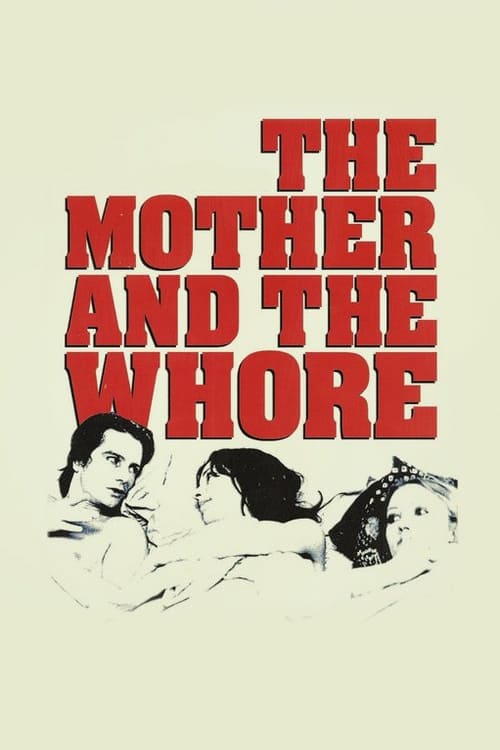
The Mother and the Whore
1973 · Jean Eustache
For a night when you want total immersion in other people's messy inner lives — a commitment, not a casual watch, best when you're ready to give a film your whole evening and let it wreck you a little.
What it's about
Alexandre, an unemployed young Parisian dandy, lives off his older girlfriend Marie while pursuing Veronika, a nurse whose bluntness about sex and love unsettles everything he thinks he believes. Over three and a half hours of café conversations, seductions, and confessions, the three of them talk their arrangement toward its breaking point.
The experience
Immersive and talky in a way almost no other film dares — you settle into its marathon conversations until the wit curdles and the raw pain underneath comes through. By the end it feels less like watching a love triangle than having lived inside one, exhilarating and bruising at once.
Performances
Jean-Pierre Léaud gives his defining adult performance as the preening, wounded Alexandre, while Françoise Lebrun's Veronika builds from wry deflection to one of the most searing monologues ever filmed; Bernadette Lafont grounds it all as the woman who pays for the men's games.
The craft
Eustache builds an epic almost entirely out of talk — dense, literary, confessional speech shot in stark black and white in real cafés and one cramped apartment. The austerity is the point: with nowhere else to look, every flicker of cruelty and need on the actors' faces registers like an event.
Why it matters
A Grand Prix winner at Cannes in 1973 and long hard to see, it became a legendary summing-up of the post-1968 generation — the film that pronounced the sexual revolution's hangover — and a lodestar for every filmmaker drawn to long, talk-driven intimacy.
Snapshot
The Mother and the Whore (La Maman et la Putain) is Jean Eustache's monumental, nearly three-and-a-half-hour chronicle of a Parisian love triangle in the exhausted aftermath of May 1968. Jean-Pierre Léaud plays Alexandre, an unemployed dandy who lives off his older lover Marie (Bernadette Lafont) while pursuing Veronika (Françoise Lebrun), a Polish-French nurse whose sexual candor eventually detonates the whole arrangement. Shot in stark black and white and built almost entirely from talk — dense, literary, confessional monologues delivered in cafés, on café terraces, and in a cramped Saint-Germain apartment — the film is at once a portrait of a specific bohemian milieu and a requiem for the utopian promises of the sexual revolution. It won the Grand Prix Spécial du Jury at Cannes in 1973 and is now routinely ranked among the greatest of all French films, though it spent decades hard to see because of rights and materials issues before a celebrated restoration returned it to circulation. It is Eustache's masterpiece and, in effect, his testament: he made only a handful of features and died by suicide in 1981.
Industry & production
The film was a low-budget independent production made outside the studio system, produced by Pierre Cottrell in association with Barbet Schroeder's Les Films du Losange — the same production house central to Éric Rohmer's Moral Tales, which situates Eustache squarely within the artisanal, auteur-driven wing of French cinema in the early 1970s. It was shot cheaply and quickly relative to its enormous length, relying on real interiors, real café locations in the Saint-Germain-des-Prés and Montparnasse quarters, and a small ensemble rather than sets or crowds. The economics were those of the post-New-Wave art film: minimal infrastructure, a director who was also a trained editor, and financing predicated on festival exposure and critical prestige rather than commercial forecasting.
Its reception at Cannes 1973 was the decisive industrial event of its life. The film scandalized part of the audience with its length, its sexual frankness, and its unrelenting verbal explicitness, yet it took the Grand Prix Spécial du Jury (the festival's second-highest honor that year) along with the international critics' FIPRESCI prize, which converted controversy into canonical standing. I would flag that precise budget and box-office figures for the film are not something I can state reliably, and I will not invent them; what is well established is that it was a modestly resourced production whose cultural impact vastly exceeded its means.
Technology
Technologically the film is deliberately austere, and that austerity is the point. It was photographed on 35mm black-and-white stock at a moment when color had become the commercial default, a choice that reads as both an economic decision and an aesthetic and elegiac one, tying the film to the monochrome of the early New Wave and of an older Parisian cinema. The production leaned on available-light and location shooting, portable enough to work inside actual cafés and a real apartment without elaborate lighting rigs.
The most consequential technical decision concerns sound: the film privileges direct, synchronous recording of the human voice above all else, with almost no non-diegetic scoring. Music enters the film through phonograph records that the characters physically play — Alexandre is forever putting a disc on the turntable — so that the film's "soundtrack" is a diegetic archive of French chanson and popular recording (Piaf, Damia, Fréhel, Zarah Leander and other period voices) rather than composed underscore. This makes the technology of reproduction — the record player, the recorded voice, even a tape recorder — part of the film's texture and its theme: these are characters who live surrounded by the mediated ghosts of earlier emotions.
Technique
Cinematography
The cinematography, by the distinguished Pierre Lhomme, is restrained to the point of self-effacement, which in context is a rigorous formal program rather than a lack of one. Lhomme favors long, largely static or minimally moving takes that hold on faces during their marathon speeches, letting the camera function as an attentive, almost documentary witness rather than an editorializing presence. The black-and-white photography is unglamorous and gray-toned, catching the flat light of café interiors and Parisian streets. Compositions frequently isolate a single speaker in close or medium framing, so that the film's drama is carried by the human face under the pressure of language; when two or three characters share the frame, the staging tends to register the physical and emotional distances between them without underlining. It is a photography of patience and attention, calibrated so that nothing distracts from the voice.
Editing
Editing is central to the film's identity, and not only because Eustache himself came out of the cutting room — his background as an editor informs everything. The credited editing work (with Denise de Casabianca among the collaborators) produced a film of roughly two hundred and twenty minutes whose rhythm is defiantly anti-commercial: scenes run far past the point where conventional cinema would cut, sustaining monologues at their full, unabridged length. The cutting favors duration and completeness over compression; rather than shaping performances into punchy exchanges, it preserves the real time of conversation, hesitation, and silence. Paradoxically, the film is not shapeless — the long takes are arranged into a deliberate accretion, so that the sheer accumulation of talk becomes structurally meaningful, wearing the characters (and the viewer) down toward the shattering final movement.
Mise-en-scène / staging
The mise-en-scène is theatrical in its concentration and cinematic in its observation. The film's world is small — cafés, a bed, a couple of rooms — and Eustache stages his actors within these confining spaces so that the geometry of the triangle becomes physical: who sits where, who shares the bed, who is left standing or excluded. The famous café terrace becomes a stage for Alexandre's performances of himself; the bedroom becomes the site where the triangle's contradictions can no longer be verbally managed. Props are charged — books, records, cigarettes, drinks — as the paraphernalia of a self-consciously literary bohemia. The staging never opens out into spectacle; it presses inward, matching the claustrophobia of three people locked in an arrangement none of them can sustain.
Sound
Sound design amounts to a philosophy. The primacy of direct-recorded speech gives the film a raw, present-tense intimacy, and the near-absence of scored music means that emotion is never cued from outside — it must be produced by the voice and then, occasionally, punctuated by a chosen record. Silence and the ambient noise of cafés carry real weight. When a song plays, it is because a character has decided to play it, so that music becomes an act of self-dramatization or consolation within the fiction. This discipline reaches its apex in Veronika's climactic monologue, where the human voice, unaccompanied and unspared, becomes the film's total expressive instrument.
Performance
The performances are the film's glory. Jean-Pierre Léaud, the living emblem of the New Wave, gives a portrait of mannered, parasitic charm curdling into helplessness — his Alexandre is all quotation, pose, and evasion, a man who has substituted talk for living. Bernadette Lafont, herself a New Wave icon, brings warmth, tolerance, and a wounded generosity to Marie, the provider who endures. The revelation is Françoise Lebrun as Veronika, in effect making her screen debut: her long, drunken, devastating final speech about sex, love, degradation and the wish for a child is one of the most harrowing pieces of acting in European cinema, and it reframes the entire film retroactively as her story. The ensemble's apparent spontaneity is, famously, an illusion produced by exacting fidelity to a fixed script.
Narrative & dramatic mode
The dramatic mode is conversational, confessional, and anti-plotted. Very little "happens" in the mechanical sense: there are no reversals of fortune, no external stakes, no genre machinery. The narrative advances through talk — seduction, self-justification, jealousy, theorizing about love — until language itself collapses under the accumulated weight of feeling it cannot resolve. Structurally the film front-loads Alexandre's verbal command and slowly transfers moral and emotional authority to the women, culminating in Veronika's monologue, which functions as the true climax and the film's ethical center of gravity. It is a drama of exhaustion rather than crisis: the "unsustainable affair" of the synopsis does not so much explode as grind itself down, arriving at a place of raw exposure where the poses have all failed. The mode is closer to the confessional novel and to a certain literary realism than to conventional screenwriting.
Genre & cycle
Nominally a drama and a romance, the film belongs more precisely to the tradition of the French chamber film of talk and manners, and it can be read as a scalding late entry — or an anti-entry — in the lineage of Rohmer's Moral Tales, sharing that cycle's producer and its interest in men who talk endlessly about desire while betraying it. But where Rohmer's men are ironized from a cool distance, Eustache's are dissected without mercy. The film also participates in the post-1968 cycle of French cinema reckoning with the political and erotic disappointments of the era. It effectively founds a genre of its own: the maximalist dialogue film, in which extreme duration and verbal density are the aesthetic. In that sense it stands slightly apart from any tidy cycle, a singular work that later films would treat as a genre unto itself.
Authorship & method
This is one of the most nakedly personal films in the auteur tradition, and its method is inseparable from its authorship. Jean Eustache (1938–1981) wrote and directed it, drawing closely and painfully on his own romantic life; the dialogue that sounds so improvised was in fact scripted with obsessive precision, and Eustache is reported to have required his actors to speak it verbatim, forbidding improvisation, so that the film's documentary spontaneity is a constructed effect. This tension — total control producing the appearance of total looseness — is the signature of his authorship. His key collaborators shaped that vision without diluting it: cinematographer Pierre Lhomme supplied the film's disciplined, witnessing image; the editing (with Denise de Casabianca) realized its radical durational rhythm; and the casting of Léaud, Lafont and Lebrun folded the actors' own cultural and biographical resonances into the roles. On music there is no conventional composer to credit, since the score is an assembled archive of pre-existing recordings — itself an authorial choice about memory and reproduction. Eustache's broader body of work — documentaries and quasi-documentaries like La Rosière de Pessac, the autobiographical Mes petites amoureuses — confirms the same commitment to the real transmuted through rigorous form. The film is haunted, too, by biography beyond the frame: it drew on Eustache's relationships, and Eustache's own life ended by suicide less than a decade after its release, which has inevitably colored its reception as a work of terminal sincerity.
Movement / national cinema
The film is a product and a critique of the French New Wave's afterlife. Eustache belonged to the generation that came up around Cahiers du cinéma and the New Wave without being one of its founding directors, and The Mother and the Whore both honors and buries that movement. Its casting is a deliberate act of film history: Léaud carries the memory of Truffaut's Antoine Doinel and of Godard, while Lafont evokes Chabrol's and Truffaut's early films, so that the New Wave's own icons are enlisted to play the disillusioned survivors of their moment. The film's monochrome, its location shooting, its café culture, and its literary self-consciousness are all New Wave inheritances, but they are turned toward a mood of depletion the early New Wave never had. As French national cinema it is intensely Parisian, rooted in the intellectual bohemia of the Left Bank, and it functions as a cultural document of a particular class and place at a particular hour.
Era / period
Its period is precisely and inescapably the early 1970s, the hangover after May 1968. The film registers the collapse of revolutionary and erotic hopes into private confusion: the barricades have given way to café tables, collective politics to solipsistic talk about feelings, free love to jealousy and disease of the spirit. The old songs on the phonograph belong to earlier eras — the pre-war and wartime French popular tradition — and their presence sets the characters' modern rootlessness against a remembered cultural past, deepening the sense of a generation stranded between a discredited utopia and an unavailable tradition. Few films locate themselves so exactly in the emotional weather of their moment.
Themes
At its core the film interrogates the Madonna/whore dichotomy encoded in its title, only to expose it as a masculine fantasy that fails everyone: Marie, the "mother," is the maternal provider Alexandre exploits; Veronika, the "whore," is the sexually free woman he cannot honor — yet the film grants both women a moral seriousness that shreds the very categories the title invokes. Related themes proliferate: the parasitism and passivity of a certain kind of intellectual man; the exhaustion of language, as talk becomes a substitute for love and finally for life itself; the disappointments of the sexual revolution, and the loneliness underneath its freedoms. Veronika's final speech pulls in questions of degradation, tenderness, and the longing for a child, insisting that sex severed from love becomes unbearable — a startlingly conservative cry from within a libertine world. Memory, cultural and personal, runs through the diegetic music. And over the whole film hangs mortality and despair, an undertow that later biographical knowledge has only intensified.
Reception, canon & influence
Critical reception moved from scandal to veneration. At Cannes in 1973 the film divided viewers and provoked walkouts and outrage even as the jury and the international critics honored it, and its length and explicitness kept it controversial. Over the following decades its reputation only grew, and it is now regularly named among the greatest French films ever made and cited in international critics' polls of the best films of all time — a standing made more poignant by its long inaccessibility, since rights and materials problems kept it from easy viewing until a widely praised restoration brought it back to screens and to home video.
Looking backward, the influences on the film include the New Wave's methods and icons, the Rohmerian tradition of talky moral inquiry (via the shared Films du Losange orbit), the confessional and analytical French literary novel, and the documentary impulse of Eustache's own earlier work, all fused with the direct-cinema value placed on the unadorned recorded voice. Looking forward, its legacy is enormous and specific: it effectively legitimized the maximalist dialogue film and became a touchstone for later directors of talk and intimacy. Its DNA is widely felt in the work of French filmmakers such as Philippe Garrel, Arnaud Desplechin and Olivier Assayas, and it is frequently invoked as an ancestor of the American conversation film — the long-take, real-time verbal intimacy later associated with directors like Richard Linklater and Noah Baumbach. More than a period piece, it endures as the definitive cinematic anatomy of post-1968 disenchantment and as proof that a film built almost entirely of talk can achieve tragic force.
A Deleuzian reading
A hand lowers a needle onto a record.
The full Deleuzian reading of The Mother and the Whore →
Reception
It scandalized Cannes 1973 — walkouts, press outrage, and a jury (presided over by an unamused Ingrid Bergman) that still handed it the Grand Prix — and is now routinely called the definitive French film of the post-'68 era, a canonization sealed by its 2022 restoration and triumphant re-release.
How The Mother and the Whore was received, from release to now →
How to watch The Mother and the Whore: what to notice on a first viewing
- Watch how long the camera holds on one face talking. Lhomme's camera stays largely static, holding on a single speaker through an entire monologue instead of cutting to reactions or other angles. The camera acts like an attentive witness rather than an editor telling you what to feel about what you're hearing.
- Listen for when a character decides to play a record. The film carries almost no score. When music appears it is because someone onscreen has physically put a record on, not because the film wants you to feel something. Music becomes something a character chooses to do, not a mood the film hands you from outside the story.
- Notice who sits, who stands, and who shares the bed. Eustache stages the triangle inside cafés, a bed, and a couple of small rooms, so where each person sits or stands becomes the shape of the relationship. The arrangement is legible in the seating before anyone says a word about who belongs where.
- Watch Alexandre perform himself even alone with a friend. Léaud plays Alexandre as pure quotation and pose, talking about love and jealousy the way someone recites lines he half remembers. He has substituted talk for living, and the film lets you watch that substitution happen in real time.
- Notice scenes keep running long after you expect a cut. Eustache sustains conversations at their full, unabridged length instead of shaping them into punchy exchanges, letting hesitation and silence run their real course. The accumulation of ordinary, unedited time is not padding; it is what slowly wears the characters down.
The whole guide to watching The Mother and the Whore, with the keys for a rewatch →
Influences: the films it descends from and the films it influenced
- The 400 Blows (1959) — Eustache's casting of Jean-Pierre Léaud deliberately imports the actor's accreted Antoine Doinel persona, so Alexandre's self-mythologizing reads as the New Wave's boy-hero curdled into a talker — a biographical-resonance casting method the film inherits directly.
- Masculin Féminin (1966) — Godard's use of Léaud in long direct-sound scenes of young Parisians talking politics and sex — quasi-interview, sync-recorded, unscored — establishes the recorded-voice-as-document technique Eustache pushes to feature-length maximalism.
- Ma nuit chez Maud (1969) — From the shared Films du Losange orbit comes the nocturnal chamber dialectic — an entire film built as a real-time moral conversation between a man and women, staged in confined rooms with talk as the sole event.
- Chronicle of a Summer (1961) — The direct-cinema faith in the unadorned synchronous voice — subjects confessing to camera with no score, the microphone as instrument of truth — is the documentary substrate Eustache transmutes into scripted confession that only sounds captured.
- L'Amour fou (1969) — Rivette's four-hour durational portrait of a couple decomposing in a single apartment legitimizes the radical running-time-as-form and the long-take endurance of intimate crisis that Eustache's 3.5-hour structure extends.
- The Fire Within (1963) — Extends the lucid, unmelodramatic portrait of Parisian bohemian-bourgeois paralysis, anchored in a single self-destructive male performance filmed in long, patient monochrome takes.
- Stolen Kisses (1968) — Takes the same actor and the same café-and-staircase Paris, then inverts the central technique — Truffaut's elisions replaced by unbroken real-time monologue — so the charm of the persona is exposed as evasion.
- Husbands and Wives (1992) — Allen's handheld, overlapping-talk verité about couples confessing infidelity — with faux-documentary interview inserts breaking the fiction — extends the scripted-to-sound-improvised confessional register into American intellectual comedy of talk.
- Cold Water (1994) — Assayas, an explicit heir, sustains long unbroken takes of youth adrift in post-68 disenchantment, prizing the durational real over plot — the Eustachean legacy of duration-as-emotional-truth.
- My Sex Life... or How I Got Into an Argument (1996) — Desplechin builds a three-hour edifice of intellectual Parisians' dialogue-maximalism — talk about love, jealousy and philosophy as the film's entire action — a direct structural descendant of Eustache's anti-plotted talk.
- Regular Lovers (2005) — Garrel films the post-68 hangover in luminous black-and-white long static takes with near-silent sound design, casting his own son to carry generational biography — the exact Eustachean fusion of B&W duration and personal myth.
- Before Sunrise (1995) — Linklater's near-real-time walking-and-talking structure, where two people's continuous scripted-to-sound-spontaneous conversation IS the film, is the American conversation-cinema that critics trace straight back to Eustache.
- Before Sunset (2004) — Compressed to a single unbroken afternoon in long ambulatory takes with no score, it perfects the real-time verbal-intimacy device — talk in continuous duration standing in for an entire relationship's history.
- Frances Ha (2012) — Baumbach shoots contemporary New York in New Wave-homage black-and-white, foregrounding rapid confessional dialogue and using pre-existing recorded music as an assembled emotional archive rather than an original score — both Eustachean signatures.
- Marriage Story (2019) — The film's dramatic peaks are sustained, near-uninterrupted dialogue confrontations in confined rooms where the writing's precision must read as raw spontaneity — the controlled-scripting-producing-looseness paradox that defines Eustache's method.
- Summer Hours (2008) — Post-New-Wave naturalism built on conversation-driven rhythm and trust in real duration and contingent space, the talk-and-time aesthetic Assayas inherits from the Cahiers tradition.
- Shame (2011) — Long, unhurried takes of sexual frankness and post-coital emptiness model the durational candor about desire and the talk-driven mapping of intimacy disorder.
- Peter Hujar's Day (2025) — Talk-saturated chamber realism where performance and listening carry the entire running time, modeling how unhurried monologue becomes the dramatic engine.
- The Green Ray (1986) — Demonstrates post–New Wave that emotional truth can be built from talk in real duration and long takes, dialogue that feels caught rather than written, licensing Rohmer's plotless accretion.
- Mes petites amoureuses (1974) — Eustache's own next feature applies the identical method — Pierre Lhomme–style disciplined witnessing image, obsessively scripted 'documentary' naturalism, autobiography transmuted through static observation — confirming the technique as authorial rather than one-off.
- Scenes from a Marriage (1973) — Released the same year, it independently arrives at chamber-confinement talk-cinema: relationships anatomized through sustained two-person dialogue takes in enclosed rooms, dialogue carrying all dramatic weight with the score nearly absent.
- The Day He Arrives (2011) — Hong's black-and-white static long takes of a filmmaker drinking and delivering circling, confessional monologues about women — dialogue as the whole event, score nearly absent — is a parallel non-French elaboration of the chamber talk-film.
- Last Tango in Paris (1972) — Eustache, again starring Léaud, extends the plotless modernist melodrama of erotic talk — long improvised confessional monologues, withheld exposition, sex as endless verbal self-analysis — in the same post-New-Wave register.
- Out 1 (1990) — Casts Léaud again and delivers post-May-68 disillusion through real-time, near-unbroken talk scenes of extreme duration, prizing accretion over dramatic compression.
- La Belle Noiseuse (1991) — Post-New-Wave chamber cinema at three-and-a-half hours built from long direct-sound takes in a few rooms, where the running time is the form and the audience's endurance is part of the transaction.
Similar films
- Masculin Féminin (1966) — influence & lineage · same viewing thread
- L'Amour fou (1969) — influence & lineage
- Chronicle of a Summer (1961) — influence & lineage
- Vivre Sa Vie (1962) — same viewing thread · often watched together
- La Notte (1961) — same viewing thread
- Cléo from 5 to 7 (1962) — same viewing thread
- Pierrot le Fou (1965) — same viewing thread
- L'Eclisse (1962) — same viewing thread
All the films related to The Mother and the Whore →
Watch it with: curated runs of related films
- Adrift in the Modern World — Watch these when you want to drift through postwar Rome and Paris alongside people who have everything and feel nothing — they rhyme on beautiful boredom, aimless days, and a search for meaning that modern comfort keeps failing to supply.