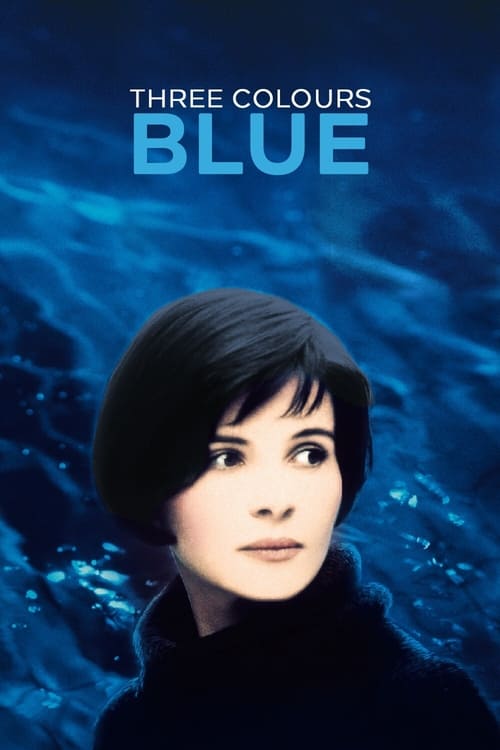
Three Colors: Blue
1993 · Krzysztof Kieślowski
For a solitary, reflective night when you want to sit with grief and come out the other side — when you need a film that takes sorrow seriously and finds grace in it. A gentle challenge, and one of the great films to watch alone.
What it's about
A woman survives the car crash that kills her husband, a famous composer, and their young daughter. Instead of grieving, she tries to erase her life entirely — selling the estate, moving to an anonymous Paris flat, cutting every tie — only to find that music, memory, and other people keep pulling her back, including a stranger from her husband's hidden life.
The experience
Quiet, immersive, and piercing — the film puts you inside one woman's numbness so completely that when feeling breaks through, in a swell of music or a flood of blue light, it hits with physical force. It's sad but never wallowing; it leaves you tender rather than wrecked.
Performances
Juliette Binoche gives a nearly wordless masterclass — whole movements of grief played in her face, in how she swims, walks, refuses to cry. It's one of the defining performances of 1990s European cinema.
The craft
Kieślowski turns color and music into the film's real language: blue light washes over scenes like a memory surfacing, the screen sometimes goes dark mid-moment, and the dead husband's unfinished score keeps erupting into the soundtrack as if it refuses to be destroyed. It's a film to watch with good sound and no distractions.
Why it matters
The opening panel of the Three Colors trilogy and a peak of European art cinema in the 1990s — it won the Golden Lion at Venice and fixed Binoche's international stature. Its way of scoring grief has echoed through intimate dramas ever since.
Snapshot
The first panel of Kieślowski's Three Colors trilogy — Liberty, Equality, Fraternity, one film per word — Blue is among the most rigorous studies of grief in European cinema. Juliette Binoche plays Julie Vignon de Courcy, who survives a road accident that kills her husband, the celebrated composer Patrice, and their young daughter Anna. Rather than mourning in any conventional sense, Julie undertakes a project of radical self-erasure: she abandons the family estate, rents an anonymous Paris flat, destroys Patrice's unfinished manuscript, and attempts to hollow out every attachment — emotional, social, mnemonic. The film tracks the failure of that project. Memory, music, and other people keep breaking through. The title's blue is not melancholy as decoration; it is the very medium in which the film thinks.
Industry & production
Blue is a French-Polish co-production, developed through Marin Karmitz's Paris-based MK2 Productions alongside TF1 Films Production and Zespół Filmowy "Tor" in Poland. Karmitz had championed Kieślowski's work in France and was instrumental in assembling the financing and distribution infrastructure for all three trilogy films, which were conceived, cast, and partly shot concurrently — though released separately across 1993 and 1994. The French setting and French-language dialogue reflected both commercial strategy (positioning the films for Cannes and César circuits) and a genuine shift in Kieślowski's late-career geography: he had relocated much of his creative operation to Paris following the success of The Double Life of Véronique (1991). Specific production budgets have not been widely published; the films were mid-scale European art productions by the standards of the period.
Technology
Blue was shot on 35 mm. Cinematographer Sławomir Idziak, who had worked with Kieślowski on earlier Polish television films and features, deployed a set of custom-graduated and color-filtering lenses that saturate frames with cool blue while leaving other tones relatively naturalistic. The technique is selective rather than totalizing: blue flares off surfaces — a glass chandelier, a swimming pool, a sugar cube slowly absorbing coffee — and the effect reads less as stylization than as perceptual interiority, the color of the consciousness we are inside. The underwater pool sequences required specialized housing and careful lighting design to sustain focus and color at depth. Post-production included a distinctive optical effect — a gradual fade to full black between certain scenes — achieved in the laboratory rather than in-camera, giving these transitions a somatic quality distinct from a standard cut or dissolve.
Technique
Cinematography
Idziak's framing is unusually intimate even for close-up-heavy European art cinema. Binoche's face is often held in extreme close-up — an eye, a cheek, the movement of breath — so that the screen becomes almost haptic. At the same time, Idziak and Kieślowski observe a discipline of withholding: the car crash that opens the film is shown from an enormous distance, the camera refusing the spectacle of impact, and subsequent scenes that convention would render dramatically visible (the funeral, for instance) are elided entirely. The pool sequences are composed with a care for negative space — the blue rectangle of water, a lone swimmer, the geometry of lanes — that renders pure isolation as landscape.
Editing
Jacques Witta edited Blue. The film's most distinctive editorial signature is the micro-blackout: a complete fade to black lasting one to three seconds, recurring throughout the film at moments when Julie attempts to suppress sensation or memory. These are not transitions between sequences in the conventional sense; they function as punctuation within scenes, representing an act of interior will — the mind attempting to go dark — that the next image immediately defeats. The editing also governs the intrusion of music: Preisner's orchestral passages cut in without diegetic preparation, as if playing inside Julie's skull, then are truncated mid-phrase when she consciously refuses to hear them. This rhythmic withholding and reinstatement of sound across the cut is among the film's central formal strategies.
Mise-en-scène / staging
Kieślowski stages the film around a handful of carefully chosen spaces — the sterile hospital room, the rented Paris apartment (minimal, deliberate), the street café, the swimming pool, a lawyer's office, a rehearsal hall — and treats each as a territory of psychological negotiation rather than mere setting. Props carry enormous weight: the blue glass chandelier that Julie brings with her as the sole personal object is at once a remnant of former life and a tool of self-torment, its refracted light appearing and reappearing throughout. The sugar cube scene — Julie watches it absorb coffee, rapt, momentarily pulled out of numbness into simple sensation — is characteristic of Kieślowski's staging: a negligible object, a close-up, duration, and the sudden revelation of a character not yet dead to the world.
Sound
The sound design by Jean-Claude Laureux operates in intimate collaboration with Preisner's score. The film uses an early, barely audible flute phrase to signal the impending eruption of the unfinished Concerto — a musical "intrusion" motif that functions like a symptom, returning before Julie has consciously summoned it. Ambient sound is similarly heightened: the scratch of a fork across a glass bowl, the sound of footsteps in an empty corridor, the mechanical noise of the hospital, the splashing of the pool. At key moments all ambient sound drops out and only the score remains, inverting the usual hierarchy and making the orchestra sound less like accompaniment than like the mind's own weather.
Performance
Binoche's performance is largely composed of suppression. The outward signs of grief — tears, trembling, verbal testimony — are withheld; what we read instead are incremental micro-expressions, small physical capitulations, the way the body betrays an interior it has been ordered to shut down. The performance demands that an audience project feeling onto apparent blankness, then catches them doing it when some tiny gesture — the swallowing, the pause before answering a question — confirms the emotion is there. Benoît Régent as Olivier, the collaborator who loves Julie, is given less room but calibrates his suppression of desire against hers with precision. Florence Pernel and Charlotte Véry, as Sandrine (Patrice's mistress) and Lucille (Julie's neighbor, a sex worker), embody alternative modes of living with desire that the film places in implicit dialogue with Julie's chosen anesthesia.
Narrative & dramatic mode
Blue works in what might be called a phenomenological register: the film's primary subject is not event but experience, specifically the texture of grief as it inhabits a body that is attempting to refuse it. Plot — the discovery of Sandrine, the question of who really composed the Concerto — is present but functions less as story engine than as a series of external pressures that force Julie's interiority into contact with the world. The film has almost no expository dialogue; backstory is delivered through inference and object. Kieślowski and his co-writer Krzysztof Piesiewicz wrote across all three trilogy scripts simultaneously, embedding cross-film echoes (characters appear briefly in adjacent films) that reward viewers who encounter the trilogy as a unit while remaining entirely self-contained for those who do not.
Genre & cycle
Blue belongs to the European art film lineage — psychologically dense, formally reflexive, skeptical of genre resolution — but also fits within a distinct sub-tradition of what might be called the mourning film, where grief becomes a formal as well as thematic problem (Bergman's Scenes from a Marriage, Akerman's Je tu il elle, later films like Hamaguchi's Asako I & II share something of this orientation). Within Kieślowski's own filmography, it is the culmination of a long-developing interest in psychological interiority that runs from the Dekalog (1988) episodes through Véronique. The trilogy as a cycle is unusual in European cinema for its systematic, declared conceptual architecture (three films, three colors, three words of the Republic's motto) executed at feature length without genre scaffolding.
Authorship & method
Kieślowski and Piesiewicz had developed a close collaborative method across the Dekalog and subsequent work: Piesiewicz would research and draft, Kieślowski would reframe and reimagine in visual terms, and the two would iterate in conversation. By the trilogy, the scripts were polished to an extreme economy — what remained on the page was almost always what appeared on screen. Sławomir Idziak as cinematographer was a longstanding collaborator; his optical experiments with filtration had been present in nascent form as far back as Kieślowski's Blind Chance (1987, though released 1987 in Poland after years of censorship). Zbigniew Preisner, who had scored Kieślowski's films since No End (1985), contributed a score of near-operatic scope: the Concerto for the Unification of Europe is a substantial choral-orchestral work that the film treats as a diegetic object (a manuscript being completed), a psychological force, and a formal structural spine simultaneously. Preisner had developed with Kieślowski the recurring fictional attribution of music to "Van den Budenmayer," a fictitious 18th-century Dutch composer whose "work" appears across Véronique and the trilogy; in Blue this conceit is folded into the film's central moral question about authorship and grief.
Movement / national cinema
Kieślowski's Blue is simultaneously a Polish film and a French film — institutionally French, culturally bicultural. The Polish New Wave of the 1970s and early 1980s, of which Kieślowski (alongside Andrzej Wajda and Agnieszka Holland) was a leading figure, had been defined by political allegory and social realism under censorship; by the trilogy, the political context had shifted dramatically (the Iron Curtain had fallen), and Kieślowski's work had moved decisively toward metaphysical and psychological terrain. Blue can be situated within a French auteur tradition of Parisian interior drama — Bresson is an acknowledged reference point — while also embodying something distinctly Eastern European in its spiritual seriousness and its comfort with silence. The film's France is not the France of the New Wave or the Tradition of Quality; it is the France of philosophical abstraction, of the Declaration's words taken as genuine problems.
Era / period
The film appeared in 1993, the year the Maastricht Treaty entered into force and the European Union formally came into being — a conjunction that made the film's central conceit (a "Concerto for the Unification of Europe") legible as political commentary as well as private grief. The early 1990s were a moment of particular vitality in European art cinema: Kieslowski, Haneke, Egoyan, and others were producing formally ambitious, philosophically dense work that found international festival and art-house audiences without requiring genre hooks. The trilogy rode and helped constitute this moment.
Themes
Liberty — the film's assigned theme — is understood not as political freedom but as existential self-determination, and the film's argument is that such determination is finally impossible: human beings cannot sever themselves from others, from memory, or from what they have made. Music is the primary figure for this impossibility; the Concerto keeps returning regardless of Julie's will. Memory is treated as involuntary and sensory — triggered by the chandelier's light, by a sugar cube — rather than as voluntary recollection. Grief is examined as a project of self-abolition and found to be self-defeating. The film also engages, obliquely, with questions of authorship: if Julie completed the Concerto, who made it? The unresolved ambiguity about what Patrice composed and what Julie contributed mirrors a broader dissolution of singular, possessive identity.
Reception, canon & influence
Blue premiered at the Venice Film Festival in September 1993 and won the Golden Lion (top prize), along with the FIPRESCI Prize and the Volpi Cup for Best Actress (Binoche). It subsequently won three César Awards including Best Film, Best Director, and Best Actress. Idziak received an Academy Award nomination for Best Cinematography — one of the most substantive Oscar recognitions the film received in the American market. Critical reception was overwhelmingly positive across European and North American press; the film was consistently cited as among the finest European productions of the decade.
Influences on the film (backward): Robert Bresson's formal asceticism and his treatment of spiritual crisis through physical gesture are a visible presence throughout, particularly in the handling of objects and the suppression of conventional dramatic affect. Michelangelo Antonioni's studies of bourgeois interiority and psychological withdrawal — L'Eclisse, La Notte — provide a structural precedent for the interior-drama-as-formal-problem. Ingmar Bergman's deployment of the close-up as psychological instrument, especially in Persona and Face to Face, inflects Idziak's camera work. Preisner's score, and the idea of music as uncontrollable psychological force, owes something to the role of music in Alain Resnais's Hiroshima mon amour.
Legacy and forward influence: The trilogy as a whole became a reference point for serious festival cinema in the 1990s and consolidated the international reputation of the Polish school of filmmakers. Binoche's performance influenced a generation of actresses working in European art film — particularly the mode of composed, suppressive interiority as opposed to expressive performance. Preisner's score entered the canon of late-20th-century film music and is still performed in concert. The trilogy's formal device of color-as-theme was echoed (rarely with equal discipline) by subsequent filmmakers. More broadly, Blue helped establish that European co-production — with French institutional infrastructure, Eastern European creative personnel — could generate work of the first international rank, a model that proved durable into the 2000s. Kieślowski announced his retirement after Red (1994), and died in 1996; Blue is therefore not only a great film but a near-closing statement, and is read accordingly.
A Deleuzian reading
A sugar cube touches the surface of a coffee and goes dark from the corner inward.
The full Deleuzian reading of Three Colors: Blue →
Reception
No rehabilitation needed — it won the Golden Lion at Venice in 1993 and has only climbed since, going from 'acclaimed European art film' to the consensus pick as the crown jewel of the Three Colours trilogy and a fixture of 90s-best lists.
How Three Colors: Blue was received, from release to now →
Influences: the films it descends from and the films it influenced
- Pickpocket (1959) — Bresson's model-direction system — drilling performers to suppress facial expression until the face becomes a neutral surface from which interiority must be inferred — is the formal ancestor of Binoche's suppression-based technique, explicitly cited by Kieślowski as his primary performance model.
- Au Hasard Balthazar (1966) — Bresson's discipline of filming around moments of maximum dramatic charge rather than into them — deaths occurring off-frame, grief registered through averted bodies and ambient sound — is the direct model for Kieślowski's refusal to show the crash impact, the funeral, or the child's body.
- Viaggio in Italia (1954) — Rossellini's phenomenological structure — a woman's interior state tracked through encounters with physical space and strangers rather than through plot causality — establishes the mourning-film template Blue inherits: grief as perceptual wandering without narrative resolution.
- Cries and Whispers (1972) — Nykvist's systematic saturation of the frame in a single primary color as a medium of consciousness — red as the film's psychological register, achieved through filtering and set design rather than total stylization — establishes the technique Idziak inherits and converts to blue.
- India Song (1975) — Duras structures the film's emotional logic around a waltz that erupts without diegetic source and recedes without resolution, functioning as symptom rather than accompaniment — the direct formal ancestor of Preisner's intrusion motif in Blue.
- Jeanne Dielman, 23 quai du Commerce, 1080 Bruxelles (1975) — Akerman's technique of applying sustained duration to domestic objects and routine tasks until they yield psychological weight — a potato peeling, a dish held in close-up past comfort — directly precedes Kieślowski's sugar cube and chandelier scenes as prop-as-psychology staging.
- The Double Life of Véronique (1991) — Idziak's custom graduated color-filtering lenses and Preisner's Van den Budenmayer method — orchestral music erupting without diegetic grounding as a figure of interiority — are both first systematically deployed here, making Véronique the direct technical laboratory for Blue's two central formal devices.
- Decalogue I (1989) — Preisner's hymnal score is promoted to a structuring narrative device—grief measured in surges of music and fades to black—extending Decalogue I's use of withholding editing and sacred sound.
- A Short Film About Killing (1988) — Extends the Preisner partnership into score-as-structure and the color-filtered image as moral atmosphere, the durational-immersive style matured for the French trilogy.
- A Short Film About Love (1988) — Structures the narrative around Preisner's score as a co-narrating authorial voice, maturing the composer-as-collaborator method rehearsed here.
- In the Mood for Love (2000) — Wong deploys Umebayashi's 'Yumeji's Theme' as an intrusion cut — the waltz begins mid-shot without preparation over slow-motion corridor imagery — applying Kieślowski's music-intrusion-cut technique to romantic grief; Doyle and Lee's warm color-filtering cinematography extends the color-as-interiority approach to a different affective register.
- Morvern Callar (2002) — Ramsay routes the soundtrack entirely through Morvern's Walkman, making technically diegetic music function as non-diegetic score-as-interiority — cutting in and out without preparation in direct application of Preisner's intrusion method — while the female mourner's project of deliberate self-erasure is structurally derived from Blue.
- Eternal Sunshine of the Spotless Mind (2004) — Gondry and editor Valdís Óskarsdóttir use complete fades to black within scenes as punctuation for the mind going dark during erasure — adopting Witta's micro-blackout as an editorial unit representing interior will — and render involuntary memory intrusions as sudden chromatic ruptures across cuts.
- Caché (2005) — Haneke radicalizes Kieślowski's withheld-spectacle principle by filming the film's central act of violence as surveillance footage from maximum distance, the camera refusing close-up access to the dramatic peak on the same formal logic as Blue's car crash observed from across the road.
- 35 Shots of Rum (2008) — Denis and Godard stage the film around four or five domestic objects — the rice cooker, the taxi, the diploma — applying Agnès Godard's extreme close-ups to negligible props until they carry the full weight of character relationships, extending Kieślowski's prop-as-psychology technique into a different social and tonal register.
- Bright Star (2009) — Greig Fraser's haptic cinematography — extreme close-ups on textile textures, skin surfaces, and physical detail — extends Idziak's use of the close-up as near-tactile perceptual contact; Campion also applies Kieślowski's withheld-spectacle discipline (Keats dies offscreen, rendered only through a letter read aloud).
- I Am Love (2009) — Guadagnino deploys color-filtering lenses to saturate interiors as a medium of awakening interiority and uses John Adams' score as an intrusion cut — orchestral passages entering mid-scene without diegetic grounding — directly applying both of Blue's central formal devices in a declared homage to Kieślowski.
- All About My Mother (1999) — Kieślowski's use of a circular melodic fragment (Van den Budenmayer's unfinished concerto) that returns involuntarily to overwhelm a grieving woman demonstrates how non-diegetic music can structure emotional memory across an anti-therapeutic arc, directly prefiguring Alberto Iglesias's recurring melodic motifs for Manuela's grief.
- Oldboy (2003) — Preisner's unfinished concerto surfaces unbidden into Julie's consciousness as an intrusive sonic presence she cannot suppress; Oldboy's piano waltz leitmotif operates identically — a melodic fragment that ambushes characters and viewers alike as a perceptual marker of psychological state, sound crossing the boundary between diegetic and interior.
- Gattaca (1997) — Idziak's second Kieślowski collaboration refines the extreme macro close-up of physical debris as evidence of interior states — shattered car glass, a dropped medication — which Niccol and Idziak directly transpose into Gattaca's recurring shots of eyelashes, fingernail clippings, and hair as surveillance objects that reduce personhood to data.
- Lady Vengeance (2005) — Kieślowski's technique of indexing a single dominant color to a sustained psychological state across an episodic character-sketch structure — one color encoding one moral condition — is the formal predecessor of Park's trilogy logic and Lady Vengeance's color-as-performance-index coding.
- Beanpole (2019) — Pre-production chromatic system where a single dominant hue carries psychological weight as dramaturgy rather than decoration — the European arthouse practice Balagov and Sereda systematize into their pre-visualized green-and-red palette.
- The Piano (1993) — Nyman's score functions as Ada's interiority by cutting in and out of scenes without diegetic grounding — the same score-as-interiority logic as Preisner's music in Blue — while Hunter's suppression-based performance renders maximum psychological pressure through minimal expression on the identical formal premise as Binoche's.
- Three Colors: Red (1994) — Establishes within the trilogy both Preisner's diegetic/extradiegetic score blur — music characters seem to half-hear from an otherworldly source — and Witta's editorial language of meaning-driven, unhurried cross-cutting that Red's structure inherits.
- Faraway, So Close! (1993) — Sibling: contemporaneous European art cinema fusing a composer's score into the narrative fabric and using sound-bridges and subjective audio to render an interior, near-metaphysical state.
- The Sweet Hereafter (1997) — Music-cued elliptical editing dramatizes a mother's grief for a dead child through fracture and withholding rather than melodrama, the 1990s art-cinema mode Egoyan shares.
- Hit the Road (2021) — Uses pre-existing/loaded musical cues as the emotional payload that carries grief the dialogue withholds, the needle-drop sensibility Panahi deploys with Persian pop songs the family sings.
- Decalogue V (1989) — Idziak returns as cinematographer to make a single saturated color carry moral and emotional meaning — the optical-filtration-as-argument principle of the jaundiced green pushed to its purest form, scored again by Preisner.
- Damage (1992) — Preisner's method carried across from Damage — a score that withdraws entirely from the film's most intimate passages and then returns as an interruption — coupled again with a car crash elided at the moment of impact.
- Exotica (1994) — Cuts and blackouts timed to musical phrase rather than dramatic beat, letting the score dictate where the edit falls in a story of a parent surviving a child's death — the same music-as-structure logic behind Danna's cues carrying Exotica's transitions.
- Three Colors: White (1994) — Runs the same interruption device from the opposite pole — Blue's mid-scene fade to black that returns to the identical frame is answered by White's overexposed whiteout flash — and shares the Preisner forward-composed score plus the courtroom cameo that knots the two films together.
Similar films
- The Double Life of Véronique (1991) — influence & lineage
- Three Colors: Red (1994) — shared sensibility
- Three Colors: White (1994) — shared sensibility
- Blue (1993) — shared sensibility
- Blue Is the Warmest Color (2013) — shared sensibility
- Maborosi (1995) — shared sensibility
- Rendez-vous (1985) — shared sensibility
- Repulsion (1965) — shared sensibility
All the films related to Three Colors: Blue →