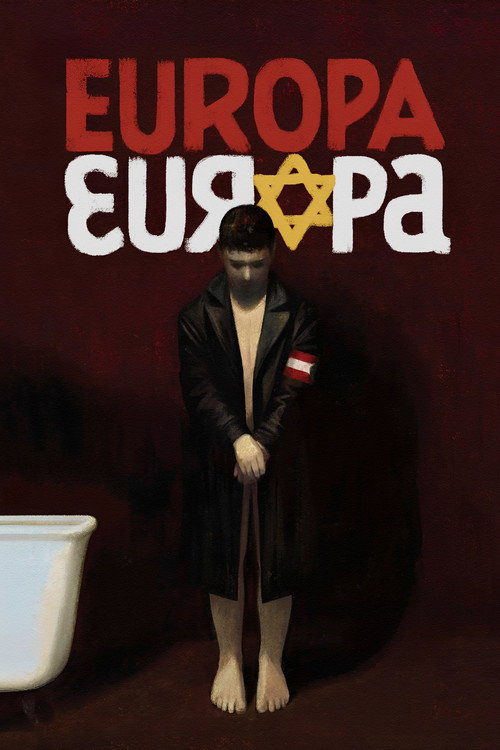
Europa Europa
1990 · Agnieszka Holland
Green Border was denounced by Poland's then-government in Nazi-propaganda terms, with a state-mandated disclaimer before screenings — the starkest filmmaker-versus-state fight inside the EU.
For when you want a gripping true story that's also a moral puzzle — a film to watch leaning forward and argue about after. Heavy subject, but it plays like a page-turner.
What it's about
A Jewish teenager separated from his family in the first days of World War II survives by becoming the one thing that should be impossible: a model young Nazi. Passing himself off as an ethnic-German orphan, Solly is swept from a Soviet orphanage into the German army and eventually into an elite Hitler Youth school — where every shower, every medical exam, every romance could expose him. It's drawn from the real memoir of the man who lived it.
The experience
A survival thriller wrapped inside a coming-of-age story, with an undertow of almost absurd irony — you're clenched with dread one minute and shaking your head in disbelief the next. It moves fast and never lets the tension fully release.
Performances
Marco Hofschneider carries the film as Solly, convincingly shifting masks — frightened boy, eager cadet, secret Jew — sometimes within a single scene.
The craft
Agnieszka Holland directs with a rare mix of suspense-craft and dark wit, staging history from inside one boy's skin so the war becomes a series of rooms he has to talk his way out of. The film's power is in its storytelling economy: each episode tightens the central, intimate danger of a body that can betray him.
Why it matters
An international breakthrough for Holland, it won the Golden Globe for best foreign-language film and became one of the most discussed Holocaust films of its era — precisely because it dared to be ironic and even picaresque about survival.
Snapshot
Europa Europa (released in Germany as Hitlerjunge Salomon) is Agnieszka Holland's adaptation of the autobiography of Solomon Perel, a German-born Jewish boy who survived the Second World War by hiding in plain sight at the center of the Nazi machine. Separated from his family in the chaos of 1939, the teenage Solly passes successively through a Soviet orphanage and then, after the German invasion of the USSR, reinvents himself as an ethnic-German foundling, "Josef Peters." His fluent German and quick wits make him useful to the Wehrmacht as an interpreter; he is eventually sent to an elite Hitler Youth boarding school, where he must live each day terrified that his circumcised body will betray him. The film is at once a survival thriller, a coming-of-age story, and a savage historical irony: a Jew decorated as an Aryan, a victim camouflaged as a perpetrator. Holland films this true story in a register that braids suspense, picaresque comedy, dream, and dread—an approach that won wide acclaim (a Golden Globe for Best Foreign Language Film and an Academy Award nomination for Holland's screenplay) and also provoked argument about whether the Holocaust could be told in so ironic a key.
Industry & production
The film was a multinational European co-production, principally German and French with Polish creative personnel, emblematic of the cross-border financing that defined Holland's exile career. The driving German producer was Artur Brauner, the Łódź-born survivor whose Berlin company CCC Filmkunst had spent decades producing both popular entertainment and films confronting the Nazi past; Europa Europa belonged squarely to the latter strand of his work and reflected a personal commitment to the material. French participation came through the art-house orbit associated with Les Films du Losange, and Polish talent supplied much of the technical and musical authorship. The shoot drew on Polish and other Eastern European locations, which in the years immediately around 1989–90 offered both period-appropriate architecture and the practical economies that made an epic, multi-country wartime canvas affordable.
The most consequential industry story attached to the film concerns its national ownership. When the German film-export body declined to advance Europa Europa as the country's official candidate for the Academy Award for Best Foreign Language Film, the decision became a public controversy: prominent filmmakers protested what looked like a reluctance to let a Jewish-survival story stand as Germany's face abroad. The episode is well documented in the film's reception history, though motives were disputed at the time and should not be over-interpreted. The film nonetheless reached the Oscars by another route, earning Holland a nomination for Best Adapted Screenplay, and it accumulated significant American critics' honors that helped it find an unusually large arthouse audience in the United States.
Technology
Technologically the production is conventional for its moment: a 35mm photochemical feature shot and finished by the standard means of the early 1990s, before digital intermediates or extensive digital effects were available to a film of this budget. There is no record of technological novelty as such, and it would be wrong to claim any. What is worth noting is the absence of spectacle technology in a war film: the Eastern Front, the Soviet orphanage, and the Hitler Youth academy are rendered through location work, production design, and crowd staging rather than through optical or mechanical effects. The film's ambitions are dramatic and ironic rather than pyrotechnic, and its means are scaled accordingly—physical sets, practical period dressing, and on-location photography carrying the historical weight.
Technique
Cinematography
The photography is credited to the Polish cinematographer Jacek Petrycki, a key figure of Polish documentary and fiction whose collaborations include work with Krzysztof Kieślowski. His images give Europa Europa a grounded, observational texture that anchors the story's improbabilities in physical reality—cold Eastern light, the institutional surfaces of orphanage and academy, the press of bodies in transit. The camera tends to stay close to Solly's experience, privileging his point of view so that the audience shares both his alertness and his concealment. This documentary-inflected realism is crucial to the film's strategy: because the events are literally unbelievable, the camera's sobriety lends them credibility, while occasional stylized passages—dreams and fantasies—break the realist surface to externalize the protagonist's terror and guilt.
Editing
The editing organizes a sprawling, episodic life into propulsive forward motion, carrying Solly across years, borders, languages, and identities without losing the thread of suspense that runs through every scene: the constant risk of exposure. The cutting must perform a delicate tonal management, modulating between thriller tension, comic absurdity, and historical horror, often within a single sequence. The precise editorial credits are a detail I cannot verify with confidence and will not invent; what can be said is that the film's structure is picaresque—a chain of episodes bound by the recurring jeopardy of the body—and that the editing sustains both the momentum of that chain and the recurring dramatic question of whether this masquerade can possibly hold.
Mise-en-scène / staging
Holland's staging turns the iconography of Nazism into a theater of unbearable irony. The Hitler Youth classroom, where Solly sits through a lesson in racial science and is even used as a living "specimen" of Aryan features, is the film's central set-piece of dramatic irony: the staging makes the audience hold two truths at once—the boy's outward conformity and his hidden truth. Uniforms, insignia, racial-typology charts, and the choreography of collective ritual are arranged so that ideology becomes visible as performance, which mirrors Solly's own performance of an identity not his own. The body is the privileged object of the mise-en-scène: showers, swimming, latrines, and intimacy with the German girl Leni become zones of acute danger, because Solly's survival hinges on what can and cannot be seen.
Sound
Language itself is a sound-design problem the film foregrounds: Solly's survival depends on which tongue he speaks and how perfectly, and the slippage between German, Russian, Polish, and Yiddish is part of the texture of jeopardy. The score is by the Polish composer Zbigniew Preisner, best known for his work with Kieślowski; his music supports the film's tonal doubleness, capable of lyricism and unease, and helps bind the comic and tragic registers without collapsing them into one another. Most memorably, the closing of the film gives the last word to the real Solomon Perel, whose presence on the soundtrack and screen returns the story from fiction to testimony.
Performance
The film rests on Marco Hofschneider as the adolescent Solly, a performance of watchfulness and adaptive mimicry: he must register continuous interior calculation behind a face that survives by giving nothing away. The casting reinforces the film's themes of kinship and concealment, and Julie Delpy appears as Leni, the German girl whose love both shelters and endangers him. The supporting ensemble populates the Soviet, Wehrmacht, and Hitler Youth worlds with figures who are by turns menacing, comic, and unexpectedly humane, keeping the film from settling into caricature. The decisive performance choice is one of restraint: Solly's emotions are largely suppressed because suppression is the price of survival, and the film's power comes from what the boy cannot allow himself to show.
Narrative & dramatic mode
The dominant mode is ironic picaresque built on the engine of dramatic irony. We always know what the Nazis around Solly do not, which converts nearly every scene into suspense and many into bitter comedy. The narrative is episodic by design—a sequence of providential escapes and reinventions—structured less around a single goal than around the recurring imperative to remain undiscovered. Holland frames the material as both true and almost fabular, occasionally puncturing realism with dreams and fantasies that let Solly (and the film) acknowledge feelings the masquerade forbids. The result is a tone that critics found extraordinary and some found troubling: the film insists that survival under such conditions was a matter of chance, performance, and grotesque luck, and it refuses the consolations of either pure tragedy or heroic uplift.
Genre & cycle
Europa Europa sits at the intersection of the war film, the Holocaust film, and the coming-of-age story, but it deliberately violates the decorum of the first two. Against a tradition that approaches the Shoah through solemnity, it deploys irony, comedy, and the conventions of the survival-adventure tale. In doing so it belongs to a small cycle of works that test whether the Nazi catastrophe can be narrated in modes other than the elegiac or documentary—an approach that would become more visible later in the decade. Within Holland's own output it joins a recurring engagement with the war and with Jewish experience under Nazism, a subject she returned to repeatedly across her career.
Authorship & method
The film is unmistakably Agnieszka Holland's, and she is its author in the fullest sense: she wrote the screenplay (adapting Perel's memoir) as well as directing. Holland's biography saturates the work. The daughter of a Jewish father and a Catholic mother, raised in postwar Poland, trained at the FAMU film school in Prague during the ferment around the Czech New Wave, she came up in the orbit of Andrzej Wajda and Krzysztof Zanussi and within the Polish "Cinema of Moral Anxiety." After the imposition of martial law in Poland in 1981 she worked largely in exile in France and Germany, and Europa Europa is in many ways a film of exile—about borders, divided identity, and the performance of belonging. Her key collaborators draw heavily on the Polish cinema she came from: cinematographer Jacek Petrycki and composer Zbigniew Preisner both belong to the same milieu that produced Kieślowski, lending the film its blend of documentary gravity and lyrical unease. The producing authorship of Artur Brauner—himself a survivor with a long record of films about the Nazi past—is also part of the work's signature.
Movement / national cinema
The film is difficult to assign to a single national cinema, and that difficulty is part of its meaning. Made by a Polish director in exile, financed chiefly from Germany and France, performed in multiple languages, and set across the whole contested map of wartime Europe, it is a genuinely transnational European production. Holland's formation in the Polish "Cinema of Moral Anxiety"—a movement preoccupied with individual conscience under political pressure—shapes the film's ethical seriousness even as its financing and reach are Western European. It can be read as a work of the post-1989 moment, made just as the Iron Curtain fell, looking back across the very borders that were then being redrawn.
Era / period
The film depicts the war years, roughly from the German invasion of Poland in 1939 to the end of the conflict, moving through the Soviet sphere after 1939 and into the Reich after the 1941 invasion of the USSR. It was produced and released at the turn of 1989–90, a hinge moment in European history. That timing is significant: a story about the porousness and violence of European borders, and about a survivor who passed through every side of the front, arrived precisely as Cold War Europe was dissolving and the continent's twentieth-century history was being reassessed. The film's title—Europa Europa—reads as a meditation on the whole blood-soaked century of the continent it traverses.
Themes
The governing theme is identity as performance and survival as improvisation. Solly is by turns Jewish, Communist youth, Aryan war hero, and Hitler Youth pupil, and the film asks what, if anything, of the self survives such serial reinvention. The body is the irreducible truth beneath the masks: circumcision becomes the mark that no costume can cover, and the film returns obsessively to the danger of exposure, making the Jewish body the site where ideology meets flesh. Chance and luck are treated almost theologically—survival is repeatedly shown to be undeserved good fortune rather than virtue rewarded. The film also probes complicity and moral ambiguity: to live, Solly must wear the enemy's uniform and play his part convincingly, and the picture refuses to let that be comfortable. Underlying all of it is the absurdity of racial ideology, exposed most sharply when the boy is held up as a model Aryan—the lie of the regime's science revealed in a single mordant image.
Reception, canon & influence
Critically, Europa Europa was widely praised, particularly in the United States, where it became one of the most successful foreign-language releases of its moment and won major critics' honors; it took the Golden Globe for Best Foreign Language Film and earned Holland an Academy Award nomination for Best Adapted Screenplay. The German export-committee controversy over its Oscar candidacy became part of the film's story and sharpened debate about how nations narrate their own histories. Not all response was uncritical: some commentators questioned whether the film's ironic, adventure-tinged treatment risked making the Holocaust too watchable or too improbable, a debate that is itself a measure of how seriously the film was taken.
Looking backward, the film's influences lie in Holland's own formation—the moral seriousness of Polish cinema, the documentary realism of her Polish collaborators—and in the long tradition of the picaresque survival tale, here turned to historical testimony and underwritten by the literal authority of Perel's memoir and his closing appearance on screen. Looking forward, Europa Europa helped legitimize a less reverent, more ironic mode of Holocaust storytelling, anticipating the controversy and possibility that would surround later films willing to mix comedy or fable with the catastrophe. For Holland it consolidated an international reputation and confirmed the Nazi era and Jewish experience as central, recurring subjects of her authorship, to which she would return in later work. Its lasting place in the canon rests on the audacity of its central conceit—the Jew at the heart of the Reich—and on the moral and formal questions it forces about how, and in what tone, the unbearable can be told.
A Deleuzian reading
A teacher holds Solomon Perel's head in a pair of calipers.
The full Deleuzian reading of Europa Europa →
Reception
Acclaimed abroad on release — a Golden Globe winner and a genuine US arthouse hit — while Germany itself famously refused to submit it for the foreign-language Oscar, dismissing it at home; time has sided with the film, which is now a fixture of the Holocaust-cinema canon with a Criterion edition to match.
How Europa Europa was received, from release to now →
Influences: the films it descends from and the films it influenced
- Ashes and Diamonds (1958) — Wajda, Holland's direct mentor, modeled the technique of compressing national catastrophe into a single young man's ironic, doomed performance of survival — the moral-anxiety register Holland inherited.
- The Tin Drum (1979) — Establishes the picaresque, child's-eye grotesque of the Nazi era and the tonal gamble of mixing fable and atrocity, with the protagonist's body (Oskar's arrested growth) deployed as political spectacle — Holland's circumcision-exposure logic in embryo.
- Lacombe, Lucien (1974) — Malle's adolescent whose identity under Nazism is pure opportunistic performance, filmed with affectless restraint that refuses moral judgment — the same suppressed-affect handling of a boy improvising allegiances to live.
- Mr. Klein (1976) — Builds its engine from unstable, mistaken Jewish identity as a survival trap under Occupation — the identity-as-performance mechanism that Perel's passing among Nazis dramatizes in reverse.
- Au revoir les enfants (1987) — Hidden Jewish identity among gentile boys carried by suppressed feeling and a single lethal exposure scene — restraint-as-register and the dramatic-irony of the audience knowing the secret the persecutors don't.
- Camera Buff (1979) — Shot by Jacek Petrycki in the handheld, documentary-realist Polish idiom Holland imported wholesale for Europa Europa's grounding gravity.
- Angry Harvest (1985) — Holland's own earlier Nazi-era film about a Jew in hiding and the lethal intimacy of concealment — the authorial dry-run for survival-as-performance and the body that must not be discovered.
- Life Is Beautiful (1997) — Extends the ironic, fable-tinged mode of Holocaust storytelling Europa Europa legitimized, staking the same wager that play and improvisation can carry catastrophe without trivializing it.
- Train of Life (1998) — A comic-picaresque Holocaust fable of Jews masquerading their way through the Reich (here as a fake deportation train) — the same survival-through-performance and tonal audacity Europa Europa opened the door to.
- Inglourious Basterds (2009) — Turns multilingual jeopardy into its central suspense engine — accent and language betraying identity — with agents and Jews passing among Nazis amid deliberate Nazi-iconography irony.
- The Counterfeiters (2007) — Jewish survival purchased by working inside the Nazi apparatus, foregrounding the moral ambiguity of complicity-to-live that Perel's Hitler Youth episode pioneered.
- In Darkness (2011) — Holland's own return to the subject: survival as continuous performance, multilingual passing and concealment, shot in the same documentary-realist grit.
- Before the Fall (2004) — The elite-academy procedural: racial-science classroom demonstrations, uniform-fitting and induction rituals, and the protagonist who passes inside the institution while concealing what would disqualify him — Napola relocates that concealment from ethnicity to class and conscience.
- Mephisto (1981) — A protagonist who survives the Reich by performing a role, the actor's mask treated as the substance of moral compromise — the identity-as-performance theme worked in the same transnational-European, period-irony key.
- The Double Life of Véronique (1991) — Zbigniew Preisner's mournful, liturgical scoring idiom — the same composer-method lending lyrical unease and moral weight that scores Holland's film.
- The Pianist (2002) — A Polish-authored survival narrative built on passive endurance and restraint rather than heroics, the body reduced to a bare instrument of staying alive — the same anti-melodramatic register.
- Europa (1991) — A hypnotic, multilingual descent into post-war German guilt and complicity where language and identity destabilize the outsider protagonist — the multilingual-jeopardy and identity-disorientation craft worked transnationally in the same post-1989 moment.
Similar films
- The Pianist (2002) — influence & lineage · same viewing thread
- Mephisto (1981) — influence & lineage · same viewing thread
- Life Is Beautiful (1997) — influence & lineage · same viewing thread
- The Tin Drum (1979) — influence & lineage
- Au Revoir les Enfants (1987) — influence & lineage
- Inglourious Basterds (2009) — influence & lineage · same viewing thread
- Schindler's List (1993) — same viewing thread
- Shoah (1985) — same viewing thread
All the films related to Europa Europa →
Watch it with: curated runs of related films
- In the Shadow of the Reich — A run of films about ordinary people inside the Nazi era — surviving it, resisting it, or trying to reckon with how it happened — that rhyme on conscience, complicity, and who chooses to act.