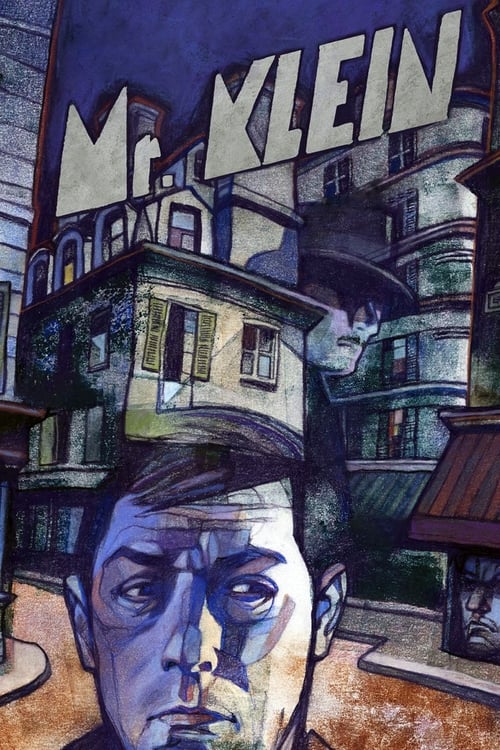
Mr. Klein
1976 · Joseph Losey
For when you want a film to chew on for days — an icy, cerebral thriller for a serious night in, not a comfort watch. Reach for it when you're in the mood to be haunted rather than jolted.
What it's about
Paris under Nazi occupation, 1942. Robert Klein is a sleek art dealer doing very well for himself, buying paintings cheap from Jews desperate to flee — until a Jewish newspaper arrives at his door addressed to another Robert Klein. Somewhere in the city is a man who shares his name, and in a time when identity is checked, stamped, and filed, being mistaken for him could be fatal. Klein sets out to find his double, and the search starts to unmake him.
The experience
Cold, elegant, and quietly terrifying — a slow-burn paranoia that tightens by increments rather than jolts. It has the logic of a bad dream you can't argue your way out of, and it leaves you unsettled long after it ends.
Performances
Alain Delon, who also produced, turns his own beauty and cool against himself: his Klein is untroubled polish slowly curdling into dread, and many consider it the finest work of his career.
The craft
Joseph Losey stages the Occupation as administration — auctions, paperwork, polite officials — which makes the horror bureaucratic and inescapable. Gerry Fisher shoots it in wintry greens and grays, the camera prowling apartments that always feel recently vacated; it's a film of chilled, exact images that reward a dark room and full attention.
Why it matters
A landmark reckoning with French complicity in the deportations, made by a blacklisted American director who understood persecution from the inside; its reputation has only grown, and it now stands among the great films about the Occupation.
Paris, 1942. Alain Delon, sleek and untroubled, plays an Alsatian art dealer buying paintings cheap from Jews desperate to flee — until a Jewish newspaper arrives addressed to another Robert Klein, and his comfortable identity begins to shear away. Joseph Losey, the American director blacklisted out of Hollywood who remade himself in Europe, brings an exile's cold eye to the machinery of Occupation: the paperwork, the auctions, the polite officials, complicity rendered as administration. The doppelgänger hunt has a Kafka chill — the harder Klein pursues his shadow-self, the less certain his own substance becomes — and Losey stages it in wintry greens and grays, Gerry Fisher's camera prowling apartments that always seem recently vacated. Delon, who also produced, gives perhaps his greatest performance precisely by curdling his own iconography: beauty as a form of moral blankness. The film confronted Vichy collaboration, culminating in a reconstruction of the Vél d'Hiv roundup, at a moment when French cinema had barely begun to look at it, and took the César for Best Film. Its final movement is among the most implacable in postwar European cinema — arrived at, not announced.
A Deleuzian reading
A Jewish newspaper is delivered to Robert Klein's apartment in Paris in 1942, his name and address printed correctly on the wrapper.
The full Deleuzian reading of Mr. Klein →
Reception
It left Cannes 1976 empty-handed (the year Taxi Driver took the Palme) and underwhelmed at the French box office, despite winning the César for Best Film and Best Director. The 2019 restoration and subsequent Criterion release completed its climb from respected-but-neglected to widely-acclaimed masterpiece.
How Mr. Klein was received, from release to now →
Influences: the films it descends from and the films it influenced
- The Servant (1963) — Losey's own template of identity usurpation staged through cold interior architecture — staircases, mirrors and framed reflections that let one man be slowly dissolved into another.
- Accident (1967) — Losey and Pinter's glacial upper-class surfaces and elliptical, ambiguous chronology, the same technique of withholding whether an event is real, remembered, or projected.
- The Trial (1962) — The literal Kafkaesque grammar Mr. Klein borrows — an innocent man processed by an unnamable bureaucracy through labyrinthine deep-focus corridors and paperwork that damns without accusing.
- Vertigo (1958) — The obsessive pursuit of a doppelgänger in which the hunter dissolves into the phantom he tracks, the protagonist's identity draining into the double he cannot find.
- Le Samouraï (1967) — Delon's affectless iconic mask, the blank minimalist persona that Mr. Klein deliberately casts against by hollowing that cool self-possession into panic.
- Army of Shadows (1969) — Occupied-France moral entrapment rendered in a drained blue-gray palette and procedural fatalism, the wintry desaturation Gerry Fisher's green-gray Paris extends.
- The Student of Prague (1926) — The foundational doppelgänger-persecution myth — a man destroyed by an autonomous double that steals his place in the world and his fate.
- Caché (2005) — Buried French complicity (colonial/wartime guilt) resurfacing as administrative and surveillance dread, extending 'complicity as administration' into the archive of the present.
- Son of Saul (2015) — The Holocaust rendered as bureaucratic machinery and process, extending the Vel d'Hiv roundup's depiction of genocide as administered logistics rather than spectacle.
- Enemy (2013) — Doppelgänger identity dissolution steeped in a jaundiced, oppressive monochrome palette — the wintry-green-gray strategy pushed toward sickly yellow to signal a self coming apart.
- Sarah's Key (2010) — Directly dramatizes the Vel d'Hiv roundup and French administrative complicity that Mr. Klein pioneered as onscreen subject matter.
- Europa Europa (1990) — Builds its engine from unstable, mistaken Jewish identity as a survival trap under Occupation — the identity-as-performance mechanism that Perel's passing among Nazis dramatizes in reverse.
- The Conformist (1970) — Complicity-as-administration: fascist collaboration dramatized as careerist bureaucratic drift, wrapped in a wintry, art-directed color scheme of guilt (Storaro's cold blues and grays).
- Lacombe, Lucien (1974) — Vichy collaboration rendered as banal, near-clerical drift rather than ideological villainy — complicity as an administrative accident of proximity.
- The Sorrow and the Pity (1969) — The contemporaneous dismantling of France's myth of innocence about Vichy, supplying the historical charge Mr. Klein weaponizes into fiction.
- The Tenant (1976) — Same-year Paris identity dissolution: a man persecuted into becoming someone else through Kafkaesque apartment-block paranoia and bureaucratic menace.
- The Passenger (1975) — A man assumes a dead stranger's identity and drifts to an implacable, unresisted death — the same existential dissolution and refusal of a rescuing climax.
- Rififi (1955) — A blacklisted American director's exile forging a cold, procedural French crime cinema — the same HUAC-exile pathway that placed Losey in a European co-production idiom.
Similar films
- Le Samouraï (1967) — influence & lineage
- Caché (2005) — influence & lineage
- The Trial (1962) — influence & lineage
- The Passenger (1975) — influence & lineage
- The Tenant (1976) — influence & lineage
- Army of Shadows (1969) — influence & lineage
- A Man Escaped (1956) — shared sensibility
- Mr. Arkadin (1955) — shared sensibility