Mephisto
1981 · István Szabó
For when you want a film to argue with afterward — a serious, meaty character study about ambition and complicity that feels uncomfortably relevant in any era. Challenge, not comfort, and worth every minute.
What it's about
A restless, ambitious German stage actor claws his way up from provincial theater to national fame just as the Nazis take power. His signature role is Mephistopheles — the devil who buys souls — and the part becomes his life: to keep his career, he accommodates the regime, performs for its leaders, and tells himself he's only an actor. As friends and colleagues flee or are destroyed, the question tightens around him: how much of yourself can you trade away before there's nothing left?
The experience
Gripping and increasingly suffocating — it plays like a thriller where the danger is moral rather than physical. You watch a charming man make one small, understandable compromise after another, and the cumulative effect is chilling; the final scene stays with you.
Performances
Klaus Maria Brandauer gives one of the great screen performances — vain, needy, electric, pathetic — a portrait of an actor so complete you can watch him lie to himself in real time.
The craft
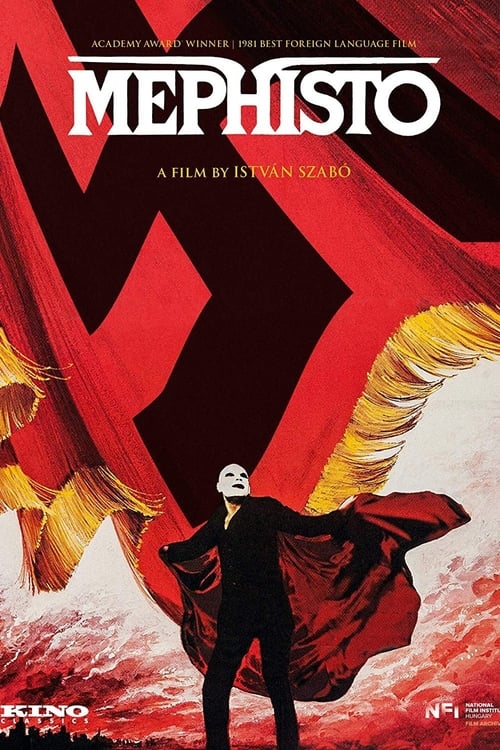
István Szabó directs with theatrical flair that matches the subject, using the stage itself — greasepaint, masks, the white face of Mephisto — as the visual language of a man disappearing into his roles. The backstage world is rendered with rich, unsettling detail.
Why it matters
Winner of the Academy Award for Best Foreign Language Film — the first Hungarian film to take the prize — and the start of a celebrated trilogy of Szabó–Brandauer collaborations about men who sell themselves to power.
Snapshot
Mephisto is a Hungarian-West German co-production directed by István Szabó, adapted from Klaus Mann's 1936 novel about an ambitious German actor who rises to artistic eminence by accommodating himself to the Nazi regime. Klaus Maria Brandauer plays Hendrik Höfgen, a provincial leftist stage performer whose celebrated turn as Mephistopheles in Goethe's Faust becomes both the engine of his fame and the emblem of his moral surrender. The film is the first installment of what is usually called Szabó's "Central European trilogy," followed by Colonel Redl (1985) and Hanussen (1988), each anchored by Brandauer and each anatomizing a man who trades his interior self for the favor of power. Mephisto won the Academy Award for Best Foreign Language Film for 1981 — the first Hungarian production to do so — and shared the screenplay prize at Cannes. It remains Szabó's most internationally visible work and one of the central films of the late Eastern Bloc art cinema.
Industry & production
Mephisto was produced by Hungary's state studio structure (Mafilm / Objektív Film Studio) in co-production with West German partners, a financing model that was increasingly common for ambitious Hungarian projects of the period seeking budgets and distribution beyond the Eastern Bloc. The collaboration mattered both economically and politically: the subject — German fascism and the complicity of the cultural class — was one that a Hungarian filmmaker could treat at a useful remove, framing questions of artistic accommodation to authoritarian power without naming the socialist state in which the film was made. That displacement is part of the film's design and was widely understood as such by contemporary audiences.
The source is Klaus Mann's Mephisto, written in exile in 1936 and long shadowed by controversy because its protagonist was a thinly veiled portrait of Gustaf Gründgens, the celebrated German actor (and Mann's former brother-in-law) who flourished under the Third Reich. The novel was the subject of protracted litigation in West Germany and was effectively suppressed there for years; it circulated more freely elsewhere before German publication was secured. Szabó and co-screenwriter Péter Dobai worked from this charged material, and the film's reception was inevitably read against the Gründgens question, though Szabó consistently framed Höfgen as a representative type rather than a documentary indictment of any single man.
Casting Brandauer, an Austrian stage actor of formidable reputation, was decisive. The film required a performer who could plausibly embody a great theatrical talent — the audience must believe in Höfgen's gift in order to feel the weight of its corruption — and Brandauer's background in classical theater supplied exactly that credibility. The international success that followed launched the Szabó–Brandauer partnership as a recognizable authorial signature.
Technology
Mephisto is a conventionally photographed 35mm color feature of its era, and the record does not indicate that it pursued any notable technical innovation in capture or processing; its achievements are aesthetic and directorial rather than technological. What is worth noting is the film's careful period reconstruction — Weimar and early-Nazi Germany rendered through production design, costume, and the textures of theatrical spaces — and its reliance on the expressive resources of color cinematography and lighting rather than on any novel apparatus. The technological dimension here is best understood as craft applied to historical illusion: the conjuring of 1920s and 1930s German theater and society on a 1980s co-production budget.
Technique
Cinematography
The photography is by Lajos Koltai, Szabó's long-standing director of photography and one of the major Hungarian cinematographers of his generation. Koltai's camera is restless and intimate, frequently pressing close to Brandauer's face and following him through the wings, dressing rooms, corridors, and reception halls that constitute Höfgen's world. The film repeatedly stages the boundary between performance and life — the proscenium, the mirror, the threshold of a private room — and Koltai's framing exploits these spaces to keep the question of authenticity visually alive. The most discussed images involve theatrical illumination: Höfgen in his Mephisto makeup lit so that the man and the mask become indistinguishable, and the film's final image, in which Höfgen is caught in a blinding stage spotlight, isolated and exposed, a performer who has nowhere left to perform.
Editing
Edited by Zsuzsa Csákány, the film favors long, sustained scenes built around dialogue and performance over rapid cutting, allowing Brandauer's gestures and the rhythms of theatrical exchange to play out. The structure tracks Höfgen's ascent chronologically across the collapse of Weimar and the consolidation of Nazi power, using ellipses to mark his successive accommodations. The cutting tightens at moments of confrontation — particularly Höfgen's encounters with the regime's representatives — where the editing isolates faces in shot/reverse-shot to dramatize the negotiation of power and flattery.
Mise-en-scène / staging
Staging is central to the film in both senses. As historical drama, Mephisto reconstructs the theaters, salons, and political ceremonies of the period with detailed production and costume design. As a film about theater, it is preoccupied with the literal stage — the play-within-the-film, the Faust production, the apparatus of curtains and footlights — and Szabó continually blurs the line between Höfgen's performances and his social conduct, so that the entire world becomes a theater in which he keeps up appearances. The recurring motif of the mirror, before which Höfgen rehearses both his roles and his selves, is the organizing visual idea of the mise-en-scène.
Sound
The score is by Zdenkó Tamássy. The film also draws on the music of the period and on the sonic world of the theater — applause, the murmur of audiences, the acoustics of grand interiors — to reinforce the atmosphere of public performance. The soundtrack is largely naturalistic and serves the drama rather than commenting on it; the most expressive sound is often the human voice, Brandauer's instrument as a stage actor put to use in the service of a man who has made his voice a tool of survival. Specific details of the sound design beyond this are not richly documented in the standard record.
Performance
Brandauer's Höfgen is the film's center and one of the celebrated screen performances of the 1980s. He must render a great actor — vain, charismatic, frightened, self-deceiving — and the performance works on two levels at once: Höfgen's external brilliance and the hollowness it conceals. Brandauer modulates between theatrical flamboyance (the Mephisto numbers, the seductive charm) and small, telling registers of fear and rationalization. The surrounding ensemble — including the women who orbit Höfgen and the Nazi official whose patronage both elevates and owns him — functions as a chorus of the choices available under the regime: exile, resistance, victimhood, and complicity. The film derives much of its force from the contrast between Höfgen's accommodations and the fates of those who refuse them.
Narrative & dramatic mode
The film is a tragic character study cast as historical drama, and its governing structure is the Faustian bargain announced by its title. Höfgen is a modern Faust who sells himself not to a supernatural devil but to a political one, and the irony Szabó sustains is that Höfgen's signature role is Mephistopheles — he plays the tempter while himself being the one tempted and bought. The narrative is essentially a moral descent disguised as a success story: each professional triumph is also a further compromise, and the dramatic tension lies less in external events than in the steady erosion of a self that may never have been fully present. The film withholds easy condemnation; it implicates the viewer in Höfgen's seductiveness, making us complicit in admiring the very gifts that doom him.
Genre & cycle
Mephisto belongs to the genre of the historical-political drama and, more specifically, to the cinema of reckoning with fascism and complicity that flourished in European art film. It is also a backstage drama and an artist's-portrait film. Within Szabó's own work it inaugurates the trilogy with Colonel Redl and Hanussen, each a study of an outsider who attains power or fame within an authoritarian order and is ultimately consumed by it; the three films together constitute a sustained cycle on the psychology of accommodation in Central Europe across the twentieth century.
Authorship & method
István Szabó (b. 1938) emerged from the Budapest film academy and the ferment of 1960s Hungarian cinema, beginning with personal, lyrical, partly autobiographical films about his generation and the Hungarian experience of war, revolution, and memory (Father, Love Film, 25 Fireman's Street). Mephisto marks his decisive turn toward large-scale historical drama in international co-production and toward the theme that would define his mature career: the individual's negotiation with power. Szabó's method centers on the close study of a single ambivalent protagonist, and his great instrument here is Klaus Maria Brandauer, whom he directs toward performances of extraordinary psychological transparency. (Szabó's own later history — the revelation, decades after, that he had informed for Hungarian state security in his youth — has been read by many critics as casting a retrospective light on his lifelong fascination with complicity, though the films stand independent of that biography.)
His key collaborators on Mephisto are essential to its identity: cinematographer Lajos Koltai, whose intimate, expressive camera defined the look of Szabó's major films before Koltai went on to an international career; screenwriter Péter Dobai, who shared the adaptation; editor Zsuzsa Csákány; and composer Zdenkó Tamássy. Above all, the film is the product of the Szabó–Brandauer authorship, a director-actor partnership in which the director's thematic obsession found its perfect physical and vocal embodiment.
Movement / national cinema
The film is a product of Hungarian cinema in its internationally engaged late-socialist phase. The New Hungarian Cinema of the 1960s and 70s — Miklós Jancsó, Márta Mészáros, Szabó, and others — had established Hungary as a serious art-film culture working, often obliquely, on questions of power, history, and the individual under the state. Mephisto represents the moment when that tradition reached for an explicitly international subject and audience through co-production, using a German historical setting to address, at a safe remove, the universal and locally resonant problem of the artist under authoritarianism. It is thus both a Hungarian national-cinema work and a transnational European art film.
Era / period
Made in 1981, the film belongs to the late Cold War, a period when Hungary's relatively liberalized "goulash communism" permitted ambitious, ideologically complex filmmaking and Western co-production. Its diegetic period is the late Weimar Republic and the early years of the Third Reich, roughly the late 1920s through the 1930s. The doubling of these eras is the film's deep structure: a 1981 Eastern Bloc artwork about 1930s Germany that could be — and was — read as a meditation on the compromises of any artist working within any system of state power, including the one that produced the film.
Themes
The central theme is complicity: the seductive, incremental process by which a talented person rationalizes collaboration with evil in the name of art, ambition, and survival. Bound to it are the themes of performance and authenticity (the actor who is only ever playing a role, even when he believes himself sincere), vanity and the hunger for recognition, and the relationship between art and power — whether art can remain autonomous under tyranny or whether prestige always implies a patron. The Faust myth supplies the moral frame, but Szabó secularizes it: there is no metaphysical damnation, only the slow disappearance of the self into the mask. The film also examines the bystander's spectrum of choices, setting Höfgen's accommodation against exile, principled resistance, and persecution.
Reception, canon & influence
Mephisto was an international critical success and is the most honored Hungarian film of its era, winning the 1981 Academy Award for Best Foreign Language Film and the screenplay award at Cannes; Brandauer's performance was singled out as a landmark. Critics praised the film's intelligence, its refusal of melodramatic moralizing, and its central performance, while some debate attended the inevitable comparison to the historical Gründgens and the ethics of dramatizing a real career.
Its influences run backward to several sources: Klaus Mann's exile novel and the Goethe Faust tradition that structures it; the long European tradition of films about artists, theater, and fascism; and Szabó's own earlier preoccupation with memory and the divided self. The Faustian template gives the film a mythic spine that connects it to a much older literary lineage.
Forward, its legacy is clearest within Szabó's own work — it set the template, the partnership with Brandauer, and the thematic program that Colonel Redl and Hanussen would extend, making the trilogy a sustained study of the seduction of power. More broadly, Mephisto helped consolidate a model of the serious European co-production that treats twentieth-century totalitarianism through the intimate study of a compromised individual rather than through spectacle, and it remains a touchstone in discussions of art, complicity, and the responsibilities of the artist under dictatorship. Its enduring critical standing rests on the still-startling final image of Höfgen pinned in the spotlight — a man exposed at last as nothing but a performer, with no audience left to deceive but himself.
A Deleuzian reading
The last thing the film does to Hendrik Höfgen is point a light at him.
The full Deleuzian reading of Mephisto →
Reception
A triumph on arrival — Cannes screenplay prize, then Hungary's first-ever Best Foreign Language Film Oscar — and its stature has only hardened since; the 2006 revelation that Szabó himself had been an informant for Hungary's secret police in the 1950s retroactively made his film about collaboration feel almost unbearably personal.
How Mephisto was received, from release to now →
Influences: the films it descends from and the films it influenced
- Faust (1926) — Supplies the explicit Faustian-pact template and German-expressionist theatrical chiaroscuro that Szabó transposes onto Höfgen's bargain, with light and shadow literally staging the soul's sale.
- The Last Laugh (1924) — Karl Freund's 'unchained camera,' which psychologically shadows one man's collapse of status without intertitles, is the direct forebear of Koltai's mobile, intimate lens locked onto a single ambivalent protagonist.
- The Blue Angel (1930) — Emil Jannings' portrait of a respectable man's abject self-degradation inside a cabaret/theatrical milieu is the performance ancestor of Brandauer's Höfgen — vanity and appetite undoing a public figure on and off the stage.
- Children of Paradise (1945) — Establishes the theater-within-film grammar Szabó adopts, where backstage intrigue and onstage performance interpenetrate so the actor's life is read through the roles he plays.
- Ivan the Terrible (1944) — Models the theatrically lit figure of the artist-performer in the service of a tyrant, and the device of the spotlight as exposure-and-trap that culminates in Mephisto's final image.
- The Damned (1969) — Operatic, theatrically staged chronicle of a German family's accommodation to Nazism that pioneers dramatizing fascism through interior decadence and intimate corruption rather than battlefield spectacle.
- The Conformist (1970) — The template of the weak, self-deceiving man whose complicity with fascism is rendered as psychological case-study through Storaro's sculptural, expressive lighting — political history compressed into one compromised interior.
- The Tin Drum (1979) — Extends the prestige literary adaptation of fascism that wins the Foreign Oscar, dramatizing collaboration through a single grotesque-comic performer in close-up.
- The Night Porter (1974) — Extends the performer's-complicity strain — the theater artist who thrives under Nazism — through a withheld, self-deceiving central performance in the Bogarde register.
- The Fifth Seal (1976) — Carries the Hungarian complicity-under-totalitarianism inquiry forward into the artist who collaborates to survive, extending the martyrdom-versus-survival dilemma into a study of self-justifying accommodation.
- Two Half-Times in Hell (1961) — Carries forward the stage-within-film device and the idea of performance-as-survival under a regime, staging theatricality itself as the site of the moral test that Fábri first embedded in a public spectacle before an occupying audience.
- Colonel Redl (1985) — Direct continuation of the Szabó–Brandauer authorship and Koltai's intimate camera, applying the identical method — a single ambivalent climber seduced and destroyed by proximity to power.
- Hanussen (1988) — Completes the Brandauer trilogy with another performer (a mentalist) whose stagecraft entangles him with rising Nazism, extending Mephisto's study of performance as complicity.
- Sunshine (1999) — Extends the single-protagonist-across-totalitarianisms structure, with Koltai again shooting one man (a dynasty of Fiennes roles) negotiating successive regimes through accommodation.
- Taking Sides (2001) — Returns to Mephisto's exact subject — a great German artist's complicity under Nazism (Furtwängler) — re-interrogating whether art exempts the artist from political responsibility.
- Being Julia (2004) — Carries forward the theater-within-film architecture and the actor's-mask preoccupation in a lighter key, with the stage performance again revealing the performer's true self.
- Downfall (2004) — Dramatizes the Nazi apparatus through claustrophobic, performance-driven intimacy with individual figures rather than spectacle — the same scale of compromised-insider portraiture Mephisto helped legitimize.
- The Lives of Others (2006) — Builds on Mephisto's model of the serious European political drama that studies a theater artist's compromise and surveillance under dictatorship through one intimate, ambivalent protagonist.
- Birdman (2014) — Realizes Mephisto's closing conceit — the performer pinned in the spotlight with no audience left to deceive but himself — as a whole film about identity dissolving irreversibly into the role.
- Cabaret (1972) — Uses Weimar-to-Nazi stage performance as the lens on political seduction, the theatrical number commenting on the regime's rise — the same staging-the-politics-through-the-stage device that drives Höfgen's career.
- Europa Europa (1990) — A protagonist who survives the Reich by performing a role, the actor's mask treated as the substance of moral compromise — the identity-as-performance theme worked in the same transnational-European, period-irony key.
- The Last Metro (1980) — Arrives at the identical braid in the same season: onstage performance intercut with backstage accommodation to Nazi patronage, using the actor's craft — makeup, curtain calls, a career built in rehearsal — as the measure of political compromise.
Similar films
- Faust (1926) — influence & lineage
- The Fifth Seal (1976) — same viewing thread
- Hitler: A Film from Germany (1978) — same viewing thread
- The Pianist (2002) — same viewing thread
- Schindler's List (1993) — same viewing thread
- Son of Saul (2015) — same viewing thread
- Europa Europa (1990) — same viewing thread
- Casablanca (1943) — same viewing thread
All the films related to Mephisto →
Watch it with: curated runs of related films
- In the Shadow of the Reich — A run of films about ordinary people inside the Nazi era — surviving it, resisting it, or trying to reckon with how it happened — that rhyme on conscience, complicity, and who chooses to act.