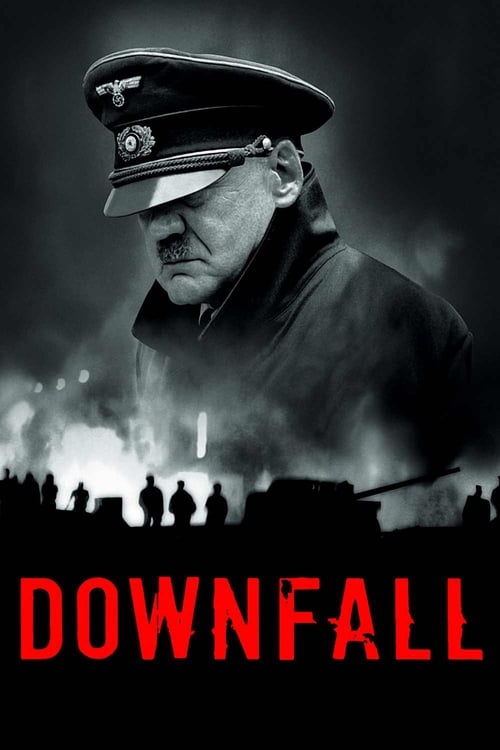
Downfall
2004 · Oliver Hirschbiegel
For when you want heavyweight, immersive history — a demanding, sobering watch for a serious evening, not a casual one. Choose it when you want to come out the other side with something to think about.
What it's about
April 1945: the Red Army is shelling Berlin, and Hitler retreats into the bunker beneath the Reich Chancellery with his inner circle for the final days of the Third Reich. Seen largely through the eyes of Traudl Junge, his young secretary, the film watches a regime devour itself — generals ordered to command armies that no longer exist, loyalists choosing between delusion and escape, a city dying above their heads.
The experience
Claustrophobic and relentless — two and a half hours of concrete corridors, dwindling candles, and people deciding what they're willing to die for. It's gripping the way a slow collapse is gripping: you know how it ends, and you can't look away.
Performances
Bruno Ganz's Hitler is one of the most discussed performances in modern cinema — vocally and physically exact, veering between grandfatherly softness and volcanic rage, and refusing to let the man be either a cartoon or a mystery. Alexandra Maria Lara's watchful, complicit innocence as Junge gives the film its conscience.
The craft
The bunker is recreated with oppressive fidelity — low ceilings, sickly light, the constant thud of artillery bleeding through the walls — while brief surfaces into the ruined city land like gasps of air. The sound design alone makes it worth good speakers; the film's power is as much atmospheric as dramatic.
Why it matters
An Oscar nominee that ignited a fierce debate about whether depicting Hitler as human was defensible, it became a landmark in Germany's cinematic reckoning with its past — and, improbably, its ranting-Hitler scene became one of the internet's most enduring memes.
Snapshot
Der Untergang (released internationally as Downfall) is a German-Austrian-Italian co-production tracing the final twelve days of Adolf Hitler's life in the Führerbunker beneath the Reich Chancellery, from 20 April to 2 May 1945. It is the most expensive and ambitious German fiction film to engage directly with Hitler's interiority, depicting the collapse of the Third Reich from within through the eyes of Traudl Junge, Hitler's personal secretary. The film generated fierce international debate about whether humanizing a genocidal dictator was ethically defensible, and it became a central text in the long German cultural reckoning with National Socialism. It was nominated for the Academy Award for Best Foreign Language Film at the 77th Academy Awards. A decade after its release, a single scene — Hitler's furious reprimand of his generals — became one of the most enduringly repurposed sequences in internet history, introducing the film to an audience that had never seen it as art.
Industry & production
Constantin Film, the Munich-based production house, financed and produced the film with co-production partners NDR, WDR, and Arte. The driving creative force behind the project was producer and screenwriter Bernd Eichinger, one of the most powerful figures in post-war German commercial cinema, who had spent years developing the material. Eichinger wrote the screenplay himself — a relatively unusual arrangement for a prestige production of this scale — drawing primarily from two source texts: Traudl Junge's memoir Bis zur letzten Stunde (Until the Final Hour, 2002, co-written with journalist Melissa Müller) and Joachim Fest's historical account Der Untergang: Hitler und das Ende des Dritten Reiches (2002). Additional testimonial material from surviving bunker witnesses — including Gerhard Boldt's memoir and accounts from SS physician Ernst-Günther Schenck — informed subsidiary perspectives.
The decision to shoot during 2003 and release in September 2004 was commercially shrewd: Eichinger positioned the film ahead of the sixtieth anniversary commemoration cycle of the war's end in 1945. The production budget has been reported in the range of €13–15 million, making it a substantial undertaking by German industry standards. Hirschbiegel, who had made his international reputation with the psychodrama Das Experiment (2001), was brought aboard for his ability to generate claustrophobic pressure from enclosed institutional spaces — a quality the bunker setting demanded.
A significant practical decision shaped the film's texture: rather than reconstructing the Führerbunker on location in Berlin (the actual site had been demolished and built over), the production built elaborate sets in Munich and filmed exteriors partly in St. Petersburg, Russia, which doubled for bombed-out Berlin streetscapes. The Russian city's preserved Soviet-era architecture provided physical analogs for wartime Berlin that no German urban location could still supply.
Technology
Downfall was shot on 35mm by cinematographer Rainer Klausmann. The production eschewed the widescreen CinemaScope ratios common to epic war films, opting instead for the 1.85:1 aspect ratio — sufficiently wide to accommodate ensemble staging but less panoramic, reinforcing the film's determination to stay inside the bunker's psychic and physical pressure rather than open outward toward spectacle. The film did not pursue digital intermediate techniques in any prominent way; the photochemical grain inherent to 35mm contributes to a slightly desaturated, documentary-adjacent texture that anchors the period reconstruction without aestheticizing it.
Sound design was built around the contrast between the muffled, reverberant acoustics of the underground bunker — dripping water, distant concussions, the thud of Soviet artillery growing closer each day — and the sudden, unfiltered devastation of the Berlin street sequences. This acoustic architecture was integral to the film's dramatic argument: the bunker's sealed soundscape becomes a figure for the deliberate unreality Hitler's court maintained in the face of total defeat.
Technique
Cinematography
Rainer Klausmann's camera strategy is built around a fundamental tension: proximity versus exposure. In the bunker, he works predominantly with a handheld or lightly supported camera, keeping the lens close to faces, trapping characters in shallow focus and narrow corridors. The effect is less the frenetic agitation of combat journalism — Saving Private Ryan's influence on war cinematography is deliberately avoided — than an oppressive intimacy, as though the camera cannot find enough space to breathe. Natural and practical sources motivate most of the interior lighting; the bunker glows amber and sickly under fluorescent strips and candles, the palette draining toward ash as the film progresses.
Street scenes in bombed Berlin invert this approach. The widescreen openness of ruined streets, the gray morning light, the bodies of civilians hanging from lamp posts with placards reading "coward" — these are filmed with a steadier, cooler eye, almost clinical, as if the camera itself recoils from what the bunker's fantasies have produced in the world above.
Editing
Hans Funck's editing maintains a patient rhythm that resists the pulse of conventional war film montage. Scenes in the bunker are allowed to run long; Hitler's tirades, his moments of sudden tenderness with his dog Blondi or his secretaries, the conferences where generals deliver news of phantom armies — these play out at close to real conversational time. The slowness is ethically deliberate: cutting away from Hitler's humanized moments before they fully register would protect the audience; staying in them forces the discomfort the filmmakers sought. Against this interior slowness, the exterior sequences — street executions, the Volkssturm children sent to die at bridges, Schenck's field hospital overflowing with the dying — are cut with blunter efficiency, refusing to romanticize suffering.
Mise-en-scène / staging
The bunker sets were designed with meticulous historical detail, and Hirschbiegel's staging exploits their architecture. Corridors funnel characters into single file, making rank and access a constant spatial metaphor. The map room, where Hitler conducts his delusional command conferences, is staged with Hitler at the center of a tight semicircle of generals — a configuration that encodes both his authority and his isolation, since no one in the ring can easily face another. As the film progresses and the inner circle fragments, staging opens up: characters drift, stop at thresholds, fail to enter rooms they once owned. The physical disorganization of the space mirrors the disintegration of command.
Magda Goebbels's arc receives particular staging attention. Her determination to kill her six children rather than allow them to live in a world without National Socialism is foreshadowed in a series of medium shots that isolate her from group compositions — she has already, spatially, departed the world of the living — before the act is rendered in close detail. Corinna Harfouch's performance in these sequences, and Hirschbiegel's willingness to linger on its quietness rather than its horror, represents the film's most morally complex choreography.
Sound
The score was composed by Stefan Zacharias, though the film uses it sparingly; long passages, particularly inside the bunker, proceed without underscore, allowing ambient sound — breathing, distant rumble, the scratch of pen on paper — to bear the emotional weight. When music enters, it tends toward spare orchestration rather than grand symphonic statement, avoiding the associative registers of heroic or mournful war film scoring. The restraint is consistent with the film's general refusal of affect manipulation: the material is considered extreme enough that conventional scoring would tip it toward either elegy or exploitation.
Performance
Bruno Ganz's Hitler remains the defining axis of the film's reception history. The Swiss actor, widely known in European art cinema (he starred in Wim Wenders's Wings of Desire in 1987), undertook months of preparation. Critically, he is known to have studied a surviving private audio recording of Hitler — widely identified as the 1942 recording made during Hitler's meeting with Finnish Marshal Mannerheim — to locate the voice Hitler used in informal speech, distinct from the amplified public oration that most existing recordings document. What Ganz found was a softer, more modulated register, and it is this private Hitler the film presents: warm to his secretaries, fond of his dog, capable of sudden charm, capable immediately afterward of ordering the abandonment of wounded soldiers. The performance refuses to grant the audience the relief of a monster; it insists on the mundane social texture in which the monstrous was embedded.
Alexandra Maria Lara, as Traudl Junge, carries the film's moral witnessing function. Her performance is calibrated to bewilderment and gradual, terrible clarification rather than resistance or heroism. Ulrich Matthes's Goebbels is gaunt and fanatical, his physical emaciation matching his doctrinal abstraction. The ensemble — which also includes Christian Berkel, André Hennicke, and Heino Ferch — was drawn largely from German stage and television, lending the ensemble the naturalistic credibility of company work.
Narrative & dramatic mode
The film adopts a witnessed-chronicle structure rather than a classical dramatic arc. Junge is not an agent of the plot — she does not act to change events, intervene, or escape through heroism — but a recorder, present in rooms she should not have been in, surviving by proximity rather than significance. This deliberately limits dramatic irony: the audience knows what Junge does not yet fully understand, but Hirschbiegel and Eichinger do not use that gap for suspense. They use it for accumulating dread.
The film's most distinctive structural decision is its framing device: Downfall opens and closes with footage of the real Traudl Junge, taken from André Heller and Othmar Schmiderer's 2002 documentary Im toten Winkel — Hitlers Sekretärin (Blind Spot: Hitler's Secretary), in which the then-elderly Junge speaks directly to camera about her years in Hitler's service and her lifelong difficulty in assessing her own responsibility. Junge died in February 2002, shortly before Blind Spot was theatrically released. Her closing statement in the documentary — that she was young, and did not know, but that a Munich street memorial to Sophie Scholl made her realize that Scholl had been the same age and had known — becomes the film's moral epilogue. The documentary footage is not inserted decoratively; it converts the fiction into an extended act of testimony, anchoring the recreation in the weight of what actually happened to a real person who was there.
Genre & cycle
Downfall belongs to a cluster of early-2000s European productions willing to grant Hitler interiority in fiction — a cycle distinct from the allegorical approach (The Great Dictator, 1940) and the morality-play approach (Hitler: The Last Ten Days, 1973, with Alec Guinness). The 2001 HBO/BBC television film Conspiracy, dramatizing the Wannsee Conference with comparable restraint and a similar refusal of distancing allegory, shares the mode. The German television landmark Heimat (Edgar Reitz, 1984) had established an earlier precedent for Alltagsgeschichte — history-from-below, through ordinary German lives — and Downfall operates within that tradition while targeting Hitler directly.
As a war film, it is anti-spectacular: no major battle sequences, no heroic sacrifice, no liberating armies. Its generic affinities lie closer to the siege film or the disaster film — an enclosed group awaiting inevitable catastrophe — than to the combat picture.
Authorship & method
Oliver Hirschbiegel came to the project with a background in German television and the psychological thriller. Das Experiment (2001), based on the real Stanford Prison Experiment, had established his interest in institutional authority, obedience, and the situational erosion of moral judgment — concerns that map directly onto Downfall. His direction is observational rather than expressionist; he does not use the camera to condemn or endorse but to watch, a stance that generated the film's central controversy. After Downfall, he moved to English-language production with mixed results, but the film remains the defining work of his career.
Bernd Eichinger, as producer-screenwriter, was arguably the film's primary creative architect. His screenplay is disciplined in its selection of documented detail and careful to introduce subsidiary figures — Schenck in the hospital, General Mohnke defending the Reich Chancellery, the fanatical SS officer Fegelein — in ways that illuminate the spectrum of loyalty and collapse across the regime's final hours. Eichinger had previously produced The Name of the Rose (1986) and The House of the Spirits (1993), and he understood how to construct ensemble historical drama for international audiences without simplifying its politics.
Rainer Klausmann, a long-time collaborator of Hirschbiegel, translated the film's ethical restraint into a visual grammar of proximity and discomfort.
Movement / national cinema
Downfall is a central document of German cinema's post-reunification reckoning with the Nazi past — the tradition Germans call Vergangenheitsbewältigung, the working-through of history. The Federal Republic's postwar cinema had long treated the Nazi period obliquely or through allegory; the New German Cinema of the 1970s (Fassbinder, Herzog, Kluge, Syberberg) engaged it experimentally but rarely through straightforward historical reconstruction. By the early 2000s, a new generation of German filmmakers and audiences was willing to engage the period directly, commercially, and from German perspectives. Good Bye Lenin! (Wolfgang Becker, 2003) had demonstrated that German audiences would attend domestic historical drama in large numbers; Downfall applied that appetite to harder material.
The film was released during a period of intense German public debate about the line between historical understanding and exculpation. Claude Lanzmann and others argued that dramatizing Hitler's domestic life risked normalization; German critics were divided. The controversy itself became part of the film's reception history, generating a sustained public discussion about representation, memory, and responsibility that arguably constituted Vergangenheitsbewältigung in action.
Era / period
Downfall appeared in 2004, at the crest of a wave of European prestige historical drama enabled by expanded co-production funding structures (the EU MEDIA program, German public broadcaster co-production obligations) and the growing international arthouse theatrical market. The film arrived as the generation of Germans with direct memory of the war was aging out of living witness, creating a cultural urgency around the question of how subsequent generations would inherit and represent the period. The sixtieth anniversary of the war's end in 2005 sharpened this urgency into public programming: Downfall was in many ways the cinematic flagship of that anniversary cycle.
Themes
The film's governing theme is the relationship between ideology and reality — specifically, the mechanism by which a closed ideological system maintains itself in the face of contradicting evidence. Hitler's insistence on ordering non-existent armies, his certainty that counterattacks will materialize, his rage at generals who report facts rather than wishes: this is depicted not as simple insanity but as the terminal phase of a totalitarian epistemology that had functioned, and required its subjects to adopt, a parallel reality. The bunker is a spatial figure for this: a sealed system beneath a ruined world.
Bound to this is the theme of complicity and its gradations. Junge is the film's conscience on this question. Other figures represent other positions: the fanatical true believer (Magda Goebbels, Fegelein before his execution), the pragmatic loyalist who knows the cause is lost but stays out of professional identity (Mohnke), the opportunist seeking the best exit, the doctor who keeps working because the wounded are real even when the command structure is fictional. The film refuses to arrange these figures into a clear moral hierarchy; it maps complicity as a distributed condition.
The sacrifice of children — most devastatingly through Magda Goebbels, but also in the Volkssturm sequences showing boys of fourteen and fifteen sent to die at Berlin bridges — frames the war's end as a crime against those who had no agency in the ideology they were born into. This is among the film's most politically pointed arguments: the regime's final violence was directed as much at its own children as at its designated enemies.
Reception, canon & influence
Downfall was a major commercial success in Germany, becoming one of the highest-grossing German domestic films of 2004. It was selected as Germany's submission to the Academy Awards and received the nomination for Best Foreign Language Film. Critical reception in Germany and across Europe was largely positive, with Ganz's performance consistently cited as extraordinary; American critical response was more divided, with some reviewers troubled by the film's proximity to Hitler's perspective, others arguing that proximity was precisely the point.
Influences on the film (backward): The film draws on the Italian neorealist tradition of reconstructed history from documentary testimony — Rossellini's Rome, Open City (1945) and Germany Year Zero (1948) are spiritual antecedents in their use of actual locations and non-professional or naturalistic performance registers. Hannah Arendt's concept of the "banality of evil," formulated in her 1963 account of the Eichmann trial, is the intellectual framework the film inhabits without ever naming, though Hirschbiegel and Eichinger did not claim direct Arendt influence in interviews known to this account. The 2002 documentary Im toten Winkel was a direct source, as described above. Earlier cinematic Hitler portrayals — including Alec Guinness in Hitler: The Last Ten Days (1973) and the strategic avoidance of direct portrayal in works like Sophie's Choice (1982) — form the tradition Downfall both inherits and ruptures.
Legacy (forward): The film's most culturally pervasive legacy has been entirely unintended by its makers. Beginning around 2006–2007, an internet practice emerged of downloading the film's pivotal scene — Hitler's eruption when told that General Steiner's counterattack had not materialized — and overlaying new subtitles reimagining Hitler raging about mundane contemporary frustrations: sports results, software failures, social media disputes. These "Hitler Reacts" parody videos, hosted primarily on YouTube, became one of the most persistent meme formats of the 2000s and 2010s, generating thousands of iterations. Constantin Film repeatedly issued takedown notices; YouTube's response and the ongoing cat-and-mouse between copyright enforcement and user creativity themselves became the subject of meta-parodies. The phenomenon is without precedent in serious historical cinema: a scene filmed with the specific intention of unsettling audiences about the human face of evil became a universal comic template. Scholars of digital culture have noted the paradox — the meme arguably reinforces the film's point about Hitler's bathos and grandiosity, even as it strips the original ethical stakes entirely.
Within European prestige cinema, Downfall normalized the first-person dramatization of Nazi leadership that had previously been largely taboo in German production, enabling subsequent films and television series — including Er ist wieder da (Look Who's Back, 2015), Conspiracy of Silence (2004), and various TV dramatizations of Nazi-era figures — to engage directly with perpetrator interiority. Whether this constitutes a healthy expansion of the historical imagination or a problematic routinization of fascist perspectives remains a live critical question. Downfall did not settle it; it opened it.
A Deleuzian reading
The hand moves across the map and the armies move with it — Steiner wheeling north to relieve the city, the Ninth pushing up from the south, the pincers closing on the Soviet line.
The full Deleuzian reading of Downfall →
Reception
A German-press firestorm on release — was it moral to portray Hitler as a human being at all? — plus an Oscar nomination for Best Foreign Language Film; two decades on it's settled comfortably into the canon of great German cinema, though it now lives a strange double life thanks to the internet.
How Downfall was received, from release to now →
Influences: the films it descends from and the films it influenced
- The Bunker (1981) — This TV film originated the Führerbunker as a dramaturgical space for Hitler's psychological collapse, its compressed single-location chronology providing the structural template Eichinger's screenplay expanded into a feature with an all-German ensemble and photochemical production scale.
- Das Experiment (2001) — Hirschbiegel developed his enclosed-space pressure technique here — handheld camera tracking psychological deterioration through institutional corridors, an ensemble fragmenting under confinement — providing the exact mise-en-scène vocabulary he transposed directly to the Führerbunker three years later.
- Come and See (1985) — Klimov and Rodionov's strategy of locking the camera to a protagonist's face during extremity — the lens unable to pull back from atrocity, shallow focus trapping the viewer in one consciousness — established the close-camera anti-spectacular grammar that Klausmann extends to a perpetrator perspective.
- Lacombe Lucien (1974) — Malle pioneered the morally neutral observational camera stance for a WWII perpetrator protagonist — refusing to editorialise through underscore, reaction shots, or punitive cutting — establishing the mode Hirschbiegel deployed to render Hitler without the framework of condemnation previous screen Hitlers had required.
- Mephisto (1981) — Szabó introduced the model of casting major stage actors in a psychologically realist register to explore Nazi-era complicity through performance; the casting of Bruno Ganz and the Downfall ensemble in the same theatrical-realist tradition is a direct methodological inheritance from Brandauer's work here.
- Stalingrad (1993) — Vilsmaier's film established the West German commercial cinema template for anti-spectacular WWII ensemble drama — recognizable German stage actors, practical production design over studio spectacle, the soldier's ground-level perspective — that Eichinger and Hirschbiegel adopted and turned inward toward the command structure.
- Conspiracy (2001) — This HBO telefilm — British and German ensemble performing the Wannsee Conference in a single interior, using surviving conference minutes as its documentary scaffold — established the chamber-perpetrators-in-bureaucratic-space model Downfall expanded; its single-room decision-making grammar is the direct forerunner of Hirschbiegel's bunker-conference staging.
- Judgment at Nuremberg (1961) — Kramer established the legal-documentary framing device for Nazi perpetrators in Western cinema — extended scenes where war criminals speak in their own voices without narrative editorialising, the audience left to process discomfort without a cut to safety — a temporal and ethical precedent for Downfall's decision to hold inside Hitler's tirades at close-to-real conversational duration.
- The Baader Meinhof Complex (2008) — Produced by Bernd Eichinger on the identical creative model — Eichinger as sole writer-producer on a controversial West German political subject, German ensemble cast, perpetrator testimony as documentary scaffold — it is the most direct continuation of Eichinger's Downfall methodology within the same Constantin Film production infrastructure.
- Son of Saul (2015) — Nemes radicalized Downfall's shallow-focus close-camera grammar — locking the 35mm frame to a Sonderkommando prisoner's face, deliberately blurring the genocide behind him — adapting the same proximity cinematography from perpetrator-interiority to victim-interiority while inheriting the ethical premise that the camera must survive by staying with one person.
- The Zone of Interest (2023) — Glazer extends Downfall's bunker-acoustic-architecture conceit to its radical conclusion: the entire moral argument is relocated to the sound field, the camera observing Nazi domesticity in daylight while Auschwitz exists only as off-screen acoustics — a formal escalation of Hirschbiegel's spatial-hierarchy staging into a total cinematic argument.
- The Captain (2017) — Schwentke's film about a Wehrmacht deserter posing as a captain to perpetrate atrocities inherits Downfall's perpetrator-humanization ethics — the camera following without moral comment — but formalizes the observational detachment further through black-and-white cinematography that cites the same archival period documentation Ganz used in his performance preparation.
- A Hidden Life (2019) — Malick extends Downfall's anti-spectacular WWII ethics and sparse underscore into the antithetical moral register — an Austrian conscientious objector as subject — inheriting the patient scene durations and refusal of action-film rhythms while substituting the resistor's moral courage for the perpetrator's moral collapse, using the same formal patience to opposite ethical ends.
- Darkest Hour (2017) — Hirschbiegel frames the confined underground bunker as a political arena where the staging of bodies around the leader enacts the collapse of authority; Delbonnel's confinement framing of the War Cabinet rooms deploys the same spatial grammar with inverted moral valence.
- The Resistance Banker (2018) — Benchmark for theatrically-trained, deliberately underplayed ensemble work inside claustrophobic, exactingly reconstructed period interiors.
- Land of Mine (2015) — Precedent for the German-perspective reckoning that humanizes without absolving, filming the vanquished side's ordinary faces with sober, non-melodramatic gravity.
- The Pianist (2002) — Released two years before Downfall, Polański's film shares Klausmann's grammar of practical-source interior lighting for Warsaw period reconstruction, 35mm photochemical grain as documentary authenticator, and patient scene durations in confined urban spaces — establishing a contemporary European standard that refuses Hollywood war-film montage rhythms.
- The Counterfeiters (2007) — Ruzowitzky's Austrian film deploys the same formal strategy in a concentration camp sub-economy: a morally compromised protagonist observed at close camera distance on 35mm, the enclosed institutional space as the entire world, extended takes without editorial comment on the protagonist's impossible moral calculus.
- Letters from Iwo Jima (2006) — Contemporary proof that a foreign-language film could humanize the wartime enemy inside a sealed bunker, sharing Letters' empathy-without-exoneration and underground claustrophobia.
- Before the Fall (2004) — Same-year twin from the Eichinger/Constantin production wave: high-fidelity Third Reich production design and psychologically accessible interiority deployed as the point of entry, which drew the identical critique — that the craftsmanship's handsomeness softens the object it depicts.
Similar films
- The Baader Meinhof Complex (2008) — influence & lineage
- Conspiracy (2001) — influence & lineage
- The Zone of Interest (2023) — influence & lineage
- Hitler: A Film from Germany (1978) — shared sensibility
- Triumph of the Will (1935) — shared sensibility
- The Last Laugh (1924) — shared sensibility
- The Great Dictator (1940) — shared sensibility
- The Lives of Others (2006) — shared sensibility
All the films related to Downfall →