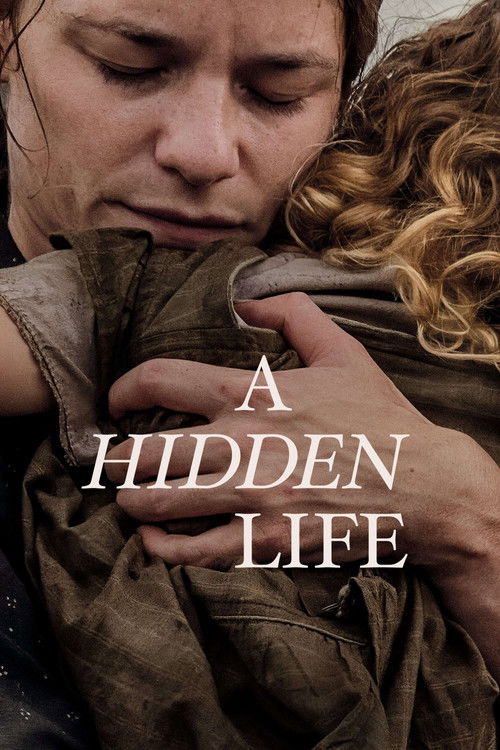
A Hidden Life
2019 · Terrence Malick
For when you want a film to sit with — patient, beautiful, and morally serious — the kind you watch alone and carry into the next week. A challenge, but a nourishing one.
What it's about
The true story of Franz Jägerstätter, an Austrian mountain farmer with a wife he adores and a valley life of almost paradisal simplicity, who refuses to swear loyalty to Hitler or fight in his war. The film follows the slow, grinding cost of that refusal — the hostility of his village, the pleading of officials who tell him his gesture will change nothing, and the letters between husband and wife as the consequences close in.
The experience
Three hours of whispered voice-over, alpine light, and moral pressure that builds like weather — meditative, ravishing, and quietly devastating. It doesn't argue; it immerses you in what conviction costs, minute by minute, until the question 'would I?' becomes personal.
Performances
August Diehl plays Franz with extraordinary stillness, letting doubt and resolve cross his face without speeches, and Valerie Pachner is his equal as Fani, whose steadfastness under the village's contempt becomes the film's second act of courage.
The craft
Malick's roaming wide-angle camera turns farmhouse kitchens and mountain meadows into something vast and sacramental, cutting on feeling rather than plot, with scenes dissolving into one another like remembered days. Shot largely in natural light against real alpine country, it's one of the most visually overwhelming films of its decade — see it on the biggest screen you can, with the sound up for its swelling orchestral score.
Why it matters
Hailed as Malick's return to disciplined storytelling after years of free-form experiments, and embraced as one of the great modern films about conscience — a touchstone for anyone thinking about quiet resistance to mass movements.
Snapshot
A Hidden Life is Terrence Malick's dramatization of the true story of Franz Jägerstätter, an Austrian peasant farmer who refused to swear the Hitler oath or bear arms for the Wehrmacht, and who was executed for that refusal in 1943. Running roughly three hours, it is at once the most narratively disciplined film of Malick's late period and a full continuation of his signature style: whispered voice-over, roaming handheld camera, wide-angle vistas of alpine country, and an editorial rhythm that dissolves scenes into one another like memory. After a decade of increasingly plotless, associative works — To the Wonder, Knight of Cups, Song to Song — the film was widely received as a return to legible story and moral seriousness. Its title comes from the closing sentence of George Eliot's Middlemarch, which honors those whose "unhistoric acts" and "hidden life" sustain the world's good from "unvisited tombs." The film is a sustained meditation on conscience, marriage, faith, and the cost of doing right when doing right changes nothing visible in the world.
Industry & production
The project carried the working title Radegund, after St. Radegund, the Upper Austrian village where Jägerstätter lived. It was an international co-production drawing German, U.S., and other financing, and was distributed by Fox Searchlight Pictures (later Searchlight Pictures) in the United States following Disney's absorption of the studio. Malick shot on location across the Alps — in South Tyrol and elsewhere in northern Italy, and in Austria and Germany — using real villages and mountain terrain rather than sets for the rural sequences, and period-appropriate interiors and prison locations for the film's second half.
The production reflects Malick's established working method more than any conventional studio pipeline: extensive shooting, a large volume of captured material, and a lengthy post-production during which the film's shape was found in the edit. As with his other late films, the star cast worked without a fixed shooting script in the ordinary sense, responding to situations and to Malick's on-set direction. The film premiered in competition at the 2019 Cannes Film Festival before a fall theatrical release. I do not have reliable box-office figures to cite; like Malick's other late work, it was positioned as a specialty release rather than a wide commercial one, and its commercial footprint was modest.
Technology
A Hidden Life was shot digitally. Malick and his team used ARRI Alexa-family cameras — consistent with the director's move to digital capture across the 2010s — though I cannot confirm the exact model designation with certainty and will not invent one. The defining technical choice is optical: the film relies heavily on very wide-angle lenses, which expand the alpine landscape, bend the edges of interiors, and place the camera intimately close to faces and hands while keeping vast depth of field. This extreme wide-angle look, combined with predominantly available light, is the film's technological signature and the foundation of its visual grammar.
Digital capture served Malick's method directly: it allowed very long takes, low-light and natural-light shooting at magic hour and in dim prison interiors, and the accumulation of enormous quantities of footage from which the film could later be assembled. The production leaned on natural and practical light sources rather than heavy artificial rigging, a discipline that shaped both the shooting schedule (chasing weather and sun) and the finished texture.
Technique
Cinematography
The cinematographer was Jörg Widmer, for whom this was a signal credit. Widmer had long served as a camera and Steadicam operator on Malick's films, and here he took the director of photography role — stepping into a lineage most associated with Emmanuel Lubezki, who shot Malick's preceding features. Widmer's camera is almost always in motion: drifting, circling, rising, following characters through doorways and across fields in unbroken movement. The wide lenses keep everything sharp and enveloping, so that the mountains, sky, and weather are never mere backdrop but active presences pressing against the human figures. Natural light dominates — the gold of harvest afternoons, the flat gray of prison cells, the blue of dusk. The contrast between the film's two worlds is largely built photographically: the expansive, luminous freedom of the valley versus the cramped, colorless confinement of the German prisons, where the same restless camera now finds only walls.
Editing
The film was cut by a team of editors — the credited editing is shared among multiple hands, reflecting the scale of the material and Malick's collaborative post-production. The editorial logic is associative rather than strictly scene-by-scene: images overlap, voice-over floats free of the moment that occasions it, and time is elastic, compressing months of imprisonment and correspondence into a lyrical continuity. Yet compared with the near-plotless montage of Malick's immediately prior films, A Hidden Life holds to a clear forward narrative — courtship, marriage, refusal, arrest, imprisonment, trial, execution — so the editing serves a story rather than dissolving it. The letters exchanged between Franz and his wife Fani provide a structuring spine, their read-aloud text binding the two separated worlds across the cut.
Mise-en-scène / staging
Staging is built on labor and land. The early sections are saturated with the physical work of subsistence farming — scything, threshing, hauling, tending animals, children underfoot — rendered as a kind of Edenic wholeness that the war will destroy. Malick stages his actors in real environments and lets them move through practical tasks rather than hitting marks for dialogue. In the prison passages the mise-en-scène inverts: bare cells, corridors, guards, the machinery of bureaucratic cruelty. The recurring motifs — hands, water, doorways, thresholds, the mill and the fields — carry the film's meanings visually. Malick also stages the village's turn against the family, the ostracism and spitting, as a communal drama of conformity pressing on a single dissenting conscience.
Sound
The score is by James Newton Howard, and the film also draws on pre-existing classical music, in keeping with Malick's long practice of scoring against a canon of concert and sacred works. (I won't attribute specific classical selections I can't verify.) Sound design foregrounds the natural world — wind, cowbells, running water, birds, the rhythm of farm work — so that the valley has an almost liturgical acoustic fullness, while the prison is defined by hard footsteps, keys, shouted orders, and silence. Voice-over, largely in the form of the couple's letters and inward prayer, is the film's intimate register, often quiet to the point of a whisper, set against the grandeur of the images.
Performance
August Diehl plays Franz Jägerstätter and Valerie Pachner plays his wife, Fani; their marriage is the film's emotional center, and much of the drama is carried in glances, letters, and endurance rather than speeches. Diehl's Franz is inward and unwavering, resisting any theatrical heroism; the performance is defined by stillness and refusal. Pachner's Fani bears the parallel ordeal at home — the labor, the children, the village's contempt — and the film gives her suffering equal weight. The supporting cast notably includes late performances by Bruno Ganz, as the presiding judge, and Michael Nyqvist, as a village priest; both actors died before the film's release, giving those roles a valedictory charge.
Narrative & dramatic mode
The dramatic mode is contemplative and interior rather than plot-driven, but the film has a firmer narrative armature than Malick's other late work. Its central dramatic question is one of conscience under total pressure: everyone — neighbors, priest, bishop, lawyer, judge, even sympathetic officials — urges Franz that his refusal is futile, that a private mental reservation would suffice, that his death will change nothing and merely orphan his children. The drama lies in his continued "no," and in the film's refusal to supply him with a triumphant vindication. Malick withholds catharsis: there is no rescue, no visible political effect, no on-screen reward. The mode is closer to hagiography and moral parable than to the war-thriller or courtroom conventions its material might suggest, and its power depends on the audience accepting the value of an act that produces no worldly result.
Genre & cycle
Nominally a historical war drama, A Hidden Life sits at the intersection of the wartime-resistance film, the faith/religious drama, and the biographical portrait. It largely refuses the pleasures of each: there is no combat, no espionage, no escape. It belongs more truly to a cycle of contemplative art cinema about conscience and martyrdom — the lineage of Bresson, Dreyer, and Tarkovsky — than to the mainstream WWII genre. Within Malick's own filmography it forms part of his recurring engagement with war and moral catastrophe (The Thin Red Line) and with the pastoral and the spiritual (Days of Heaven, The Tree of Life), while marking the point where his abstract 2010s "Weightless" cycle gave way again to narrative.
Authorship & method
The film is unmistakably a Malick work: written and directed by him, built from voice-over interiority, natural light, roaming camera, elliptical editing, and a metaphysical preoccupation with grace and creation. His method — shooting vast amounts of material largely without a locked script, then discovering the film in a long edit — is fully present, but here bent toward a real historical narrative and a single sustained moral line. His key collaborators shape that vision: cinematographer Jörg Widmer, elevated from Malick's operating team, translating the director's style through extreme wide-angle lenses and natural light; composer James Newton Howard, supplying an original score woven with classical music; and a team of editors constructing the associative-yet-linear whole. Malick is credited as sole writer. The Eliot epigraph that gives the film its title functions as an authorial thesis statement, framing the entire project as an argument for the moral weight of unrecorded, uncelebrated lives.
Movement / national cinema
A Hidden Life is difficult to assign to a single national cinema. It is an American-authored, internationally financed film shot in German and English about Austrian and German history, made by a director who is himself a singular figure standing outside any national school. Its true affiliations are transnational and art-cinematic: it descends from European modernist and spiritual traditions — French, Danish, Russian — more than from any Hollywood genre lineage. Its subject matter connects it to the broader European reckoning with the Nazi era and civilian complicity, and to the specific Austrian memory of Jägerstätter, who was long a contested figure at home before his posthumous rehabilitation.
Era / period
The film is set principally between the late 1930s and 1943 — the years of the Anschluss, mobilization, and the war — culminating in Franz's imprisonment and execution in 1943. As a 2019 production it belongs to a late-2010s moment in which questions of conformity, complicity, and the individual's duty to resist illegitimate authority carried evident contemporary resonance, though Malick keeps the film's address historical and spiritual rather than topical. Within Malick's career it marks the close of his most experimental decade and a deliberate return to grounded storytelling.
Themes
The film's governing themes are conscience and moral witness: the value of doing right when it accomplishes nothing measurable, and the temptation to rationalize compromise as prudence. Closely bound to this is faith — Jägerstätter's Catholicism is the ground of his refusal, and the film dramatizes the failure of institutional religion (priest, bishop) to support the radical demand of individual conscience. Marriage and shared sacrifice form a second axis: the film insists that Fani suffers alongside Franz and shares the decision, making the story as much about a marriage as about a martyr. Further themes include the destruction of an Edenic natural and communal wholeness by ideology; the cruelty of conformity and the village's turn against the dissenter; and, through the Eliot epigraph, the hidden, unrecorded goodness that sustains the world without recognition. Malick frames all of this within his enduring concern with grace, creation, and the relationship between the human and the natural order.
Reception, canon & influence
A Hidden Life premiered in competition at the 2019 Cannes Film Festival, where it was warmly received and, by broad consensus, regarded as a significant recovery of form after the divisive reception of Malick's preceding films; it is generally reported to have been recognized by the festival's Ecumenical Jury. Critical reception was strong overall, though not unanimous: admirers praised its moral gravity, its beauty, and the discipline of its narrative return, while some critics found its three-hour length and repetition taxing and questioned whether its style suited the historical weight of the material. The film also drew poignancy from carrying the final performances of Bruno Ganz and Michael Nyqvist.
Its influences run backward to a clear tradition of transcendental and resistance cinema — Bresson's studies of grace and imprisonment, Dreyer's martyrdom dramas, Tarkovsky's spiritual landscapes — and to Malick's own earlier war and pastoral films. It is also rooted in real documentary and historical sources: Jägerstätter's own letters and the historical record of his case, and the broader recovery of his memory that led to his beatification by the Catholic Church in 2007.
Its forward legacy is still consolidating and, given the film's recency, the record is genuinely thin on measurable influence. Its clearest significance to date is as a landmark within Malick's own arc — the film that reconciled his radical late style with sustained storytelling — and as one of the most substantial contemporary contributions to the cinema of conscience, keeping alive a Bressonian, faith-inflected mode of filmmaking at a moment when few major directors attempt it. Whether it comes to be seen as a durable part of the canon will depend on how Malick's late period is ultimately assessed.
A Deleuzian reading
The lens is wide enough that when the camera comes in close on Franz's face, the mountain behind him stays sharp.
The full Deleuzian reading of A Hidden Life →
Reception
Premiered at Cannes 2019 to instant 'Malick is back' headlines after his divisive improvised period, winning the Ecumenical Jury prize — then got completely shut out of the Oscars. Since then it's only climbed: now routinely cited as one of the best films of 2019 and late-period Malick's masterpiece.
How A Hidden Life was received, from release to now →
How to watch A Hidden Life: what to notice on a first viewing
- Watch the mountain stay sharp behind every close-up face. Widmer shoots close on faces with a lens wide enough that the valley, sky, and ridgeline never blur into soft backdrop the way a close-up normally would. A private moment never gets to feel private. The whole world stays visibly part of it.
- Watch what Franz's hands are doing in almost every scene. Scything, threshing, hauling, tending animals, the film stages long stretches of physical work rather than dialogue, letting labor itself carry the early sections. You are watching a body at work register a life, before any decision the plot needs is even raised.
- Listen for voice-over that doesn't match what's on screen. Franz and Fani's letters are read aloud over images that are not the moment being described, so the words and the picture keep drifting apart. The two of them stay connected in voice even when the film keeps them apart in every image.
- Notice how gold the light looks in the valley scenes. Malick shoots almost entirely in available natural light, harvest gold in the fields, a flatter gray creeping in as the story's pressure increases. The light itself is tracking the film's mood before anything is said about it.
- Notice how often doorways and thresholds frame the family. Malick keeps returning to entrances and crossings, hands passing through doorways, figures caught at the edge of a room or a field. These small passages keep marking the boundary between the family's private world and everything pressing in on it.
The whole guide to watching A Hidden Life, with the keys for a rewatch →
Influences: the films it descends from and the films it influenced
- Diary of a Country Priest (1951) — Its whispered first-person voiceover lifted verbatim from a real written diary, narrating spiritual interiority against austere images, is the exact device Malick builds from Jägerstätter's actual letters.
- A Man Escaped (1956) — Renders imprisonment and resistance as a patient accretion of hands, gestures and objects toward an unseen 'grace,' the model for A Hidden Life's undramatized prison sequences.
- The Trial of Joan of Arc (1962) — Dramatizes martyrdom by reconstructing the surviving trial/interrogation record almost verbatim, the same fidelity-to-the-historical-document method Malick applies to Jägerstätter's case.
- The Passion of Joan of Arc (1928) — Stages conscience and endurance almost entirely through wide-lens facial framing, teaching the tradition of reading martyrdom off the human face that Widmer's wide-angle close-ups extend.
- Ordet (1955) — Roots transcendental faith in the concrete textures of rural labor-and-land and slow, ceremonial staging — the 'grace in the everyday' register Malick works in the Radegund fields.
- Andrei Rublev (1966) — Sets an artist-believer's conscience against historical brutality through a long, episodic spiritual-landscape structure that trusts silence and nature over plot mechanics.
- Mirror (1975) — Its associative montage weaving memory, wind-through-grass nature imagery and whispered off-screen voice is the poetic-editing grammar Malick's editors deploy.
- Winter Light (1963) — Dramatizes God's silence and a crisis of faith through withheld affect and austere stillness, the anti-cathartic emotional key A Hidden Life sustains for three hours.
- Come and See (1985) — Uses immersive first-person witness and the face as moral register to make WWII a test of conscience rather than an action arena.
- Days of Heaven (1978) — Establishes Malick's own foundational grammar — natural/magic-hour light and a plain-spoken whispered folk voiceover laid associatively over pastoral labor — that A Hidden Life restages.
- The Thin Red Line (1998) — Introduces the multi-voice whispered interior monologue floating over a wartime moral drama, counterpointing nature's beauty against human violence exactly as the seed does.
- The New World (2005) — Pioneers the roaming handheld, wide-angle, available-light shooting with Lubezki's operating team — from which A Hidden Life's DP Jörg Widmer was directly elevated.
- The Revenant (2015) — Carries the Malick–Lubezki grammar of wide-angle, roaming-handheld, natural-light wilderness shooting into mainstream cinema, popularizing the visual method the seed refines.
- The Tree of Life (2011) — Perfects the 'associative-yet-linear' montage organized around a grace-versus-nature thesis, and was operated by Widmer, whose camera language carries straight into the seed.
- To the Wonder (2012) — Represents the fully radicalized, script-light, voiceover-and-drift late method that A Hidden Life takes and disciplines back onto a single sustained narrative line.
- First Reformed (2017) — A contemporaneous, deliberate application of Schrader's own 'transcendental style' (Bresson/Dreyer/Ozu) to a modern clergyman's crisis of conscience, drawing on the same Bressonian source.
- Of Gods and Men (2010) — Dramatizes a communal choice of martyrdom over flight through contemplative stillness and liturgical rhythm rather than suspense, mirroring the seed's moral patience.
- Small Things Like These (2024) — The lone conscience refusing complicity with a community that has made its peace with evil; moral witness staged as quiet, costly daily refusal rather than confrontation — the same bystander-to-actor arc.
- The Testament of Ann Lee (2025) — Binds a handheld, roaming wide-angle 'possession' camera to a figure of unyielding religious conviction set against an unaccommodating society.
Similar films
- Silence (2016) — influence & lineage · often watched together
- The Tree of Life (2011) — influence & lineage
- Days of Heaven (1978) — influence & lineage
- The Thin Red Line (1998) — influence & lineage
- Ordet (1955) — influence & lineage
- The Revenant (2015) — influence & lineage
- The Fifth Seal (1976) — same viewing thread · often watched together
- Hitler: A Film from Germany (1978) — same viewing thread · often watched together
All the films related to A Hidden Life →
Watch it with: curated runs of related films
- In the Shadow of the Reich — A run of films about ordinary people inside the Nazi era — surviving it, resisting it, or trying to reckon with how it happened — that rhyme on conscience, complicity, and who chooses to act.