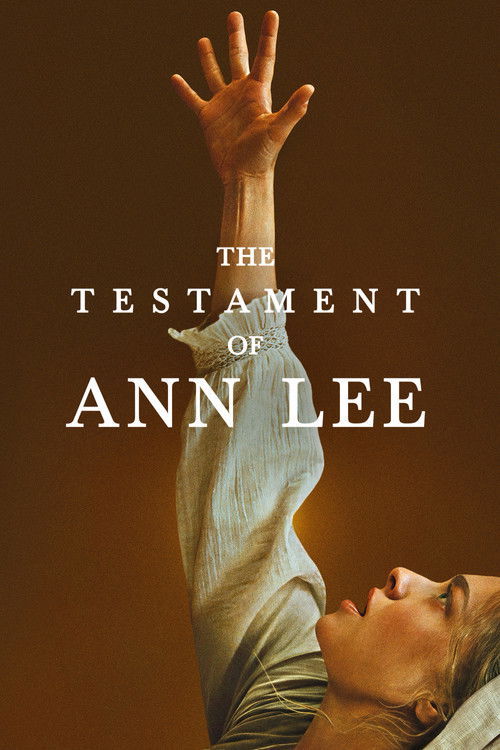
The Testament of Ann Lee
2025 · Mona Fastvold
When you want to be swept somewhere genuinely unfamiliar — a big, serious, visionary night at the movies rather than an easy one. For viewers craving awe over comfort.
What it's about
The true legend of Ann Lee, an eighteenth-century Manchester textile worker who became a religious visionary — founder of the Shakers, preacher of celibacy and radical equality between the sexes, revered by her followers as the female Christ. The film follows her from English mill-town poverty and persecution across the Atlantic to colonial New York, where she plants a movement built on ecstatic worship, communal life, and defiance of every norm around her. And it tells it as a musical.
The experience
Strange, solemn, and transporting — hymns erupt into full-body ecstatic numbers, and the film moves between hardship and rapture with hypnotic confidence. It asks for patience and repays it with images and sounds you won't shake.
Performances
Amanda Seyfried is the reason to come: a fierce, transfigured, career-redefining turn as Ann Lee, carrying the film's songs and its suffering with equal conviction, backed by a deep ensemble including Thomasin McKenzie, Lewis Pullman, and Tim Blake Nelson.
The craft
Mona Fastvold, co-writing with Brady Corbet, reinvents the musical as devotional cinema — the numbers grow out of Shaker worship itself, all stomping feet, spinning bodies, and unearthly harmony. It's period filmmaking on a grand canvas that begs for the biggest screen and best sound you can find.
Why it matters
Premiering in competition for the Golden Lion at Venice, it confirmed Fastvold as a major director in her own right and gave Amanda Seyfried the most acclaimed role of her career.
Snapshot
The Testament of Ann Lee is a historical musical drama directed by Mona Fastvold, who co-wrote the screenplay with her longtime creative partner Brady Corbet. It dramatizes the life of Ann Lee (1736–1784), the Manchester-born textile worker who became the founding visionary of the United Society of Believers in Christ's Second Appearing — the celibate, ecstatic, gender-egalitarian sect known popularly as the Shakers — and who led a small band of followers across the Atlantic to plant the movement in colonial New York. Amanda Seyfried plays Lee in what critics widely received as a career-redefining performance, supported by an ensemble including Thomasin McKenzie, Lewis Pullman, Stacy Martin, Tim Blake Nelson, and Christopher Abbott. The film premiered in competition for the Golden Lion at the 82nd Venice International Film Festival on 1 September 2025, and was released by Searchlight Pictures, opening on 70mm in limited U.S. engagements on 25 December 2025 before a wider rollout in January 2026. Running roughly 137 minutes, it stages Lee's biography not as costume hagiography but as a possessed, song-driven account of religious transport — a film about how bodies in motion become a theology.
Industry & production
The picture belongs to a distinctive production lineage: the Fastvold–Corbet partnership, which has functioned as one of the more singular author-units in contemporary art-house cinema. Fastvold and Corbet co-wrote The Childhood of a Leader (2015), Vox Lux (2018), and The Brutalist (2024); The Testament of Ann Lee arrives as Fastvold's directorial follow-up to The World to Come (2020) and as the immediate creative successor to the Corbet-directed, Fastvold-co-written The Brutalist. The two films share not only authorship but an entire production apparatus — a transatlantic, partly Hungarian-rooted financing-and-craft model. The producing roster includes Andrew Morrison, Joshua Horsfield, Viktória Petrányi, Gregory Jankilevitsch, and Fastvold and Corbet themselves; Petrányi's involvement signals the same central-European production base (long associated with Hungarian art cinema) that underwrote the look and economy of The Brutalist. Searchlight Pictures acquired North American and several international rights, betting on a prestige musical with awards momentum and pairing it with a deliberately old-fashioned exhibition strategy: a 70mm-forward holiday platform release expanding to a wider run in early 2026. Specific budget figures are not part of the reliable public record, and should not be guessed; the film reads, however, as a mid-budget independent epic, ambitious in scale of staging but economical in the way it concentrates resources on performance, music, and a handful of charged locations.
Technology
The film was shot photochemically on 35mm Kodak stock rather than digitally — a choice consistent with the Fastvold–Corbet circle's commitment to celluloid texture, and amplified by the decision to strike 70mm prints for theatrical presentation. Cinematographer William Rexer has described working with Arricam 35mm bodies (in both studio and lightweight configurations) paired with Sigma lenses chosen for their low-light latitude, flare characteristics, and bokeh — glass that lets candlelit and overcast interiors breathe without collapsing into murk. The production reportedly considered, then discarded, a more elaborate format scheme (an early notion of shooting Lee's English origins on 16mm for a rougher, neorealist grain before shifting to large-format imagery for her mature American ministry); the released film settles on a unified anamorphic-scale widescreen frame. As a planning tool, Rexer used the Artemis viewfinder app during the lengthy New York rehearsal period to pre-visualize the dance lensing — a workflow detail that underscores how much of this film's "technology" lived in choreographic preparation rather than on-set machinery. The 70mm exhibition format is less a capture technology than a statement of exhibition values: an insistence that ecstatic communal movement deserves the largest, most tactile image plane available.
Technique
Cinematography
Rexer frames the film in a widescreen ratio (around 2.39:1), a choice he has explained as driven by the dance itself — only the broad horizontal field could hold the Shakers' ranked formations, their lines and circles and facing rows, as legible spatial geometry. His governing concept is striking: the camera as a participant rather than an observer. It watches, watches, watches — patient, frontal, almost documentary — and then breaks loose, going handheld to "join" the dance as though possessed by the same spirit that seizes the worshippers. This produces a cinematography of two temperatures: a composed, painterly stillness for testimony and labor, and a fevered mobility for worship. Critics and craft writers have reached for the term "modern baroque" to describe the result — chiaroscuro interiors, period light sources, but a restless modern eye inside them. The handheld is not shaky-naturalist shorthand for authenticity so much as a kinetic theology: the frame catches the contagion of belief.
Editing
The cutting serves the musical structure first. Because the film is organized around numbers — adapted Shaker hymns and original songs — the editing must hold long enough to let bodies and voices build to transport, then release into the next movement. (The specific editor credit is not something I can attest with confidence from the reliable record, and I won't invent a name.) What is observable in the film's reception is a rhythm that alternates duration and rupture: sustained takes that let an ecstatic sequence accumulate, set against harder breaks between the worldly and devotional registers. The montage logic is closer to the dance film and the through-composed musical than to conventional biographical chronology, which gives the picture its hypnotic, ritual cadence and also its divisiveness — some viewers found the structure incantatory, others self-indulgent.
Mise-en-scène / staging
Staging is arguably the film's central craft achievement, because for the Shakers worship was staging: the dance, the march, the trembling, the gendered geometry of bodies in a meeting room. Choreographer Celia Rowlson-Hall — who had collaborated with Corbet on Vox Lux — built the movement vocabulary across an extended New York rehearsal process, and the film's mise-en-scène is essentially the photographing of that choreography in lived spaces. The Shaker aesthetic of plainness — bare wood, ladderback chairs, white walls, unornamented dress — gives the production design a severe, near-abstract canvas against which the explosions of motion register all the more violently. Costuming and color are disciplined toward austerity, so that the ecstatic body becomes the only ornament.
Sound
Sound is inseparable from the score here. Composer Daniel Blumberg — fresh from his work on The Brutalist — drew directly on the surviving corpus of Shaker hymnody, freely adapting roughly a dozen hymns and writing original songs that thread through the drama. Blumberg has described the project as among the most experimental and extreme of his career, and he worked alongside Fastvold from pre-production through the final mix, so that music, voice, and ambient sound are conceived as one continuous fabric rather than a score laid over finished images. The result foregrounds the human voice — chant, call-and-response, the wordless cry of "gift" and transport — and uses lush strings to lift communal singing toward the transcendent.
Performance
Seyfried anchors everything. The performance is physically committed and vocally exposed: she sings, she shakes, she carries the burden of a woman who must convince followers (and herself) that she is the female embodiment of Christ's second coming. Critics across the Venice and awards-season coverage repeatedly called it her finest work, and it drew nominations including the Golden Globe for Best Actress in a Musical or Comedy and a Critics' Choice nomination. The surrounding ensemble — McKenzie, Pullman, Martin, Nelson, Abbott — orbits her as disciples, antagonists, and intimates, but the film is structurally a study of a single charismatic body and the gravitational field it generates.
Narrative & dramatic mode
The dramatic mode is the sung biography — neither conventional biopic nor pure musical, but a hybrid in which song carries the narrative load that dialogue would carry elsewhere. The film proceeds in a quasi-episodic, testimonial structure (the "testament" of the title is apt), moving through Lee's English persecution, the formative trauma of multiple lost children, her revelation that carnal union is the root of sin, imprisonment, emigration, and the precarious building of a celibate community in a hostile New World. Rather than psychologizing Lee in modern terms, the screenplay tends to render her interiority through performance and music — belief is enacted, not explained. This is the film's principal risk: it asks the audience to inhabit a worldview from inside rather than to assess it from outside, and reviewers split sharply on whether the approach achieved ecstatic immersion or hermetic opacity.
Genre & cycle
The film sits at the crossing of several traditions: the religious-founder drama, the art-house musical, and the dance film. Its closest contemporary kin is the through-composed, formally aggressive musical exemplified by Vox Lux, and behind that a longer lineage of films that treat song as spiritual or social rupture rather than entertainment. As a faith-and-founder narrative it joins a sparse cycle of films willing to take ecstatic religion seriously on its own terms rather than debunking it. And as a women's-visionary portrait it extends the concerns of Fastvold's The World to Come. Within the 2025 prestige landscape it reads as part of a small revival of the serious original musical — films using song to do dramatic, even theological, work — positioned against the more familiar jukebox and adaptation models.
Authorship & method
The authorship is genuinely collaborative-conjugal. Fastvold directs and co-writes with Corbet, and the film cannot be fully understood apart from their shared body of work, in which an outsider visionary collides with an unaccommodating society and is partly broken, partly vindicated by history — the throughline from The Childhood of a Leader and Vox Lux to The Brutalist and now Ann Lee. The method is craft-forward and rehearsal-intensive: months of pre-shoot choreographic development with Rowlson-Hall; Blumberg embedded from pre-production so that score and image co-evolve; Rexer pre-lensing the dances with the director before a frame was exposed. The recurrence of key collaborators — Blumberg's score, Rowlson-Hall's choreography (a Vox Lux veteran), the Hungarian-inflected production team carried over from The Brutalist, the insistence on photochemical capture and large-format exhibition — marks this as a coherent, repertory-like authorship rather than a one-off.
Movement / national cinema
Nationally, the film is a transatlantic hybrid: an American subject, a Norwegian-born director working in English, a partly central-European production and post-production base, and U.S. studio-specialty distribution via Searchlight. It belongs less to any one national cinema than to a contemporary international art-house formation — auteur-driven, festival-launched, celluloid-committed — that pools European craft labor and financing in service of American or transatlantic stories. In that sense it extends the Brutalist model of the "American epic made through a European production grammar."
Era / period
The film is set in the second half of the eighteenth century — Lee's Manchester years amid early industrial Lancashire, and the revolutionary-era American frontier where the Shakers established themselves. But its sensibility is pointedly contemporary in form: a 2025 film using a period subject to interrogate present concerns about gender, charismatic authority, communal life, and the body as a site of both repression and liberation. The friction between archaic content and modern technique — baroque light, handheld possession, an experimental score built from antique hymns — is the period strategy itself.
Themes
The dominant theme is the female prophet: a woman who claims, and is granted by her followers, divine authority in a world structured to deny it. From this flow the film's other concerns — celibacy as both radical refusal and self-mortification; the conversion of grief (Lee's lost children) into doctrine; gender and social equality as lived practice rather than slogan; and ecstasy as a form of knowledge that exceeds language, which is why the film so often abandons speech for song and motion. Underneath runs a more ambivalent meditation, recognizable from the Fastvold–Corbet corpus, on the costs of visionary leadership: the way charisma can liberate and consume in the same gesture.
Reception, canon & influence
Backward (influences on the film): The picture draws on Shaker hymnody and material culture directly, and formally on the Fastvold–Corbet lineage — the experimental musical of Vox Lux, the visionary-outsider epic of The Brutalist, and the women-centered period intimacy of The World to Come. Its dance-as-cinema impulse and its "modern baroque" image owe to a longer tradition of films that photograph choreography as drama, and its commitment to film stock and large-format projection situates it within the celluloid-revival current of 2020s prestige cinema.
Reception: The film premiered in competition at Venice 2025 and provoked exactly the divided response its formal risk-taking invites — hailed by some as transcendent and singular, dismissed by others as self-indulgent and hermetic ("Venice's most WTF movie," in one outlet's framing). The consensus point of agreement was Seyfried, whose performance drew near-unanimous acclaim and carried the film into awards season with Golden Globe and Critics' Choice recognition; Blumberg's score and Rexer's cinematography were also singled out in craft coverage.
Forward (legacy): As a very recent release, its long influence cannot yet be honestly assessed, and I won't manufacture one. What can be said is that it strengthens the case for the original art-house musical as a viable prestige form, consolidates Fastvold's standing as a director of serious women's spiritual lives, and — alongside The Brutalist — helps define a transatlantic, celluloid-committed mode of epic filmmaking whose ongoing reach will only become legible with time.
A Deleuzian reading
Watch the camera in the meeting room.
The full Deleuzian reading of The Testament of Ann Lee →
Reception
It split the Lido in September 2025 — walk-outs and baffled press at the screening, then a 15½-minute ovation at the premiere — before settling into solid acclaim (86% on Rotten Tomatoes) and a Best Actress awards push for Amanda Seyfried, even as its Christmas release barely registered at the box office.
How The Testament of Ann Lee was received, from release to now →
How to watch The Testament of Ann Lee: what to notice on a first viewing
- Watch the camera stay still, then suddenly go handheld. Rexer holds a patient, frontal camera during ordinary scenes and breaks loose into handheld movement only when the worship and shaking begin. The camera's own discipline breaking is how the film shows you belief taking hold.
- Notice the ranked rows of men and women facing each other. The Shakers arrange themselves in symmetrical lines, men on one side and women on the other, equal and apart, filling the wide frame. The seating plan alone argues for the equality the film never has to state in dialogue.
- Notice how bare and plain every room in the film is. Production design strips interiors down to bare wood, white walls, and unornamented dress, giving the moving body almost nothing else to compete with. Severity in the rooms makes any motion inside them look larger and more urgent.
- Listen for hymns and chant carrying scenes instead of dialogue. Blumberg's score draws on real Shaker hymnody, adapted and expanded, so singing and wordless cries often do the narrative work dialogue would elsewhere. Belief here gets expressed through voice and song more than through anything anyone explains.
- Watch Seyfried's body shake before her face ever explains why. Seyfried plays Lee's conviction physically, singing and trembling through long sequences that ask her body to carry meaning dialogue never spells out. You're watching belief performed as motion, not argued as an idea.
The whole guide to watching The Testament of Ann Lee, with the keys for a rewatch →
Influences: the films it descends from and the films it influenced
- Vox Lux (2018) — Establishes the Corbet–Fastvold template of an artist's life told in chaptered movements built around original songs, with an embedded composer's score (Scott Walker) treated as the film's formal spine rather than accompaniment.
- The Childhood of a Leader (2015) — Originates the visionary-versus-society throughline scored by a foregrounded, dissonant composer embedded from pre-production, so that overpowering music co-authors the drama scene by scene.
- The World to Come (2020) — Fastvold's prior women-centered period intimacy, structured around a foregrounded interior voice and a hushed, candlelit austerity of plain rooms and restrained palette.
- The Red Shoes (1948) — Photographs choreography as the dramatic climax itself — the extended dance as the film's emotional and formal engine — rather than as decorative interlude.
- Black Narcissus (1947) — Chiaroscuro of religious enclosure and sublimated ecstasy, staging an austere female religious community pushed by repression toward a visionary breaking point.
- The Passion of Joan of Arc (1928) — Foregrounds the face and voice of a female prophet in ecstatic possession through plain, unornamented framing that treats spiritual rapture as the primary photographic subject.
- Ordet (1955) — Austere plainness and patient long takes serving a faith-as-literal-miracle subject, where ecstasy is presented as a mode of knowledge rather than delusion.
- The Tree of Life (2011) — Deploys the restless handheld camera as an instrument of the sacred, photographing devotion as perpetual motion and ecstasy as continuous gliding movement.
- Jesus Christ Superstar (1973) — Renders a religious figure's biography as a fully sung-through work, delivering the prophet's life entirely as hymn and score in continuous musical structure.
- The Brutalist (2024) — Shares the large-format photochemical epic mode — period capture engineered for 70mm projection — and the Hungarian-inflected repertory production team, dramatizing an uncompromising outsider broken yet vindicated by history.
- Suspiria (2018) — Builds dance-as-possession from months of choreographic development, staging the moving body as a conduit through which an external force seizes and reshapes it.
- A Hidden Life (2019) — Binds a handheld, roaming wide-angle 'possession' camera to a figure of unyielding religious conviction set against an unaccommodating society.
- Annette (2021) — An original sung-through art-house musical whose composer-authored score (Sparks) is the narrative's spine, with voice pushed forward as the dramatic engine.
- Dancer in the Dark (2000) — A Scandinavian art-house musical that generates its numbers out of a heroine's transfiguring inner world, setting handheld immediacy against the eruption of staged song.
- Pina (2011) — Conceives the film itself as the act of photographing choreography, making dance the primary cinematic text rather than illustration of a story.
- First Reformed (2017) — Applies transcendental-style austerity — withheld camera, plain mise-en-scène, sparseness as spiritual pressure — to channel an interior crisis of faith.
Similar films
- Ordet (1955) — influence & lineage
- Latin Blood – The Ballad of Ney Matogrosso (2025) — same viewing thread
- Michael (2026) — same viewing thread
- The Red Shoes (1948) — influence & lineage · often watched together
- First Reformed (2018) — often watched together
- Annihilation (2018) — often watched together
- The Housemaid (2025) — shared sensibility
- Hamnet (2025) — shared sensibility
All the films related to The Testament of Ann Lee →
Watch it with: curated runs of related films
- The Making of a Legend — A run of biopics that watch private people get forged into public icons — the ambition, the pressure, and the loneliness of becoming somebody the world can't stop looking at.