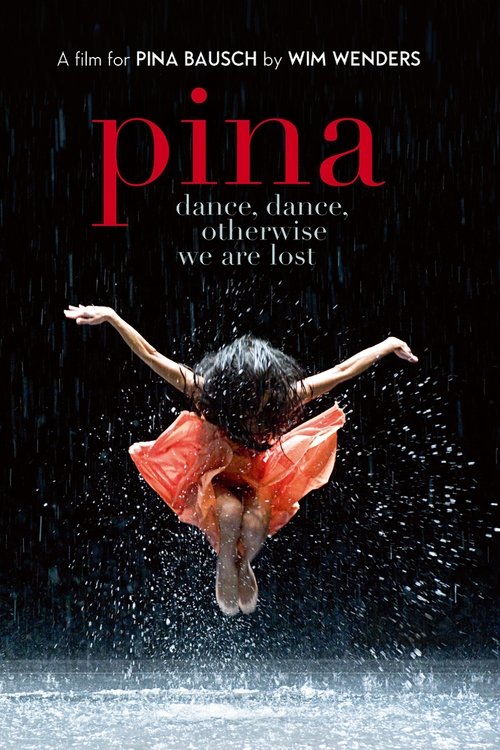
Pina
2011 · Wim Wenders
For when you want pure sensory beauty and something genuinely moving without a plot to follow — a film to feel rather than decode. Also the rare arthouse documentary that works as a shared, jaw-dropping experience with someone who 'doesn't watch documentaries.'
What it's about
A portrait of the German choreographer Pina Bausch, begun with her and finished without her: she died days before filming was to start, and her company asked Wim Wenders to make the film anyway. What he made is a memorial in motion — four of her major stage works performed by her Tanztheater Wuppertal ensemble, interleaved with solos and duets danced in the streets, factories, and famous suspended monorail of Wuppertal itself, while her dancers remember her in their own words.
The experience
Rapturous and grief-soaked at once — bodies hurling themselves through dirt, water, and city traffic with an intensity that needs no dance background to feel. It's hypnotic rather than narrative; you surrender to it the way you would to a concert, and it leaves you strangely elated.
Performances
The Tanztheater Wuppertal dancers — many of whom worked with Bausch for decades — perform with a ferocity and vulnerability that blurs the line between dancing and confession; their silent, grieving faces in the portrait interludes are as expressive as anything they do with their bodies.
The craft
This is one of the few films that made 3D feel essential rather than gimmicky: Wenders uses depth to put you inside the choreography, on the stage, in the rain and the dirt. See it as big and loud as you possibly can — the staging of dance against real industrial landscapes is the whole point, and it's breathtaking.
Why it matters
It redefined what a dance film could be and became the standard-bearer for 3D as an art-cinema tool, while introducing Bausch's radical dance-theater to a worldwide audience that would never see it live.
Snapshot
Pina is a 3D dance film made in the immediate aftermath of a death. Wim Wenders had spent roughly two decades circling the idea of filming Pina Bausch and her Tanztheater Wuppertal, and had finally begun preproduction in 2009 on a project she was co-designing with him. Bausch died on 30 June 2009, days before principal photography was to begin, having been diagnosed with cancer only shortly before. Wenders abandoned the film; the company asked him to make it anyway. What emerged is neither biography nor conventional performance capture but a memorial architecture: four Bausch stage works filmed in the Wuppertal Opera House, interleaved with solos and duets staged by company members in the industrial landscape of Wuppertal itself, and punctuated by portraits of dancers who sit before the camera in silence while we hear their remembrances in voiceover.
The film's central formal wager is that stereoscopic 3D — then largely a blockbuster technology, two years after Avatar — could solve the oldest problem in dance cinema: that a flat image collapses the volume in which choreography actually exists. Wenders has said repeatedly that he saw no way to film Bausch until he watched the concert documentary U2 3D (2008) and recognized a tool adequate to the depth of a stage. Pina premiered out of competition at the Berlinale in February 2011, won the European Film Award for Best Documentary, and became the first 3D film nominated for the Academy Award for Best Documentary Feature. It also performed unusually well commercially for a dance documentary, though precise figures vary across sources and are not worth asserting here.
Industry & production
The film was produced by Neue Road Movies, the Berlin company Wenders runs with producer Gian-Piero Ringel, with public and broadcast money typical of German auteur documentary — including participation from ZDF in association with Arte. This is the standard European art-documentary financing stack, but the 3D requirement pushed the budget and schedule well past what such a stack usually supports: native stereoscopic capture in 2009–2010 meant heavy beam-splitter rigs, a dedicated stereography department, doubled data volumes, and a postproduction pipeline that barely existed outside the studio system.
The production's timeline was ruptured by Bausch's death. The four works to be filmed — Le Sacre du printemps (1975), Café Müller (1978), Kontakthof (1978), and Vollmond (2006) — had been selected by Bausch herself, and that selection survived her as the film's spine. What did not survive was the conceptual premise: Wenders had intended a collaboration with a living choreographer, with Bausch shaping how her work met the camera. Resuming production meant rebuilding the film around the ensemble, and around absence as a structural condition rather than a subject.
That reconstruction also solved a distribution problem. Arthouse exhibition in 2011 had almost no 3D-capable screens outside multiplexes, and Pina arrived as a test case for whether specialty distributors — IFC/Sundance Selects handled it in the United States — could route a subtitled German documentary through premium-format bookings. Its relative success helped establish that a small audience would pay a 3D surcharge for something other than spectacle.
Technology
Pina was shot natively in stereoscopic 3D, not converted in post — a distinction that mattered enormously in 2010, when studio conversion work was routinely criticized for producing cardboard-cutout depth. The production worked with mirror rigs (beam-splitter arrangements in which two camera bodies capture through a half-silvered mirror, permitting interaxial separations narrower than two camera bodies placed side by side) and compact digital camera heads. Detailed public documentation of the specific camera bodies is inconsistent across sources, and the more consequential technical record is the stereographic method rather than the hardware list.
That method belonged largely to Alain Derobe, the veteran French stereographer who served as the film's 3D consultant and who advocated what he called a natural approach to depth: interaxial distance and convergence set to approximate human binocular geometry for the given viewing distance, rather than exaggerated for effect. The consequence is that Pina almost never throws objects at the audience. Negative parallax — the illusion of something protruding in front of the screen plane — is used sparingly, and mostly for elements that would occupy foreground space in a real theater: a chair, a body passing close. Depth in this film is a container, not a projectile.
The rigs imposed real limitations. They were heavy, slow to reconfigure, and hostile to the handheld, reactive shooting that documentary had come to depend on after the DV revolution. Pina accepts those constraints and converts them into style. It is a documentary made with the equipment ethics of a studio production, and it looks like one.
Technique
Cinematography
Hélène Louvart, the French cinematographer known for her work in intimate, tactile European art cinema, photographed the film — an interesting choice for a technology-forward production, and a legible one: the stage sequences avoid the clinical evenness of televised performance capture. Louvart lights for volume, letting depth read as sculptural rather than illustrative.
The stage material is often framed from a position approximating a good seat in the stalls, establishing the proscenium as a reference plane, and then violated: the camera walks onto the stage, moves among the dancers, and occupies space no spectator could. This alternation is the film's essential visual grammar. It first grants the theatrical contract — you are watching a performance, at a distance — and then dissolves it, using stereo depth to make the viewer's intrusion physically felt.
Shots are long. Camera movement is predominantly lateral and slow, often on crane or dolly, because in 2010-era 3D, fast panning induced strobing and viewer fatigue. The location sequences loosen this considerably, using the found geometry of Wuppertal — the Schwebebahn suspension railway running overhead, quarry walls, glass-and-steel industrial buildings, roads and embankments — as depth cues that a flat image would flatten into graphic pattern.
Editing
Toni Froschhammer's cutting works against documentary convention in two ways. First, average shot length is long, partly a technical necessity — stereoscopic viewing requires the eye time to re-converge after each cut — and partly a philosophical one: dance is destroyed by coverage, and Bausch's choreography in particular depends on duration, on repetition wearing a gesture down until it means something else.
Second, the film's macro-structure is anthological rather than narrative. There is no chronology of Bausch's life, no rise-and-recognition arc, no explanatory voiceover, no dated titles marching through a career. Sequences are grouped associatively: a stage excerpt gives way to a dancer's solo in a factory, which gives way to a portrait, which gives way to another excerpt. The four principal works are broken into fragments and distributed across the running time, so that Le Sacre du printemps and Café Müller recur as motifs rather than resolving as complete objects. The effect is closer to a memorial anthology or a book of remembrances than to a documentary argument.
Mise-en-scène / staging
The film's most inventive gesture is the transposition of Bausch's scenography out of the theater and into the city. Bausch's stages were famously material: Le Sacre du printemps danced on a floor covered in peat, Vollmond on and around a monolithic rock in running water, Café Müller through a thicket of café chairs cleared by a dancer running ahead of a blind, closed-eyed woman. Wenders films these in situ at the Wuppertal Opera House — and then relocates their logic outdoors, where dancers perform in a gravel pit, on a traffic island, beside the monorail, on a hillside.
Wuppertal is not incidental. It is a mid-sized post-industrial city in the Bergisches Land, the unlikely place where Bausch spent nearly four decades and built one of the most influential bodies of work in twentieth-century performance. Placing the choreography in the city's quarries, verges and infrastructure argues that the work was never separable from that ground, and it also grants the film a documentary texture — weather, traffic, passersby — that the stage material by definition cannot have.
The dancer portraits are the film's most austere staging: a performer seated, still, looking into the lens, while their voice speaks on the soundtrack. The image is a photographic portrait; the sound is testimony; the two are deliberately unsynchronized. Grief is legible in the discrepancy.
Sound
Pina's music is largely the music of the works themselves — Stravinsky for Le Sacre du printemps, Purcell for Café Müller, the heterogeneous popular and world-music selections Bausch favored elsewhere. Around this, Wenders assembled an original and curated score in which the Japanese composer Jun Miyake is the dominant voice, with additional material from Thom Hanreich; Miyake's cues, in particular, became widely associated with the film.
Equally important is what the stage recording captures: breath, the impact of feet on peat and water, the friction of fabric, the small involuntary sounds of exertion. These are the sounds theater audiences hear only in the front rows, and stereo image plus close-miked stage sound produces a sensory proximity that is the film's real argument for its technology. Sound is also where the film does its most careful withholding — the portraits' silence, the decision to let voiceover float free of lip movement, the long passages carried by music and body noise alone.
Performance
The dancers of Tanztheater Wuppertal — among them Dominique Mercy, Malou Airaudo, Lutz Förster, Nazareth Panadero, Josephine Ann Endicott, Regina Advento, Rainer Behr, Julie Shanahan, Helena Pikon, Damiano Ottavio Bigi, Fernando Suels Mendoza — are the film's authors as much as its subjects. Bausch's working method was famously interrogative: she built pieces by posing questions to her company and constructing material from their answers, so that the choreography carried the biographical residue of the specific bodies that made it. A film about that method almost has to be a film of individuals rather than of a corps, and Pina is.
The casting is also visibly multigenerational. Kontakthof, which Bausch restaged in the 2000s with a cast of nonprofessional seniors and again with teenagers, appears in the film across these versions, so that the same rituals of courtship, display and humiliation are performed by bodies decades apart. Lutz Förster's solo signing the lyrics of "The Man I Love" — drawn from Nelken (1982) — is among the film's most cited passages, and the Nelken-Line, the company's processional gesture of the seasons, recurs as a unifying figure.
Bausch herself appears only in archival material, most of it 2D footage of her dancing Café Müller. Embedded in a stereoscopic film, this footage reads as flat, grainy, and irrecoverable — an accidental but devastating formal correlate of loss.
Narrative & dramatic mode
The film is essayistic and elegiac rather than expository. It declines the standard documentary apparatus almost entirely: no narrator, no interviews framed as interviews, no historians, no archival montage explaining postwar German dance. Viewers arriving without prior knowledge of Bausch will leave without a chronology of her life.
This is a defensible choice and also the film's principal critical vulnerability. What replaces exposition is a mode of address closer to a wake — a sequence of offerings by people who knew the deceased, arranged by a filmmaker who declines to interpret them. Dramatic tension comes not from Bausch's story but from the gap between the work, which persists and can be performed, and the person, who cannot be filmed. The film's forward motion is the accumulation of that gap.
Genre & cycle
Pina sits at the intersection of three lineages. The first is the dance film proper, in which the camera is a choreographic instrument rather than a recording device — Maya Deren's A Study in Choreography for Camera (1945), Norman McLaren's Pas de deux (1968), and the long tradition of screen dance that treats editing and framing as extensions of movement. The second is the performing-arts documentary, which around 2010 was in an unusually strong phase: Frederick Wiseman's La Danse: Le ballet de l'Opéra de Paris (2009) had just demonstrated the observational alternative, and later films — Ballet 422 (2014), Mr. Gaga (2015) — extended the cycle.
The third is the brief, remarkable moment of auteur 3D. Between roughly 2010 and 2014, filmmakers with no interest in franchise spectacle took up stereoscopy as a formal problem: Werner Herzog in Cave of Forgotten Dreams (2010), Martin Scorsese in Hugo (2011), Ang Lee in Life of Pi (2012), and Jean-Luc Godard, most radically, in Adieu au langage (2014). Pina is the documentary anchor of that cycle and arguably its most persuasive case, because dance is the subject for which the added dimension is least decorative.
Authorship & method
Wenders arrives at Pina with a long practice of films about artists and artifacts of culture: Tokyo-Ga (1985) on Ozu's traces, Notebook on Cities and Clothes (1989) on the designer Yohji Yamamoto and on the electronic image, Buena Vista Social Club (1999), The Soul of a Man (2003). His recurring method in these is to make the film's own medium part of its subject — video's grain in Notebook, the digital camera's mobility in Buena Vista — and Pina follows the pattern exactly, with 3D as the declared instrument.
His account of the origin is consistent across interviews: he encountered Bausch's work in the 1980s, was overwhelmed by it, became a friend, and spent years unable to imagine a filmic form adequate to it. That impasse is the film's real authorial premise.
The key collaborators are unusually legible in the result. Hélène Louvart's photography supplies the tactile, non-televisual surface. Alain Derobe's stereography supplies the restraint that keeps the depth from becoming an effect; Derobe, a significant figure in European stereoscopic practice, died in 2012, and Pina stands as a major statement of his approach. Toni Froschhammer's editing supplies the anthological structure and the patience. Jun Miyake's music supplies the film's distinctive tonal register — melancholy, slightly displaced, neither German nor conventionally documentary. And Bausch herself, through her selection of the four works and through a method that inscribed her dancers into the choreography, remains a posthumous co-author in a more than sentimental sense.
Movement / national cinema
Wenders is a principal of the New German Cinema, the postwar movement that emerged from the Oberhausen Manifesto's rejection of "Papas Kino" and produced Fassbinder, Herzog, Schlöndorff and von Trotta alongside him. Pina belongs to that movement's long afterlife rather than its core, but shares its defining preoccupation: the problem of German cultural memory and of what images can be trusted after the mid-century rupture.
Bausch's own lineage is the more directly relevant national story. Tanztheater descends from Ausdruckstanz, the German expressive dance of Rudolf von Laban and Mary Wigman — a tradition whose figures had deeply compromised relationships with the Nazi state, and which had therefore to be reconstructed after 1945. Bausch trained at the Folkwang school in Essen under Kurt Jooss, who had gone into exile in 1933 and returned; she then studied and performed in New York around 1960, encountering American modern dance and the Metropolitan Opera Ballet milieu, before returning to Folkwang and taking over the Wuppertal company in 1973. Her mature form — spoken text, repetition, social ritual, extreme scenography, gendered violence and courtship — is thus a specifically postwar German synthesis, and Wenders's film is a German artist's account of the most internationally exported German art form of the late twentieth century.
Era / period
Pina is a 2011 film in the narrow sense that it could not have been made in 2007 or, arguably, in 2016. Digital 3D infrastructure existed because of Avatar; native-capture rigs and stereographers were briefly available to non-studio productions; premium-format screens were being installed at a rate that made specialty 3D bookings imaginable. Within a few years the format's commercial collapse had removed most of that support, which is one reason Pina's technological argument has had fewer direct successors than it deserved.
Culturally, the film belongs to a moment of intense interest in archive and cultural memory — in what can be preserved of ephemeral art forms, and by what means. Bausch's death in 2009 created an institutional emergency of exactly this kind, and the Pina Bausch Foundation, established by her son Salomon Bausch, took up the preservation and licensing of her repertory. Pina is the popular face of that project.
Themes
The body as archive. Bausch's method made her dancers the physical repositories of her work. With her gone, the choreography survives only in and as their bodies, and the film's insistence on individual dancers rather than an anonymous ensemble follows directly from that fact.
Absence and the limits of the image. The film's subject cannot be photographed. Everything in it is a form of indirection: the works she made, the people she made them with, the city she made them in, archival footage that is visibly not present-tense. The 3D technology is thereby put in a strange position — it delivers unprecedented presence for everything except the one thing sought.
Ritual, courtship and violence. Bausch's recurring material — the formal line of chairs in Kontakthof, the repeated presentation of the body for approval, the sacrificial logic of Le Sacre du printemps — concerns the choreographies societies impose on desire, particularly on women. The film transmits this without commentary; the material is legible enough not to need it.
The elements. Earth in Sacre, water and stone in Vollmond, and the industrial mineral landscape of Wuppertal outdoors. Bausch's theater was famously physical in this literal sense, and the film's depth capture makes soil and water register as substance rather than as design.
Dance as necessity. The remark widely attributed to Bausch — that she is interested not in how people move but in what moves them — states the anti-formalist premise the film honors. So does the line, also widely attributed to her and often quoted in connection with the film, that we must dance or be lost.
Reception, canon & influence
Critical reception was strongly favorable, and unusually so for a dance documentary, which is a genre that ordinarily earns respect rather than enthusiasm. Reviewers converged on two points: that the film was the first fully convincing artistic use of digital 3D outside spectacle cinema, and that its emotional force derived from a documentary accident — the death of its subject — that Wenders had converted into form rather than exploited. It appeared widely on year-end lists, won the European Film Award for Best Documentary, and took the Academy Award nomination for Best Documentary Feature, a first for a 3D film.
The dissent is worth stating fairly. Some critics found the film uncritical — a memorial that declines any distance from its subject, offers no account of how Bausch worked or what her work was arguing, and assumes an audience that already reveres her. There is also a defensible complaint that the location sequences, striking as they are, sometimes convert choreography into scenery. Neither objection displaced the general assessment.
Backward. The film inherits from screen-dance experiment (Deren, McLaren) and from the tradition of the artist portrait, including Wenders's own. It is also directly preceded in the Bausch-on-film record by Chantal Akerman's Un jour Pina a demandé… (1983), a documentary made during a company tour that remains the essential observational counterpart to Wenders's elegy. Bausch's cinematic profile was further shaped by Federico Fellini, who cast her in And the Ship Sails On (1983), and above all by Pedro Almodóvar, whose Talk to Her (2002) opens with Café Müller and closes with Mazurca Fogo, introducing her work to a mass film audience a decade before Pina.
Forward. Its clearest direct descendant is Alla Kovgan's Cunningham (2019), a 3D documentary on Merce Cunningham that adopts Pina's core strategies — native stereo capture, choreography relocated to non-theatrical spaces, structure by anthology rather than biography. Wenders himself extended the method: 3D omnibus work in Cathedrals of Culture (2014), a 3D narrative feature in Every Thing Will Be Fine (2015), and, most directly, Anselm (2023), a 3D portrait of the painter Anselm Kiefer that is Pina's formal sibling. His The Salt of the Earth (2014), on Sebastião Salgado, continued the artist-portrait strand in 2D.
Beyond film, Pina materially altered the visibility of Tanztheater Wuppertal, bringing the company and Bausch's repertory to audiences with no prior relationship to contemporary dance, and it stands as the reference case in arguments about immersive capture of live performance — arguments that have since migrated from stereoscopic cinema to volumetric video and VR. Its most durable contribution may be the simplest: it demonstrated that a technology developed to sell spectacle could be turned, with restraint and grief, into an instrument for preserving something about to disappear.
A Deleuzian reading
A woman crosses a café with her eyes shut.
The full Deleuzian reading of Pina →
Reception
Hailed in 2011 as the film that proved 3D could be art — the year it and Herzog's Cave of Forgotten Dreams turned a gimmick briefly respectable, capped by an Oscar nomination for Best Documentary. Now that 3D is dead, it's remembered wistfully as one of the very few films that actually needed it, and cinephiles mourn that most people can only see it flat.
How Pina was received, from release to now →
How to watch Pina: what to notice on a first viewing
- Watch the camera start from a theater seat, then walk onstage. Wenders first frames a dance piece as though you were sitting in the stalls, proscenium and all, then the camera stands up and moves in among the dancers themselves. The shift breaks the usual distance between a stage and its audience, right in front of you.
- Notice dancers performing in a quarry and on a traffic island. Bausch's stage pieces are relocated outdoors into Wuppertal itself, using gravel pits, hillsides, and the city's suspended monorail as the setting instead of a theater. The choreography belongs to this specific, unglamorous city, not just to a stage.
- Watch a dancer sit silent while their voice speaks separately. Each dancer portrait shows a still, silent face on screen while a remembrance plays on the soundtrack, the two deliberately never lining up. Grief becomes visible in the very gap between the quiet face and the moving voice.
- Listen for breath and feet landing under the music. The stage recordings capture the close, physical sounds of dance, breath, feet striking peat or water, fabric friction, the kind of detail only a front row would hear. The sound puts you closer to the dancers' bodies than any seat in the actual theater could.
- Notice there's no narrator, no dates, and no chronology. The film has no biography of Bausch at all, just stage excerpts, city solos, and portraits arranged associatively, with the same works returning as fragments rather than complete pieces. The structure works like a book of remembrances rather than an account of a life and career.
The whole guide to watching Pina, with the keys for a rewatch →
Influences: the films it descends from and the films it influenced
- A Study in Choreography for Camera (1945) — Cuts a single continuous movement phrase across radically discontinuous spaces — forest, apartment, museum — so that the edit rather than the dancer completes the gesture, founding the screen-dance grammar Wenders uses to move a Bausch phrase out of the opera house into a quarry, a traffic island and the Schwebebahn.
- Pas de deux (1968) — Rakes hard side-light across dancers isolated against pure black and step-prints trailing exposures so movement reads as sculpted volume rather than silhouette — the flat-image precedent for Pina's stereographic separation of the body from its ground.
- The Red Shoes (1948) — Begins its ballet from the stalls with proscenium, orchestra pit and audience in frame, then dissolves the theater into impossible space with the camera onstage among the dancers — the exact two-stage strategy of Pina's opening, which frames Café Müller frontally from the house before entering the set.
- Un jour Pina a demandé… (1983) — Films Tanztheater Wuppertal observationally on tour — corrections in rehearsal, dancers talking between numbers, repertory shown in excerpt rather than whole — establishing the excerpt-plus-testimony architecture Wenders inherits and inverts by removing Bausch's live voice.
- Talk to Her (2002) — Opens on the rising curtain of Café Müller shot straight-on from the stalls, presenting a Bausch work as a film's prologue rather than as documentation — the framing convention Wenders quotes when he stages the same piece as his own first movement.
- Tokyo-Ga (1985) — Builds an artist portrait around the subject's absence, laying first-person commentary over observational footage of traces and collaborators — the method Wenders falls back on when Bausch dies days before the shoot and the film must be assembled around a missing center.
- Wings of Desire (1987) — Holds faces in silence while their interior speech runs asynchronously on the track as the camera drifts past — the precise device of Pina's silent dancer portraits, where performers stand mute to camera under recorded testimony recorded elsewhere.
- Notebook on Cities and Clothes (1989) — Makes the recording medium itself part of the argument, interrogating the electronic image on-screen while the artist works — the same declared-instrument logic by which 3D in Pina is subject as much as tool.
- Buena Vista Social Club (1999) — Alternates staged performance, performers relocated into the streets of Havana, and spoken recollection carried over unrelated images — the three-track cycle Pina reproduces as stage number / city relocation / voiceover portrait.
- U2 3D (2008) — Established multi-rig native stereo capture of live performance and the discipline of pulling convergence to hold bodies in comfortable depth rather than thrusting them past the screen plane — the production template behind Derobe's restrained negative parallax for the Tanztheater sequences.
- The Beaches of Agnès (2008) — Hélène Louvart's hand-held, available-light photography of fabricated tableaux staged in real exteriors — mirrors planted on a beach — is the tactile, deliberately non-televisual surface she carries into Pina's location choreography.
- Cathedrals of Culture (2014) — Ports Pina's rig and stereography discipline onto architecture, keeping the slow lateral crane travel through volume and the anthological chapter structure, with asynchronous voiceover speaking in place of the absent subject.
- The Salt of the Earth (2014) — Continues the artist-portrait strand in 2D by laying the subject's recorded testimony over his own photographs rather than cutting to interview setups — the same refusal of the talking-head that produces Pina's silent portraits.
- Every Thing Will Be Fine (2015) — Carries the restrained-parallax stereo into fiction, applying 3D to domestic interiors and two-shot conversation so depth measures distance between people, with nothing permitted to protrude past the screen plane.
- Cunningham (2019) — Adopts Pina's full method wholesale — native stereo capture, repertory relocated to tunnels, rooftops and sculpture gardens, and organization by work rather than biography — for a choreographer likewise unavailable to be filmed.
- Anselm (2023) — Formal sibling built to the same plan: 3D tracking moves through the artist's studio spaces, archival and re-enacted fragments in place of chronology, and the subject's voice arriving asynchronously over images he is not in.
- David Byrne's American Utopia (2020) — Puts the camera at dancer height inside the moving group rather than in the proscenium seat, the same handheld-inside-the-ensemble vantage Kuras uses to shoot Annie-B Parson's task-based, pedestrian-gesture unison.
- Dancing Dreams (2010) — Documents the same restaging of Kontakthof with untrained teenagers that supplies Pina's multigenerational casting, but from inside the rehearsal room with a fixed observational camera — the process record to Wenders's finished-result presentation.
- Cave of Forgotten Dreams (2010) — Uses native 3D non-spectacularly to register relief and surface — the bulge of rock that carries a drawn animal — with slow lateral moves and almost no negative parallax, making the identical argument that stereo is a preservation instrument for something inaccessible.
- The Testament of Ann Lee (2025) — Conceives the film itself as the act of photographing choreography, making dance the primary cinematic text rather than illustration of a story.
- Sing, Lola, Sing! (2023) — Makes staged performance numbers the primary documentary language of remembrance and mourning rather than talking-head recollection.
Similar films
- The Red Shoes (1948) — influence & lineage
- Triumph of the Will (1935) — shared sensibility
- Phoenix (2014) — shared sensibility
- Memoria (2021) — shared sensibility
- Melancholia (2011) — shared sensibility
- Varda by Agnès (2019) — shared sensibility
- The Metamorphosis of Birds (2021) — shared sensibility
- Ida (2013) — shared sensibility