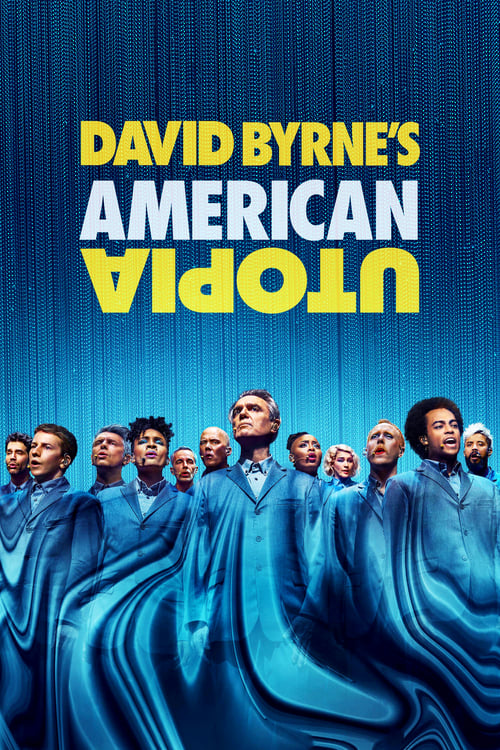
David Byrne's American Utopia
2020 · Spike Lee
For when you need your spirits lifted and your faith in people restored — a concert film that works as a party, a meditation, or a cure for a lousy week. Play it loud.
What it's about
David Byrne and eleven musicians — identical gray suits, bare feet, every instrument carried on the body, no cables or risers anywhere — perform a hundred-minute Broadway show of Talking Heads songs and solo material, threaded with Byrne's gentle monologues on the brain, immigration, voting, and how to be a person among other people. Spike Lee films the box of chain-link curtain they inhabit from angles no theater seat ever had.
The experience
It builds from spare and cerebral to full-body euphoria — by the back half you will be fighting the urge to dance in your living room. Joyful, humane, and quietly moving, with an undertow of urgency about the state of the country.
Performances
Byrne, in his late sixties, performs with undiminished strangeness and warmth, and the twelve-piece mobile band executes marching-band choreography while playing live — a feat of stamina that's thrilling to watch.
The craft
Freeing the musicians from cables and amps turns the whole stage into choreography, and Spike Lee shoots it with overhead cameras, gliding close-ups, and cuts that honor the staging rather than chopping it up. The percussion-heavy arrangements demand good speakers — this is one to feel in your chest.
Why it matters
Filmed weeks before Broadway went dark in 2020, it became a pandemic-era touchstone — proof of what live communal performance means — and an instant entry in the short canon of great concert films.
Snapshot
A Broadway stage stripped to nothing — no risers, no amplifiers, no cables, no wings — enclosed on three sides by a curtain of metal chain, and inside it twelve people in identical gray suits, barefoot, carrying every instrument they play. Spike Lee's film of David Byrne's American Utopia is a record of that box and what happens inside it over roughly a hundred minutes: twenty-odd songs drawn from Talking Heads and Byrne's solo catalog, interleaved with monologues about neurology, immigration, voter turnout, and the difficulty of being a person among other people. It was shot at the Hudson Theatre during the show's first Broadway run, which closed in February 2020, weeks before the theaters went dark; it premiered as the opening film of the pandemic-reconfigured Toronto International Film Festival in September 2020 and reached audiences on HBO that October. The result is one of the strangest artifacts of that year: a documentary of collective presence released into a season when collective presence was forbidden, made by a director who had spent the summer of 2020 watching American streets fill with the exact grief the film's penultimate number names aloud.
Industry & production
The lineage runs album → tour → theater → film. Byrne released American Utopia in 2018 and toured it with an ensemble already organized around the untethering principle; the tour's staging was developed into a theatrical piece that opened at the Hudson Theatre in October 2019 for a limited run through mid-February 2020. Alex Timbers, who had directed Byrne and Fatboy Slim's Here Lies Love at the Public Theater, served as production consultant; Annie-B Parson, Byrne's choreographic collaborator across the Love This Giant tour and the Contemporary Color color-guard project, made the movement. The Broadway production was later recognized with a Special Tony Award, and returned to Broadway in a second engagement in 2021–22 — a fact worth registering, because the film did not replace the show but advertised it.
Lee came to the project directly off the most productive stretch of his late career: BlacKkKlansman (2018) and Da 5 Bloods, released on Netflix in June 2020. He filmed the show during its Broadway run rather than after it, with an audience in the house — a choice with consequences for the film's whole rhetorical structure, and one that, in retrospect, preserved a room full of unmasked strangers sitting shoulder to shoulder as an image from a vanished world.
Distribution was television-first. HBO carried it on 17 October 2020, three weeks before the U.S. presidential election, into a market where the "capture" — the filmed stage production released as a premium streaming event — had just been validated at enormous scale by Hamilton's arrival on Disney+ that July. That placement determined the film's institutional afterlife: it was campaigned and judged as television rather than as cinema, and its awards path ran through the variety-special categories rather than the documentary Oscars. The specific corporate financing structure behind the production is not the film's interesting industrial fact; the interesting fact is that a Spike Lee picture of a Broadway musical could be commissioned, shot, and released as a streaming premium in under a year.
Technology
The show's entire aesthetic is downstream of a technical premise: everything is wireless. Guitars and basses transmit; keyboards are portable; the percussion — a contingent of six players, an unusually large share of a twelve-person company — is carried in marching harnesses. There are no monitor wedges on the floor because the performers are on in-ear monitors, and there is no visible amplification because the amplification lives offstage. Byrne has been explicit that the goal was to remove from the stage everything that is not a human being. What makes that possible in 2019 and not in 1984 is a matured ecology of low-latency wireless audio, battery-powered instrument electronics, and in-ear monitoring reliable enough to trust with a Broadway run. The staging is not a metaphor that technology enabled; it is a technology that became a metaphor.
Lee's side of the equation is a multi-camera digital shoot working at theatrical light levels, including a fixed overhead position looking straight down at the stage floor — a rig that only pays off because the choreography is designed as pattern. The specific camera package, lens set, and finishing format are not well documented in the readily available record, and I would rather flag that than guess. The distribution technology matters more anyway: this is a film whose primary exhibition venue was a living room, at a moment when that was the only venue there was.
Technique
Cinematography
Ellen Kuras shot it, and the choice reads as a deliberate convergence of two histories. Kuras had photographed three earlier Lee films — the documentary 4 Little Girls (1997), Summer of Sam (1999), and Bamboozled (2000) — so she arrives with two decades of shorthand with the director. She had also photographed Jonathan Demme's Neil Young: Heart of Gold (2006), which places her one degree from Stop Making Sense, the film every frame of American Utopia is measured against whether it wants to be or not.
Her strategy alternates between two incompatible vantages. On the floor, the camera is inside the company — moving among the players, catching them at close range and often at eye level, treating the ensemble as a crowd you have been admitted to rather than a spectacle you are watching. Overhead, the same choreography resolves into flat geometry: bodies as marks on a white-lit plane, lines forming and dissolving, the shot Busby Berkeley invented for exactly this purpose and that almost no concert film has a stage clean enough to use. The chain curtain does a great deal of the photographic work, catching light as a shimmering scrim, absorbing performers who exit through it at any point on the perimeter, and giving Kuras a background that is neither wall nor void.
Editing
Adam Gough's cutting is fast where the arrangements are fast and patient where Byrne is talking, but its consequential decisions are structural rather than rhythmic. Demme's celebrated rule in Stop Making Sense was to withhold the audience almost entirely, so that the film could be a closed system with the viewer as its only witness. Lee and Gough do the opposite: the audience is present, cut to, sung to, eventually risen to its feet. The film wants you to see people watching, because its subject is the condition of being among others.
The single most important editorial act is an interpolation. During the performance of "Hell You Talmbout" — Janelle Monáe's protest chant, which names Black Americans killed by police and racist violence and demands that the audience say their names — Lee brings photographic portraits of the named dead into the film, images that exist nowhere in the stage show. It is the point at which the capture stops being a capture. A theater audience in early 2020 heard a list; a home audience in October 2020, after the summer of George Floyd, saw faces. Lee did not change the performance; he changed what the performance is a document of.
Mise-en-scène / staging
The design is subtractive to the point of provocation. A gray floor, a gray box, the chain curtain on three sides, and twelve identical gray suits — Kenzo tailoring — worn barefoot by every performer including Byrne. Uniforming the company erases the standard concert hierarchy of frontman-plus-backline; when everyone is dressed identically and nobody is anchored to a fixed position, the only way to read status is by attention, and Parson's choreography keeps redistributing it. The movement vocabulary borrows from marching band and drill team as much as from concert dance: unison walking, ranks, wheels, sudden dispersals. Lee, a Morehouse alumnus with a long relationship to the visual grammar of Black marching-band tradition, is an unusually well-matched reader of that material, and the overhead camera is the reading.
The one prop is the model brain Byrne holds at a desk in the opening number, "Here," which supplies the show's organizing conceit before a single ensemble member has entered. Players then accumulate one at a time, so the film's first movement is literally the assembly of a collective from a solitary man with an object.
Sound
The film presents as live performance audio rather than playback, and the mix privileges the percussion mass — the arrangements are rebuilt so that the Afro-diasporic rhythmic layer that was always latent in Talking Heads' Remain in Light period becomes the surface of the whole evening. "I Zimbra," whose lyric is Hugo Ball's 1916 Dada sound poem, and "Born Under Punches (The Heat Goes On)" sit comfortably beside 2018 material because everything has been retooled to the same portable, hand-struck idiom. The detailed post-production mixing chain is not something the public record documents well, and I will not invent it; what is audible is a deliberate refusal of studio gloss and a room tone that keeps the theater in the recording.
Performance
Byrne at sixty-seven performs his own past mannerisms without impersonating them: the jerked limbs and the flat affect are still there, but slowed, drier, more lecturer than seizure. He is funny in a register that depends entirely on not seeming to know he is funny. The counterweight is supplied chiefly by vocalists-dancers Chris Giarmo and Tendayi Kuumba, who carry the show's warmth, its physical extravagance, and much of its emotional signaling, and by an ensemble of players — among them percussionist Mauro Refosco, a long-standing Byrne collaborator, bassist Bobby Wooten III, and guitarist Angie Swan — who are asked to play and march and act simultaneously. The film's most quietly radical performance decision is that Kuras's camera treats every one of the twelve as a face worth holding on.
Narrative & dramatic mode
Formally this is a lecture with songs, and the lecture has a thesis. Byrne opens with the neurological claim that infants have vastly more neural connections than adults and that we spend our lives pruning the ones we don't use — a fact about brains that he immediately converts into a fact about societies. Everything after that is an argument that connection is a use-it-or-lose-it capacity. The monologues move from the cognitive to the civic: an introduction of the band by country of origin, Byrne noting that most of the players are not American and that he, born in Scotland, is himself a naturalized immigrant; a passage on how few eligible Americans vote in local elections; a story about a high-school choir in Detroit whose version of "Everybody's Coming to My House" sounded, to Byrne, more welcoming than his own — a small, precise admission that the song's meaning was not his property.
The dramatic arc is therefore from isolation to assembly and from the personal to the political, and it lands on "Hell You Talmbout" as its moral crux before releasing into "One Fine Day" and, as encore, "Road to Nowhere." The film's coda leaves the building entirely: the company on bicycles through New York streets, which is both a Byrne signature and the last argument, that the thing made in the room was not confined to it.
Genre & cycle
Two cycles intersect. The first is the concert film, from Monterey Pop (1968) and Woodstock (1970) through Scorsese's The Last Waltz (1978) and Demme's Stop Making Sense (1984), the film that established the possibility of a rock concert as designed theater rather than documented event. The second is the theatrical capture — National Theatre Live, the Disney+ Hamilton of July 2020, and a broader streaming appetite for filmed stage work. American Utopia sits precisely on the seam: a rock show that had become a Broadway production, filmed by a feature director for television.
It also belongs to a cycle inside Lee's own filmography that is routinely underweighted: Freak (1998), The Original Kings of Comedy (2000), A Huey P. Newton Story (2001), Passing Strange (2009), and Rodney King (2017). Lee has been filming live performance, and specifically the solo or ensemble stage monologue, for a quarter century. American Utopia is not a detour from his work; it is the mature statement of one of its standing modes.
Authorship & method
The film has two authors and the tension between them is productive. Byrne wrote the text, made the song selection, conceived the staging, and had already fixed the piece through a tour and a Broadway run before a camera arrived; Lee's authorship is exercised in vantage, rhythm, and the decision about what a camera owes a protest song. Lee brings his own established collaborators — Kuras, with whom his relationship dates to 4 Little Girls — and lets Byrne's collaborators keep authorship of what they made: Parson's choreography, Rob Sinclair's lighting, Timbers's structural hand on the stage version.
The method is best described as principled non-interference punctuated by one decisive intervention. Lee does not restage, does not cut away to talking heads, does not add narration, does not break the theatrical fiction — except during "Hell You Talmbout," where he does all the things a documentarian does. That asymmetry is the film's argument about its own form: a capture is neutral until neutrality becomes a position.
Movement / national cinema
It is New York cinema in the most literal sense — a Manhattan theater, a Brooklyn-identified director, a downtown musician whose career began at CBGB — but its cultural sourcing is deliberately non-national. The rhythmic foundation is Afro-diasporic, routed through Brazilian, Cuban, and West African percussion practice and through Talking Heads' own late-1970s absorption of Fela Kuti-era Afrobeat; the lyric of "I Zimbra" is Zurich Dada; the company is multinational by design and by Byrne's explicit onstage accounting. The film thus positions American utopia as something assembled from imported parts, which is either the country's founding claim or its standing irony, and Byrne is careful not to resolve which.
Era / period
Few films are so completely defined by the four-month gap between shooting and release. Filmed with a live Broadway audience before mid-February 2020; Broadway shuttered on 12 March; George Floyd was killed on 25 May; Lee's Da 5 Bloods arrived in June; American Utopia premiered at a Toronto festival held mostly online in September and aired on HBO in October, three weeks before a national election it openly urges viewers to participate in. The film is simultaneously a pre-pandemic object and a post-uprising one. Every shot of a crowded theater reads as elegy, and every syllable of "Hell You Talmbout" reads as prophecy fulfilled between takes.
Reception, canon & influence
Critical response was close to unanimous in its enthusiasm, and the film appeared widely on 2020 year-end lists; the dissenting line, where it existed, held that Byrne's utopianism is a comfortable posture and that a white artist's assembly of global rhythm and Black protest song deserves harder interrogation than the show conducts on itself — a critique the film partly anticipates in the Detroit choir anecdote and in Lee's insistence on making the dead visible.
Backward, the debts are legible and mostly acknowledged. Stop Making Sense is the inescapable precursor and the film's chosen antagonist: Demme's accretive opening (one man, then more) is reproduced and inverted, his withheld audience is deliberately restored, his big suit is replaced by twelve small identical ones. Behind that stand Berkeley's overhead geometry, marching-band and drill-team formation, the austerity of the Wilson-Glass theatrical tradition, and Byrne's own directorial experiment True Stories (1986). On Lee's side, the debt runs to his documentary practice — 4 Little Girls above all — for the conviction that a photograph of a dead person is an argument.
Forward, the record is genuinely young, and it is too early to claim a school. What can be said concretely is that the film enlarged the audience for the stage production, which returned to Broadway in 2021 and continued to tour; that it stands with Hamilton as one of the two pictures that made the streaming-era capture a legitimate first-class release rather than a souvenir; and that it consolidated the argument, running from Demme through Homecoming (2019) to Questlove's Summer of Soul (2021), that the concert film is a form for making claims about who a nation contains, not merely a record of a good night. Within Lee's own body of work, it is the film that retroactively organizes his performance documentaries into a coherent line — and it is likely to be remembered longest for a single act of authorship: the moment a filmed play stopped being a filmed play and looked at us.
A Deleuzian reading
A man sits alone at a desk, barefoot, holding a plastic model of a brain.
The full Deleuzian reading of David Byrne's American Utopia →
Reception
It landed in October 2020 as pure catharsis — a film about the joy of gathering, released when nobody could gather — and was instantly embraced as a pandemic balm. A few years on it's settled comfortably into the modern concert-film canon rather than fading with the moment that made it.
How David Byrne's American Utopia was received, from release to now →
How to watch David Byrne's American Utopia: what to notice on a first viewing
- Notice that no one wears anything different from anyone else. All twelve performers, Byrne included, wear identical gray suits and bare feet, so there's no frontman, no backline, and status has to be read through attention instead of position. Nobody is anchored to a spot, so the whole company reads as one moving body rather than a star and his band.
- Notice the stage has no cables, risers, or wings. Everything is wireless and portable, and performers simply exit through a curtain of hanging metal chain on any side, so the stage never reads as a fixed set with a backstage. The bare box could be anywhere, which is exactly what lets anyone move through it in any direction.
- Watch for a shot looking straight down at the floor. Kuras occasionally cuts to a fixed overhead camera that turns Parson's choreography into pure pattern, bodies as lines and marks on a lit plane rather than individual dancers. From straight above, you stop being able to tell who's leading, or even which one is Byrne.
- Listen for how much of the sound is drums. The mix pushes a six-person percussion section to the front, rebuilding the arrangements around a hand-struck, marching rhythm that runs under nearly every song in the show. The beat isn't backing up the songs anymore. It's carrying them.
- Count how many players join before the stage fills up. The show opens with Byrne alone at a desk holding a model brain, and the other eleven performers walk on one or two at a time until the full company is assembled. The structure itself argues the point before a single monologue does: connection has to be built person by person.
The whole guide to watching David Byrne's American Utopia, with the keys for a rewatch →
Influences: the films it descends from and the films it influenced
- Stop Making Sense (1984) — Demme's accretive opening — one man with a boombox, then a bassist, then the band assembling in full view of the camera — is reproduced beat-for-beat and then systematically inverted: the same entrance logic, twelve identical small gray suits in place of the one big suit, and Demme's famously withheld audience deliberately restored.
- Footlight Parade (1933) — The god's-eye overhead that converts bodies into abstract rotating symmetry; Kuras's top-down rig above the chain-curtain box quotes the 'By a Waterfall' kaleidoscope, with barefoot percussionists standing in for chorines.
- True Stories (1986) — Byrne's own directorial experiment in flat frontal tableau staging with a deadpan lecturer addressing the lens in mock-anthropological register — the direct source of the lecture-with-songs structure and of Byrne's late-style delivery.
- 4 Little Girls (1997) — Established, with Kuras, Lee's operating conviction that holding on a still photograph of a murdered person constitutes an argument rather than illustration — the exact device detonated during 'Hell You Talmbout.'
- Passing Strange (2009) — Lee's prior capture of a fixed Broadway staging: multi-camera coverage assembled across live performances with a handheld operator physically inside the ensemble on the stage floor rather than shooting from the house.
- The Original Kings of Comedy (2000) — Lee's template for cutting a solo stage performer against reaction shots of specific, individuated audience members, making the crowd a named co-subject instead of ambient atmosphere.
- Storefront Hitchcock (1998) — Demme's bare-stage capture of a single performer against a plain unadorned field — no set, no scenery, no crowd inserts — the minimalist empty-box aesthetic Byrne's gray void inherits and populates.
- Neil Young: Heart of Gold (2006) — Kuras's own earlier concert grammar for Demme: warm low-contrast lighting of a stripped stage and patient held framings on hands, mouths and instruments, the specific photographic eye she carries into American Utopia.
- Wattstax (1973) — Reconceived the concert film as a claim about who a nation contains by interrupting performance with political address and community testimony — precisely the register Lee's protest-photo interpolation switches into.
- The Last Waltz (1978) — The shooting-script method: every camera position pre-assigned a role song by song, the concert designed as a film shoot with deliberately theatrical rather than rock-vérité staging.
- Einstein on the Beach: The Changing Image of Opera (1985) — Preserves the Wilson–Glass stage grammar — bare cyclorama, uniform costume, scenery-free repetition-driven blocking — from which Byrne's empty gray room, chain curtain and twelve identical suits directly descend.
- Pina (2011) — Puts the camera at dancer height inside the moving group rather than in the proscenium seat, the same handheld-inside-the-ensemble vantage Kuras uses to shoot Annie-B Parson's task-based, pedestrian-gesture unison.
- Summer of Soul (2021) — Extends the Wattstax-through-Lee line by interrupting performance footage with archival and present-day testimony so the concert record becomes an argument about erased public memory rather than a document of a good night.
- Renaissance: A Film by Beyoncé (2023) — Treats the tour's staging and choreography as a fixed authored text to be captured faithfully, reserving directorial intervention for interpolated non-concert material — the same principled non-interference punctuated by one editorializing move.
- Taylor Swift: The Eras Tour (2023) — Theatrical event release of a straight multi-camera capture with set list and staging untouched, the commercial consolidation of the first-class-release status American Utopia and Hamilton established for the stage capture.
- Springsteen on Broadway (2018) — The same monologue-with-songs architecture on a deliberately bare stage, with the theatrical text fixed through a long run before any camera arrives so that the film's only authorship is vantage and rhythm.
- Homecoming: A Film by Beyoncé (2019) — Builds its staging from HBCU marching-band and drill-team formation — ranks of bodies moving in unison carrying their instruments rather than stationed behind them — the identical solution to the wireless-instrument problem Byrne poses.
- Hamilton (2020) — Multi-camera capture of an unaltered Broadway staging shot across live performances plus an audience-free day for crane and dolly work; with American Utopia it converted the filmed play from souvenir into a first-class release.
Similar films
- The Last Waltz (1978) — influence & lineage
- Crooklyn (1994) — shared sensibility
- Moonage Daydream (2022) — shared sensibility
- Birdman or (The Unexpected Virtue of Ignorance) (2014) — shared sensibility
- 25th Hour (2002) — shared sensibility
- Do the Right Thing (1989) — shared sensibility
- tick, tick... BOOM! (2021) — shared sensibility
- The Greatest Showman (2017) — shared sensibility