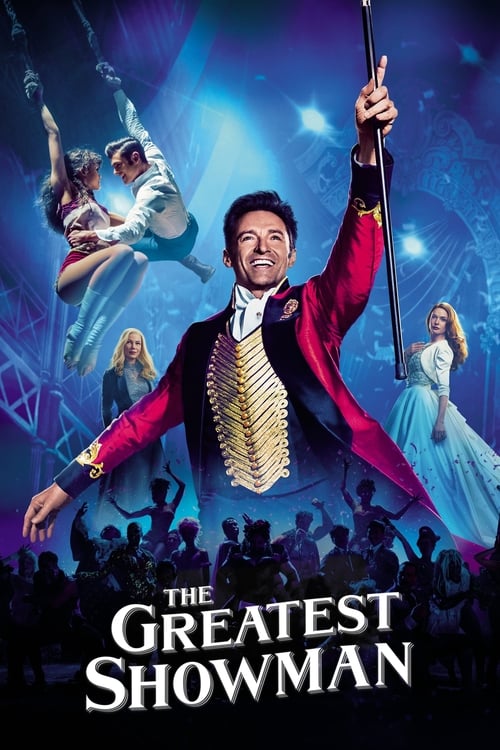
The Greatest Showman
2017 · Michael Gracey
For when you want to feel lifted — a sing-along, lights-off, give-yourself-over kind of night. Pure comfort and spectacle; save the skepticism for another evening.
What it's about
A big, unabashed original musical spun loosely from the life of P.T. Barnum, the nineteenth-century showman who built a circus out of nothing. A tailor's son with a rich man's ambitions marries up, gambles everything on a museum of curiosities, and gathers a troupe of sidelined performers — the people polite society calls freaks — into a family and a spectacle. It's a rags-to-riches fable about self-invention, and about what chasing the crowd's applause costs the people closest to you.
The experience
Wall-to-wall pop anthems delivered at full belt — it moves like a concert, barely pausing between numbers, and it aims squarely for your chest rather than your head. Expect goosebumps, a lump in the throat, and at least one song stuck in your head for a week.
Performances
Hugh Jackman pours a decade of wanting this role into every frame — few movie stars can sell a showman's charm and hunger like this — and Keala Settle's anthem of self-acceptance became the film's signature for a reason.
The craft
The Pasek and Paul songbook is the engine: modern pop anthems set against a stylized Gilded Age world of top hats, trapezes, and torchlight. The choreography-heavy numbers are built like music videos — big, glossy, precisely cut — and the film genuinely rewards good speakers turned up loud.
Why it matters
Critics shrugged; audiences turned it into a phenomenon, with a soundtrack that dominated the charts for months and 'This Is Me' becoming a self-acceptance anthem far beyond the film. It helped prove the original movie musical could still be a blockbuster.
Snapshot
The Greatest Showman is an original movie musical, loosely inflected by the life of nineteenth-century American impresario P.T. Barnum, released by 20th Century Fox in December 2017. It was the feature directorial debut of Michael Gracey, a visual-effects artist and commercials director, and the culmination of a development effort that Hugh Jackman championed for the better part of a decade. Built around original songs by Benj Pasek and Justin Paul — the lyricist-composer team then cresting on the success of La La Land and Dear Evan Hansen — the film sets a contemporary pop-anthem idiom against a stylized Gilded Age backdrop, telling a fable of outsiders, self-invention, and spectacle. Critics were broadly cool; audiences were not. The film became a genuine cultural phenomenon, its soundtrack one of the defining album successes of 2018 and its centerpiece song, "This Is Me," an anthem well beyond the movie's own footprint. As a case study, The Greatest Showman is most interesting for the gap between its critical and popular receptions, and for the way it revived the commercial viability of the wholly original (non-adapted, non-jukebox) screen musical.
Industry & production
The project's long gestation is the central fact of its production history. Jackman, whose musical-theater credentials run from Australian stage work through The Boy from Oz and the film of Les Misérables (2012), had wanted to make a Barnum musical for years, and the film moved through extended development and workshopping at Fox. The most frequently recounted episode — reported by Jackman and the songwriters in interviews around release — is a studio workshop presentation at which Keala Settle performed an early version of "This Is Me," a demonstration credited with securing the studio's confidence in the material. Because so much of this narrative comes from promotional interviews, the precise internal decision-making at Fox is not fully documented in the scholarly record.
Michael Gracey, previously known for commercials, music videos, and visual-effects supervision, was an unconventional choice to helm a studio musical and came to the film without a prior feature. The screenplay is credited to Jenny Bicks and Bill Condon; Condon, notably, had written Chicago (2002) and directed Dreamgirls (2006), giving the production a screenwriter deeply versed in the modern screen-musical form. The film was produced on a mid-range budget for a studio musical and, after a soft opening, displayed unusually strong holds through the winter holidays and into the new year — a "legs" profile driven by repeat viewing and word of mouth rather than a front-loaded launch. It ultimately grossed several hundred million dollars worldwide, making it one of the more commercially successful live-action musicals of its era; readers should consult a current box-office database for exact figures, but the pattern of a modest debut followed by an exceptionally long tail is well established. The soundtrack's commercial life outstripped even the film's, topping album charts and selling durably across 2018.
Technology
The Greatest Showman is a digitally originated, effects-forward production, and its technology profile reflects Gracey's background. Period New York, the harbor, and the circus milieu are substantially realized through digital set extension and compositing rather than location or standing-set fidelity — the film is frankly a constructed, painterly environment rather than a naturalistic one. The musical numbers were built on the standard modern-musical pipeline of pre-recorded, studio-produced vocal tracks to which performance was staged and lip-synced, allowing the songs to carry full contemporary pop production — layered vocals, programd percussion, big compressed choruses — rather than the thinner sound of live capture. This is a deliberate aesthetic choice: the film wants the sonic scale of a chart single, not the intimacy of live singing that Les Misérables had pursued five years earlier. The choreography, staged by Ashley Wallen, was designed to be captured in fluid camera moves and long developing takes, which in turn required extensive rehearsal and, in the more elaborate numbers, rigging and wire work.
Technique
Cinematography
Cinematography is by Seamus McGarvey, a two-time Academy Award nominee whose credits include Atonement and Anna Karenina. McGarvey lights the film in saturated, high-contrast, jewel-toned registers, favoring warm amber interiors, deep blacks, and pools of theatrical color that read as heightened rather than historical. The camera is mobile and often choreographic, gliding with the dancers and rising to catch the geometry of ensemble numbers; the opening "The Greatest Show" and the barroom deal-making of "The Other Side" are staged as continuous or near-continuous kinetic set-pieces. The visual grammar is explicitly presentational — the film addresses the audience as an audience — and McGarvey's imagery consistently prioritizes emotional legibility and spectacle over period texture.
Editing
The film carries an unusually large editing credit — several cutters share the card, among them Tom Cross (Whiplash, La La Land), Michael McCusker (a frequent James Mangold collaborator), Robert Duffy, Joe Hutshing, Jon Poll, and Spencer Susser. A shared editorial credit of this size typically signals a long, heavily reworked post-production, and press around the film indicated substantial reshaping after early screenings. The finished cutting style is brisk and musical, tightly locked to beat and lyric, with numbers built for propulsion; dramatic connective scenes are compressed, sometimes to the point that critics faulted the storytelling as thin between songs.
Mise-en-scène / staging
Production design and staging render the nineteenth century as a stylized, storybook America — clean silhouettes, bold primary colors, an idealized circus of light and motion rather than the grubby, exploitative reality of Barnum's actual enterprise. The "curiosities" of Barnum's troupe are staged sympathetically as a found family of the marginalized, a framing choice with real thematic and ethical consequences (see Themes). Numbers are conceived as theatrical events within the world — the ring, the stage, the rooftop — so that the film's artifice is diegetically motivated by the subject of showmanship itself.
Sound
The sound design serves the songs first. Pasek and Paul's numbers are mixed as full contemporary pop productions, and the film's aural signature is the anachronistic collision of period image with modern power-ballad and pop-stomp arrangements — a strategy inherited from Baz Luhrmann. The underscore, by John Debney and Joseph Trapanese, bridges the songs, but the film's identity lives in its set numbers: "This Is Me," "The Greatest Show," "Rewrite the Stars," "Never Enough" (sung on the soundtrack by Loren Allred as the voice of Jenny Lind).
Performance
Jackman anchors the film with the triple-threat command his stage background affords; his Barnum is charismatic, driving, and — by design — only lightly interrogated. The supporting ensemble is central to the film's appeal: Zac Efron (himself a musical performer since High School Musical) and Zendaya as the interclass, interracial romantic pair whose "Rewrite the Stars" is staged as an aerial trapeze duet; Michelle Williams as Barnum's wife Charity; Rebecca Ferguson as the singer Jenny Lind; and Keala Settle as the bearded lady Lettie Lutz, whose delivery of "This Is Me" became the film's emotional and commercial keystone. The performances are pitched to the film's presentational mode — broad, warm, and audience-facing rather than psychologically granular.
Narrative & dramatic mode
The film operates in the biopic-musical mode but is best understood as fable rather than biography. It borrows the outline of Barnum's rise — poverty, ambition, the museum and the circus, the Jenny Lind tour, reversal, and reconciliation — but organizes these beats around universal emotional archetypes: the striver who overreaches and rediscovers what matters, the outcasts who find belonging, the lovers divided by class and race. Dramatic causation is delivered largely through song; the numbers do the work of interiority and transformation that dialogue scenes might otherwise carry. This produces the film's characteristic texture — emotionally direct, structurally streamlined, and untroubled by the historical Barnum's documented deceptions and exploitations, which the screenplay elides or reframes.
Genre & cycle
The Greatest Showman belongs to the small, high-risk category of the wholly original studio musical — not adapted from a stage show, not assembled from a pre-existing song catalog. Its release sits within a brief mid-2010s resurgence of screen-musical confidence catalyzed by La La Land (2016) and Disney's live-action Beauty and the Beast (2017), and it shares personnel and idiom with the former through Pasek and Paul. Within the musical genre it is a "pop musical": its songs are written in a current commercial-radio vocabulary rather than in period or Broadway pastiche, deliberately courting a chart life independent of the film. The clearest generic antecedent is Baz Luhrmann's Moulin Rouge! (2001), with which it shares the strategy of anachronistic pop scoring, maximalist staging, and a showbiz-about-showbiz reflexivity.
Authorship & method
The film is a producer-driven, collaboratively authored work rather than a director's personal statement, and its "authorship" is best located across several hands. Michael Gracey, the director, brought a music-video and VFX sensibility — glossy, kinetic, image-forward — and made his feature debut here; his later Better Man (2024), the Robbie Williams biopic staged with a CGI chimpanzee in the lead, confirms a directorial signature built on stylized spectacle and unconventional musical staging. Hugh Jackman functioned as the film's animating force and de facto author-star, having driven its development for years. Benj Pasek and Justin Paul shaped the film's cultural identity more than any other collaborators; the songs are the film's durable achievement. Seamus McGarvey provided the saturated, mobile visual style; John Debney and Joseph Trapanese the connective score; screenwriters Jenny Bicks and Bill Condon the fable-shaped book. Because the film was extensively reworked in post — as the multi-editor credit attests — its final form is better read as the product of studio-workshop iteration than of a single controlling vision.
Movement / national cinema
This is a mainstream American studio product, made within the Hollywood musical tradition and financed by 20th Century Fox. It does not belong to a movement in any avant-garde sense; its lineage is the classical Hollywood musical of spectacle and the more recent transnational, pop-inflected musical typified by Luhrmann's Australian-Hollywood hybrid style. Its cast and creative team are internationally sourced (Australian, British, Irish, American), but its idiom and market are squarely Hollywood-commercial.
Era / period
Released in December 2017, the film is a document of a specific late-2010s media moment: the post–La La Land appetite for original musicals, the ascendancy of streaming and playlist culture that let its soundtrack achieve a life independent of the film, and the sing-along/repeat-viewing behaviors that produced its extraordinary theatrical legs and long soundtrack tail. It is set, diegetically, in the mid-nineteenth century, but makes no serious attempt at period authenticity; its "era" that matters is the one of its making.
Themes
The film's controlling themes are self-acceptance and the dignity of the marginalized ("This Is Me" as manifesto), the making of a chosen family among society's outcasts, and American self-invention through hustle, showmanship, and spectacle. A secondary romantic thread — the Efron–Zendaya pairing — foregrounds barriers of class and race. Running beneath these is the tension between spectacle and authenticity, between Barnum's crowd-pleasing illusions and genuine feeling, a tension the film raises but ultimately resolves in favor of uplift. This is also the film's most-contested dimension: by recasting Barnum — a historical figure whose fortune rested substantially on deception and on the display and exploitation of human beings — as a benevolent champion of the different, the film has been widely criticized for sanitizing and even inverting its own source material. The gap between the movie's celebration of inclusion and the historical record's account of exploitation is the interpretive crux of any serious reading.
Reception, canon & influence
Critical reception was mixed to negative. Reviewers frequently praised Jackman's charisma, the energy of the numbers, and the strength of "This Is Me," while faulting thin characterization, historical whitewashing, and a synthetic, over-processed sheen; aggregate critical scores sat in unenthusiastic territory. Audience reception was the near-opposite: exit polling was strongly positive, and the film generated the kind of repeat-viewing and sing-along enthusiasm that sustained an exceptionally long theatrical run. "This Is Me" won the Golden Globe for Best Original Song and was nominated for the Academy Award in the same category (losing to "Remember Me" from Coco). The soundtrack became a chart-topping, long-selling phenomenon and spawned a covers-and-reworkings album, The Greatest Showman: Reimagined (2018).
Influences on the film (backward): the classical Hollywood spectacle musical (Busby Berkeley–style ensemble geometry, the showbiz backstage musical), the biopic-musical form Bill Condon had worked in with Chicago and Dreamgirls, and — most directly — Baz Luhrmann's Moulin Rouge!, whose anachronistic pop scoring and maximalist reflexivity are the film's clearest template. The immediate commercial permission came from La La Land's success and its songwriters.
Legacy (forward): The Greatest Showman's most tangible influence is as proof-of-concept that an original pop musical could achieve massive commercial life primarily through its soundtrack and repeat/sing-along culture, reframing how studios and audiences valued the form in the streaming era. "This Is Me" entered the wider culture as an anthem of self-affirmation used well beyond the film. For its director, the film established the stylized-spectacle approach he extended in Better Man. Its critical-versus-popular split has itself become a frequently cited example of the divergence between reviewer consensus and audience embrace in the late 2010s. The scholarly and critical record on the film's longer-term influence remains thin and still-forming, and claims about its impact on subsequent musicals should be treated as provisional rather than settled.
A Deleuzian reading
A bar, late.
The full Deleuzian reading of The Greatest Showman →
Reception
Critics shrugged (it opened soft and got middling reviews), but word-of-mouth turned it into one of the leggiest box-office runs of the modern era — and it's since settled in as a beloved singalong comfort-watch that cinephiles still love to roll their eyes at.
How The Greatest Showman was received, from release to now →
How to watch The Greatest Showman: what to notice on a first viewing
- Watch how long the camera travels during the barroom number. The Other Side plays as a near-continuous move. McGarvey's camera glides with Jackman and Efron around the bar while a negotiation turns into choreography. The cutting is not doing the work here. The change in the scene is carried by a moving camera and two bodies rather than by a cut.
- Notice that people change their minds during songs. The dialogue scenes between numbers are short and quick. Decisions, reversals and declarations all land inside the music. Almost nothing gets settled by what anyone says in a room. The songs carry the causation. Watch for plot between numbers and you will find very thin connective tissue.
- Look at the colors in the interiors and the ring. McGarvey works in saturated jewel tones: amber rooms, deep blacks, pools of theatrical color. None of it is trying to look like 1850s New York. Every choice is pitched to feeling. The palette does the emotion's job rather than the period's. Color is the main instrument the film plays.
- Watch the troupe move as a single body. In the big numbers the performers lock into shared patterns, arranged from above into shapes no individual dancer can see. Gracey holds the ensemble in frame instead of cutting out soloists. The group becomes one figure on screen. These are people who get no standing as individuals anywhere outside the ring.
- Listen for how modern the songs sound against the costumes. Pasek and Paul write in current radio language: pop stomps and power ballads mixed as full contemporary productions. The images stay nineteenth century. Nothing in the music attempts a period sound. The collision is the strategy Luhrmann used in Moulin Rouge. These songs are built to leave the film and live on their own.
The whole guide to watching The Greatest Showman, with the keys for a rewatch →
Influences: the films it descends from and the films it influenced
- Moulin Rouge! (2001) — The direct template: anachronistic pop scoring and maximalist reflexive montage, where period spectacle is cut to contemporary chart music and numbers erupt as delirious editing set-pieces rather than staged theater.
- Chicago (2002) — Establishes the beat-locked, quick-cut number as internal fantasy intercut with drab reality — the editorial grammar Showman borrows for staging songs as psychological interiority rather than diegetic performance.
- Dreamgirls (2006) — Condon (co-writer here) supplies the fable-shaped biopic-musical book that fictionalizes a real showbiz figure into clean archetype, plus the original studio-produced pop-idiom score standing in for period sound.
- 42nd Street (1933) — The urtext backstage 'putting on a show' structure — impresario assembles misfit troupe, everything builds to opening night — that Showman maps onto Barnum's circus.
- Gold Diggers of 1933 (1933) — Busby Berkeley's kaleidoscopic overhead ensemble geometry and human-ornament mass choreography, the classical-Hollywood spectacle vocabulary Showman digitally revives for its ring-filling crowd numbers.
- Cabaret (1972) — Fosse's diegetic-showmanship model — numbers confined to the stage/ring as ironic commentary on the action — underwrites Showman's framing of performance as both spectacle and self-mythology.
- Singin' in the Rain (1952) — The exuberant showbiz musical whose camera moves as a dance partner rather than a recorder — the choreographic-camera principle Gracey pushes with sweeping crane and Steadicam integration.
- Pitch Perfect (2012) — Extends the contemporary pop-vocal-arrangement spectacle with formation choreography and concert-stage lighting, chasing the same participatory, repeat-listen anthem culture Pitch Perfect's soundtrack proved.
- Better Man (2024) — Gracey's own extension of his signature: stylized VFX-forward spectacle and unconventional musical staging (a CGI chimpanzee as the star), confirming the image-first, digital-set-extension method he debuted here.
- Rocketman (2019) — Extends the fantasy biopic-musical into full song-driven interiority — characters break into anachronistic numbers as emotional projection, dissolving the line between biography and reverie that Showman blurred.
- Wonka (2023) — Inherits the storybook-stylization and saturated jewel-tone palette wedded to an original pop-musical score, banking on the same soundtrack-and-sing-along commercial model Showman proved viable.
- Aladdin (2019) — Pasek & Paul reprise their Showman anthem method with the added 'Speechless,' a self-affirmation belter engineered for streaming afterlife, over digital-set-extension spectacle staging.
- Wicked (2024) — Scales the prerecorded pop-production belt-anthem and digital-set-extension crowd spectacle into blockbuster form, with 'Defying Gravity' occupying the 'This Is Me' cultural-anthem slot.
- La La Land (2016) — The immediate commercial permission for an original (non-adapted) movie musical, sharing the choreographic long-take camera and the post-2016 revival's bet that new songs, not IP, could carry a musical.
- In the Heights (2021) — Shares the choreographic camera roaming through massed ensemble street numbers and beat-locked cutting that treats the crowd itself as the choreography.
- The Prom (2020) — Carries forward the marginalized-dignity anthem staged as a hyper-saturated, glossy ensemble showstopper aimed squarely at self-affirmation sing-along culture.
- Mamma Mia! (2008) — Engineers pop-anthem numbers for mass communal sing-along and contemporary belted vocals, chasing the same participatory-blockbuster audience Mamma Mia proved existed.
Similar films
- Rocketman (2019) — influence & lineage
- Better Man (2024) — influence & lineage
- Wonka (2023) — influence & lineage
- Singin' in the Rain (1952) — influence & lineage
- La La Land (2016) — influence & lineage
- Moulin Rouge! (2001) — influence & lineage
- Michael (2026) — shared sensibility
- Bohemian Rhapsody (2018) — shared sensibility