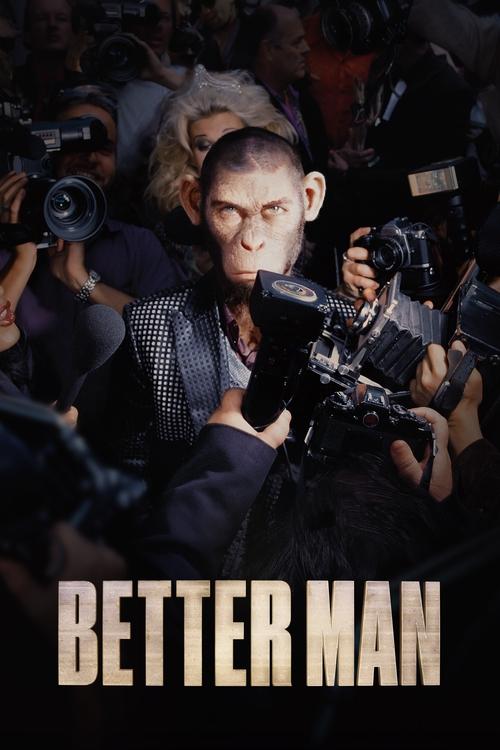
Better Man
2024 · Michael Gracey
For when you want to be genuinely surprised — a big musical night that turns into something confessional and dark. Come for the audacity, stay because it makes you feel for a chimp having a breakdown.
What it's about
The life of British pop star Robbie Williams — working-class kid, teenage boyband sensation in Take That, record-breaking solo act — told as a musical, with one wild swing: Williams is played from childhood to stardom as a photorealistic CGI chimpanzee, while everyone around him is human. Nobody in the film ever mentions it. Underneath the spectacle is a blunt story about fame, addiction, depression and a man performing for love he can't accept.
The experience
Exhilarating and bruising in the same breath — huge, inventive musical numbers crash into raw scenes of self-destruction, and the monkey conceit stops feeling like a gimmick shockingly fast. It's funnier, filthier and sadder than any pop biography you're braced for.
Performances
Jonno Davies gives the ape his body through motion capture, with Williams himself narrating — and the strange alchemy works: you read shame, swagger and terror on a digital chimpanzee's face and forget you're watching an effect.
The craft
Michael Gracey stages the musical numbers with the maximalist showmanship he brought to arena-scale pop spectacle — one street-set sequence to a Take That hit is a genuine jaw-dropper — while the visual-effects team makes the impossible central conceit feel emotionally literal rather than absurd. Loud, lush and built for good speakers.
Why it matters
It instantly became the case study in how far the music biopic can be pushed — a film people describe to friends in one incredulous sentence — and a cult favorite that outgrew its quiet box-office debut.
Snapshot
Better Man is a musical biography of the British pop star Robbie Williams that stakes its entire identity on a single, audacious conceit: Williams is portrayed throughout — child, teenager, boyband ingénue, imploding solo superstar, recovering addict — as a photorealistic computer-generated chimpanzee, while every other character appears as a live human being. The device is never explained in dialogue and never winked at; the world of the film simply accepts the ape as a man. Director Michael Gracey, arriving off the enormous commercial success of The Greatest Showman (2017), frames the choice as an externalization of Williams' own self-image as a "performing monkey," a phrase drawn from the singer's long-running self-deprecation about celebrity. The result is a jukebox musical built from Williams' catalog that is also a formally daring VFX experiment — a combination that earned strong reviews and, on the commercial side, one of the more conspicuous disappointments of its release season. It sits at the intersection of the modern music biopic cycle, the digital-performance frontier opened by motion-capture cinema, and the maximalist stage-musical sensibility Gracey brought to Hollywood.
Industry & production
Better Man was produced as a largely Australian-based international production, shot in and around Melbourne with additional work keyed to London locations that Williams' story requires (Stoke-on-Trent, the West End, Knebworth). The film's financing and distribution passed through the turbulence of the late-eON/Lionsgate-Paramount landscape; Paramount Pictures handled the principal theatrical release. Its budget was widely reported to be substantial — figures in the region of a hundred-million-plus dollars circulated in trade coverage, driven overwhelmingly by the visual-effects burden of a fully digital lead performer — and the picture's theatrical gross fell dramatically short of that outlay, making it a headline example of a critically admired film that failed to convert acclaim into ticket sales. Exact box-office and budget figures vary across sources, so they are best treated as approximate rather than settled.
The rollout followed a prestige-festival pattern: a premiere on the fall circuit (Telluride, followed by Toronto), a platform release timed to the year-end awards window, and a wider expansion into early 2025. The commercial underperformance became part of the film's story, frequently attributed to the difficulty of marketing an art-house-adjacent VFX gamble about a star whose fame is enormous in the UK and Australasia but comparatively muted in the United States — a mismatch between the film's ambitions and its most reliable audience.
Technology
The film is, at bottom, a technology showcase. The central chimpanzee performance was realized through performance-capture and digital character animation executed by Wētā FX, the New Zealand house whose lineage runs through the Lord of the Rings, Planet of the Apes reboot trilogy, and Avatar work that established the modern grammar of the digital primate. That inheritance is not incidental: the credibility of a singing, dancing, emotionally legible ape depends directly on two decades of accumulated technique in facial capture, fur and skin simulation, and the integration of a synthetic performer into live-action plates alongside human actors and practical sets.
Crucially, Better Man extends that toolkit from the realm of naturalistic creature work into the register of the musical — a genre defined by choreography, crowd staging, and sustained camera movement. The technological problem is therefore not only "make a believable ape" but "make a believable ape sing and dance in continuous musical numbers, matched to real dancers, in complex moving-camera shots." This pushed the pipeline toward large-scale set-piece integration rather than isolated hero shots.
Technique
Cinematography
The photography, by cinematographer Erik Wilson, has to serve two masters at once: the intimacy of a fraught personal drama and the scale of arena spectacle. Wilson's background in character-driven British work lends the domestic scenes a grounded, unglamorous texture that keeps the digital protagonist tethered to a recognizably real England, while the musical numbers open up into saturated, high-gloss showmanship. The film's most discussed camera achievement is the "Rock DJ" sequence, a bravura, seemingly continuous musical number staged along a crowded shopping thoroughfare, in which the camera travels with a growing ensemble of dancers — a set piece that consciously echoes the one-take musical tradition and functions as the film's statement of confidence in its own conceit.
Editing
The editing carries the biopic's characteristic burden of compression — decades of a life delivered in montage, needle-drop, and elliptical time-jumps — while also managing the rhythmic demands of the songs. In the musical passages, cutting is subordinated to choreography and camera, favoring longer takes that let spectacle breathe; in the dramatic connective tissue, it accelerates to cover the sweep of Williams' rise, breakdown, and recovery. The film credits multiple editors, which is consistent with a large VFX-heavy production assembled over a long post window; the precise division of labor among them is not a matter of clear public record.
Mise-en-scène / staging
Gracey stages the film as a series of escalating production numbers punctuated by scenes of collapse. The design moves from the drab specificity of a working-class Midlands childhood to the neon abstraction of pop stardom, and the staging repeatedly literalizes psychological states — most strikingly in the climactic Knebworth sequence, where Williams is confronted by an army of alternate versions of himself, the ape multiplied into a battlefield of self-loathing. This willingness to render inner life as physical, choreographed event is the connective thread between Gracey's stagecraft and the film's central metaphor.
Sound
As a jukebox musical, the film's sound design is organized around Williams' recorded catalog, reworked and re-performed to fit dramatic context rather than reproduced as concert facsimile. The songs function narratively — mapped onto life events so that the familiar hits acquire biographical weight — and the mix must knit a synthetic vocal-and-body performance into live acoustic space. The film also features an original song, "Forbidden Road," which drew notice during awards season when it was removed from Academy Award consideration after the Academy determined it drew too heavily on pre-existing material; this is a documented episode rather than an interpretive claim.
Performance
The performance architecture is unusual and worth stating precisely. The physical, on-set performance of the Williams character was carried by actor Jonno Davies through motion capture, providing the body, movement, and dramatic base later transformed into the chimpanzee by Wētā FX; Robbie Williams himself provides the singing voice and narration and shaped the interior perspective, effectively playing himself at one remove. The human ensemble around this digital center is anchored by seasoned British character actors — including Steve Pemberton as Williams' entertainer father and Alison Steadman as his grandmother — whose naturalism is essential to selling the ape as simply another person in the room. The film's emotional risk is that a CGI primate must sustain a feature-length character arc; the general critical verdict is that it does, which is itself the film's primary claim to significance.
Narrative & dramatic mode
Better Man adopts the confessional, first-person mode of the modern star biography, narrated by its subject and structured as a cradle-to-redemption arc: childhood in Stoke, the paternal wound of an absent, showbiz-chasing father, sudden elevation as the youngest member of Take That, the acrimony of leaving the group, the vertiginous solo superstardom, and the descent into addiction and self-destruction before a recovery coda. Onto this conventional skeleton the film grafts a frankly expressionist device. The chimpanzee is not merely a gimmick but the narrative's organizing metaphor — an insistence that we experience Williams as he claims to experience himself, as a trained animal performing for approval. The dramatic mode is thus doubled: naturalist family melodrama on one axis, and on the other a self-aware fable about performance, shame, and the manufacture of a public self.
Genre & cycle
The film belongs squarely to the 2010s–2020s wave of music biopics — the cycle that runs through Bohemian Rhapsody (2018), Rocketman (2019), Elvis (2022), and their many kin — and shares that cycle's structural DNA: the rise-fall-redemption template, the catalog-as-score, the tension between authorized hagiography and genuine reckoning. Rocketman is the most instructive comparison, since it too abandoned strict realism for a fantasia mode that stages a pop life as full-blown musical. But Better Man pushes past Rocketman's theatrical unreality into the domain of the effects blockbuster, hybridizing the jukebox musical with the digital-creature film. That crossbreeding is what distinguishes it within the cycle: it is a biopic that is also, unmistakably, a VFX movie.
Authorship & method
The controlling authorial intelligence is Michael Gracey, whose method — visible already in The Greatest Showman — fuses commercial-music showmanship with a background in visual effects and commercials, yielding films that treat the musical number as the fundamental unit of storytelling. Better Man reads as a deliberate escalation of that project: where The Greatest Showman smoothed a real historical figure into inspirational myth, Better Man uses an even more artificial surface (the ape) to reach for something more raw and self-critical about fame. The screenplay is credited to Gracey with Oliver Cole and Simon Gleeson, developed in close collaboration with Williams himself, which accounts for the film's confessional intimacy and its willingness to render its subject unflattering.
Among key collaborators, cinematographer Erik Wilson supplies the tonal doubleness described above; the visual-effects team at Wētā FX functions as a co-author of the lead performance in a way that has few precedents in the biopic form; and Jonno Davies's capture performance is the human substrate of the character. The film's music direction draws on Williams' own body of work, with an original song ("Forbidden Road") produced for the film. Editing and score are credited to multiple hands, reflecting a large production; where individual attributions are not firmly documented, they are best left unstated rather than guessed.
Movement / national cinema
The film resists tidy national placement. Its subject and sensibility are thoroughly British — the class textures, the geography, the Take That story are specific to UK pop culture — but its production base is substantially Australian and its effects work New Zealander, and its distribution is Hollywood-scaled. It is therefore best understood as a transnational production in the contemporary mode, in which a nationally specific story is financed, shot, and finished across the Anglophone Pacific. If it belongs to a "movement," it is less a geographic one than the ongoing convergence of the stage-musical revival and effects-driven cinema that Gracey personifies.
Era / period
Released at the close of 2024 into early 2025, Better Man arrives at a moment when the music biopic had become both a reliable awards-and-box-office engine and a target of exhaustion, its formula so well-worn that parody (Weird, the Walk Hard legacy) shadowed every sincere entry. Its bet was that a radical formal device could revitalize a tired cycle. It also arrives at a specific technological juncture — after performance-capture had fully matured but before generative tools reshaped the conversation about synthetic performers — making it a kind of high-water mark for artist-driven, labor-intensive digital character work deployed in the service of an intimate human story.
Themes
The film's governing theme is the split between the performing self and the private self, dramatized through the chimpanzee as a permanent visual reminder that Williams cannot see himself as fully human. Radiating from that center are the biopic's classic concerns given fresh charge: the inheritance of paternal ambition and abandonment, the corrosive loneliness inside mass adoration, addiction as both symptom and anesthetic, and the possibility — treated with some skepticism — of redemption through self-acceptance rather than external validation. The multiplied-selves climax crystallizes the film's psychology: the enemy is internal, a chorus of one's own contempt, and survival means making peace with the animal one believes oneself to be.
Reception, canon & influence
Critical reception was strongly favorable, with much of the discourse organized around a single arc of surprise: reviewers arrived braced to find the ape conceit a gimmick and left persuaded that it worked, crediting the film with genuine emotional effect and praising Gracey's staging and Wētā's craft. That critical embrace ran directly counter to the film's commercial fate, which was poor; the gap between acclaim and audience became one of the defining narratives around the release, and the picture is now frequently cited as a case study in the difficulty of selling formal ambition to a mass market. Its awards-season presence centered on technical recognition and the "Forbidden Road" song controversy noted above.
Looking backward, the film's influences are legible: the fantastical, non-realist biopic mode of Rocketman; the one-take musical bravura and processional choreography that descend from the classical Hollywood musical through contemporary long-take set pieces; and, most consequentially, the entire Wētā lineage of digital primates from the Planet of the Apes films, without which its lead performance would be inconceivable. Looking forward, its legacy is still unfolding and should not be overstated, but its clearest significance is as a proof of concept: it demonstrates that a fully synthetic protagonist can anchor an intimate, adult drama and carry a feature-length emotional arc, extending performance-capture from spectacle creatures into the territory of the character study. Whether that proof invites imitators or stands as a singular experiment is, as of this writing, genuinely unsettled — and the honest account is to say so rather than to predict.
A Deleuzian reading
Alison Steadman sits in a kitchen in Stoke-on-Trent and talks to a chimpanzee.
The full Deleuzian reading of Better Man →
Reception
One of the most spectacular box-office bombs of its moment — a ~$100M biopic that barely grossed $20M because America had no idea who Robbie Williams was — yet critics loved it, and almost immediately the flop became the pitch: word-of-mouth turned 'the monkey movie' into a see-it-to-believe-it favorite.
How Better Man was received, from release to now →
How to watch Better Man: what to notice on a first viewing
- Watch how no one in the film reacts to the chimpanzee. Robbie Williams appears throughout as a photorealistic CG chimp while everyone else is human, and the film never explains or winks at the choice. The film builds its own version of the man rather than filming the real one.
- Watch for a single unbroken shot moving down a crowded street. The Rock DJ sequence travels with a growing crowd of dancers along a shopping street in what plays as one continuous take. The number is the film's confidence trick: if this can hold together, so can the whole conceit.
- Watch the human actors talk to the chimp like he's ordinary. Steadman and Pemberton play scenes with the ape exactly as they would with a person, never once breaking the illusion with a reaction shot. Their belief is doing most of the work of making you believe it too.
- Notice the shift from drab kitchens to neon stage lighting. The film moves visually from a working-class Stoke childhood, plain and unglamorous, to the saturated neon abstraction of pop stardom. The palette tracks his distance from where he started, long before the story says so.
- Listen for which song plays under which moment in his life. The soundtrack reworks Williams's own catalog and maps specific songs onto specific life events rather than reproducing them as concert footage. Familiar hits pick up new biographical weight every time one lands on a scene.
The whole guide to watching Better Man, with the keys for a rewatch →
Influences: the films it descends from and the films it influenced
- Rise of the Planet of the Apes (2011) — Established the Wētā FX pipeline—markerless on-set facial capture driving a fully digital ape (Serkis's Caesar) whose micro-expressions read as interior emotion rather than creature spectacle, the exact technical substrate Better Man inherits for Robbie's face.
- War for the Planet of the Apes (2017) — Proved a performance-captured primate could headline a somber, adult dramatic feature and sustain a feature-length emotional arc in close-up, the precedent Better Man extends from war epic into intimate biopic.
- King Kong (2005) — Wētā plus Serkis's capture built an ape whose pathos in tight facial close-ups carried a tragic love story—the first fusion of this studio's primate craft with genuine emotional intimacy that Better Man reproduces.
- The Lord of the Rings: The Two Towers (2002) — Gollum was the origin point of Wētā's fully emotive digital character driven by a single actor's performance capture, founding the lineage of synthetic-yet-humanly-legible leads Better Man belongs to.
- Avatar (2009) — Pioneered the head-rig facial-capture system that lets an actor's performance survive translation onto a non-human digital face, the enabling technology behind a synthetic protagonist anchoring a live-action drama.
- Rocketman (2019) — Model for the non-realist, first-person-confessional music biopic that stages a star's psychology through fantastical musical numbers rather than realist chronology—Better Man's structural template minus the ape.
- The Greatest Showman (2017) — Gracey's own prototype for treating the pop musical number as the fundamental storytelling unit, fusing commercial-music showmanship with VFX-commercial craft that Better Man escalates into self-critique.
- All That Jazz (1979) — Founding text of the confessional rise-fall showbiz musical that renders the performer's private self-loathing, paternal wounds, and mortality as staged spectacle—the performing-vs-private-self dialectic Better Man inherits.
- Cabaret (1972) — Codified tonal doubleness—glittering diegetic stage numbers ironically commenting on the squalor of the private life around them—the cinematographic register Erik Wilson supplies in Better Man.
- Chicago (2002) — Literalized characters' interior psychology as fantasy production numbers cut against mundane reality, the staging device Better Man uses to externalize Robbie's mental states.
- Singin' in the Rain (1952) — Classical-Hollywood source of the continuous-take, camera-tracking-a-solo-performer musical number whose long-take bravura Better Man's set pieces descend from.
- Walk the Line (2005) — Template for the rise-fall-redemption music biopic organized around paternal abandonment and addiction, with the lead re-performing the artist's own catalog—Better Man's narrative and thematic chassis.
- Alita: Battle Angel (2019) — Wētā's other test case of a wholly CG lead carrying audience empathy through hyper-detailed eye and facial capture, running the same 'can a synthetic face anchor a human drama' experiment in parallel.
- La La Land (2016) — Revived the ostentatious unbroken-take musical set piece with processional crowd choreography as a bravura calling card, the continuous-take number craft Better Man deploys in its street sequences.
- Bohemian Rhapsody (2018) — Contemporary jukebox music-biopic sibling built on the same commercial arc—hit-song montage, self-destruction, comeback-concert climax—that Better Man both uses and interrogates.
- The Congress (2013) — Interrogates the synthetic/digital rendering of a star's likeness and the split between the performing image and the private person, sharing Better Man's meta-anxiety about a manufactured public self.
Similar films
- Bohemian Rhapsody (2018) — influence & lineage · same viewing thread
- Rocketman (2019) — influence & lineage
- The Greatest Showman (2017) — influence & lineage
- Rise of the Planet of the Apes (2011) — influence & lineage
- War for the Planet of the Apes (2017) — influence & lineage
- Walk the Line (2005) — influence & lineage · same viewing thread
- Michael (2026) — same viewing thread
- The Smashing Machine (2025) — same viewing thread
All the films related to Better Man →
Watch it with: curated runs of related films
- The Making of a Legend — A run of biopics that watch private people get forged into public icons — the ambition, the pressure, and the loneliness of becoming somebody the world can't stop looking at.