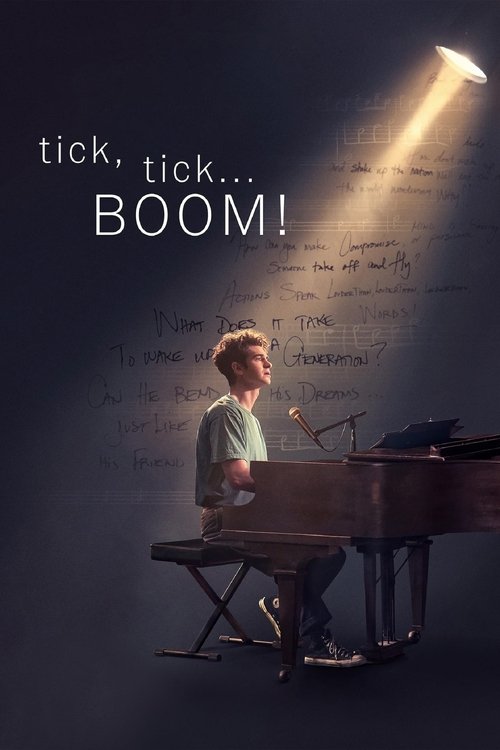
tick, tick... BOOM!
2021 · Lin-Manuel Miranda
For when you need to feel something about the work you love and the time you have — equal parts motivation and good cry. Ideal for artists, strivers, and musical-theater hearts.
What it's about
New York, 1990. Jonathan Larson is a diner waiter about to turn thirty, convinced he's running out of time to matter, pouring years of his life into a workshop of the ambitious musical he's sure will be his break. Around him: a girlfriend who wants a future he can't commit to, a best friend leaving art for a salary, and the AIDS crisis quietly claiming the people he loves — all while the clock in his head ticks louder.
The experience
Restless, warm, and quietly devastating — it bounces between concert-stage energy and small-apartment intimacy, and its ticking-clock anxiety about wasted time will hit anyone who's ever chased a creative dream. It sneaks up on you emotionally, especially if you know what came next for Larson.
Performances
Andrew Garfield, who learned to sing for the role, gives one of his career-best performances — jittery, funny, and openhearted, capturing a man who is exhausting and impossible not to root for. The work earned him an Oscar nomination.
The craft
Lin-Manuel Miranda's directing debut cuts fluidly between Larson performing his own story on stage and living it, so the numbers comment on the life in real time. The film is dense with love for the theater world — the musical staging, the era detail, the cameos — and the songs land hard through good speakers.
Why it matters
It reintroduced Jonathan Larson to a generation that only knew Rent, and announced Miranda as a filmmaker; it's become the go-to portrait of the unglamorous years before an artist breaks through.
Snapshot
tick, tick... BOOM! is Lin-Manuel Miranda's feature directing debut, a screen adaptation of Jonathan Larson's autobiographical rock musical, itself drawn from the solo "rock monologue" Larson performed in the early 1990s before Rent made him — posthumously — one of the most mythologized figures in American musical theater. The film dramatizes Larson (Andrew Garfield) in the weeks around his thirtieth birthday in 1990, straining to finish a workshop of a science-fiction musical called Superbia that he has labored over for years, while his relationships, his day job at the Moondance Diner, and the deepening AIDS crisis around him press in. Its central formal gambit is to keep the stage show and the life in simultaneous view: Larson narrates his own story from a concert stage even as we watch it unfold. Released by Netflix in November 2021, the film earned Garfield the Golden Globe for Best Actor in a Musical or Comedy and an Academy Award nomination, and it received an Oscar nomination for Best Film Editing. It arrived as both an act of custodianship — Miranda openly regards Larson as a formative influence — and a meditation on artistic ambition measured against a running clock.
Industry & production
The project sits at the intersection of Broadway pedigree and streaming-era financing. It was produced under Imagine Entertainment (Ron Howard and Brian Grazer) together with Miranda's own producing interests, with a screenplay by Steven Levenson, the playwright best known for the book of Dear Evan Hansen. Netflix distributed, which shaped the film's economics and its release logic: a limited theatrical run paired with global streaming, and — as is standard for Netflix titles — no publicly reported box-office gross, so any circulation claims must remain qualitative rather than numerical.
Principal photography took place in New York in 2020 and was interrupted by the COVID-19 shutdown that spring, resuming later in the year. That timing is worth stating plainly: the film about a young artist racing an unforgiving clock was itself made under a pandemic that suspended live theater entirely, and the movie's elegiac register cannot be fully separated from the moment of its making. Miranda came to the material as a longtime devotee — he had performed in tick, tick... BOOM! onstage himself — which lent the production the character of a passion project stewarded by insiders of the musical-theater world rather than a studio commodity engineered from outside it.
Technology
The film was shot and finished digitally, consistent with the technical norms of a 2020 studio-scale musical. Its most consequential technological choices are those governing musical performance capture rather than any novel imaging apparatus. Like most contemporary movie musicals, it relies on prerecorded vocal tracks with the possibility of live-vocal capture in select passages; the specific track-by-track methodology is not something the public record documents in fine detail, so it is more honest to note the ambition — an intimate, "unpolished" vocal presence suited to a rock score — than to overspecify technique. Beyond that, the picture's technology is largely invisible by design: it does not foreground digital spectacle, and its effects work is confined to period reconstruction of early-1990s New York rather than to the kind of stylized fantasy sequences a different director might have layered over the songs.
Technique
Cinematography
Alice Brooks, who shot Jon M. Chu's In the Heights the same year, photographs the film in two distinguishable registers. The concert-frame material — Larson performing the monologue-with-band before an audience — is lit theatrically, with pooled light, hard edges, and the deliberate artifice of a stage. The narrative scenes of Larson's daily life adopt a warmer, more naturalistic palette keyed to a nostalgic early-'90s downtown Manhattan. Brooks's camera is mobile and character-tethered, tracking Garfield through cramped apartments, the diner, and rehearsal rooms, and it opens up for the setpieces. The visual argument of the photography is that memory and performance are the same act for this protagonist: he cannot live an experience without simultaneously staging it.
Editing
Editing is the film's most decorated craft element, and deservedly its signature. Cut by Myron Kerstein (also the editor of In the Heights) and Andrew Weisblum (a frequent collaborator of Wes Anderson and Darren Aronofsky), the film is built on constant intercutting between the concert frame and the dramatized past. A lyric sung onstage bleeds into the scene it describes; a spoken transition on the stage becomes the doorway into a flashback. This associative construction is what allows the movie to metabolize its own theatricality — the Oscar nomination for Film Editing recognized a structure in which the editing is not merely assembling scenes but performing the story's central conceit of a life narrated as it is lived.
Mise-en-scène / staging
The production design reconstructs a specific milieu: the bohemian, pre-gentrification Lower Manhattan of aspiring theater artists in 1990, with Larson's cluttered walk-up and the Moondance Diner as anchoring spaces. Miranda, working from his own long familiarity with the show, stages numbers so that the mundane environment becomes the set — the diner sequence in particular turns a working restaurant into a stage. The staging privileges density and texture (notes pinned to walls, the physical evidence of a stalled project) over glamour, reinforcing the theme of an artist rich in ideas and poor in nearly everything else.
Sound
As a musical, the film lives or dies by its sound design and score presentation. The arrangements preserve the rock-band intimacy of Larson's original — keyboard, guitar, drums — rather than inflating the material into orchestral bombast, which suits both the character and the small-ensemble origins of the piece. The sound frequently uses diegetic ambiguity as a tool, letting a song begin as onstage performance and expand to fill a remembered scene, a strategy that depends on the editing and the sound mix working in concert. Beyond the music, the sonic world of the film is deliberately grounded in the noise of the city and the diner, keeping the songs tethered to lived reality.
Performance
Garfield's performance is the film's center of gravity. A non-singer before the project, he trained extensively to sing the role live, and the widely noted quality of his work is its ferocious, slightly frayed sincerity — the sense of a man performing at the edge of his own nerves. The supporting performances give the film its emotional stakes: Robin de Jesús as Michael, Larson's closest friend who has traded acting for advertising and is living with HIV; Alexandra Shipp as Susan, the dancer-girlfriend whose future diverges from Jon's; and Vanessa Hudgens as Karessa, part of the onstage ensemble. Judith Light appears as Larson's agent, and Bradley Whitford plays Stephen Sondheim, the mentor figure whose approval Larson craves. The performances are calibrated to the film's double register — heightened in the numbers, grounded in the scenes between them.
Narrative & dramatic mode
The film's dramatic mode is meta-theatrical autobiography. It nests three temporal layers: Larson performing his monologue onstage, the 1990 events that monologue recounts, and the retrospective knowledge — carried by every viewer who knows Larson's fate — that hangs over both. The engine of the plot is deceptively small-scale: will Larson finish and successfully workshop Superbia, and what will he sacrifice to do it? The countdown of the title functions less as conventional suspense than as an existential metronome, the "tick" of time and mortality. Because the framing narrator addresses us directly, the film is confessional rather than observational; it asks to be received as testimony. This is also its most delicate move, since the historical Larson is both author and subject, and the film must dramatize his self-mythologizing without simply endorsing it.
Genre & cycle
tick, tick... BOOM! belongs to the recent cycle of prestige movie musicals and, more specifically, to the sub-tradition of the musical about making theater — the backstage musical turned inward. It also sits within the biographical-artist film, joining a lineage of movies about creators in crisis. What distinguishes it from the jukebox biopic is that its subject is himself the composer of its songs, so the score is diegetically motivated by the story rather than curated from a back catalog. Within the broader 2020s revival of the form — arriving in the same span as In the Heights, West Side Story, and other screen musicals — it occupies the intimate, low-spectacle end of the spectrum.
Authorship & method
The controlling authorial sensibility is Miranda's, and the film reads as an act of stewardship by an artist who regards Larson as a direct ancestor of his own work. Miranda's method here is notably self-effacing for a first-time director: rather than imposing a flashy visual signature, he foregrounds performance, editing, and the songs, trusting collaborators who know the musical idiom. Those collaborators matter as much as the director. Screenwriter Steven Levenson shaped the adaptation's structure, expanding a chamber stage piece into a film with room for Larson's world. Cinematographer Alice Brooks supplied the two-register visual language; editors Myron Kerstein and Andrew Weisblum built the associative architecture that makes the meta-theatrical conceit legible. On the music side, Miranda drew on longtime collaborators from his own career in shaping the arrangements and music production, ensuring continuity with the theatrical DNA of the source. The film is thus best understood as a collaborative custodianship — a director-fan assembling a team of musical-theater specialists to honor a text he loves — rather than a work of solitary directorial vision.
Movement / national cinema
The film is a product of American commercial cinema in its streaming-financed, Broadway-adjacent variant. It does not belong to a formal film movement, but it is deeply embedded in a distinctly American institutional culture: the New York theater world, its economics, its rituals of workshops and readings, and its mythologies. That embeddedness extends to the casting of the film's crowning setpiece with real Broadway performers, so that the movie functions in part as a self-portrait of an artistic community honoring one of its own. If it has a "national cinema," it is the cinema of Broadway rendered for the screen.
Era / period
The story is set in 1990, and the film is meticulous about that threshold moment: the tail of the 1980s downtown scene, the height of the AIDS crisis, and the anxious cusp of a new decade. The AIDS epidemic is not backdrop but structure — Michael's illness and the losses ringing the characters give the countdown of the title its gravest meaning. The film's own era of production, 2020–2021, forms a second, unspoken period layer: made during a pandemic and released weeks around the death of Stephen Sondheim in late 2021, it reached audiences freighted with a contemporary sense of fragility and loss that its 1990 setting anticipated.
Themes
The film's governing theme is the collision of artistic ambition with time — the fear that one's best work, and one's life, may run out before either is realized. Adjacent to it runs the theme of sacrifice: what love, friendship, and financial security an artist trades for a vocation that may never pay off. The AIDS crisis threads mortality through every relationship, transforming a young man's ordinary thirtieth-birthday panic into something closer to a reckoning. The film also examines the tension between commercial pragmatism and artistic integrity, embodied in the contrast between Larson's uncompromising path and his friend Michael's move into advertising. Finally, it is about mentorship and lineage — Larson's reverence for Sondheim, and, at a further remove, Miranda's reverence for Larson — so that the film enacts the very chain of influence it depicts.
Reception, canon & influence
Critically, the film was received warmly, with the strongest praise directed at Garfield's transformation and at the editing that sustains its meta-theatrical form; awards recognition bore this out, with Garfield's Golden Globe win and Academy Award nomination for Best Actor and the film's Oscar nomination for Best Film Editing. (Detailed critical consensus beyond these markers is well documented in aggregate but is not usefully reduced to a single figure here.)
The influences on the film are, unusually, layered and traceable. First is Larson's own source material — the solo tick, tick... BOOM! he performed in the early 1990s, later reshaped after his death into the three-actor Off-Broadway musical that has circulated ever since. Behind that stands Stephen Sondheim, Larson's acknowledged model, whose Sunday in the Park with George the film explicitly invokes: the diner number is staged as a loving pastiche of Sondheim's "Sunday," and the film restages Sondheim's real-life encouragement of Larson, with Sondheim himself reportedly contributing to the recorded voice message heard in the film. And behind the whole enterprise stands Rent, the work Larson would not live to see triumph — knowledge of which shadows every frame.
Its legacy — what the film shaped, looking forward — is best assessed with appropriate caution given its recency. Most concretely, it functioned as a significant career pivot for Andrew Garfield, reframing him as a musical performer, and it further consolidated the early-2020s revival of the prestige screen musical. Culturally, it renewed attention to Jonathan Larson beyond Rent, restoring the earlier, more autobiographical work to wider awareness and reaffirming his place in the canon of American musical theater. As a directorial calling card it established Miranda behind the camera. Claims larger than these would outrun what the historical record can yet support, and are better revisited as the film's longer influence becomes legible.
A Deleuzian reading
The Moondance Diner, brunch rush.
The full Deleuzian reading of tick, tick... BOOM! →
Reception
Landed in late 2021 as a Netflix awards player, with near-universal praise for Andrew Garfield even from people allergic to movie musicals — and it hit right at peak Miranda-fatigue (In the Heights and Encanto the same year), so some wrote it off as theater-kid catnip. A few years on it's settled in as the consensus 'actually the good Lin-Manuel Miranda movie' and a comfort rewatch for anyone staring down a milestone birthday.
How tick, tick... BOOM! was received, from release to now →
How to watch tick, tick... BOOM!: what to notice on a first viewing
- Watch a lyric on stage open a door into 1990. Kerstein and Weisblum cross constantly between the concert stage and the past. A sung line bleeds into the scene it describes. A spoken transition becomes a doorway. Neither image is the original. The editing is the storytelling here, not just the assembly. It is what the film's Oscar nomination recognized.
- Look at the hard stage light against the warm apartment light. Alice Brooks keeps two looks. The stage gets pooled light, hard edges, visible artifice. The 1990 scenes get warm naturalistic color, cluttered walk-ups, diner fluorescents, a downtown Manhattan that no longer exists. You can tell which layer you are in by the light alone. Then the film starts mixing them.
- Watch the diner rush turn into a musical number. Larson is working a brunch shift. Orders begin to rhyme, customers stack into harmony, and the room arranges itself into a number around a man who is not leading it. The day job supplies the choreography. Being broke at twenty-nine becomes visible as movement instead of complaint.
- Listen to Garfield's voice strain at the top of phrases. Garfield had never sung professionally and trained about a year for this. He sings live and keeps the strain audible, pushing into notes at the edge of what he can hold. The fray is the characterization. A man assembling his own myth can barely hold the note.
- Listen for the band: keyboard, guitar, drums, nothing bigger. The arrangements stay at rock-band scale. Nobody inflates Larson's songs into an orchestra. City noise and diner clatter stay in the mix underneath the numbers. Keeping the songs small keeps them tied to the apartment and the shift they came out of.
The whole guide to watching tick, tick... BOOM!, with the keys for a rewatch →
Influences: the films it descends from and the films it influenced
- Sunday in the Park with George (1986) — The film's diner number is staged as an explicit musical-and-visual pastiche of Sondheim's contrapuntal 'Sunday' finale, borrowing its layered ensemble build and static-tableau composition.
- All That Jazz (1979) — Fosse's autobiographical showbiz musical pioneered intercutting a creator's life against its own staged performance and against approaching death — the exact meta-theatrical editing architecture tick tick BOOM! adopts.
- Cabaret (1972) — Fosse confined nearly every number inside a plausible performance venue (the Kit Kat Club), establishing the diegetic-ambiguity model tick tick BOOM! uses to root its songs in club, stage, and rehearsal spaces.
- 8½ (1963) — Fellini's blocked-artist film codified the montage of fantasy, memory, and reality around a creator in crisis that All That Jazz musicalized and tick tick BOOM! inherits as its interior-life editing.
- Rent (2005) — Larson's own rock musical supplies the sung idiom and East Village bohemian milieu; the film scores Larson's life in the same rock-band arrangements he was writing toward in Rent.
- Hedwig and the Angry Inch (2001) — Mitchell's rock-club musical models the intimate, direct-address performance of a single autobiographical singer fronting a live band — precisely tick tick BOOM!'s rock-band-intimacy sound register.
- Les Misérables (2012) — Hooper established on-set live vocal capture as the prestige-musical standard, the technique enabling Garfield's live-sung, un-lip-synced performance.
- A Chorus Line (1985) — Attenborough's backstage musical stages performers narrating their own autobiographies on a bare rehearsal stage — the confessional backstage-musical genre lineage tick tick BOOM! extends.
- La La Land (2016) — Chazelle's revival of the original screen musical pairs a heightened, saturated palette against naturalistic scenes to dramatize ambition versus love — the two-register cinematography and central theme tick tick BOOM! shares.
- Black Swan (2010) — Editor Andrew Weisblum's associative cutting between a performer's craft and psychological interior — carried directly into tick tick BOOM!, which he co-edited — is the associative-intercutting grammar the film runs on.
- In the Heights (2021) — Cinematographer Alice Brooks shot both in the same year, supplying the character-tethered mobile camera and the neighborhood-as-stage 'environment-as-set' visual language.
- Dear Evan Hansen (2021) — Screenwriter Steven Levenson adapted both, applying the same structural method of expanding a chamber stage musical into cinematic scenes with interiorized song placement.
- West Side Story (2021) — Spielberg's film is the flagship co-node of the early-2020s prestige-screen-musical revival tick tick BOOM! helped consolidate, both restaging canonical American musical theater for the screen.
- Cyrano (2021) — Wright's same-year sung-through prestige adaptation extends the two-register, performance-forward screen-musical craft revived alongside tick tick BOOM!.
- Birdman (2014) — Iñárritu's backstage film dissolves the boundary between a performer's life and the show he's mounting — the same meta-theatrical fusion of biography and staging, pursued through the long take rather than the cut.
- Hamilton (2020) — Miranda's filmed stage musical is direct authorial continuity, sharing his music-production collaborators and the theatrical-DNA custodianship that shapes tick tick BOOM!'s arrangements.
Similar films
- La La Land (2016) — influence & lineage · same viewing thread
- All That Jazz (1979) — influence & lineage · same viewing thread
- Black Swan (2010) — influence & lineage · same viewing thread
- Rocketman (2019) — same viewing thread
- Marty Supreme (2025) — same viewing thread
- Whiplash (2014) — same viewing thread
- Challengers (2024) — same viewing thread
- Marriage Story (2019) — often watched together
All the films related to tick, tick... BOOM! →
Watch it with: curated runs of related films
- Burning to Be the Best — Watch these together for the shared fever of ambition — musicians, dancers and one table-tennis obsessive driving themselves past exhaustion toward a greatness that keeps costing more.