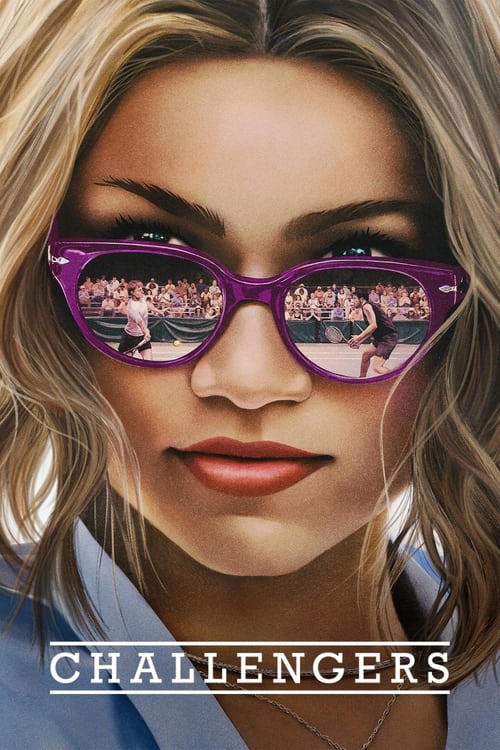
Challengers
2024 · Luca Guadagnino
The horniest discourse event of 2024: throuple debates, the churro scene, the techno score, Zendaya's tennis-core press tour — proof that an original mid-budget movie about desire could dominate the conversation for months.
For when you want something hot-blooded and propulsive — a date-night movie with teeth, or a solo watch when you're craving drama between people who can't quit each other. More adrenaline than comfort.
What it's about
Art Donaldson is a tennis champion in a slump, coached and managed by his wife Tashi — a onetime prodigy whose own playing career ended in injury. To shake him awake, she enters him in a low-tier Challenger event, where his first-round opponent turns out to be Patrick, his former doubles partner and best friend — and Tashi's ex. Flashbacks spanning thirteen years peel back how these three became tangled up in each other, on the court and off, until a minor-league match carries the weight of everything unsaid between them.
The experience
It plays like a thriller wearing tennis whites — every rally crackles with subtext, and the pounding electronic score keeps your pulse up even in the quiet scenes. Sexy, funny, and mean in the best way, it builds tension the way a long deuce game does: point by point, until you're leaning forward without realizing it.
Performances
Zendaya plays Tashi with a competitor's cold hunger that never fully softens, and Josh O'Connor is magnetic as the charming wreck Patrick; Mike Faist makes Art's neediness quietly heartbreaking. The three-way chemistry is the whole engine of the film.
The craft
Guadagnino shoots tennis like nothing else — cameras swooping at ball's-eye level, sweat in extreme close-up, time slowing mid-serve — while Trent Reznor and Atticus Ross's throbbing techno score turns matches into rave sequences. The nonlinear script keeps recharging a single match with new meaning. Loud speakers are almost mandatory.
Why it matters
It became one of 2024's most talked-about films, minted its score as a cultural object in its own right, and confirmed Guadagnino as a director who could make an original mid-budget adult drama feel like an event.
Snapshot
Challengers is a chamber drama disguised as a sports film — a three-body problem in tennis whites. Across a nonlinear structure spanning roughly thirteen years, it tracks the entanglement of Tashi Duncan (Zendaya), a prodigy whose career is cut short by injury and who redirects her competitive drive into coaching and marrying Art Donaldson (Mike Faist), and Patrick Zweig (Josh O'Connor), Art's former doubles partner, best friend, and Tashi's ex-lover. The film's present tense is a low-stakes "Challenger"-tier match in New Rochelle where Art and Patrick meet across the net, and its flashbacks continually reframe that match as the culmination of a decade-long erotic and professional negotiation. Directed by Luca Guadagnino from a debut feature screenplay by Justin Kuritzkes, scored by Trent Reznor and Atticus Ross, and led by Zendaya in a producing as well as starring capacity, it became one of the most discussed studio-backed adult dramas of its year — notable precisely because films of its scale and register had grown rare.
Industry & production
Challengers was produced for and distributed by Amazon MGM Studios, with Zendaya credited as a producer alongside Guadagnino and others through his and partners' production entities. It sits at an increasingly uncommon budget tier: a mid-range, star-driven, non-franchise adult drama greenlit by a major, at a moment when such projects had largely migrated to streaming or disappeared. Its most consequential industrial fact is scheduling: the film was originally set for a fall 2023 theatrical release (it had been announced as the opening film of the 2023 Venice Film Festival), but the 2023 SAG-AFTRA strike — during which actors were barred from promoting struck productions — prompted a withdrawal from Venice and a pushed release into April 2024. The delay turned Challengers into an early-2024 event and let it open ahead of the crowded prestige season rather than inside it.
Commercially it performed respectably for an original adult drama without being a blockbuster; I won't cite specific grosses, as reported figures vary by source and the exact numbers are not something I can verify here. Its cultural footprint outran its ticket sales: the marketing (built around the central trio, tennis iconography, and the Reznor/Ross score) and the film's frank eroticism made it a social-media and discourse phenomenon disproportionate to its box-office rank.
Technology
Challengers is, at the level of apparatus, a film about putting the camera where a body — or a ball — cannot comfortably go. It was shot digitally, and its production is defined by an arsenal of specialized rigs built to render tennis as visceral kinetics rather than televised spectacle: camera mounts that ride at court level and beneath the playing surface, point-of-view setups approximating a player's or the ball's vantage, and high-frame-rate capture enabling the extreme slow motion of the climactic rally. The film also deploys a literal ball's-eye view in its final match, a shot that only reads as coherent because of purpose-built rigging and digital tools. I'd flag that the granular technical record — exact camera bodies, lens sets, and rig manufacturers — is the kind of detail that lives in trade interviews and is easy to misremember; I won't assert specifics I can't confirm. What is unambiguous is the intent: the technology exists to abolish the neutral broadcast angle and replace it with an embodied, sometimes hallucinatory, proximity.
Technique
Cinematography
Sayombhu Mukdeeprom, the Thai cinematographer who shot Call Me by Your Name and Suspiria for Guadagnino (and much of Apichatpong Weerasethakul's work), photographs Challengers with a restlessness that departs from the sun-warmed classicism of his Italian collaboration with the director. The tennis sequences escalate through a catalog of destabilizing choices: low and under-court angles, whip pans tracking the ball, over-the-shoulder and first-person perspectives, and finally the ball's-eye and near-abstract slow-motion passages of the last set. Off-court, the film is warmer and more voyeuristic, framing bodies in hotel rooms, saunas, and diners with an appraising intimacy. The through-line is subjectivity — the camera is rarely a dispassionate witness and often an interested party.
Editing
Marco Costa, who cut Bones and All for Guadagnino, is arguably the film's decisive craftsman. Challengers is structured as a braid: the New Rochelle match is intercut with flashbacks reaching back to the trio's junior careers, and the editing continually withholds and then supplies context, so that a present-tense point of tennis is repeatedly recolored by what we belatedly learn about the past. The cutting also modulates rhythm violently — from the propulsive, on-the-beat montage of rallies synced to the score, to held, near-still images at moments of emotional exposure. The film's celebrated final sequence, an accelerating slow-motion rally that collapses the three characters' history into a single exchange, is fundamentally an editorial construction.
Mise-en-scène / staging
Guadagnino stages desire as geometry. The recurring visual figure is the triangle — three chairs, three bodies, the net as a dividing line — and the film's most quoted early scene, a hotel-room encounter between the two young men and Tashi that resolves into the two boys kissing while she withdraws, establishes the whole drama's erotic circuitry in a single blocked configuration. Costume and setting track status and time: junior-tour scruffiness, sponsor-logo professionalism, the deliberately unglamorous Challenger venue. Product and brand surfaces (the corporate sheen of Art's later career) are part of the design's argument about what winning costs.
Sound
The sound design leans into tennis as percussion — the grunt, the squeak of shoes, the report of strings on ball — and then fuses that acoustic palette with the electronic score until the distinction between diegetic impact and non-diegetic beat blurs. The most talked-about instance is the climactic rally, where crowd, ball, breath, and synthesizer merge into a single pulse. This integration of sound effect and music is central to the film's sensory logic.
Performance
The film is a three-hander and lives on its casting. Zendaya plays Tashi as controlled appetite — a woman who has converted thwarted athletic ambition into directorial power over the men around her, watchful and often unreadable. Mike Faist gives Art a wounded, accommodating quality that curdles into passivity; Josh O'Connor's Patrick is the film's engine of disorder, charming, feckless, and physically loose. The performances are calibrated against the film's chronology: all three actors must play roughly a decade of aging and hardening, and much of the acting is reactive — reading a face across a net or a table.
Narrative & dramatic mode
Challengers is a melodrama built on a sports-film chassis, and its formal signature is the achronological structure that makes the New Rochelle match a container for memory. Kuritzkes's screenplay treats the tennis match less as a plot to be resolved than as a stage on which an unresolved past is re-litigated in real time; suspense derives not primarily from "who wins" but from the gradually revealed emotional stakes each point carries. The mode is unabashedly romantic and erotic, with dialogue that is aphoristic and combative ("Tennis is a relationship" is the film's thesis stated aloud), and it withholds interiority in favor of surfaces, gestures, and reversals. The ending is deliberately open — an ecstatic collision that resolves feeling without resolving plot — refusing the sports genre's customary verdict.
Genre & cycle
The film hybridizes the sports drama, the erotic triangle romance, and the prestige auteur art film. Within the sports lineage it is closer to the psychological register of a Raging Bull than to the underdog uplift of most tennis pictures, using the game as a metaphor for domination and desire rather than as a site of clean triumph. Within the erotic-triangle tradition it revives a mode — the adult, sexually frank studio drama centered on ambivalent desire — that had become scarce in mainstream American cinema, and much of its reception framed it as a hopeful sign for that cycle's survival. It also belongs to Guadagnino's own cycle of films about consuming appetite.
Authorship & method
Luca Guadagnino's cinema is organized around desire as a physical and disruptive force — the sensual coming-of-age of Call Me by Your Name, the appetites of A Bigger Splash and Bones and All, the bodily horror of Suspiria. Challengers extends this preoccupation into competitive sport, treating the tennis court as another arena where wanting is enacted through bodies. His method favors strong craft collaborators and a sensuous, subjectivity-forward style, and here he pushes further than usual toward kinetic formalism.
The screenplay is by Justin Kuritzkes, a playwright and novelist for whom this was a debut produced feature; he would also write Queer for Guadagnino, and the two films were made in close succession, marking the start of a significant writer-director partnership. (Kuritzkes is married to filmmaker Celine Song, whose Past Lives arrived the prior year — a biographical note, not a claim of creative overlap.) The score by Trent Reznor and Atticus Ross — the Nine Inch Nails principal and his longtime collaborator, previously Oscar-winning for The Social Network and Soul — is aggressively electronic, a driving techno/house pulse that runs against the grain of the "genteel" tennis picture and is arguably the film's single most identifiable authorial signature; it was widely acclaimed and won the Golden Globe for Best Original Score. Cinematographer Sayombhu Mukdeeprom and editor Marco Costa are both established members of Guadagnino's working circle, and their contributions (discussed above) are inseparable from the film's effect.
Movement / national cinema
Challengers resists tidy national categorization: an Italian director working in the American studio system, with a Thai cinematographer, on a story set in the world of American professional tennis, financed and distributed by a Hollywood major. It is best read as transnational auteur cinema — a European art-film sensibility applied to American genre materials and American stars — a lineage Guadagnino has occupied throughout his English-language work. It does not belong to a coherent film "movement" so much as to the internationalized, festival-adjacent authorship that circulates through both Venice/Cannes and major-studio release.
Era / period
The film is a product of the mid-2020s American film industry and speaks directly to that moment. Its delayed release owing to the 2023 labor actions ties it concretely to a period of upheaval over compensation and streaming in Hollywood. More broadly, it arrived amid persistent anxiety about the viability of the theatrical, mid-budget, adult, non-IP drama, and it was received partly as a test case for whether such films could still find an audience and cultural oxygen. Its aesthetic — the fusion of a driving electronic score with hyperkinetic sports imagery — also reads as contemporary, aligned with a broader post-2010s taste for maximalist, sensorial genre filmmaking.
Themes
The governing theme is that competition and desire are the same drive wearing different clothes — that ambition, sex, love, and control are inextricable, and that tennis, a game of isolated bodies exchanging a single object across a barrier, is a perfect figure for a relationship. Tashi's aphorism that tennis is "a relationship" is literalized by the plot's structure. Adjacent themes include: the transfer of thwarted ambition (Tashi coaching through Art the career her injury denied her, raising questions of agency, control, and living through others); the erotics of spectatorship and being watched; masculinity defined relationally between the two men and mediated by the woman between them; and the ambiguity of winning — the film repeatedly asks what victory is worth and whether any of the three can distinguish wanting to win from wanting each other. Its refusal to name a winner is thematic, not merely formal.
Reception, canon & influence
Critical reception was strongly favorable, with particular praise concentrated on Guadagnino's direction, the Reznor/Ross score, the editing and camerawork of the tennis sequences, and the central trio — with Zendaya's producing-and-starring stake and O'Connor's and Faist's performances all singled out. It became a notable awards-season presence in the music categories (the Golden Globe win for Best Original Score) even as its overall major-awards profile was more modest than its cultural prominence; I'd note that award tallies across the many bodies are easy to misstate, and I'm citing only what I can attest to. Beyond formal criticism, the film generated an outsized volume of online commentary — memes, discourse about its sexual politics and open ending, and enthusiasm for its style — that made it a genuine 2024 cultural event.
Influences on the film (backward): It draws on the psychological sports-drama tradition (the interiorized, non-triumphalist use of athletic competition), on the erotic-triangle melodrama, and on Guadagnino's own body-and-appetite cinema. The decision to score a tennis film with propulsive electronic music is a deliberate inversion of the genre's usual sonic register.
Legacy / what it shaped (forward): As one of the most visible original adult dramas from a major studio in its year, Challengers functioned as an argument for the continued viability of star-driven, mid-budget, non-franchise filmmaking, and it consolidated Zendaya's standing as a producer and dramatic lead, O'Connor's and Faist's as leading men, and the Kuritzkes–Guadagnino partnership. Its most concrete formal legacy is likely the license it offered for aggressive, music-forward sensory treatment of sport on screen and for the frank, adult erotic drama as a commercial proposition. Because it is recent, its longer-term canonical standing remains genuinely unsettled — that judgment belongs to a future vantage — but its immediate impact on discourse and on the careers at its center is already clear.
A Deleuzian reading
A hotel room, three teenagers, one bed.
The full Deleuzian reading of Challengers →
Reception
Landed in April 2024 as a word-of-mouth event — the rare adult drama that became a genuine phenomenon — then its total Oscar shutout (not even the score!) instantly recast it as the year's great snub, which only cemented fan devotion.
How Challengers was received, from release to now →
How to watch Challengers: what to notice on a first viewing
- Watch how often Tashi is sitting still and watching. Zendaya plays Tashi as controlled appetite. She withdraws to the edge of a room or to a courtside chair and reads the men. The stillness throws off more heat than either man's serve. She plays by getting other people to move for her.
- Watch where the camera sits during a rally. Sayombhu Mukdeeprom drops to court level, under the playing surface, over a shoulder, into a first-person view, with whip pans chasing the ball. The neutral broadcast angle is almost never on offer. The tennis arrives as somebody's experience rather than as a scoreline, which is what this film wants from a match.
- Notice how close the camera gets in saunas and diners. Off court the framing turns warm and appraising, following bodies through hotel rooms and across tables. It does not observe from a distance. You feel it in the room, interested, taking a side. Looking is an act in this film, and the camera keeps joining in instead of standing back from it.
- Listen for the grunts and shoe squeaks joining the beat. Trent Reznor and Atticus Ross write a driving techno pulse, and the sound design fuses it with the report of strings on ball, breath, and rubber on hard court until score and noise are one thing. The match and the music become a single pulse, which is how a genteel sport ends up sounding like a club.
- Count the triangles: three chairs, three bodies, the net. Guadagnino stages desire as geometry. The early hotel-room scene lays out the whole circuitry in one blocked configuration, and the film keeps arranging the three of them back into it over thirteen years. Blocking tells you where the power sits, so read positions in the frame before you read the dialogue.
The whole guide to watching Challengers, with the keys for a rewatch →
Influences: the films it descends from and the films it influenced
- Raging Bull (1980) — Establishes the interiorized, non-triumphalist sports film via Michael Chapman's in-the-arena subjective camera and impressionistic variable-speed slow-motion of the athletic body under duress — the exact register Guadagnino imports to the court.
- The Social Network (2010) — The template for a Reznor/Ross pulsing-electronic score laid over a talky prestige drama, plus the deposition-braid that intercuts competing pasts against a present — both the scoring method and the achronological framing are directly descended here.
- The Hustler (1961) — Treats a game (pool) as a psychological duel where competition is the medium of desire and self-definition, staging the table as an arena — the games-as-eros grammar Kuritzkes rebuilds around tennis.
- Jules et Jim (1962) — Sustains an erotic triangle across years with restless time-compression and shifting alliances, using the three-hander itself as the structuring principle rather than a subplot.
- The Dreamers (2003) — A three-hander of charged proximity and rotating desire among a closed trio, with bodies arranged in explicit triangular geometry — the Italian-auteur precedent for Challengers' staging of wanting as spatial arrangement.
- Y tu mamá también (2001) — Frames desire among a threesome as competition and one-upmanship within a transnational-auteur sensuality, the erotic triangle driven by rivalry rather than mere romance.
- Out of Sight (1998) — Anne V. Coates's intercut flashback braid organizes a romance around nonlinear time-jumps, cross-cutting deferred consummation with its buildup — the editing architecture Marco Costa extends across the match.
- Call Me by Your Name (2017) — Guadagnino's own subjectivity-forward, sensuous treatment of desire as a disruptive bodily force, with Mukdeeprom's tactile camera — the authorial method Challengers carries into competitive sport.
- A Bigger Splash (2015) — An erotic quadrangle of leisure-class appetite, jealousy, and performance staged among sun-soaked bodies — the direct self-precedent for reading affluent sport as a theater of possession and rivalry.
- Enter the Void (2009) — Pioneers the impossible-vantage subjective rig that plants the viewer inside the perceptual field of the action — the lineage behind Challengers' under-court angles and ball's-eye-view camera.
- Bones and All (2022) — Guadagnino's appetite-and-body cinema pushed into transgressive physical hunger, with the Reznor/Ross-adjacent sensory scoring — the immediately prior entry in his desire-as-consumption cycle.
- Queer (2024) — The very next Kuritzkes–Guadagnino collaboration, made in close succession, extending the same writer-director partnership and subjectivity-forward staging of desire and pursuit.
- Speed Racer (2008) — Hyperkinetic, physics-defying camera vantages and stylized speed-ramping turn a sport into pure abstracted sensation — a precedent for aggressively formalizing athletic motion beyond documentary realism.
- Whiplash (2014) — Accelerating rhythmic cross-cutting locked to a driving percussive beat, escalating to a climactic set-piece — the structural analog to Challengers' accelerating slow-motion rally and diegetic-score fusion.
- Drive (2011) — Fuses a synth/electronic score (Cliff Martinez) with genre material to foreground sensory surface over plot, scoring a masculine competition in propulsive pulse against the genre's expected register.
- Uncut Gems (2019) — Daniel Lopatin's relentless electronic score generates continuous bodily anxiety around high-stakes competition, weaponizing sound design as pressure — the same music-forward sensory assault Challengers applies to tennis.
- After the Hunt (2025) — The immediate companion piece After the Hunt 'cools': same Reznor-Ross propulsion and power-triangle of desire, here re-routed from athletic heat into verbal interrogation.
- Marty Supreme (2025) — Scores athletic compulsion with a pulsing electronic Reznor/Ross track set against the sport — the same productive friction of synth idiom against a body-driven game.
- Materialists (2025) — Guadagnino renders a love triangle as an openly transactional competition — desire indistinguishable from leverage, sponsorship, and market position — the commodification-of-attraction thesis Materialists argues in a quieter register.
Similar films
- Call Me by Your Name (2017) — influence & lineage
- Queer (2024) — influence & lineage
- Whiplash (2014) — influence & lineage · same viewing thread
- Marty Supreme (2025) — same viewing thread
- La La Land (2016) — same viewing thread
- Tatami (2024) — shared sensibility
- La bola negra (2026) — shared sensibility
- King Richard (2021) — shared sensibility
All the films related to Challengers →
Watch it with: curated runs of related films
- Burning to Be the Best — Watch these together for the shared fever of ambition — musicians, dancers and one table-tennis obsessive driving themselves past exhaustion toward a greatness that keeps costing more.