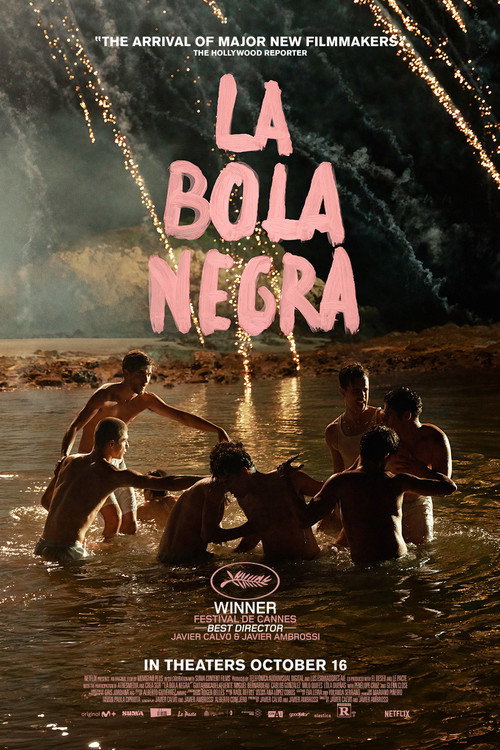
La bola negra
2026 · Javier Ambrossi
For when you want a big, sweeping epic that makes you feel something — a film to surrender an evening to and carry around for days after. It's a commitment, emotionally and in runtime, but it pays you back; bring tissues, not expectations of comfort.
What it's about
Three gay men, three Spains: a young man in 1932 Granada blackballed from a private gentlemen's club by anonymous vote, a wounded prisoner and the reluctant Francoist soldier guarding him in the civil war of 1937, and a man in 2017 who stumbles on a long-buried family secret. The strands are intimately linked, and the modern thread works like a slow investigation into the other two. Behind it all sits a real absence — a play Federico García Lorca started in 1936 and never finished — which the film dares to imagine forward.
The experience
A long, swelling triptych that moves between intimate rooms and full period spectacle — it builds slowly, braiding its eras until the connections land with cumulative force. It's a melodrama in the proudest sense: romantic, mournful, angry, and finally devastating, with a scale that earns its two-and-a-half hours.
Performances
The casting is part of the point: singer-songwriter Guitarricadelafuente, in his acting debut, plays the conflicted soldier of 1937 opposite Miguel Bernardeau as his prisoner — the real-life Rafael Rodríguez Rapún, Lorca's companion — while Penélope Cruz and Glenn Close orbit the newcomers rather than overshadow them. Unfamiliar faces standing in for lives history erased is the whole idea, and it works.
The craft
Shot on 35mm by Gris Jordana, which gives all three eras a shared, tactile film texture — stylised, confident, built for a big screen. Raül Refree's score draws on Iberian and flamenco-adjacent traditions rather than orchestral period wallpaper, and Alberto Gutiérrez's editing turns three timelines into one slow-burning reveal, from a rattling opening to a devastating coda. The governing image — a club vote cast with white and black balls — turns prejudice into ritual you can see.
Why it matters
It won Best Director at Cannes 2026 (shared), drew the festival's longest ovation that year, and transformed Los Javis from celebrated TV creators into major Spanish film auteurs — proof that a queer period epic could be national event cinema, with one of the biggest Spanish openings ever and a Netflix deal to follow.
Snapshot
La bola negra (international title The Black Ball) is the second feature directed by Javier Ambrossi and Javier Calvo, who work together as "Los Javis." Although some databases list Ambrossi alone, the film is a joint credit. It is a period drama of about two and a half hours (listings give 155 to 159 minutes) told in three timelines: Granada in 1932, the Spanish Civil War in 1937, and the present day in 2017. Each strand centres on a gay man, and together they ask how desire, shame, violence and memory pass from one generation of Spanish men to the next.
The film starts from a real literary absence. La bola negra is a play Federico García Lorca began in 1936 and never finished; only about four manuscript pages survive. The second source is Alberto Conejero's play La piedra oscura (2015), which imagines the last days of Rafael Rodríguez Rapún, Lorca's companion. The film premiered in Competition at the 79th Cannes Film Festival on 21 May 2026. There Los Javis shared the Best Director prize with Paweł Pawlikowski (Fatherland). The film was then programmed at Toronto and San Sebastián and opened in Spanish cinemas on 25 September 2026. It is widely described as one of the most ambitious queer historical dramas in recent European cinema, and as the moment two directors known mainly for television arrived as major auteurs of Spanish cinema.
Industry & production
The film was produced by Suma Content Films (Los Javis' own company), Los Esquiadores and Telefónica Audiovisual Digital. It was announced as a Movistar Plus+ original in May 2025. Co-producers include El Deseo, the company of Pedro and Agustín Almodóvar, and the French company Le Pacte. El Deseo's involvement matters both practically and symbolically. It links the film to the most important company in the history of queer Spanish cinema, and to a production model that pairs domestic television money with French co-production and festival positioning.
Elástica Films handled distribution in Spain. After a reported bidding contest following Cannes, Netflix took the film for the United States, with a US theatrical run starting in November and streaming from 4 December 2026. Spanish trade reporting put the domestic opening weekend at more than €4.7 million, which these reports ranked among the strongest openings ever for a Spanish film. Final totals were not settled at the time of writing, so this dossier gives no cumulative figure.
The casting mixes very different worlds, and the combination is part of the film's identity:
- First-time actors: the singer-songwriter Guitarricadelafuente and the newcomer Milo Quifes.
- Rising Spanish screen actors: Miguel Bernardeau, known for Élite, and Carlos González.
- Established Spanish performers: Lola Dueñas, Antonio de la Torre and Natalia de Molina.
- International stars: Penélope Cruz, as Nené Romero, and Glenn Close, as Isabelle Durand.
- Supporting cast: Julio Torres, Lorenzo Zurzolo, the musician Albert Pla, Mona Martínez, Yenesi and others.
Technology
The film was shot on 35mm film. For a Spanish production of this size in the mid-2020s, that was a deliberate choice. It signals period texture and a "cinema" identity, as opposed to the streaming look of Los Javis' television work, and it fits a wider return to photochemical capture in prestige festival filmmaking.
Beyond the format, published detail is limited: no information on lenses, aspect ratio or post-production workflow. This dossier does not speculate. Covering three historical periods (1930s Granada, a 1937 wartime setting, and contemporary Spain) required substantial period design and location work, but the specific methods are not documented in available sources.
Technique
Cinematography
Gris Jordana shot the film. Critics consistently describe its visual design as stylised and confident rather than naturalistic. The Hollywood Reporter called the film "dazzling and self-assured," and Richard Lawson called it an epic "staged with heaps of thought and style." Shooting on celluloid gives the three eras a shared material base. The film can therefore suggest continuity across time through its image texture as well as its plot. A detailed shot-by-shot account of how each period is coded (colour, framing, camera movement) is not yet available in the critical record.
Editing
Alberto Gutiérrez edited the film. With three timelines, the central editing problem is how to move between them. The film's structure depends on gradually revealing how the strands connect: the 2017 thread is an investigation that reconstructs the earlier two. The cutting therefore works like a slow detective story played out in historical time. Critics stress the film's "rattling opening" and "devastating coda" (Zachary Lee, TheWrap), which points to a long structure built towards a cumulative emotional payoff rather than towards separate episodes.
Mise-en-scène / staging
Roger Bellés was production designer. The 1932 strand is built around a central location from Lorca's fragment: the Granada casino, a private gentlemen's club whose members vote on admission with white and black balls. A black ball means rejection, and the film turns that voting ritual into its governing image of social exclusion. The 1937 strand, adapted from La piedra oscura, uses Conejero's confined two-hander setting, in which a wounded prisoner is guarded by a young soldier. The film's range across intimate rooms and larger period set pieces is part of what critics call its "epic" scale.
Sound
The original score is by Raül Refree. He is a Catalan producer and musician best known for his work at the edges of flamenco and experimental music, including Rosalía's debut album Los Ángeles (2017) and his collaboration with the fado singer Lina. His involvement points to a sound world rooted in Iberian song traditions rather than a conventional orchestral period score. That fits a film that casts a singer-songwriter in a lead role and draws on Lorca, whose work is steeped in Andalusian song. Alejandro López and Anna Harrington are credited for sound. The press has reported that the film includes three previously unpublished poems connected to Lorca, but how they are used on the soundtrack needs closer documentation.
Performance
The casting deliberately mixes types of performer. Guitarricadelafuente, in his acting debut, plays Sebastián, a young soldier in the 1937 strand who serves with Franco's forces reluctantly and becomes drawn to the prisoner he is ordered to guard. Miguel Bernardeau plays that prisoner, Rafael Rodríguez Rapún, the historical figure who worked as secretary to Lorca's touring theatre company La Barraca, was close to Lorca, and died of wounds on the northern front in 1937. Milo Quifes, also a newcomer, plays the young man blackballed in 1932. Carlos González plays Alberto, the present-day man whose discovery of a long-hidden family secret connects the strands.
Los Javis have used non-professional and crossover performers before. La llamada began as their stage musical, and their television work regularly mixes established actors with figures from music and popular culture. Here that method serves a historical argument: unfamiliar faces stand for lives the historical record erased. The stars (Cruz, Close, Dueñas) are placed around these central performances rather than at their centre.
Narrative & dramatic mode
The film is a triptych melodrama. It braids three stories that belong to the same lineage, although the characters do not know this. Roughly, its dramatic mode is:
- 1932: tragedy of social exclusion. The rumoured desire of Quifes's character for other men gets him blackballed, and he faces silence and condemnation.
- 1937: a wartime chamber romance under threat of death. Sebastián and Rapún meet across the lines of a civil war.
- 2017: investigation and recovery. Alberto's discovery lets him, and the audience, reconstruct what came before.
The structure turns Lorca's unfinished play into a central device. The only scene Lorca actually wrote, a son telling his father he was refused entry to the casino, is reportedly the one passage in the film that comes directly from Lorca. The rest imagines what the play, and the lives it gestured towards, might have become. The film is therefore partly a speculative completion of an interrupted text. Since the interruption was Lorca's murder in August 1936, the gap in the play is itself a historical wound. Spanish commentary has discussed at length "what is real and what is invented" in the film, which suggests it deliberately mixes documented figures such as Rapún with invented characters.
Genre & cycle
La bola negra belongs to several overlapping groups:
- The multi-era queer historical epic. These films set gay lives side by side across generations to argue for continuity and inheritance. Comparable structures include Stephen Daldry's The Hours (2002), a three-timeline literary adaptation organised around a canonical writer, and, more loosely, the cross-era design of Cloud Atlas (2012). Critics also placed it alongside recent ambitious queer festival dramas such as Robin Campillo's 120 BPM (2017).
- Spanish Civil War and historical-memory cinema. Its Cannes reception was repeatedly compared with Guillermo del Toro's Pan's Labyrinth (2006), mostly through the comparison of standing ovations. The thematic link is real all the same: both films treat 1930s–40s Spain as a buried trauma that the present must dig up.
- The Lorca cycle. This covers screen and stage works about Lorca's life and death and his circle. Examples include Marcos Zurinaga's The Disappearance of Garcia Lorca (1997), Paul Morrison's Little Ashes (2008, about Lorca and Dalí), and on stage, Conejero's La piedra oscura itself.
Authorship & method
Javier Ambrossi and Javier Calvo (Los Javis) began in theatre and acting. Their stage musical La llamada (2013) became a long-running hit, and they adapted it into their first film in 2017. They then became central figures in Spanish prestige television:
- Paquita Salas (2016–2019), a mockumentary comedy that started on Flooxer and moved to Netflix;
- Veneno (2020), a widely praised series about the trans icon Cristina Ortiz Rodríguez, "La Veneno," which featured trans performers;
- La Mesías (2023), an ambitious family melodrama about religious fanaticism, made for Movistar Plus+;
- as producers through Suma Content, the series Cardo, among others.
Several patterns run through their work and come together in La bola negra: 1. queer subjects treated with melodramatic seriousness rather than as subculture; 2. mixed casting of non-professionals, musicians and stars; 3. a strong investment in Spanish popular music and performance; 4. increasingly, structures that cover generations or entire lives (La Mesías already moved between childhood and adulthood across decades).
The press has noted that the duo, who were once a couple, made the film after their personal separation, while keeping their creative partnership.
Key collaborators:
- Alberto Conejero (writer and dramatist) developed the story with Los Javis. His play La piedra oscura supplies the 1937 strand, and his long engagement with Lorca's world gives the project its literary basis.
- Gris Jordana, cinematography (35mm).
- Raül Refree, original music.
- Alberto Gutiérrez, editing.
- Roger Bellés, production design.
Movement / national cinema
The film sits where three strands of contemporary Spanish cinema meet. The first is the Almodóvar inheritance: a queer, melodramatic, performer-centred cinema, emphasised here by El Deseo's co-production and Penélope Cruz's presence. The second is historical-memory cinema, which has grown in the period of Spain's Historical Memory Law (2007) and Democratic Memory Law (2022) and treats the Civil War and Francoism as unfinished business. Lorca's still-unlocated remains are the most famous symbol of that unfinished business. The third is the prestige-television-to-cinema pipeline: platform and telecom money (Movistar Plus+, then Netflix) increasingly backs Spanish auteur projects of international scale.
The Best Director prize at Cannes placed the film within a notable period of Spanish success on the international festival circuit in the 2020s. It also confirmed that queer Spanish history could be presented to audiences at home and abroad as national epic, not niche cinema.
Era / period
The film's three dates are chosen with care:
- 1932 falls in the Second Republic, a time of liberalisation in which social exclusion still operated through private institutions such as the provincial casino.
- 1937 is a year of the Civil War. Lorca was already dead, murdered near Granada in August 1936, and Rapún died that year on the northern front.
- 2017 is a liberal present with full marriage equality, legal in Spain since 2005, in which the past still has to be pieced together from family silence.
As a production, the film belongs to the mid-2020s. That moment combines a revival of the long, ambitious "event" film in festivals and cinemas, renewed political debate in Spain over historical memory, and broad international interest in gay history at a time of political backlash in several countries. Critics noted that Los Javis spoke out for LGBTQ rights during the Cannes premiere.
Themes
- Exclusion as ritual. The blackball vote turns prejudice into procedure: anonymous, collective and deniable. The film treats it as a model for how communities expel people without anyone having to say why.
- The unfinished and the interrupted. Lorca's four-page fragment, Rapún's cut-short life and the cut-short lives of men the archive never recorded all have the same shape. The film's speculative completion is a form of restitution.
- Inheritance and genealogy. The synopsis names "legacy" as a governing idea. The 2017 strand recasts queer history as family history: the secret is a matter of descent, not only of identity.
- Desire across enemy lines. In 1937 the guard and the prisoner stand on opposite sides of the war, so the film asks whether intimacy can exist under total political division.
- Silence and speech. The Cannes Festival's own editorial framing stressed "the impossibility of communicating," and the film's structure turns on things that cannot be said within each era.
- Art as testimony. Lorca, poetry, song and the casting of a singer as a lead all present art as the place where suppressed lives survive.
Reception, canon & influence
Critical reception. The film's Cannes premiere was one of the main events of the 2026 festival. The standing ovation was widely reported as the longest of that year's festival, though reports of its length vary from about 16 to 20 minutes. English-language trade and critical response was strongly positive:
- Richard Lawson called it "a big gay epic staged with heaps of thought and style."
- The Hollywood Reporter called it "a dazzling and self-assured film."
- IndieWire's Sophie Monks Kaufman described it as "an era-spanning monument to gay storytellers" and "a heartbreaking work of staggering genius."
- *Zachary Lee (TheWrap)* praised it as a film that "feels both old and new."
Some press coverage tipped it for the Palme d'Or, which went to Fjord. Instead it won Best Director, shared with Pawlikowski. Spanish reception was celebratory, and the film was framed as a landmark for Spanish cinema. A full map of dissenting or mixed reviews has not yet been compiled. The length and the melodramatic intensity are the obvious points of contention in such films, but this dossier does not attribute specific objections without a source.
Backward influences. The documented sources are Lorca's unfinished La bola negra and Conejero's La piedra oscura, and through them the larger body of Lorca scholarship and memory. Institutionally and stylistically, the Almodóvar lineage is clear through the El Deseo co-production. Structural parallels with The Hours and other multi-era literary adaptations are critics' comparisons, not documented influences acknowledged by the directors. The same goes for the cross-generational queer melodramas of the 2010s and 2020s and the long tradition of Civil War memory cinema. Los Javis' own earlier work, especially Veneno (queer history recovered through biography) and La Mesías (melodrama across generations), is the most direct line of development.
Forward legacy. Only months after release, any assessment of the film's influence is necessarily provisional. Its immediate effects can already be seen:
- It moved Los Javis from celebrated television creators to Cannes-awarded film auteurs.
- It showed that a Spanish queer period epic could combine top festival prestige, a large domestic box office and a major US platform deal.
- It returned Lorca's fragment, and Rapún as a historical figure, to wide public attention.
Whether it becomes a lasting model for Spanish historical-memory cinema or for the multi-era queer epic in general will depend on later films and critical reassessment. The record on that question is not yet written.
Reception
It premiered at Cannes 2026 to a marathon standing ovation and a shared Best Director prize for Calvo and Ambrossi, then rode the fall circuit to TIFF's People's Choice Award and Sydney's audience prize. Critics stayed on board (88% on Rotten Tomatoes, 83 on Metacritic), and Spanish audiences turned out, with a EUR 4.67 million opening building to EUR 29.5 million at home.
How La bola negra was received, from release to now →
Influences: the films it descends from and the films it influenced
- Bodas de sangre (1981) — Films Antonio Gades's flamenco version of Lorca as a dress rehearsal in a bare studio, the model for staging Lorca as ritual: performers in a stripped space with Iberian song carrying the drama instead of naturalistic sets.
- La casa de Bernarda Alba (1987) — Keeps Lorca's play inside a single sealed house, using doorways, shutters and interior framing to make confinement the dramatic engine, which is the template for the film's chamber two-hander passages.
- The Disappearance of Garcia Lorca (1996) — Cross-cuts a later-era investigator searching Granada with flashbacks to Lorca's final days in 1936, the investigative structure La bola negra uses to recover an erased life.
- Little Ashes (2008) — Puts Lorca's queer intimacy at the Residencia de Estudiantes on screen and casts a little-known actor as Lorca, an early case of using an unfamiliar face to undo the poet's iconography.
- Law of Desire (1987) — El Deseo's founding production, which set the house grammar of queer melodrama played without irony through saturated colour, theatricality and a playwright protagonist whose work and desire blur together.
- Bad Education (2004) — Nests a film-within-the-film and an investigation inside Franco-era queer history, completing a lost manuscript on screen in the way La bola negra speculatively completes Lorca's fragment.
- Pain and Glory (2019) — Builds its emotional climax as a confined two-hander reunion between former lovers in an apartment, cut against memory sequences from decades earlier, the device La bola negra extends across its eras.
- Parallel Mothers (2021) — Ties a contemporary melodrama to the exhumation of a Civil War mass grave, binding queer and family storylines to historical-memory politics under the El Deseo banner.
- The Spirit of the Beehive (1973) — Sets up Spanish cinema's elliptical approach to the Civil War, where violence and the disappeared are suggested through withheld information and stylised light rather than shown.
- The Hours (2002) — The defining literary triptych: three eras orbit one author's text and are joined by match-cut gestures and one continuous score, the structure critics compare La bola negra to most often.
- Moonlight (2016) — Splits a queer life into three titled chapters with different, largely unknown actors in each, showing that a fractured casting structure can hold one identity across time.
- BPM (Beats per Minute) (2017) — Recovers queer activist history with an ensemble of mostly unknown and non-professional performers, using ritualised group assemblies as the dramatic form.
- While at War (Mientras dure la guerra) (2019) — Reconstructs a real intellectual (Unamuno) in the 1936 crisis as a prestige period piece, the closest recent Spanish model for staging the Second Republic's collapse through a writer's fate.
- Cloud Atlas (2012) — Pushes multi-era cross-cutting to its limit, with graphic and sound matches across centuries and a queer love story carried by a musical composition, the editing approach La bola negra uses to bridge its timelines.
- Benediction (2021) — Follows a queer war-era poet's life with two actors playing him young and old, cutting between periods through his verse and song, a sibling form of the poet-centred queer memory epic.
Similar films
- Pain and Glory (2019) — influence & lineage
- Moonlight (2016) — influence & lineage
- The Secret Agent (2025) — same viewing thread
- Magellan (2025) — same viewing thread
- Latin Blood – The Ballad of Ney Matogrosso (2025) — shared sensibility
- Close Your Eyes (2023) — shared sensibility
- Athena (2022) — shared sensibility
- The Beloved (2026) — shared sensibility
All the films related to La bola negra →
Watch it with: curated runs of related films
- The Long Shadow of the Coup — A run of films tracing political violence from the mutiny and the massacre through martial law to the decades-long reckoning that follows — watch them near each other and the same machinery of power keeps rhyming across continents and eras.