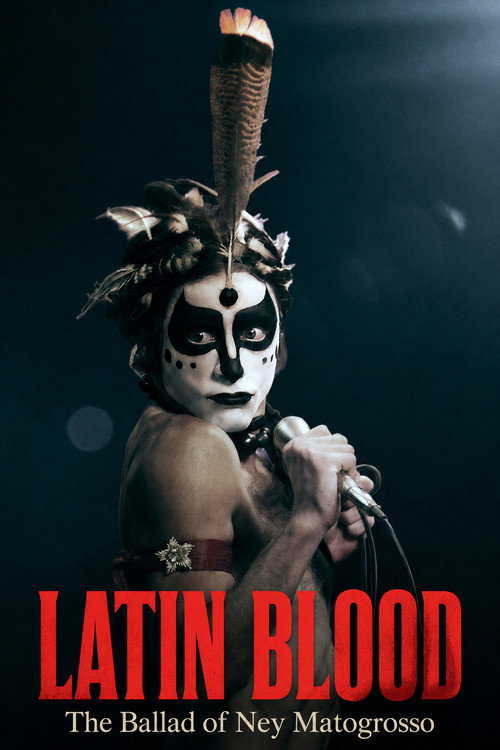
Latin Blood – The Ballad of Ney Matogrosso
2025 · Esmir Filho
When you want a music biopic with real fire in it — for a night you'd like to be seduced, stirred, and reminded what defiance looks like in feathers and body paint. More cathartic than cozy.
What it's about
The life of Ney Matogrosso, the Brazilian countertenor who rose from a repressive military-family childhood to become one of his country's most electrifying and defiant performers — first as the androgynous face of the early-1970s group Secos & Molhados, then across a shape-shifting solo career. It's the story of a man inventing himself onstage, in a country and an era that punished exactly that.
The experience
Sensual, theatrical, and charged — it moves between the ecstatic release of performance and the bruises of a life lived against prejudice, carrying you on the music as much as the drama. Expect glitter and grief in roughly equal measure.
Performances
Jesuíta Barbosa throws himself into Ney Matogrosso body and soul — the stage physicality, the piercing presence, the vulnerability under the plumage — and the film rests on how completely he commits.
The craft
Esmir Filho stages the concert sequences as full-blooded spectacle, recreating the shock of Ney's 1970s performances with costume, movement, and sound design that beg for good speakers. Adapted from an authorized biography, it balances the arc of a long career with intimate passages about desire, family, and self-invention.
Why it matters
A major Brazilian theatrical event in 2025 that carried Ney Matogrosso's story to a worldwide streaming audience, reintroducing a national icon of queer artistic courage to a new generation.
Snapshot
Latin Blood – The Ballad of Ney Matogrosso (Portuguese title Homem com H) is a Brazilian biographical music drama directed and written by Esmir Filho, adapted from journalist Julio Maria's authorized biography Ney Matogrosso: A Biografia. It traces the life of Ney Matogrosso (b. 1941), the countertenor and stage performer who became one of the defining figures of Brazilian popular music — first as the androgynous front of the early-1970s trio Secos & Molhados, then across a long, shape-shifting solo career. Jesuíta Barbosa plays the singer. The film opened theatrically in Brazil on 1 May 2025 and had its world premiere five days later at the closing of the 27th Paris Brazilian Film Festival; it later reached a wide streaming audience via Netflix. Running roughly two hours and nine minutes, it was among the more visible domestic releases of the Brazilian 2025 slate, both a popular success and a critically well-received work. Its guiding subject is the one Matogrosso himself embodied for half a century: theatricality and self-invention as instruments of freedom under — and after — a repressive order.
Industry & production
The film is a mainstream Brazilian studio production. It was produced and distributed by Paris Filmes, working with Paris Entretenimento, the São Paulo municipal film agency Spcine, and Claro Brasil, with producers credited including Marcio Fraccaroli, André Fraccaroli, Veronica Stumpf and Karla Amaral. Paris Filmes is one of Brazil's largest distributors, and the pairing of a commercial house with public-sector and telecom partners is characteristic of how large-scale Brazilian titles are financed in the post-Ancine/incentive-law ecosystem. A widely cited budget figure of roughly R$18 million places it well above the typical Brazilian art-film budget and in the register of a prestige popular biopic — a scale legible, critics noted, in its period reconstruction, sets and costuming.
Commercially the film performed strongly for a domestic release; early reporting recorded it passing 600,000 admissions and around R$13 million in box office during its theatrical run, a healthy result in a market where local films compete against Hollywood tentpoles for screens. Its subsequent move to Netflix extended its reach substantially, and it functioned as a cultural event as much as a release — the first major screen life of a living, still-active national icon. Note that admissions and gross figures cited in trade coverage reflect an early-run snapshot rather than a certified final tally; the record on its complete theatrical total is not firmly fixed in the sources available.
Technology
The film was shot digitally, as is now standard for a Brazilian production of this scale, but the specific capture format, camera system and lens package are not reliably documented in the available public record, and I will not guess at them. What is technically salient is the demand the project placed on craft rather than hardware: a story spanning from a 1940s rural military childhood through the countercultural 1970s and beyond required period reconstruction across several decades, integrated with numerous staged musical-performance sequences. The reproduction of Matogrosso's stage work — the feathered, body-painted, near-nude spectacle of the Secos & Molhados era in particular — is the film's central technical undertaking, requiring costume, makeup, lighting and choreography to be conceived together as a single performance apparatus rather than as decoration around dialogue scenes.
Technique
Cinematography
Azul Serra is credited as director of photography. Brazilian critics singled out the camerawork's handling of the musical numbers: rather than treating concert footage as an obligatory biopic insert, Serra's photography was praised for staging performance as narrative and visual argument — the songs advancing character and story rather than pausing it. This is the film's most-remarked formal strength, and it suggests a cinematography built to move between two registers: the heightened, saturated theatricality of the stage and the more intimate observational grammar of the domestic and private scenes.
Editing
Germano de Oliveira edited the film. The cut's most discussed feature is structural. Reviewers credited the film with a "clearer narrative line" than the biopic norm precisely because musical sequences are positioned as story beats — turning points — rather than as a greatest-hits recital. The same critics, however, located the film's chief weakness in its final stretch: the last twenty-odd minutes were felt to compress decades of Matogrosso's later life into a rushed, list-like accounting, a shift from vibrant drama to "protocol" that betrays the completeness-anxiety endemic to the cradle-to-present biopic. The editing, in other words, is most assured when it is selective and most strained when it tries to be comprehensive.
Mise-en-scène / staging
Staging is arguably the film's true subject as well as its method. Its animating idea — repeatedly identified by critics — is that theatricality is a tool of liberation, and the mise-en-scène is organized to dramatize that thesis: the transformation of a constrained, watched body into a spectacular, self-authored one. The recreated Secos & Molhados performances, with their glam-inflected costuming and Matogrosso's exotic, sinuous stage movement, are staged as the hinge between private repression and public self-realization. The reported budget is visible here, in the density of period sets and costume.
Sound
Music is credited to Amabis. As a film about a singer whose instrument was a famously high, androgynous countertenor, the sound design and the treatment of the voice carry unusual weight, though the specific technical solution — the degree to which Matogrosso's original recordings, re-recordings, or the actor's own voice are used — is not something I can confirm from the available record and should not be asserted. What is clear is that the songs function structurally rather than ornamentally, which places a corresponding demand on the music-and-sound team to integrate performance audio with dramatic scene work.
Performance
Jesuíta Barbosa's lead performance was the near-unanimous critical high point. Reviewers described it as the role that had been "missing" from his career and praised the "body work" and physical characterization through which he conveyed Matogrosso's distinctive stage physicality — the dance, the posture, the erotic charge of the persona. Critic Isabela Boscov's observation that the film "is as unique as Ney Matogrosso himself" was tied largely to what Barbosa achieves. The surrounding ensemble includes Rômulo Braga as Matogrosso's father, Caroline Abras and Hermila Guedes in the family sphere, and figures from the singer's musical and romantic life — Mauro Soares as Secos & Molhados co-founder João Ricardo, Jeff Lyrio as Gérson Conrad, Bruno Montaleone and Jullio Reis (as Cazuza) among the loves and peers.
Narrative & dramatic mode
The film is a chronological life-story biopic, structured as the ballad of its subtitle: an episodic progression organized around songs and performances that serve as emotional and narrative punctuation. Its dramatic spine is relational — the wound of the repressive father and the succession of friendships and love affairs — rather than purely careerist. Within the genre it leans toward the confessional and romantic rather than the ironic or fragmented; there is no framing conceit or unreliable-narrator gambit of the kind recent musical biopics have favored. Its most distinctive dramaturgical move is the integration of the musical numbers into the causal chain of the story. Its most conventional move, and the one critics flagged, is the terminal sprint through the later decades — the point at which the well-made ballad gives way to the dutiful chronicle.
Genre & cycle
Latin Blood sits squarely within the international musical-biopic cycle that gained renewed commercial momentum in the wake of films such as Bohemian Rhapsody and Rocketman — a cycle notable for foregrounding queer musical icons and for treating the concert sequence as an emotional set piece. Within Brazilian cinema it belongs to a strong local tradition of the cinebiografia of musicians, which has proven one of the most bankable domestic forms. It is also, importantly, a queer biopic: its subject's androgyny and openness are not subtext but text, and the film reads as a contribution to Brazilian LGBTQ+ screen culture as much as to the music-biopic shelf.
Authorship & method
Esmir Filho (b. 1982) is the film's clearest authorial signature, credited as both director and screenwriter. Filho emerged in the late 2000s as a festival name — his debut feature Os Famosos e os Duendes da Morte (2009) screened at Cannes and announced a filmmaker preoccupied with adolescence, sexuality, identity and longing, often in southern-Brazilian and youth-cultural settings. Latin Blood extends those preoccupations onto a far larger canvas and a real historical subject: the through-line from his earlier films is the study of a self trying to become itself against a constraining environment. Critics credited Filho specifically with a sensibility for translating queer experience into visual spectacle — that is, for making the film's political content and its show-business surface one and the same.
His key collaborators shape that vision materially: cinematographer Azul Serra (whose performance photography drew particular praise), editor Germano de Oliveira (responsible for the song-as-structure approach and, by the same token, the contested final act), and composer Amabis on the musical fabric. The screenplay's method is adaptation: it derives its authority from Julio Maria's biography of Matogrosso, which grounds the film in a researched, authorized account rather than in invention — a choice consonant with the film's status as the sanctioned screen life of a living legend.
Movement / national cinema
The film is a product of contemporary mainstream Brazilian cinema, made within the incentive-financed, distributor-led system that produces the country's commercial slate, with public support via Spcine. It arrives in a period of reconsolidation for Brazilian film after years of political pressure on the sector's funding institutions, and its scale and success register as evidence of the domestic industry's commercial vitality. Thematically it is deeply national: it cannot be separated from the history of the Brazilian military dictatorship (1964–1985), the counterculture and desbunde that flourished in its shadow, and the specific place Matogrosso and Secos & Molhados hold in that story. The film thus functions simultaneously as popular entertainment and as an act of national memory.
Era / period
As a 2025 release the film belongs to the streaming-era biopic moment, in which theatrical success is increasingly a prelude to a much larger life on platforms — a trajectory this film followed to Netflix. As a period piece it reconstructs several distinct Brazilian eras: the conservative rural-military milieu of Matogrosso's mid-century childhood, and above all the early-1970s countercultural explosion in which Secos & Molhados became a phenomenon while the dictatorship's censorship apparatus was at its height. Part of the film's dramatic irony, which its staging exploits, is that Matogrosso's most flamboyant self-expression occurred under one of the most repressive periods of modern Brazilian history.
Themes
The film's governing theme, identified by its critics and built into its staging, is theatricality as freedom: the use of costume, voice, androgyny and performance to author a self that a repressive society would deny. Around that core cluster several others — the father-son wound and the escape from an authoritarian patriarchal childhood; queer identity and desire lived openly at a dangerous moment; art as resistance under dictatorship; and the cost and loneliness that shadow a life of continual self-reinvention. The title Homem com H itself gestures at the film's play with masculinity: it borrows from a song in Matogrosso's repertoire and turns an assertion of conventional manhood into something the singer redefined on his own terms. (The precise provenance and wording of the song's history is a matter for music scholarship rather than something to over-specify here.) The film's later-act rush, critics argued, is where it fails its own themes — declining to sit with the "social density" its subject's life invites.
Reception, canon & influence
Critical reception in Brazil was generally positive, with a clear consensus shape: near-total admiration for Barbosa's transformation, strong praise for Filho's direction and Serra's performance photography and for the song-driven structure, and a shared reservation about the compressed final act. The outlet Omelete rated it 4/5; individual critics including Bruno Ghetti and Walter Felix highlighted Barbosa's characterization and physical work, and Isabela Boscov emphasized the film's singularity. It was received not merely as a competent biopic but as a notable Brazilian cultural release of its year, reinforced by robust box office and a large streaming afterlife.
Its influences run backward to two lineages: the recent international wave of queer-musician biopics that reframed the concert film as emotional drama, and the durable Brazilian tradition of the musical cinebiografia; behind both stands the primary source, Julio Maria's biography, and behind that, Matogrosso's own body of recordings and performances. As for its forward influence, that record is by definition still thin — the film is recent, and it is too early to trace what it will shape. What can be said is that it consolidates the queer musical biopic within mainstream Brazilian cinema and offers a career-redefining showcase for its lead; whether it becomes a canonical reference point for future Brazilian music films is a question only time will answer.
Sources consulted: Latin Blood: The Ballad of Ney Matogrosso — Wikipedia; Homem com H — AdoroCinema; Homem com H — IMDb; Crítica: Homem com H — Omelete; Homem com H chega a 600 mil espectadores e R$13 milhões — Omelete.
Reception
A theatrical hit in Brazil in May 2025 (600k+ admissions), then Netflix carried it worldwide the following month as 'Latin Blood' — turning a local celebration of a 1970s glam icon into an international discovery, and one of the highest-rated 2025 releases on Letterboxd almost overnight.
How Latin Blood – The Ballad of Ney Matogrosso was received, from release to now →
How to watch Latin Blood – The Ballad of Ney Matogrosso: what to notice on a first viewing
- Watch how a musical number moves the story forward, not sideways. Serra's camera treats each performance as a turning point rather than a break from the plot, so a song changes what happens next instead of pausing to showcase it. The music is doing narrative work here, not just filling time between scenes.
- Notice the costume and stage movement in the Secos & Molhados scenes. Glam-inflected costuming and sinuous, exotic movement stage the hinge between a private, watched body and a public, self-authored one. You can see the exact moment a constrained person turns himself into a spectacle on his own terms.
- Watch Jesuíta Barbosa's posture and hands during every stage number. Barbosa builds Matogrosso's physicality through dance, posture, and gesture rather than through dialogue, carrying the character's erotic charge in his body. The performance argues that self-invention here is physical work, not just a costume change.
- Listen for how high and androgynous the singing voice stays. The film treats Matogrosso's famously high countertenor as central to his whole persona, integrating performance audio directly into the dramatic scenes rather than around them. His voice itself becomes the clearest evidence of a masculinity he refused to perform in the ordinary way.
Influences: the films it descends from and the films it influenced
- Velvet Goldmine (1998) — Establishes the glam-biopic grammar of androgynous performance photographed as spectacle and a fractured, multi-witness structure where the star exists only through others' staged memories — the same performance-as-narrative and theatricality-as-liberation Filho applies to Matogrosso.
- Cabaret (1972) — Pioneers the dual-register cut between the numbers onstage and the political/sexual reality offstage, so each performance comments on the world outside — the formal engine behind Latin Blood's dual-register cinematography and art-as-resistance framing.
- All That Jazz (1979) — Fuses stage performance with confessional autobiography through editing and compresses its final act into a death-haunted show-number climax — the direct precedent for the song-as-structure editing and the film's contested compressed ending.
- I'm Not There (2007) — Splinters a single musician into multiple embodied registers of self, treating performance itself as the narrative rather than a chronological life — the model for Latin Blood building story out of Matogrosso's stage personae.
- Bohemian Rhapsody (2018) — Anchors the named 'Bohemian Rhapsody cycle' by reconstructing concert-film set pieces with meticulous lip-sync fidelity and reframing the arena performance as emotional drama — the commercial template the film consciously joins.
- Cazuza – O Tempo Não Para (2004) — An early Brazilian cinebiografia of a queer/bisexual MPB singer that welds concert reconstruction to a confessional-romantic, illness-shadowed register — a direct national forebear of the queer musical cinebiografia.
- 2 Filhos de Francisco (2005) — Set the mainstream box-office template for the Brazilian musical cinebiografia — song-driven emotional beats plus researched, sanctioned life story — the industrial model Latin Blood scales up.
- Madame Satã (2002) — Renders a real Brazilian queer performer through intense physical body-work and drag/stage theatricality staged as social defiance — the ancestor for staging queer performance as bodily liberation and resistance.
- Os Famosos e os Duendes da Morte (2009) — Filho's own debut establishes his authorial method — a self straining to become itself against a constraining milieu, rendered through longing, youth-cultural imagery and dual-register visuals carried directly into Latin Blood.
- Rocketman (2019) — Deploys songs as non-diegetic fantasy numbers that dramatize interior states and drive the emotional arc rather than mark real gigs — the same song-as-structure principle organizing Filho's edit.
- Elvis (2022) — Photographs the performing body as kinetic, sexualized glam spectacle and lets montage-driven musical numbers carry the biography — a contemporary sibling in performance-photography and song-as-structure.
- Judy (2019) — Builds the whole film around a lead's total physical-vocal transformation photographed in extended stage numbers as emotional drama — the same 'career-redefining lead showcase via performance photography' praised in Barbosa's turn.
- Gonzaga: de Pai pra Filho (2012) — Structures a Brazilian music biopic explicitly around a generational father-son conflict, using the songbook to voice the wound — the same father-son-wound spine and cinebiografia craft.
- Tim Maia (2014) — Centers a Brazilian musical cinebiografia on a lead's immersive physical embodiment of a larger-than-life performer across decades — the physical-body-work showcase Latin Blood pursues with Barbosa.
- Elis (2016) — A Brazilian MPB cinebiografia built on meticulously staged performance photography of iconic recordings, treating the concert stage as the site of characterization — Latin Blood's national performance-photography sibling.
- Tatuagem (2013) — Dramatizes a glam theatrical troupe using androgynous cabaret spectacle as freedom against the military dictatorship — the exact theatricality-as-freedom and art-as-resistance staging of Matogrosso's own era.
Similar films
- Madame Satã (2002) — influence & lineage
- Bohemian Rhapsody (2018) — influence & lineage · same viewing thread
- Elvis (2022) — influence & lineage · same viewing thread
- The Testament of Ann Lee (2025) — same viewing thread
- The Secret Agent (2025) — shared sensibility
- La bola negra (2026) — shared sensibility
- Marighella (2021) — shared sensibility
- Sing, Lola, Sing! (2023) — shared sensibility
All the films related to Latin Blood – The Ballad of Ney Matogrosso →
Watch it with: curated runs of related films
- The Making of a Legend — A run of biopics that watch private people get forged into public icons — the ambition, the pressure, and the loneliness of becoming somebody the world can't stop looking at.